DEATH OF A RETIRED WARRIOR

Diarmuid Breatnach

(Reading time: 12 mins.)

In mid-April (2022) Gardaí, the police force of the Irish State, broke down the door of Mick Plunkett’s home. They would not have been able to claim he resisted their entry or arrest (the usual explanation for injuries on the detained individual) – he was already dead.

To be fair to them, this time they were forcing entry in response to concerns from people that Plunkett had not been seen and wasn’t answering calls.

Still, Mick Plunkett’s door had been forced by police a number of times before – by the Special Branch, at least once by the Garda ‘Heavy Gang’ and another time by the special ‘anti-terrorist’ Paris police.

Mick was born into a working class family of ten siblings in Dún Laoghaire, in Kelly’s Avenue in the small area of council houses built for rent to the seaward side of the town’s main road.

These however did not overlook the sea itself, a view reserved for the big houses and hotels, later somewhat ruined by the DART wires and towers).

Dún Laoghaire1, long-imagined as a area in which only the affluent or at least comfortably-off lived, nevertheless contained such council (formerly ‘Corporation”) houses in the nearby bottom of York Road, also Cross Avenue, Glasthule, Carriglee Gardens, Monkstown Farm and Sallynoggin areas.

As many of that era, especially among manual workers, Mick’s father died relatively young which left his widow Lilly to care for ten children with all siblings able to work and find employment contributing to the care of the rest.

Mick followed his father Oliver into a skilled manual worker trade, trained and qualified as a gas fitter-plumber and, by reputation, a good one; later he would often carry out repair jobs for neighbours free of charge or in exchange for fish caught nearby or by trawlers that docked in the harbour.

“We saw and ate fish that many other people never saw,” said one of his sisters at his funeral reception in the evening.

Amidst the student and youth upsurge of the 1960s around the world, of which Ireland was also a part, many Irish youth of the time became rapidly politicised.

The Vietnam War, Black struggles in the USA and South Africa, Civil Rights in the British colony, lack of sufficient housing in the Irish state (just as today!) were issues that engaged lively interest and which to people like Plunkett, called for solidarity and, in Ireland, direct action.

At his funeral, Niall Leonach2, formerly of the IRSP, related how Plunkett, at the age of 17, had resisted the neglect of the young apprentices by his union and won improvements by organising a sit-in at the union’s office.

April 1991 article Evening Mail on conditions in the Glasthule Housing Estate (Source image: CATU)

HOUSING AND HISTORY

The Dublin and Bray Housing Action Committees were campaigning for an end to slums and for affordable rental housing around the city and Dún Laoghaire soon had its own Housing Action Committee too.

Nial Leonach, former comrade of Plunkett’s told the mourners at Mount Jerome that a large public housing building program was initiated as a result of this campaigning, a program that not only replaced derelict inner city tenements but created large new housing areas such as that in Ballybrack in south county Dublin.

The Housing Action campaigns not only squatted homeless families, they also fought evictions, held marches and public meetings. And in at least one case, became involved in a struggle for historical building conservation.

A Dún Laoghaire IRSP public agitation and information post pictured in the IRSP’S Newspaper (Source image: CATU).

The Dún Laoghaire group joined with conservationists wishing to save Frescati House, a large derelict building on acreage of the property planned by Roches Stores to demolish and convert into a shopping centre.

The original building dated from 1739 but had been purchased by the largest landowning family in Ireland at the time, the Fitzgeralds and had wings added and the grounds planted with exotic shrubs.

The house had been the childhood residence and favoured retreat of Edward Fitzgerald3, a much-loved leader of the first Irish Republican revolutionary movement, the United Irishmen, as late as 1797, the year before their Rising.

The figures heading the campaign were not only conservationists but fairly conservative too (Desmond Fitzgerald, son of a father of the same name who was Minister in a number of Fine Gael governments, was its chairperson).

But it was of course the activist supporters of the DHAC who occupied the building in protest at plans for demolition and were subjected to a baton-wielding police attack to evict them.4

Niall Leonach told the crowd in the Mount Jerome chapel that the criminal charges against the arrested were serious but that Plunkett’s stratagem of issuing a subpoena for Liam Cosgrave5 to appear as witness for their defence got the charges lowered.

The politician had been part of the conservation campaign, the more serious charges were dropped and, on the lesser ones, the penalties were lower-scale fines.

Much of DHAC soon became the Markievicz Cumann of Sinn Féin6, then a very socialist Irish Republican party, particularly in Dublin.

The Civil Rights campaign in the British colony of the Six Counties became a focus for activity and Leonach told his audience that Plunkett had been particularly affected by the colonial police killing of a child by indiscriminate fire from machine-guns at a nationalist housing estate, the Divis Flats.

In 1969 the IRA, the military wing of Sinn Féin, was caught unprepared and largely unarmed to face the pogroms in the British colony, which was one of the reasons for the 1970 split in the party, out of which emerged the Provisional IRA and Provisional Sinn Féin.

Plunkett and others in the Markievicz Cumann, the three Breatnach brothers for example7, viewing the Provos as socially conservative, remained in what was now known as “Official Sinn Féin” but tried to change their party’s direction.

Failing in that, they split, along with others such as the charismatic Séamus Costello8 and formed the Irish Republican Socialist Party in 1974.

It seems clear that the ruling elite of the Irish State viewed the IRSP and the associated INLA as a threat and decided to go beyond the standard and regular harassment, intimidation and petty and medium arrests9 with which they had been treating all Irish Republicans and some socialist activists.

FRAMED IN DUBLIN AND IN PARIS

On 31st March 1976 the Cork-Dublin mail train was stopped near Sallins, Co. Kildare by armed men who netted around £200,000.10 The State decided to believe, at least officially that the operation had been carried out by the INLA.

As a result armed police raided the homes of 40 members of the IRSP and their families. The Gardaí beat up their victims and obtained “confessions” from a number of them – however, some who gave self-incriminating statements could not have been present and their prosecutions were dropped.11

Eventually, a trial in the political Special Criminal Court proceeded against Plunkett and another three IRSP members: Osgur Breatnach, Nicky Kelly and Brian McNally.

Poster supporting the four framed and on trial for the Sallins Mail Train Robbery, depicting Mick Plunkett on far right of images. (Source image: Internet)

After many abuses of the legal system and the longest judicial procedure in the State, three of the four were convicted on the basis of their tortured “confessions” which they had denied.

Forensic “evidence” was provided against the only one who had refused to sign a “confession” – an alleged lock of Plunkett’s hair12 was claimed to have been found at the scene of the robbery; that was insufficient and Plunkett was finally discharged.

The others were released after years of campaigning13 and were paid a financial compensation but an official enquiry into the arrests, trials and convictions was never held and currently a campaign for such is underway.14.

Mick Plunkett remained politically active but after his arrest in the vicinity of an armed training camp was charged with “membership” and scheduled to appear before the Special Criminal Court.

Plunkett, knowing the chances of acquittal in no-jury “the Special” were next to nil, decamped to France.

In Paris he and Mary Reid, a poet-activist and also formerly of the IRSP, shared accommodation. In the summer of 1982, their door was kicked down by armed police of the new special “anti-terrorist” French unit.

Both were arrested, along with another Irishman Stephen King and charged with possession of automatic weapons and explosives. This followed the bombing of a delicatessen in the Jewish quarter of the city which was later revealed to have had police complicity.

Plunkett, Reid and King were accused of being part of an Irish-Palestinian cell, a figment of the special unit’s imagination.

All three denied the charges, the accusation and the existence of such a cell, insisting that if any weapons and explosives had been found in their accommodation, it had been planted there by the police.

Niall Leonach commented to the mourners in Mount Jerome that Plunkett had gone from being involved in the greatest miscarriage of justice in the Irish state to being accused in the greatest miscarriage of justice in the French State’s modern history.

Fortunately for the Irish accused, the special police unit was in serious conflict with the main police force and that helped bring to public view the fact that the armaments had, indeed, been planted on the accused by the “anti-terrorist” police unit.

All three were released after nine months in jail and Mary Reid’s nine-year-old son Cathal had been taken into care.

The whole case was by then such as to convince the Irish State authorities to refrain from severely embarrassing their French counterparts by requesting Plunkett’s extradition to face his charges in the Special Criminal Court.

FRANCE – OCTOBER 05: Michael Plunkett, Mary Reid, Stephen King in Vincennes, France on October 05th , 1983. (Photo by Eric BOUVET/Gamma-Rapho via Getty Images). Note poster of the Sallins Trial behind them.

Working in London at the time, I read the news about the arrests of Irish political activists in Paris and was shocked to see names I recognised.

I remembered the last time I had seen Mick; I had been back in Dún Laoghaire on holiday and with four of my brothers we set off in Mick’s brother Jimmy’s rowing boat from a pier, Mick himself in it too. We had fishing rods and lines and began to fish as we cleared the harbour.

Hours later as the sun dropped to the west, we turned back with our varied catch. Once inside between the piers it was quite dark; a large ship entering the harbour appeared to be bearing down on us and we couldn’t find our flashlight.

The incident provided more excitement than we had wished for but seemed to give extra taste to the pints in the local pub afterwards.

Mick found happiness for a time with Tracy out of which union came their daughter Natacha. After the Good Friday Agreement Mick felt safe to return to Ireland but Tracy remained in Paris with their daughter, Natascha visiting him and his extended family by arrangement on occasion.

Plunkett seemed to have retired from political activity and had also withdrawn from social contact with many of his former contacts. His health deteriorated significantly but nevertheless his death came as something of a shock to many.

Mick Plunkett’s coffin at the funeral parlour, officiated by his daughter Natacha. (Photo: D.Breatnach)

Many came to pay their respects at the funeral parlour where his coffin lay and to watch the wonderful collection of photos collected by his ex-partner, Tracy.

His daughter Natacha was there to receive condolences and to offer shots of Irish whisky over the coffin (where tobacco roll-ups were also placed irreverently on the crucifix attached to the woodwork – Mick was reportedly an atheist).

Natacha was also at the cremation service in Mount Jerome cemetery with her mother Tracy, where Plunkett’s coffin was covered in the blue version of the Starry Plough flag15 before being removed from the hearse, carried by relations.

The Seamus Costello Memorial Committee, in uniform and white gloves, providing a small ceremonial guard of honour.

Mick’s nephew Karl chaired the event and in turn called Jennifer Holland to give a short talk on Mick and his times followed by Niall Leonach, former General Secretary of the IRSP and close comrade of Plunkett’s, for a longer oration on Mick’s background and activism.

Karl provided many personal anecdotes from his association with his uncle and from within family stories, many of them amusing and some hilarious.

He did not however avoid the political and recounted that many of them were kept unaware of the reasons for Mick’s absence and his apparent inability to travel back to Ireland even to visit.

It was by going through some papers in his mother’s room that he came across the IRSP pamphlet on the Sallins case and was shocked; confronting his mother, the story began to be told.16

Recollecting the family’s trip to Paris to present two children for baptism in Notre Dame Cathedral which Mick attended, Karl spoke about their warm reception there and being touur-guided around by Plunkett, who had acquainted himself with much of the city’s history.

One wonders whether that included the “Wall of the Communards” where in 1871, revolutionaries of the Paris Commune were summarily executed by French firing squads under the command of Marshall Patrice McMahon.

The Marshall was a descendant of Irish “Wild Geese” refugees from Williamite-controlled Ireland. Plunkett would hardly have been unaware of that history and its irony for the Irish.

The hearse carrying Mick Plunkett’s coffin arrives at Mt. Jerome cemetery, escorted by guard of honour supplied by the Seamus Costello Memorial Committee (the photo is from their FB page).

SOCIAL, SONG AND FLAG

Later that evening in a large reserved section of the Rochestown Lodge Hotel (formerly the Victor Hotel) just above the large Sallynoggin housing estate, mourners and celebrants gathered to eat, drink and talk.

Some had not seen one another for decades.

Among the many reminiscences of the social and music scene in Dún Laoghaire in the later decades of the last century, including the remark that “our harbour is a marina now”, one of Mick’s sisters spoke of raids by the Special Branch on their family home.

Children would be ordered or pulled out of bed and the mattresses and beds tipped over, allegedly searching for weapons.

Strangely perhaps, there was no performance of musicians or singers or even sing-alongs at the event, though the traditional song The Parting Glass was sung to Plunkett’s daughter Natacha and a small unexpecting audience on the covered patio outside.

Later inside, by which time some had left and following a query about a ceramic badge of the Starry Plough worn by one those remaining, a whole length of the original green-and-gold version of the flag was unfurled, causing much interest and queues forming asking to be photographed behind it.

And a little later, a man sang Patrick Galvin’s Where Is Our James Connolly? to much applause.

Securing the Starry Plough flag to the coffin on the shoulders of relatives of Mick Plunkett, about to be carried into Mt. Jerome’s chapel for a non-religious remembrance event. (Photo: D.Breatnach)

This was fitting for as the mourners had been reminded in Mount Jerome, Connolly17 had been a great inspiration to Mick Plunkett’s political activism and to the IRSP too.

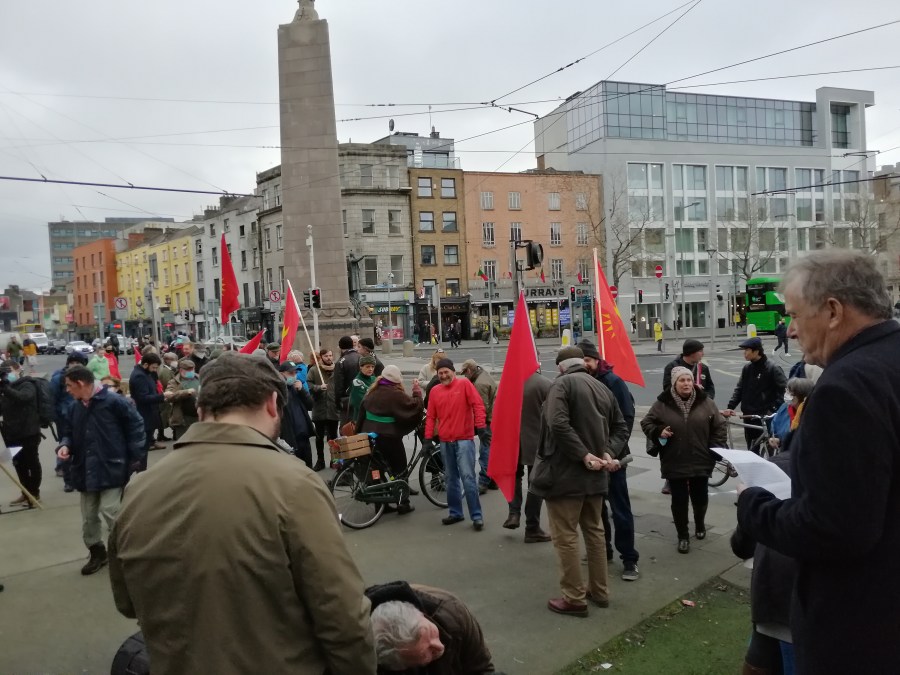
But not only that: a hostel in Dublin city centre empty for many years and very recently occupied by socialist Republicans had been named Connolly House and had that very day witnessed a rally held outside it to resist a threatened Garda operation to evict the occupants.

It seemed to me that something other than the remembrance of a retired fighter alone had happened at the Plunkett memorial events, something more than the appropriate marker of a past and finished period in Irish history, as had been suggested by Holland in her oration.

It seemed to me that the history of struggle in Ireland for national self-determination and social justice had to an extent been re-invoked, that it appeared to some extent as the ghost of struggles past but also as the gaining substance of struggles present and, in particular, yet to come.

I think Mick would have been pleased and, in any case, in defiance of the declarations of Fukuyama and such idealogues, history is nowhere near finished or dead. As some have commented, it is not even past.

End.

FOOTNOTES

1A harbour town seven miles south of Dublin city centre, in Dublin County but administered by DL-Rathdown Council for some years now.

2Which I heard pronounced as “Lennox”.

3He is more usually referred to as “Lord Edward Fitzgerald” which, apart from being somewhat historically inaccurate, does him a service. He was a republican, renounced his title and his sister Lucy said of him some years after his death in prison that “He was a paddy and no more; he desired no other title than this.”

4The Wikipedia entry on Frescati House and the campaign makes no mention at all of this sit-in, Garda attack or the subsequent court cases, of which there is ample documentary evidence. Hopefully someone will undertake its appropriate updating.

5Liam Cosgrave was a Fine Gael politician, son of the Leader of the Irish parliamentary Opposition from 1965 to 19873 and Taoiseach (Prime Minister) from 1973 to 1977, W.T Cosgrave.

6The Sinn Féin party has gone through many metamorphises, from being a reformist dual-monarchy party, to revolutionary republican to constitutionalist. Constance Markievicz was a socialist Republican who took part in the 1916 Rising as an officer in the Irish Citizen Army – the name of a socialist revolutionary woman chosen for the cumann (‘association’, a branch of the SF party at the time) indicated an inclination towards revolution, feminism and socialism.

7Osgur, Caoilte and Oisín.

8Séamus Costello (b. 1939) was murdered by the Official IRA in Dublin on 5th October 1977.

9An example of the medium-seriousness was the charge of “membership of an illegal organisation” under the Amendment to the Offences Against the State Act, introduced in 1972 which required only the unsupported word of a Garda officer at rank of superintendent or above for conviction and a virtually automatic jail sentence of one to two years.

10€237,389.81 –without taking into account inflation — for today’s value

11Notably John Fitzpatrick, who years later publicly challenged the State to charge him with the offence to which he had “confessed” – there was no response.

12If it had been Plunkett’s hair, it had to have been planted by the Heavy Gang, since Mick had been nowhere near that scene and, in fact, the robbery had been carried out by the Provisional IRA. In addition, without the later development of DNA testing, all a sample of hair could tell, apart from its natural colour, was the blood-type of its owner and millions may share that.

13Some of those involved at the time, whether as victims or as campaigners, were present at some of the funeral events too, including Osgur Breatnach, Nicky Kelly, Caoilte and Peetera Schilders-Bhreatnach.

14https://sallinsinquirynow.ie/

15The flag with a design in the shape of the constellation known as Ursa Mayor was of the Irish Citizen Army, formed to defend the workers during the strike and 8-month lockout of 1913 and later fought in the 1916 Rising. Originally the design was of the constellation in white or silver overlaid by the depiction of a plough in gold, with sword as the plough-share and all on a green background. A later version was the plain blue one with Ursa Mayor outlined in white stars. That version was the one in use by the short-lived Republican Congress of the 1930s and was for many years later, probably up to the end of the century, the main one displayed and therefore familiar to Republicans and socialists (even for years flown by the Irish Labour Party) but has now been largely supplanted by the original green version.

16This is not at all an unusual experience in Ireland and, whether by desire to protect the young, pain of reminiscence or even disapproval, much of our history has been concealed from generations for a time or even completely lost.

17James Connolly, revolutionary socialist, trade union organiser, historian, journalist, song-writer and one of the Seven Signatories of the 1916 Proclamation of Independence, was tried by British military court for his leading role in the Rising and executed by firing squad.

SOURCES & FURTHER READING

https://rip.ie/death-notice/michael-mick-plunkett-glasthule-dublin/494040

Edward Fitzgerald a republican: https://www.irishtimes.com/culture/heritage/praise-the-lord-and-pass-the-egalitarianism-1.1534895

Frescati House (with the curious omission at the time of access of the DHAC sit-in, police attack and subsequent trials): https://en.wikipedia.org/wiki/Frescati_House

Call for enquiry into the Sallins case: https://sallinsinquirynow.ie/

Civil and human rights criticism of the Special Criminal Court: https://www.iccl.ie/2022/international-call-for-end-to-special-criminal-court/

Mary Read & Paris frame-up: https://en.wikipedia.org/wiki/Mary_Reid_(activist)
https://www.irishtimes.com/news/socialist-republican-and-poet-with-a-big-heart-1.349096
https://www.rte.ie/brainstorm/2020/0325/1126344-1982-irish-republicans-france-mitterrand-vincennes/

https://en.wikipedia.org/wiki/Sallins_Train_robbery
Sallins frame-up: https://www.rsvplive.ie/news/irish-news/1976-sallins-robbery-saw-nicky-25971809
https://www.thewhistleblower.ie/booking
https://extra.ie/2022/01/17/news/irish-news/hunger-striker-nicky-kelly
UP LIKE A BIRD – a review

Diarmuid Breatnach

(Reading time: 2 mins.)

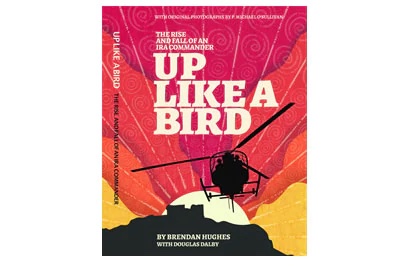
He planned the spectacular helicopter escape from Dublin’s Mountjoy Jail and, a year later, planned another escape from there, blasting their way out with smuggled-in explosives. Before he began planning escapes, he operated early in his IRA career as commander of an armed robbery unit, ‘fund-raising’ for the Movement. But when he began robbing banks for himself and his family, the Movement sent assassins to kill him. Up Like a Bird is the story of that man, Brendan Hughes, nowhere near as celebrated as his other IRA namesake but certainly deserving of much more fame than he has received to date.

Brendan Hughes with his book outside Mountjoy Jail (Image sourced: Phoenix Magazine)

Douglas Dalby’s handling of Hughes’ reminiscences, told in Hughes’ voice, is masterly. The book reads like a thriller, hard to put down; we are driven to turn the next page to see what will happen – even when, through history, we know the eventual outcome. We know, for example, that the helicopter escape was carried out and yet, as readers, we tense as Hughes does his investigations, tense tighter as he identifies the components of the plan, moan with frustration at a delay or last-minute hitch, hold our breaths as the action takes place.

The helicopter escape was carried out on 31st October 1973 and from the prison exercise yard three high-level IRA officers were flown to freedom: Chief of Staff Séamus Twomey and senior Volunteers JB O’Hagan and Kevin Mallon. The following year, on 18th August 1974, 19 prisoners escaped, blasting their way through a gate with a small amount of smuggled gelignite. Not only had Hughes planned that operation – he himself was leading the escapers.

INSIGHTS

Apart from the excitement in reading, the book gives us an insight into the world of IRA volunteers active in Dublin and surrounding areas in the 1970s – the ‘safe-houses’ and network of active supporters, the ‘fund-raising’, stolen getaway cars, false identification documents, high-level awareness of the hunted, carrying concealed weapons, the even better-armed police ….

The Mountjoy helicopter escape revealed something even more important and enduring – the cultural bedrock within the Irish state, the sharp division between the elite and the mass. Although the majority of politicians had voted in 1972 for repressive legislation against Republicans and special no-jury courts to sentence them, a song celebrating the escape reached No.1 in the Irish singles disc charts, selling 12,000 copies in the first week despite being banned by the national broadcaster, RTÉ! Composed by Sean McGinley from Castlefin, Co. Donegal and performed by the folk and ‘rebel song’ band The Wolfe Tones1, Up and Away (the Helicopter Song) became the most-played and most-purchased disc for four weeks until nudged out by Slade’s Merry Christmas Everybody. It is tempting to think that if the escape had taken place a longer period before the approach of the festive season, that the recording might have remained at the top of the charts for months on end. The counterposing of the anger and embarrassment in elite circles, reflected in ranting of politicians, Garda sweeps and raids and media outrage on the one hand, with the delight and empathy at the lower levels revealed much of the tensions in Irish society and the opposing sympathies of different social classes.

The single that sold 12,000 copies in its first week, containing a jocular song celebrating the helicopter escape. (Image sourced: Internet)

Hughes was a maverick, revelling in the description and though for much of his career that was of value to the Provos, there came a time when it ceased to be so. A guerrilla army must have discipline, of course but it also needs volunteers who can quickly assess a situation and seize the initiative, without referring back to the command structure. The balance between both requirements must be very hard to strike — for individuals as well as for the organisation.

When he and other such activists fell out with their leaderships or “went solo”, they were shunned or worse. In Hughes’ final spell in Mountjoy jail, he was on the “non-aligned” wing of the jail, a Republican prisoner but not under Republican leadership control.

ISOLATION

Hughes says that assassins were sent to kill him – he stayed low and carried a loaded .44 Magnum. The leadership of the Republican movement does not always shoot or beat up its dissidents – more usually, it seeks to isolate them. Friends, neighbours, former comrades and even relatives will be advised to shun those no longer welcome, they and their families.

The family feeling, the communal solidarity in the movement becomes its opposite when the leadership brands its pariahs.

Cover of the book (Image credit: Siopa Gaeilge)

Hughes feels he was betrayed to the political police, the Special Branch of the Irish State. But what he says he felt the worst was the treatment of his family while he was in jail. No space on a Republican prison visitor communal transport was made available to his wife and children and cars containing former friends and acquaintances would pass them at the side of the road, even in the rain.

It seems Hughes finds that unforgivable — and no wonder.

As a postscript, Hughes surprisingly declares his support for the Good Friday Agreement, the pacification process. He had been a man of action and, as he said himself, not one for thinking through ideology or politics. But it doesn’t take any great grasp of ideology or politics to see that today it’s more or less business as before in a partitioned Ireland occupied by a foreign power.

End.

UP LIKE A BIRD, Hughes, Brendan; Dalby, Douglas (2022)

FOOTNOTES

1Named after Theobald Wolfe Tone, a leader of Irish republican revolutionary organisation the United Irishmen, died in prison in 1798.

SOURCES

https://en.wikipedia.org/wiki/The_Helicopter_Song

JARDUN CALL FOR REVOLUTION ON BASQUE NATIONAL DAY IN GERNIKA

Diarmuid Breatnach

(Reading time main text: 10 mins.)

The revolutionary Basque socialist coordination organisation Jardun Koordinadora organised a celebration of Aberri Eguna, the Basque national day, combining political, social and cultural forms. Aberri Eguna takes place annually on Easter Sunday, a date chosen by its founder Elias Gallestegi based on a traditional commemoration day of the Easter Rising in Ireland. Aberri Eguna was first celebrated in Bilbo in 1932 attended by 65,000 people, including members of Emakume Abertzale Batza1, the Basque nationalist women’s organisation founded by Gallestegi also in emulation of the Irish organisation Cumann na mBan. Around 1,000 people, with a high representation of youth but also of veterans of the struggle, attended the events in Gernika2.

Jardun-organised Aberri Eguna procession passing through Gernika (Photo courtesy Jardun)

The Irish connection was reiterated on Sunday by the reading at the political rally of messages of solidarity from three Irish-based sources: Anti-Imperialist Action, Anti-Internment Committee of Ireland and Dublin Basque Solidarity Committee.

Jardun Koordinatora is a relatively new initiative which is a sharp departure from the trajectory in recent decades of the official leadership of the Abertzale Left, a trajectory which has served to dismember and dishearten the movement.

La Haine Report

(Translation by Dublin Basque with explanatory notes in italics)

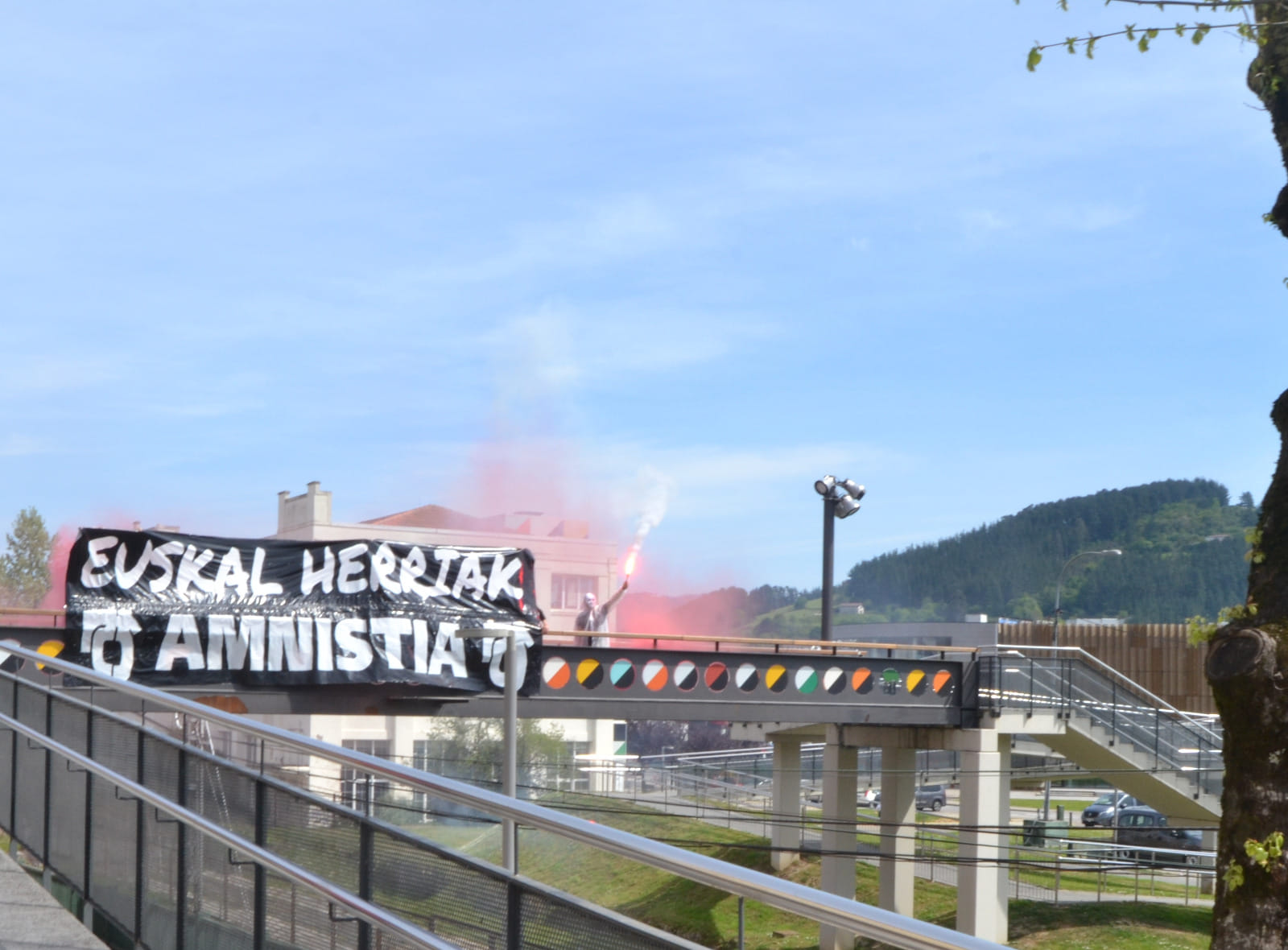
The different organisations comprising this Coordination (Jardun) demonstrated in Gernika under the slogans “Aberri gorria, biharko Euskal Herria, “Independentzia eta Sozialismoa”, “Euskal Herrilangilea Aurrera”, “Presoak Kalera Amnistia osoa” and “Amnistiarik gabe bakerik ez” (“Bright future in tomorrow’s Basque Country” “Independence and Socialism”, “Forward Basque workers”, “Prisoners Free with Full Amnesty” and “No Peace Without Amnesty”).

This Sunday, April 17, the JARDUN Coordination convened the Aberri Eguna (Basque National Day) gathering some 1,000 people to claim the national objective of the Basque Working People.

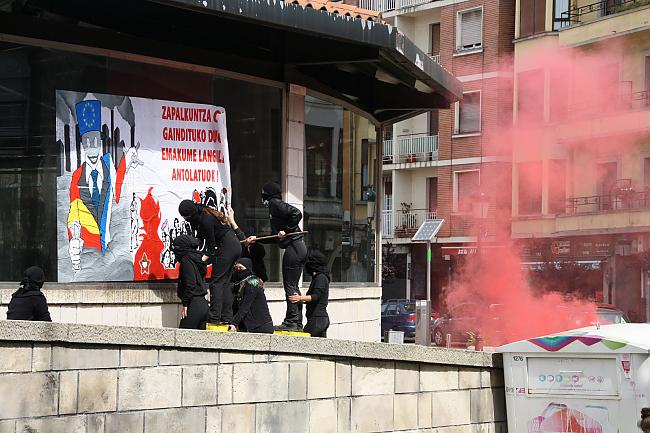
Along with a Zanpantzar group (performers with bells in traditional costumes representing animals), the event began with a march starting from Plaza Mercurio and during the journey different acts were carried out to demand prisoner amnesty and rights for working women. The event ended with the speeches read in Pasealeku Plaza: the first two were messages of solidarity sent by Anti-Imperialist Action and Anti-Internment Committee (both of Ireland) and ended with the political statement of the JARDUN Coordination.

Tradition Zapantzarak lead the procession (Photo courtesy Jardun)

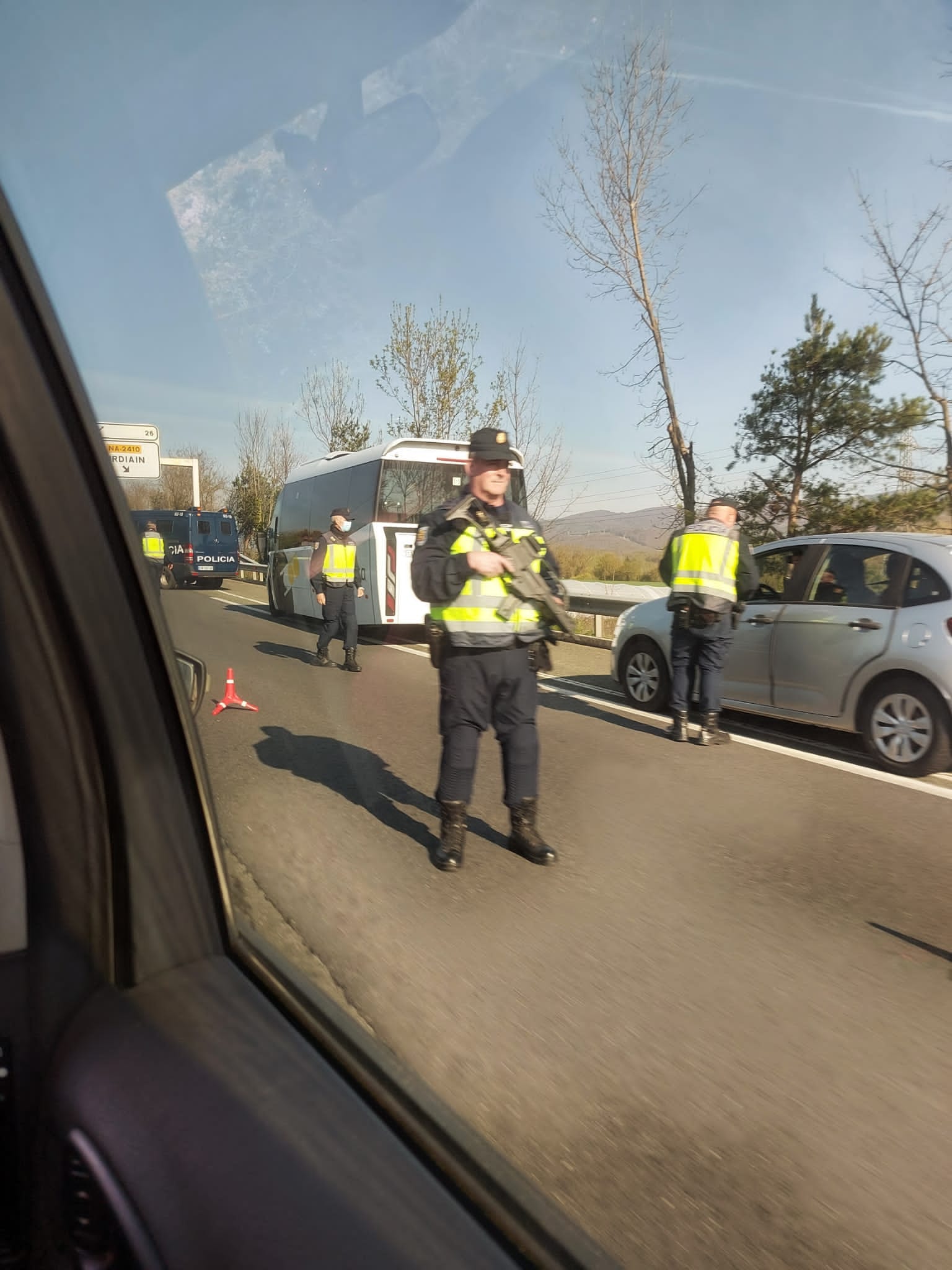
The demonstration went smoothly. However, the bus that departed from Irunea/ Pamplona had problems getting there because the National Police stopped it in Urdiain, taking details of the occupants.

To conclude, JARDUN Coordination stated that the only alternative for the Basque Working People will come from the hand of independence and socialism. To conclude, the Internationale and the Eusko Gudariak (Basque Soldier) were sung.

Spanish armed police stopped the contingent from Irunea/ Pamplona heading for Gernika and recorded their details. (Courtesy of Jardun)


Jardun Statement for Aberri Eguna 2022
(Translated by D.Breatnach from text supplied in Castillian Spanish)

Under capitalism, we workers are condemned to survive. We build our lives around work and the exploitation we suffer in it, while the bourgeoisie lives at the expense of this work. Such is the dynamic of capital. This is the logic of the economic system currently in force in the world. That is why it is important to clearly identify and point out the adversary facing us; because the capitalist system, the bourgeoisie, normalises and legitimises the fears and the repression that it produces daily to absorb the blood of the workers.

(Photo courtesy Jardun)

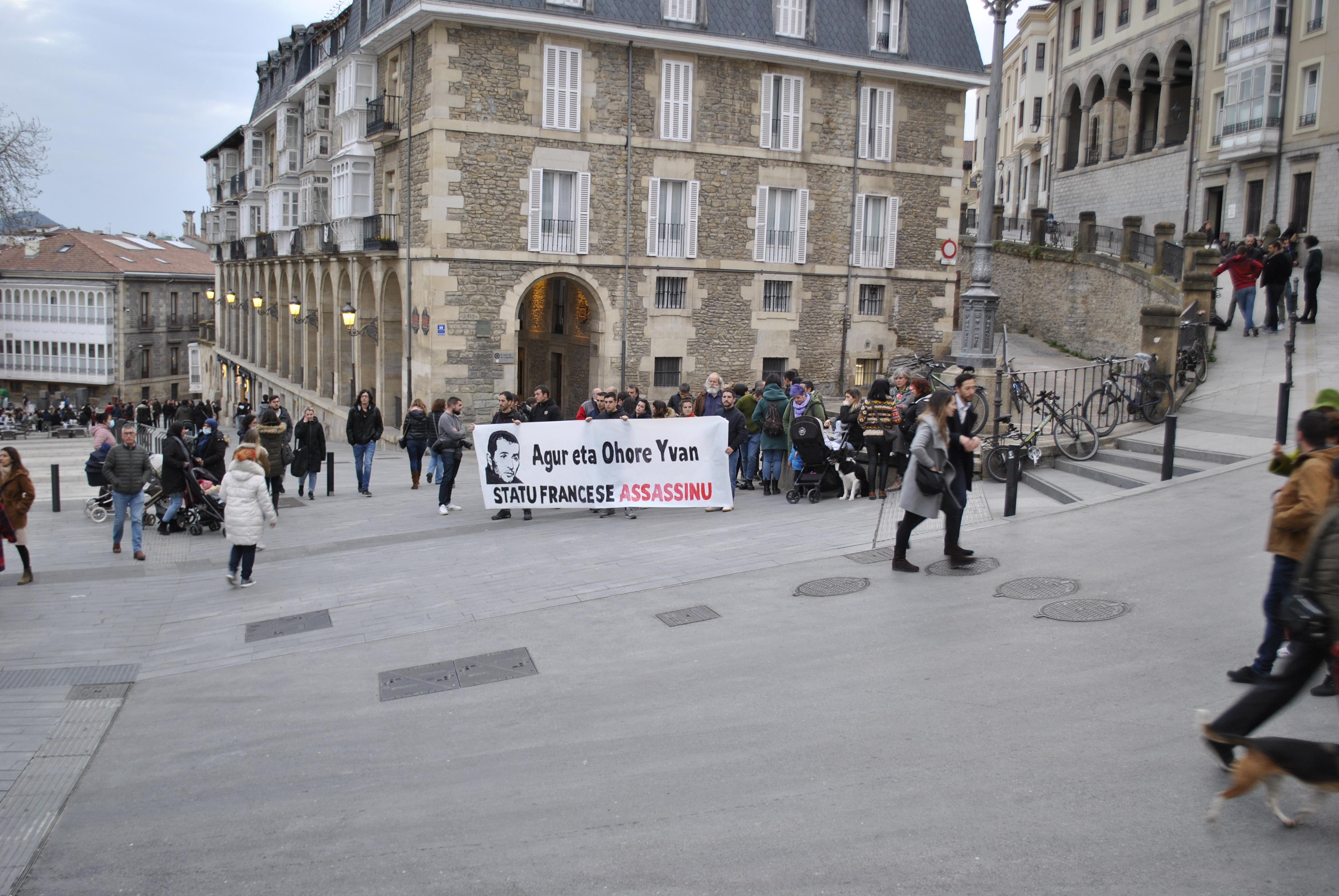
But with 19 years in prison for the freedom of his people, the murder of Iván Colona, a direct consequence of the criminal French prison policy, is not normal. The situation of the working people of Ireland, suffering from crushing British occupation for more than 800 years, is not normal. After eight long years of war, the situation of the working people of Donbass, who experience bombings, murders and massacres on a daily basis, is not normal. And much more heinous, outside of the norm, are the attempts to whitewash and legitimise criminal institutions such as NATO murderers.

We must situate ourselves in that context, understand within that reality, the situation that Euskal Herria (the Basque Country) is experiencing. Today our country are controlled by both the French and Spanish states. Not only do both these states not recognise Euskal Herria but they carry out an oppression based on that denial against the working class of Euskal Herria. In effect, we must understand well that, beyond the national question providing the a joint market for the states, the working class can only use the political project of the bourgeoisie as an element of unity to support and protect it, promoting interclassist attitudes.

“We, the organized women workers, will overcome all oppression!” (Photo courtesy Jardun)

The aforementioned denial, as well as the attacks carried out by the Spanish and French States against the Basque Working People, must be understood as an ideological motivation of the national State. We must, therefore, situate the oppression of Euskal Herria in the very creation of the Spanish and French capitalist states; because the objective of the denial is clear, the assimilation of Euskal Herria. To do this, the states take advantage of the institutions aimed at creating divisions and gaps in the Basque consciousness. And to protect these institutions and guarantee the supremacy of the bourgeoisie, they take advantage of dogs of various colours to attack the working people. To promote alienation and renounce our identity, in addition to normalising the attacks against the language, they have turned the Basque language and culture into souvenirs of a territory that today wants to dedicate itself to tourism, since for the bourgeoisie everything is business, to the point of commodifying our places of residence.

This being the case, given that denial is a decision of a political nature, we must cover with a political character the oppression experienced by Euskal Herria to view it with a class vision. We have to be clear about the concept of the political nature with regard to Euskal Herria nationality. Therefore, we have to fight against normalised oppression. Along this path, it is up to the workers of Euskal Herria to build our own political project and in response to this we have to equip ourselves with our own institutions that have to arise out of the counter-power that we need to form. And for this it is necessary for a Workers’ Euskal Herria to break politically with the Spanish and French states.

Photo shows a substantial following by veterans of the struggle (Photo courtesy Jardun)

These States offer the working people the use and threat of both persecution and violence, within the capitalist system that condemns the working class to servitude for the benefit of the bourgeoisie. For this reason, to carry out the aforementioned political rupture, political confrontation must be a valued concept in order to carry out the political project of the workers of Euskal Herria. Political confrontation must also be the engine of the revolutionary process aimed at achieving an independent and socialist Basque state in Euskal Herria.

For this, it is necessary to take the revolutionary process to the extreme and form a political body that must feed the revolutionary alternative. Specifically, a political body to be formed by organised workers in favour of national and social liberation and the sale of their labour power in the Basque Country. A political body that is committed to achieving an independent and socialist Basque State. Because the Basque Working People cannot be limited to the forms of work authorised by the capitalist system. These not only destroy the revolutionary potential of the working class, but are aimed at sustaining and reproducing the ideology of the bourgeoisie; because the enemy will not give, in any way, more than he is willing to give. The bourgeoisie will not voluntarily give up its privileges.

(Photo courtesy Jardun)

It is essential to set in motion the revolutionary process that must take place on the path of a classless society, towards the acquisition of political power by the working class; the aforementioned subject will only be achieved through the confrontation carried out with the capitalist state. Through the counter-power built in the confrontation, the Basque Working People must articulate revolutionary structures that wear down the centres of power of the oppressor and guarantee his liberation against the exploiters, to guarantee the achievements obtained during the revolutionary process. Because the political power of the Basque Working People must be based on counter power. In other words, the revolutionary alternative of the working people will be built and take root as the control and power of the capitalist states over the workers of the Basque Country is annulled. The revolutionary alternative must be a comprehensive political alternative that satisfies the needs of the Basque Working People.

It must be understood that this will be capable of leading struggles based on the activation and commitment of the workers. Therefore, in order to weave and build a revolutionary alternative at this time, the priority is the activation of workers aimed at promoting the ideological struggle and mobilization, understanding the JARDUN coordinator as an instrument to achieve this. In short, JARDUN is a framework created with the aim of promoting the organisation of bodies and militants to win the freedom of Euskal Herria. Its objective is that, under a common political project and strategic approach, each organisation carries out its contribution in specific political areas, but that all act within the framework of a common strategy and direction.

We have to be aware that this will be achieved through gradual activation and participation through the awareness of the Basque Working People. In this process, the revolutionary process itself will be carried out gradually, and the Alternative of the Basque Working People must carry out struggles based on the different forces, conditions and problems of the moment. As its political work deepens and Basque workers’ participation in the Coordination increases, JARDUN will create new framework organisations and acquire comprehensiveness and integrity, with the revolutionary movement’s priority being to create the conditions to achieve it.

(Photo courtesy Jardun)

When talking about the liberation of Euskal Herria, self-determination is a frequently mentioned term: self-determination, a term that appears many times when a nation is subjected to the sovereignty of another against its will. But when we speak of self-determination, considering the revolutionary process developed under a counter-power based on political rupture, we are not referring, in any way, to the vote marked, accepted and facilitated by the States that persecute Euskal Herria, but to the process of separation of one nation from the state structures of another nation. Self-determination as synonymous with the revolutionary process that must be carried out to achieve an independent and socialist Basque State, in the case of Euskal Herria.

Autonomism, because it is a struggle based on the management of the remains provided by the states, is not an option. It is not a legitimate choice on the table for the revolutionary movement, since this implies reformism and the strengthening of the position of power and subjugation of the States, together with the renunciation of the strategic objectives aimed at the liberation of the Basque Working People. However, it would be a serious mistake to believe that, through national liberation, the liberation of the workers will take place mechanically. This must be understood within the class struggle, in which we must place self-determination itself within the class conflict.

On the other hand, there exists the denial, underestimation or rejection of the national question, the strengthening of the repression that the capitalist states carry out and accepting the framework of the oppressive nation imposed, in the name of socialism, with the argument of unity of the workers. Regarding the national issue, the lack of correct position also allows the French and Spanish States to continue applying unjust laws and coercion, helping to hide the dimension of oppression suffered by the working class of Euskal Herria. Keeping silent before a crushing stomp, since taking a neutral position means protection from crushing; taking neutral positions allows oppressive power relations to continue unchanged over time and space, perpetuating them.

The political rally of Jardun’s celebration of Aberri Eguna in Gernika (Photo courtesy Jardun)

Consequently, the mere demand for independence only benefits the interest and political project of the bourgeoisie of the Basque Country. And the socialism that in Euskal Herria does not address the national question goes hand-in-hand with denial, denying in class parameters the revolutionary potential of the national question. The achieving of the independent and socialist State must be the result of the revolutionary process of Euskal Herria due to the national oppression suffered by the Basque workers. Revolutionary alternatives beyond the essential defence of independence and socialism must be the basis of the political position of the Basque Working People. They are only alternative for the Basque Working People, because it inevitably comes hand-in-hand with independence and socialism.

Long live a free Basque Country!

Long live a socialist Basque Country!

End.

FOOTNOTES

1A strong organisation in the antifascist resistance to the fascist-military uprising against the Spanish Republic but no longer in existence.

2Guernica, in Spanish.

SOURCES

Jardun Koordinadora: https://www.facebook.com/Jardun_koordinadora-100598125431163

https://eh.lahaine.org/eusk-cast-jardun-koordinadorak-2022ko

SUBJECTED TO A MEDIA DISINFORMATION ONSLAUGHT

Diarmuid Breatnach

(Reading time main text: 12 mins.)

Yes, indeed, we have been. Let us look back over the campaign of misinformation about conflict in Ireland for it has much to teach us about the mass media, about human credulity. We don’t need to go back over 800 years – just to the recent the 30-Year War.

In 1968 a civil rights campaign1 took off in the British Six-County colony in Ireland to include a number of marches and sit-ins, which was regularly met with violence from Loyalist2 mobs and the State. As part of the campaign, in 1969 a march from Belfast to Dublin was organised under the slogan “Civil Rights – North and South”. One of that march’s stops was in Lurgan, Co. Armagh, where the marchers sat at a crossroads and were instantly attacked by the armed British colonial police (then the RUC3, now the PSNI).

Some of the marchers had come from Britain to support the campaign and after being attacked in Lurgan, they bought an English newspaper to see whether the incident had been reported. An occurrence in the town had been reported alright but not what had occurred – the report told their readers that a fight between Catholics and Protestants had been broken up by the RUC, keeping the two sides apart. “There wasn’t a Protestant in sight,” commented a marcher angrily, “except those in RUC uniform …. or unless he was one of us4.”

Later that year, in August, the RUC killed four civilians, including a child, in the Divis Flats area of Belfast by firing at the area with a machine-gun mounted on an armoured car. Their claim they were returning fire from the area was widely refuted by local people but repeated in the media. The incident was not investigated until decades later when the claims of family and local witnesses were vindicated in an Ombudsman’s report.

The representation of the RUC as a force for peace between two groups in a sectarian conflict was to be a repeated media disinformation line through the ongoing conflict, as the struggle became an armed one — although to a large degree the honest broker ‘peacemaker’ cloak shifted from the colonial police on to the British Army.

British troops were sent in to the colony (by a Labour Government, in case we had illusions) in August 1969 and were initially greeted by many people in the ‘nationalist’5 community as saviours, sent to keep the sectarian RUC and Loyalist mobs (often enough amounting to the same thing) away from them. Most politicians and the media represented them as peace-keepers. For most nationalists the illusions did not last long as the Army turned their guns on them.

Although no British soldier had been killed in the Six Counties by the IRA as yet6, on 3rd July 1970 the British Army invaded the staunchly nationalist area of the Lower Falls and forced their way into homes, saying they were searching for arms. Local youths mobilised and attacked the soldiers with stones and petrol bombs7. The soldiers responded by pumping CS gas into the area and soon gun-battles between the IRA and the British Army broke out.

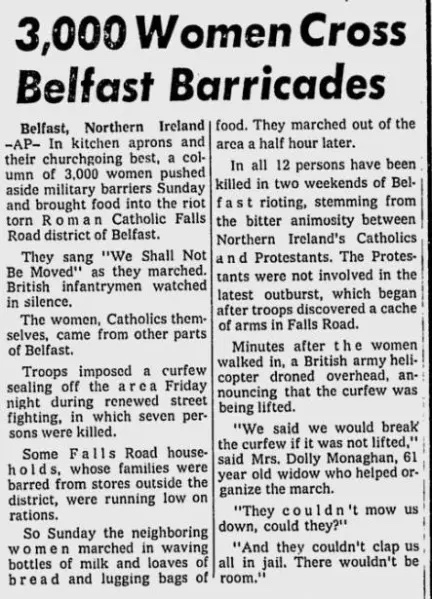
After four hours of continuous clashes, the British commander sealed off the area, which comprised 3,000 homes, and imposed a curfew which would last for 36 hours. Thousands of British troops moved into the curfew zone and carried out house-to-house searches for weapons, while coming under intermittent attack from the IRA and rioters. The searches caused much destruction, and a large amount of CS gas was fired into the area. Many residents complained of suffering abuse at the hands of the soldiers. On 5 July, the curfew was brought to an end when thousands of women and children from Anderstonstown8 marched into the curfew zone with food and other supplies for the locals.

During the operation, four civilians were killed by the British Army, at least 78 people were wounded and 337 were arrested. Eighteen soldiers were also wounded. Large quantities of weapons and ammunition were (allegedly – DB) captured. The British Army admitted afterwards that some of its soldiers had been involved in looting.’9

Mural on the Falls Road depicting Andersonstown women breaking the British cordon, Falls Curfew, 1970 (Source photo: Wikipedia)
Cutting of unknown newspaper report displaying misrepresentation of the struggle, despite being friendly towards the women who broke the British Army siege of the Falls Road, July 1970.
(Source photo: Step Back Ireland)

At the time, most of the media reported the clashes as unruly elements irrationally attacking the Army who were there to protect them and were only doing their job. However, the opinion of the nationalist community, though ignored by the media had undergone a huge shift and the first serving British soldier (of many to follow) was killed by the IRA the following year.10

Later in 1970, during riots in Derry, the Army shot two men from the nationalist area, Seamus Cusack and Desmond Beattie, claiming afterwards that they were armed, a claim local people denied. There was no investigation by the authorities, obliging the constitutionalist SDLP11 to withdraw from the colony’s parliament in protest.

On 4th December 1971, an explosion in the Catholic-owned McGurk’s Bar in Belfast killed 15 people and injured 16. Due to the bar’s ownership and location, the most logical attribution would be to Loyalists or British forces. It would be hard to pin it on the IRA – unless it could be said to have been an accidental explosion of an IRA bomb during storage or transportation. That was what the “security forces” came up with, which of course was repeated by the media. An alternative media theory was that in some manner it was a result of a feud between the Official and Provisional IRA. In order to construct that theory, the denials of the IRA had to be discounted12, despite the organisations’ track record of taking public responsibility for its actions.

The explosion had occurred in the pub’s doorway, which would have thrown doubt on the “IRA bomb in transit” story but somehow, the RUC’s forensic examination did not determine that. But even worse, the evidence of an eyewitness had to be dismissed.

On 6 December, however, the RUC took a witness statement from an 8-year-old boy. He said that a car had stopped outside the pub with four men inside and “a wee Union Jack stuck in the back window”. He said one left a package in the Great George’s Street doorway and ran back to the car, which sped off just moments before the package exploded. A man and a woman backed up his story, although they did not witness as much as the boy.13

In March 1976 the RUC received intelligence that linked UVF member Robert Campbell and four others to the McGurk’s bombing. Campbell was arrested on 27 July 1977 and held at Castlereagh RUC base. He was interviewed seven times during 27 and 28 July. He admitted his part in the bombing but refused to name the others. Campbell’s story matches that given by the young boy witness.’14

On 29 July 1977, Campbell was charged with the 15 murders and 17 attempted murders and in September 1978 pleaded guilty to all charges (he also had a separate conviction for the murder of a Protestant delivery driver in 1976). He eventually served fifteen years in prison, being released on 9th September 1993.15

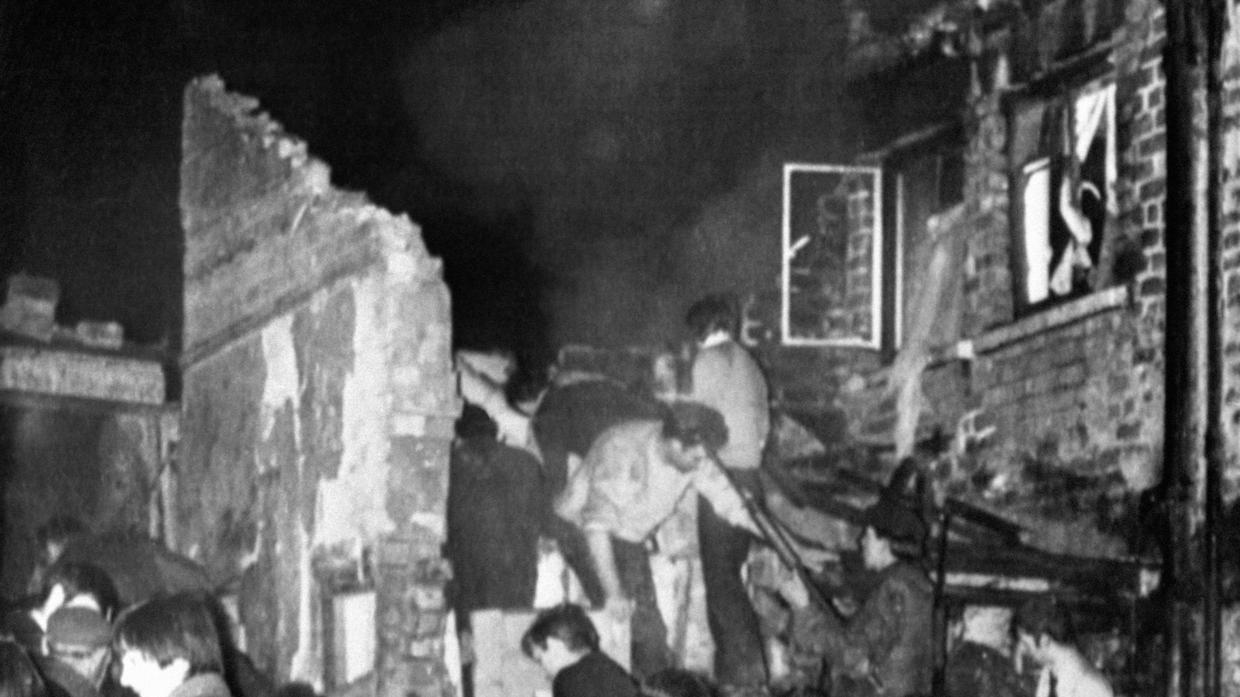
Local people searching in the rubble of McGurk’s Bar after the bombing by Loyalists killing 15 but which was blamed on the Republican armed organisations. (Photo credit: AP)

Despite the 1978 convictions and even Campbell’s confessions, the “own goal bomb” theory of responsibility lingered and relatives sought for years to have the case properly investigated, some also alleging that the RUC had colluded in helping the killers get away out of the area and in the false atrributions later, possibly even with the intention of setting the two IRA organisations at one another’s throats.

In what has become a depressingly familiar story, the relatives campaigned on in the face of police inaction and media disinterest for years, during which many of the directly-affected died through natural causes, to receive partial vindication at last in an Ombudsman’s report which laid the blame squarely on a Loyalist gang and castigated the RUC for a biased and inadequate investigation. The report was published in February 2011– it had taken the campaigners only 40 years16.

The introduction of internment without trial in August 1971 was, according to the media, a necessary measure to deal with political violence from all sides. Not one Loyalist was arrested that year, or the next and it was not until 1973 that a single Loyalist had been interned, the total by December 1975, when the measure was ended, having been 107 against 1,874 from the Nationalist community.17

The Paratroop Regiment, British Army shocktroops, were sent into the colony that year too18. Between 9th and 11th August in the Belfast area of Ballymurphy, the Paratroopers caused the deaths of 10 men and a woman and wounded many19. The Paratroopers claimed they had been shot at and were returning fire and that all their targets had been “terrorists”20. The media repeated these lies and, if reporters interviewed wounded and other witnesses, their accounts were not published. There was no investigation and, as with the deaths of many victims of RUC and British Army, there was no inquest concluded until decades later (2021 for these victims21).

The nationalist community called a demonstration in Derry for 30th January the following year to protest the massacres and against the introduction of internment. The Paratroopers were there again and they and other British Army soldiers shot down unarmed demonstrators, causing the deaths of 14 and injuring at least another 15. The Army claimed they had been returning fire from Irish Republicans and had shot only gunmen and bombers and on the whole, the media parroted their claims.

The British put their top judge, Lord Chief Justice Widgery, to hold an inquiry and in April that year his verdict upheld the Army’s version and also blamed the organisers of the march. The media of course promoted that verdict too. It was not until the extraordinarilyy long and hugely expensive Bloody Sunday Inquiry set up 1998 22 produced the Saville Report in 2010 that the British officially (and then of course also the media) accepted what all of Derry and much of Ireland already knew, that the Paras had opened fire in a non-threatening situation and selectively targeted and killed unarmed civilians23.

British soldiers shot another five unarmed people dead in the Springhill area of Belfast on July 9th, yet again as in Ballymurphy the previous year, including a priest administering the last rites but this time their tally was also an thirteen-year-old girl24. The original ‘official’ account of the shootings— that those shot were ‘gunmen’ — was almost immediately discredited, and was changed shortly after; the claim then became that those murdered were simply caught in the crossfire. Again the media covered the Army story without investigation or challenge.

In 1988 on Sunday 6th March British SAS soldiers shot dead three unarmed IRA volunteers in Gibraltar. When it was revealed that the three had been unarmed, firstly the media claimed that they had been about to trigger an explosion but some time later the British found the explosives in a car in a Spanish carpark across the border without any electronic link to the dead volunteers. When the British claimed that the Volunteers had made threatening moves, eyewitnessed testified that not only had they been unarmed when shot but had been extra-judicially executed as they lay on the ground with their hands up in surrender position. One of the eye-witnesses was Gibraltar resident Carmen Proetta, who then became a target for British media slurs, even going to the extent of suggesting that she was a sex-worker.

On Monday 7 March all eleven British national daily newspapers reported the story that a bomb had been found. Many gave detailed information about the size (mostly 500 pounds), purpose and type of the bomb as well as how it was defused. The Daily Mail suggested that the bomb might have a ‘video timing device’, while Today and the Independent mentioned ‘remote control’. The Daily Mirror told us that ‘a controlIed explosion failed to set off the bomb’ whilst the Daily Mail added ‘RAF disposal men defused it later’.25

On 28 April 1988, almost two months after the Gibraltar shootings, the ITV television channel defied British Government pressure and threats of legal action to broadcast “Death on the Rock” an episode of its current affairs series This Week, produced by Thames Television, based on investigations of three journalists and many interviews. This led to a ferocious media attack on the documentary, its programers and the IBA, the governing watchdog authority.

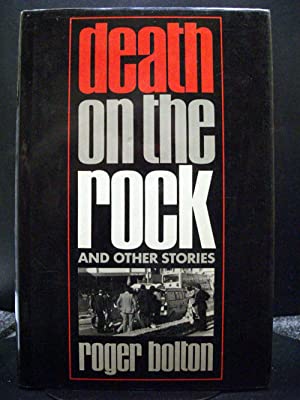
Documentary program maker Roger Bolton’s account of his hounding by government and media about an accurate documentary of the 1988 SAS murders of three unarmed IRA Volunteers in Gibraltar. (Image sourced: Internet).

Over the following weeks, newspapers repeatedly printed stories about the documentary’s witnesses, in particular Carmen Proetta, who gave an account of seeing McCann and Farrell shot without warning by soldiers who arrived in a Gibraltar Police car. Proetta subsequently sued several newspapers for libel and won substantial damages. The Sunday Times conducted its own investigation and reported that “Death on the Rock” had misrepresented the views of its witnesses; those involved later complained to other newspapers that The Sunday Times had distorted their comments.’26

A great number of situations arose during the 30 Years War in the British colony that were either unreported or misrepresented by the mass media, including “confessions” obtained through torture, RUC and British Army collusion with Loyalist murder gangs, inhumane treatment of political prisoners, Army shooting of unarmed civilians, extra-judicial executions of Republican Volunteers and blackmailing individuals for information or to carry out agent-provocateur actions.

WITHIN THE IRISH STATE

In 1969 the grave of Wolfe Tone in Bodenstown was blown up by Loyalists27 and between 1971 and 1974 there was a series of bombings in Dublin by Loyalists and British Intelligence. The bombing campaign began by aiming at symbolic structures and went on to target civilians which cost the lives of 36 civilians (and a full-term unborn child) and injured around 490, presumably to pressurise the Irish Government into increased repression of Republican paramilitaries.

In January 1971 the O’Connell Tower in Glasnevin Cemetery was damaged (not repaired finally until 2019, 47 years later)28, presumably as an attack on a prominent Irish Catholic29 icon. But in February 1971 the Wolfe Tone30 monument in Stephen’s Green was also blown up, like the blowing up of the grave, an attack on Irish Republicanism and its rebellious Protestant origins31. Bombings now aimed at civilians in Dublin followed and between 26 November 1972 and 20 January 1973, there were four paramilitary bombings in the centre of Dublin, claiming the lives of three public transport workers and injuring 185.

The first suspicion of responsibility for those bombings should naturally have fallen on the Loyalists and perhaps, by extension, on a British intelligence agency. It didn’t though; in the media and political circles, it was projected on to the IRA.

That could not have made logical sense, since such explosions could only have harmed the IRA among the Irish population. However there was another specific reason why it made even less sense, (if possible): in 1972 Leinster House32 was about to debate repressive legislation that would set up special no-jury courts to convict Republicans with the word of a police officer (at the rank of Superintendent or above) sufficient to convict of “membership of an illegal organisation”, with an automatic two-year jail sentence. The proposed legislation was being put forward by Fianna Fáil but Fine Gael and the Labour Party were mustering to vote against it and if they did, the new legislation would fall.

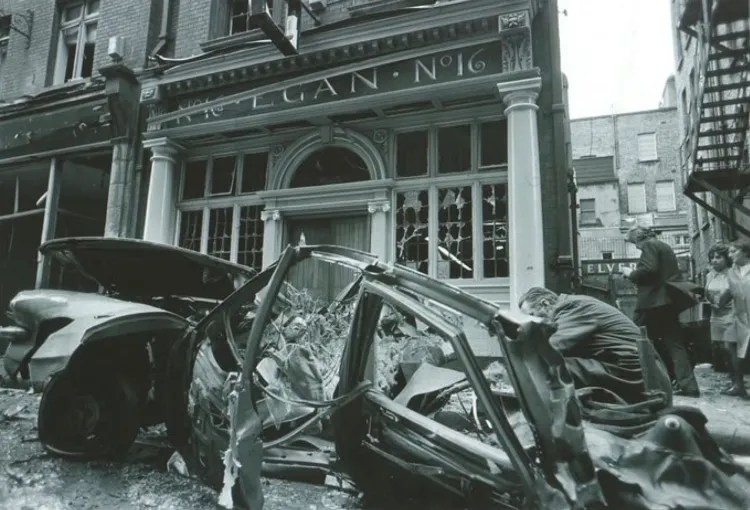
Scene of 1973 bombing in Sackville Place, Dublin city centre. The bombing the previous year was irrationally blamed on the IRA and the panic was used to collapse the opposition to proposed undemocratic repressive legislation, which was passed and is with us to this day. (Photo sourced: Stair na hÉireann Facebook page)

In the midst of the horror about the bombing, the opposition crumbled and the bill went through, against protests of many human and civil rights agencies33; it became law, has sent many people to jail on dubious ‘evidence’ and is in force to this day.

The illogical focus on the IRA as the source of the 1972 and ‘73 bombings and the consequent failure to investigate them and follow up on the likely perpetrators had a horrific result in 1974: three bombs in Dublin city centre and one in Monaghan town centre killed 34 and injured around 30034, the highest number of people killed in any one day during the 30 Years War (often conveniently forgotten by the media, as for example in this report https://www.belfasttelegraph.co.uk/news/northern-ireland/army-knew-mcgurks-bar-bomb-was-placed-in-doorway-solicitor-says-35516460.html.)

Not only that, but the failure to energetically investigate the 1974 bombing meant that some of the Loyalist perpetrators were free to murder many civilians in the following years – some of the bombers were members of the infamous Glennane Gang, a Loyalist-RUC-British Intelligence group of killers responsible for up to 120 murders of civilians35.

WITHIN BRITAIN

The events in Ireland were of course being felt by the Irish diaspora in England too. Marches, pickets and public meetings protesting the RUC’s repression of marches for civil rights were held in many British cities, as they were against sending the British Army into the Six Counties, introduction of internment without trial and shooting protesters dead. Some groups on the British Left were also attending these events and occasionally organising their own. Irish solidarity was becoming a major issue for anti-imperialist solidarity in Britain and abroad, in addition to being in a sense a major domestic issue in Britain too.

The IRA began to extend Britain’s war to their homeland in a bombing campaign in 1971, at first targeting property. However, in 1974 bombs in two pubs in Birmingham killed 21 people which was difficult to understand but according to an alleged perpetrator, the warning intended by the bombers was frustrated through out-of-order public telephone boxes. The Guildford and Woolwich bombs, aimed at pubs frequented by British soldiers, killed five soldiers and two civilians overall and injured 101 people.

The horror and outrage resulting from that carnage gave the British State the environment in which they could launch a wholesale clampdown on the Irish diaspora. The Prevention of Terrorism Act was rushed through the Westminster Parliament in 1974, specifically targeting the Irish community. The Act empowered the police to raid homes, to hold suspects without access to a solicitor for up to five days and longer on special application and to summarily deport Irish people from Britain – even to their own colony. It also empowered the police to stop and question Irish people without warrant or having to show cause and thousands were stopped and questioned at ports and airports as they travelled from Ireland to Britain or vice versa, sometimes missing their flights or boat as a result. People were questioned on the street too and on Irish solidarity demonstrations.

In that atmosphere, of which the media was the main facilitator in British society, it was fairly easy for the State to frame nearly a score of innocent people on bombing charges and to sentence them to many years in jail on the flimsiest of “evidence”, later to refuse their right to appeal, later still, granting that right but denying the justice of their cases.

Judith Ward was arrested in February 1974, sentenced to life imprisonment plus 30 years in October 1974 and her conviction overturned in May 1992.

The Birmingham Six were arrested in November 1974, sentenced to jail for life in August 1975, their convictions finally overturned in March 1991.

The Guildford Four were arrested in December 1974, sentenced to imprisonment for life in October 1975, their convictions finally overturned in October 1989.

Giuseppe Conlon and the Maguire Six were arrested in December 1974, sentenced to 4, 51, 12 and 14 years in 1976, their convictions overturned in 1991. By that time Vincent and Patrick had already served their sentences and Giuseppe Conlon, father of Gerry Conlon of the Guildford Four, had died in jail.

1Patrick Maguire was only 14 at the time and Vincent only 17.

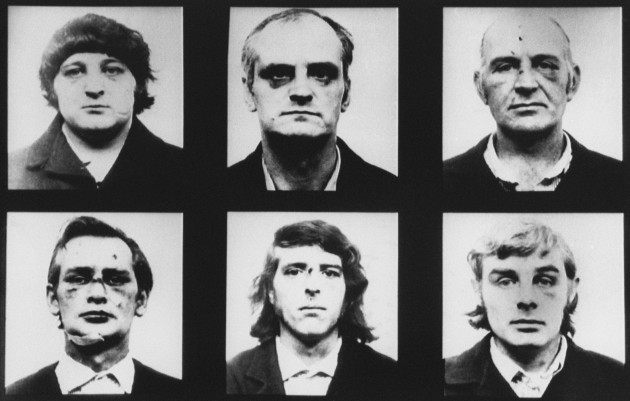
The innocent Birmingham Six at their appearance in court after being beaten up by prison warders as they arrived at the jail falsely charged with the bombings in Birmingham. The mass media played a major role in their being found guilty and in frustrating campaigns to free them which only succeeded 17 years later. (Image sourced: Internet)

The UK media in particular played a huge part in setting the atmosphere in which these unjust convictions could take place and in making the struggle of the innocent for justice difficult. Even after their acquittal, some of the media insinuated that they had been guilty and had got free through some kind of legal loopholes.

Could the media have known differently? Yes, certainly, not one of the cases would stand up to reasonable inspection. The Guildford Four were hippies living in a squat, the Birmingham Six were escorting the body of a deceased IRA man to Ireland when the bombs exploded, the Maguires were a Tory-voting woman with teenage children, Giuseppe was only in London to help his son after the latter’s arrest and Judith Ward was mentally ill, homeless and penniless37. Their ‘confessions’, obtained through torture and intimidation38, were admitted as evidence against them, although they all retracted them and declared how they had been obtained. The forensic evidence was faulty and besides recording a false positive and even though the defence team had a forensic expert to refute it during their trial, the Prosecution’s expert was the one accepted.

The February 1977 confession by an IRA unit to the Woolwich and Guildford bombing after their capture in the Balcome Street siege was not accepted, although they were able to give details of the bombing. So tortured and retracted ‘confessions’ were acceptable whereas one voluntarily given was not.

Apart from the logical doubts that should have arisen in even a light examination of the cases, the media also had access to detailed refutation of the case against the Birmingham Six. Although much has been made recently of the investigation of the case by Chris Mullin, the publication of his book Error of Judgment: The Truth About the Birmingham Pub Bombings (1985), the research for which went into the earlier 1984 ITV World in Action documentary, a detailed challenge to the convictions had been published much earlier. Only two years after the arrest of the Birmingham Six, Fathers Murray and Faul had published The Birmingham Framework39, which they had sent to British politicians and media agents. In 1982 the Irish in Britain Representation Group40 also publicly called for the freeing of the framed prisoners and continued to do so for every year thereafter. Other organisations such as the Troops Out Movement41 called for their release also and trade union branches began to support such calls.

Exposure of the case against the Birmingham Six published by Frs. Murray and Faul as early as one year after the convictions of the innocent men. (Source image: Internet)

It suited the State that the British public think the prisoners guilty and the British media played their part in that purpose. In a way, it also suited the State if the Irish community knew the prisoners were innocent since, if even the innocent could be jailed so easily, how could any Irish person be safe except by keeping his or her head down low? Irish solidarity activities declined in occurrence and in numbers attending. With few exceptions, the Irish community in Britain was cowed from 1974 until the Hunger Strikes of 1981 brought them out on the streets again, the terror broken by the spirit of solidarity and outrage.

WHY?

The above examples are only a selection of situations in Ireland during the period under discussion about which we and the world were misinformed or censored. Throughout the 30 Years’ War so many accusations against the British armed forces, including their armed colonial police, have been ignored or recorded disbelievingly by the media – in particular the British section but within the Irish state also – and repeated by media services abroad, to be picked up by other media …. and so on, and on. And likewise with accusations against British intelligence services and their domestic police force.

Why then are the current claims of the Ukrainian government published through the mass media being accepted without question on every count? Why is everything the Russian government says discounted or ignored without checking? Why are we not concerned at banning of alternative media and censorship of commentators who are not repeating the party line? Why are we not outraged at the agreed delivery of Julian Assange by the UK to the USA on charges of “spying” because he exposed their lies and murderous activities in Iraq and Afghanistan? Given our own experience over 30 years of the UK media’s dismal record of reporting on the conflict in Ireland – and its equally dismal repetition in the western media – why are we now believing without critical examination the western media reporting on the war in the Ukraine?

End.

FOOTNOTES

1The civil rights campaign in the Six Counties was in pursuance of equal rights for the Catholic minority with the Protestant majority there, in the electoral franchise, in housing and employment, along with the repeal of the repressive Special Powers Act.

2‘Loyalists’ is a term describing militants – always of Protestant community background – in various organisations — who insist on remaining within the UK. The first armed actions in the 30 Years War were by Loyalists.

3Although the Royal Ulster Constabulary was created in 1922, when Ireland was partitioned, it was in effect a continuation of the Royal Irish Constabulary, the British occupation’s gendarmerie (nation-wide semi-military police force, such as exists in Spain, Turkey, Italy, France, etc) in existence throughout all of Ireland since 1822. Although the personnel of the RIC had been mostly Catholic in background (usually with Protestant senior officers), the RUC was determinedly Protestant from the start, both in its full-time and part-time membership. However, a minority of the civil rights campaigners were also from Protestant backgrounds.

4As part of the control structures in the Six Counties, the authorities had recruited only non-Catholics into the colonial police force, which helped unionist politicians and media represent an attack on the police as a sectarian attack. Though a few Catholics have been recruited since the 1990s and Sinn Féin has been supporting recruitment drives in nationalist areas, the PSNI personnel remain overwhelmingly of Protestant background.

5A convenient term used to describe the large minority community, mostly of Catholic background, mostly of the original population but with some earlier intermarriage into the majority community, which is of mostly colonist/ settler origin.

6Ironically, the first serving British soldier killed in the Six Counties was killed by indescriminate firing by the RUC into the nationalist area of Divis Flats in Belfast. Trooper Hugh McCabe of the Queen’s Royal Irish Hussars was home on leave, staying with his family when the RUC opened fire with machine-gun on the nationalist area (this was one of the incidents that led to the barricading of “no go” areas excluding the RUC and later also the British Army). Three others were also killed by RUC bullets, including a nine-year-old boy. It took over 50 years for the families to get an acknowledgement and apology after an Ombudsman’s report. https://www.theguardian.com/uk-news/2021/may/06/ruc-erred-at-troubles-dawn-by-firing-on-flats-from-armoured-cars#:~:text=Patrick%20Rooney%2C%20nine%2C%20Hugh%20McCabe,the%20Divis%20and%20Ardoyne%20areas.

7People had learned to make those in defence against RUC and Loyalist attacks during the earlier Civil Rights period.

8A large Belfast nationalist area separated from the Falls area by unionist areas and the city centre.

9https://en.wikipedia.org/wiki/Falls_Curfew

10https://www.irishnews.com/news/northernirelandnews/2021/02/16/news/new-details-about-death-of-first-british-soldier-killed-by-pira-revealed-by-former-commanding-officer-2222034/

11The Social and Democratic Labour Party, advocating reform through legal and constitutional methods.

12Two days after the explosion, on December 6th, both the Official and Provisional IRAs issued statements condemning the bombing and denying any involvement. Local people also denied any association between the pub and either of the armed organisations.

13Quoted from https://en.wikipedia.org/wiki/McGurk%27s_Bar_bombing, accessed on 11 April 2022.

14Ibid.

15Campbell was the only person ever to have been charged for the atrocity.

16https://www.reuters.com/article/uk-irish-ira-report-idUKTRE71K2U520110221

17https://en.wikipedia.org/wiki/Operation_Demetrius#:~:text=It%20involved%20the%20mass%20arrest,Ireland%20against%20the%20British%20state.

18Despite some time searching online I have not come across the exact date they were there by May 1971 and it may be that they had been sent there as part of plan that included the introduction of internment without trial later that year.

19http://www.ballymurphymassacre.com/cms/massacre/

20The fact that one fatal victim was a mother of eight children and another, a local priest, should have alerted media to the fact that the Paras were likely lying and local people likely telling the truth.

21https://www.irishtimes.com/news/crime-and-law/ten-shot-dead-in-ballymurphy-massacre-entirely-innocent-coroner-finds-1.4561691

22Likely initiated as as a payoff to the Provisionals for buying into the Peace/ Pacification Process, the other being the early release on licence of their members in jail, the inquiry lasted twelve years and cost £195 million.

23No senior Army officer or senior politician of the time has even been charged for those murders. One lower-ranking soldier was eventually charged but in July 2021, the Public Prosecution Service decided it would no longer prosecute him either.

24https://belfastmedia.com/springhill-westrock-massacre

25https://www.academia.edu/3176252/The_Media_on_the_Rock_The_Media_and_the_Gibraltar_Killings

26https://en.wikipedia.org/wiki/Operation_Flavius#Aftermath

27https://journals.sagepub.com/doi/10.1177/0332489319881245n

28https://www.irishtimes.com/news/ireland/irish-news/o-connell-tower-in-glasnevin-reopens-47-years-after-bomb-blast-1.3460774

29Daniel O’Connell, a constitutional Irish nationalist politician and Catholic, campaigned for the repeal of the anti-Catholic Penal Laws in which he was largely successful in 1869 and unsuccessfully for repeal of the Act of Union, which had transferred the internal legislation of Ireland through its Parliament to Westminster instead in 1801.

30Theobald ‘Wolfe’ Tone was an Anglican campaigner for reform of anti-Catholic legislation (only Anglicans could be elected to the Irish Parliament) who became a revolutionary Irish Republican when those attempts failed. He was a founder of the revolutionary republican United Irishmen organisation. He was captured by the British after surrender of the French naval ship on which he was travelling on 12th October 1978. Although an officer in the Army of France he was tried for treason and sentenced to be executed; on 19th September 1798 he died in prison of wounds, apparently self-inflicted to deny the State his public execution.

31https://www.atlasobscura.com/places/wolfe-tone-statue and https://www.irishphotoarchive.ie/image/I000063xdWJKXewQ

32The parliament of the Irish State.

33For the most recent statements by the Irish Council of Civil Liberties on the no-jury Special Criminal Courts, see https://www.iccl.ie/2021/iccl-special-criminal-court-a-fundamental-denial-of-constitutional-rights-to-a-fair-trial/ and https://www.iccl.ie/2022/international-call-for-end-to-special-criminal-court/

34https://en.wikipedia.org/wiki/Dublin_and_Monaghan_bombings

35https://www.irishtimes.com/culture/books/lethal-allies-british-collusion-in-ireland-a-shameful-part-of-our-troubled-history-1.1578119

36Patrick Maguire was only 14 at the time and Vincent only 17.

37https://www.thejusticegap.com/buried-alive-case-judy-ward-25-years/

38In the case of at least one of the Guildford Four, while she was in a psycho-tropic drug episode.

39The Birmingham Framework — Six Innocent Men Framed for the Birmingham Bombings, by Fr. Denis Faul and Fr. Raymond Murray (1976), https://cain.ulster.ac.uk/events/other/1974/faul76.htm

40The IBRG was formed late in 1981 as an independent community organisation, among the issues it took up were those of anti-Irish racism, access to resources for the community, an end to strip-searching of prisoners, freedom for the framed prisoners and British withdrawal from Ireland.

41The Troops Out Movement was founded in 1973 as a broad organisation to mobilise the British public for withdrawal of British troops from Ireland; with branches in many parts of Britain, it organised marches, pickets, public meetings and published pamphlets. The relevant Wikipedia incorrectly claims it was “an Irish Republican organisation” — though it naturally did contain Irish Republicans, it also contained British revolutionary left and social-democratic elements. Though maintaining its independence for decades, it did towards the end of the 1990s become closely linked to Provisional Sinn Féin.

SOURCES

The Battle of the Falls/ Falls Curfew: https://en.wikipedia.org/wiki/Falls_Curfew

The RUC killed the first serving British soldier along with three civilians in 1969: https://belfastmedia.com/trooper-mccabe-1969-truth-still-hidden
and https://www.theguardian.com/uk-news/2021/may/06/ruc-erred-at-troubles-dawn-by-firing-on-flats-from-armoured-cars#:~:text=Patrick%20Rooney%2C%20nine%2C%20Hugh%20McCabe,the%20Divis%20and%20Ardoyne%20areas.

Internment without trial: https://en.wikipedia.org/wiki/Operation_Demetrius#:~:text=It%20involved%20the%20mass%20arrest,Ireland%20against%20the%20British%20state.

Ballymurphy Massacre: http://www.ballymurphymassacre.com/cms/massacre/
and https://www.irishtimes.com/news/crime-and-law/ten-shot-dead-in-ballymurphy-massacre-entirely-innocent-coroner-finds-1.4561691

Bloody Sunday Massacre Derry: https://en.wikipedia.org/wiki/Bloody_Sunday_(1972)#Murder_investigation

Springhill Massacre:

https://belfastmedia.com/springhill-westrock-massacre

The first acknowledged serving British soldier killed in the Six Counties, 1971: https://www.irishnews.com/news/northernirelandnews/2021/02/16/news/new-details-about-death-of-first-british-soldier-killed-by-pira-revealed-by-former-commanding-officer-2222034/

40 years after McGurk’s Bar bombing: https://www.reuters.com/article/uk-irish-ira-report-idUKTRE71K2U520110221
50 years after: https://www.irishtimes.com/news/ireland/irish-news/fifty-years-on-and-grief-of-the-mcgurk-s-bar-massacre-still-resonates-1.4746143

Gibraltar murder of three IRA Volunteers: https://www.academia.edu/3176252/The_Media_on_the_Rock_The_Media_and_the_Gibraltar_Killings

In the Irish State
Wolfe Tone grave Bodenstown blown up by Loyalists:

https://journals.sagepub.com/doi/10.1177/0332489319881245n

Dublin bombings 1972 & 1973: https://en.wikipedia.org/wiki/1972_and_1973_Dublin_bombings

Dublin and Monaghan Bombing 1974: https://en.wikipedia.org/wiki/Dublin_and_Monaghan_bombings

Review of Lethal Allies (2013) by Anne Cadwaller: https://www.irishtimes.com/culture/books/lethal-allies-british-collusion-in-ireland-a-shameful-part-of-our-troubled-history-1.1578119

In Britain:
The Birmingham Framework by Frs. Murray and Faul: https://cain.ulster.ac.uk/events/other/1974/faul76.htm

The Guildford Four and Maguire Seven: https://en.wikipedia.org/wiki/Guildford_Four_and_Maguire_Seven

Judith Ward: https://www.thejusticegap.com/buried-alive-case-judy-ward-25-years/

Basque Solidarity for Corsican Patriot Murdered in French Jail

Clive Sulish

(Reading time: 2 mins.)

SPEECH DELIVERED AT THE RALLIES ORGANISED BY JARDUN IN RESPONSE TO THE MURDER OF CORSICAN POLITICAL PRISONER YVAN COLONNA (Se encuentra la versión anterior en castellano/español al fondo)

Yvan Colonna was from a young age a member of the Corsican liberation movement. After being forced to remain in hiding for four years, he was arrested in 2003, accused of participating in an action carried out by an anonymous group. The accusation was based on statements of several of the movement’s members detained at the police station, who later rejected the statements but Yvan was sentenced to life imprisonment.

Posters demanding justice for Yvan Colonna after his arrest (Photo sourced: Internet)

Colonna was left in a very serious coma after the beating by a jihadist prisoner in Arles prison. On Monday of this week, Yvan passed away after three weeks in hospital. During that time there were riots denouncing the role of the French state in Yvan’s murder.

Yvan was murdereded by the penitentiary policy of dispersal and the conditions of the prison. We in the JARDUN Coordination charge that the beating and death received by Yvan was a direct consequence of the penitentiary policy of the French State. Likewise, we want to underline the need to create an organisation in support of the freedom of political prisoners and the fight against oppression and exploitation.

It should not be forgotten that in Corsica, the struggle for independence has been ongoing for decades with the aim of overcoming the political-economic system imposed by the French State and fighting for a popular and democratic government that would act in favour of the Corsican people. The struggle of the Corsicans is the struggle against French imperialism, against the oppression of the local working people and against the exploitation they suffer.

In Euskal Herria (the Basque Country – Trans.) we are well aware of the repression and oppression by oppressive states and we are witnesses to the massacres committed so many times by the French State. Because we cannot forget the imperialist attitude of the French State in Algiers and other colonies, becoming, together with the United States, the main promoters of contemporary torture.

Solidarity picket in Gastheiz/ Vitoria, southern Basque Country, on Friday 25th (Photo: Jardun Koordinadora)

All of this shows us nothing less than the need for the organisation of the working class. It is evident that both the imperialist power and the oppressive States exercise a monopoly on violence to defend their economic interests and, in every nation, those who pay are always the working class.

It is time to denounce the fraud of social peace, it is time to denounce the warlike attitude of NATO, in Donbass, the Sahara, Palestine, today they are waging endless wars in defence of the interests of imperialism and its servants — and in view of this, it is time to awaken internationalist solidarity!

For this reason, we in JARDUN proclaim that it is time to turn to revolutionary organisation for all working people! Because only the organised people can offer real help and, as far as we are concerned, only the Basque working people can obstruct the participation of the Spanish and French States, organizing themselves in Euskal Herria to face the enemy, working for a political system in favour of the Basque working people.

We are clear that struggle is the only way and we will loudly proclaim that we have to confront the enemy, exploitation and class oppression. That is why we encourage you to join the organisation, because it is time to fight, it is essential to resist!

AGUR ETA OHORE YVAN! (Farewell with Honour Yvan!)

GORA KORSIKAKO HERRI LANGILEAREN BORROKA! (Long live the struggle of the Corsican working people!)

GORA EUSKAL HERRIA ASKATUTA! (Long live a free Basque Country!).

end.

Solidarity picket in Donosti/San Sebastian, southern Basque Country, on 26th March (Photo: Jardun Koordinadora)

Lectura lanzada en las concentraciones organizadas por JARDUN ante el asesinato de Yvan Colonna

Yvan Colonna era miembro del movimiento de liberación corso, en el que militó desde joven. Tras ser obligada a permanecer 4 años en la clandestinidad, fue detenida en 2003 acusada de participar en una acción llevada a cabo por un grupo anónimo. La acusación se fundamenta en la declaración de varios de los miembros detenidos en la comisaría, que posteriormente rechazaron la declaración, pero Yvan fue condenado a cadena perpetua.

Colonna quedó en coma muy grave tras la paliza de un preso yihadista en la cárcel de Arlés. El lunes de esta semana, Yvan falleció cuando llevaba 3 semanas hospitalizado. Con el objetivo de denunciar el papel del Estado francés en el asesinato de Yvan desde que ingresó en hospital, durante ese tiempo  ha habido disturbios.

Yvan fue asesinado por la política penitenciaria por la dispersión vivida y las condiciones de la prisión. Desde la  coordinadora JARDUN  denunciamos que la paliza y la muerte recibida por Yvan ha sido consecuencia directa de la política penitenciaria del estado francés. Asimismo, queremos subrayar la necesidad de articular una organización a favor de la libertad de los presos políticos y de la lucha contra la opresión y la explotación.

No hay que olvidar que en Córcega, la lucha por la independencia se ha dado durante décadas con el objetivo de superar el sistema político económico impuesto por el Estado francés y luchar por un gobierno popular y democrático que actuara en favor del pueblo corso. La lucha de los corsos es la lucha contra el imperialismo francés, la opresión del pueblo obrero local y la lucha contra la explotación que sufren.

En Euskal Herria conocemos bien la represión y la opresión de los estados opresores y somos testigos de las masacres cometidas tantas veces por el Estado francés. Porque no podemos olvidar la actitud imperialista del Estado francés en Argel y otras colonias, llegando a ser, junto con los Estados Unidos, los principales impulsores de la tortura contemporánea.

Todo ello no nos demuestra más que la necesidad de la organización de la clase trabajadora.. Es evidente que tanto la potencia imperialista como los Estados opresores ejercen el monopolio de la violencia para defender sus intereses económicos, y en todo pueblo, su pagador, es siempre la clase obrera.

Es hora de denunciar el fraude de la paz social, es tiempo de denunciar la actitud guerrera de la OTAN, Donbass, el Sáhara, Palestina, hoy en día están dando un sinfín de guerras en defensa de los intereses del imperialismo y de sus siervos, ¡y ante eso es tiempo de despertar la solidaridad internacionalista!

Para ello, desde JARDUN proclamamos que es hora de volcarse en la organización revolucionaria para todo pueblo obrero!! ¡Porque sólo el pueblo organizado puede ofrecer una verdadera ayuda, y en lo que a nosotros se refiere, sólo el pueblo trabajador vasco puede interrumpir la participación de los Estados Español y Francés, organizándose en Euskal Herria para hacer frente al enemigo, trabajando por un sistema político a favor del pueblo trabajador vasco.

Nosotros tenemos claro que la lucha es el único camino y proclamaremos en voz alta que tenemos que enfrentar al enemigo, a la explotación y la opresión de clase. Por eso os animamos a uniros a la organización, porque es tiempo de lucha, ¡es imprescindible resistir!

AGUR ETA OHORE YVAN!

GORA KORSIKAKO HERRI LANGILEAREN BORROKA!

GORA EUSKA HERRIA ASKATUTA!

IRRATIONAL CRITICISM OF ZELENZKY BY PALESTINIAN ANALYST

Diarmuid Breatnach

(Reading time: 2 mins.)

The online publication Middle East Eye published on March 22nd an open letter from Palestinian political analyst As’ad Ghanem sharply criticising the Ukrainian President, Volodomir Zelensky, for the latter’s March 20th speech by Zoom before the Knesset, the Israeli parliament. The Palestinian academic’s criticism was, at base, entirely irrational.

As’ad Ghanem is a senior lecturer at the School of Political Sciences, University of Haifa. Ghanem’s theoretical work has explored the legal, institutional and political conditions in ethnic states. He has covered issues such as Palestinian political orientations, the establishment and political structure of the Palestinian Authority, and majority-minority politics in a comparative perspective. His books include Palestinian Politics after Arafat: A Failed National Movement (Indiana Series in Middle East Studies). Ghanem has initiated several empowerment programs for Palestinians in Israel.

As’ad Ghanem at a speaking engagement (Photo sourced: Internet)

Ghanem’s opening paragraph, though a denunciation of Zelensky’s speech, seemed to display a misapprehension of the conflict in the Ukraine and of Zelensky’s role there: Your recent speech before the Israeli Knesset was a disgrace when it comes to global struggles for freedom and liberation, particularly of the Palestinian people. You reversed the roles of occupier and occupied. You missed another opportunity to demonstrate the justice of your cause and the broader cause of freedom.

Any hope that Ghanem’s words were some kind of subtle attack on imperialism in Eastern Europe, an exposure of its false defence of national sovereignty, democracy and freedom, were swiftly expelled in reading the third and fourth paragraphs of his letter:

I am angry and sad that Russia is seeking to occupy your country and to crush the rights of the Ukrainian people to self-determination and freedom, and I believe that every possible support must be given to Ukrainians as they resist this barbaric aggression……

And while I admire your success in building a large international coalition to support your struggle against Russian aggression, I wish we as Palestinians could persuade the world to mobilise in a similar fashion, and force Israel to abide by international resolutions.

But Ghanem wants to show that although he may be a liberal, he is also an anti-imperialist. So he adds the following line to his third paragraph: At the same time, I reject the policies of the US and its Nato allies around the globe.

What an irrational position to hold! “The policies of the US and its Nato allies around the world” being enacted are precisely what is causing the current conflict in the Ukraine and it is those forces that are backing Zelensky and employing him in their contention with Russia.

Asad Ghanem’s plaintive criticism and appeal to Zelensky and — by implication — to imperialism exposes the ideological bankruptsy of the liberal critics of imperialism1. He is disappointed by Zelensky’s support for the murderous and racist rule of Israeli Zionism and sees it as somehow in contradiction with his position in the Ukrainian state’s conflict with Russia.

TO GAIN UNDERSTANDING, ASK BASIC QUESTIONS

The answers to a few simple questions would have disabused Ghanem and other pro-Palestinian liberal critics of imperialism of any confusion or illusion about the situation:
Which major imperialist military bloc is supporting the Ukraine in the current conflict? NATO.
Which imperialist state controls NATO at least since 1951? The USA.
Which power fundamentally props up and defends the Zionist state? US imperialism.

Even without any consideration of the reported Zionist state’s training and arming of the Ukrainian Azov, Zelensky’s stance towards Israeli Zionism is entirely in line with his alliances and Ghanem’s criticism completely irrational. If Zelensky is to be criticised politically for anything, it is for perhaps making his alliances so clear.

RATIONAL STANCE TOWARDS IMPERIALISM

Ghanem concludes his letter thus:

I know that most Palestinians are watching your stubborn struggle and wishing you victory over Russia’s brutal aggression. (Really? I sincerely doubt it – DB2). I also know that a Russian victory would be a great gift to Israel’s aggressive posture – a victory for its “Iron Wall” concept, which regulates its dealings with us until our complete defeat.

On the other hand, the struggle and victory of your people, even with the destruction of much of your country and the displacement of scores of Ukrainians, would give hope to other peoples struggling against oppression and erasure, rekindling our hopes for return and liberation. To this end, I urge you to stop supporting our oppressors.

The only rational stands towards imperialism are outright support or outright opposition — and the latter is the revolutionary position. Liberals want to criticise imperialism without being revolutionary, presumably because they feel more comfortable in the imperialist world than fear they would in a revolutionary one. They ask imperialism (which is what they usually mean by “the international community”) to remedy a situation here and there, a situation that usually only exists directly or indirectly because of imperialism.

Of course, imperialism regularly disappoints them but, like besotted lovers in an abusive relationship, they never learn, they never abandon their relationship but instead keep returning, asking their partner to behave better this time.

End.


FOOTNOTES

1Which is certainly no worse than that of the appalling stance of a major part of the Western Left

2“The two Arab Israeli (this is Zionist apartheid code for Palestinians – DB) parties chose to snub Ukrainian President Volodymyr Zelensky’s speech to the Knesset on Sunday night, with only one Arab lawmaker out of their 10 MPs showing up. Joint List chief Ayman Odeh skipped the speech, as did the two other lawmakers from his Hadash faction, party officials said. A spokesperson for Odeh did not respond to a request for comment. “Our position is that NATO and its leader America imposed this war,” said Mansour Dahamsheh, the Hadash party’s secretary-general, in a phone call with The Times of Israel. https://www.timesofisrael.com/arab-israeli-mks-skip-zelenskys-knesset-speech-nato-imposed-this-war/

SOURCES

Text of As’ad Ghanem’s letter: https://www.middleeasteye.net/opinion/russia-ukraine-war-israel-palestine-zelensky-support-disgrace?utm_source=Twitter&utm_medium=Social&utm_campaign&utm_content=ap_qf0gnh7kqc

Zelensky’s speech to the Knesset: https://www.timesofisrael.com/full-text-ukraine-president-zelenskys-speech-to-israeli-lawmakers/

Palestinian Knesset MP’s attitude to Zelensky: https://www.timesofisrael.com/arab-israeli-mks-skip-zelenskys-knesset-speech-nato-imposed-this-war/

Israeli Zionist Government Minister’s reaction to Zelensky’s speech: “The war is terrible but the comparison to the horrors of the Holocaust and the final solution is outrageous” — https://www.jpost.com/israel-news/politics-and-diplomacy/article-701850

https://www.al-monitor.com/podcasts/ambassador-liel-zelenskyys-knesset-speech-exposes-gaps-perception-over-conflict

CATALAN PROMOTES NEW INDEPENDENCE STRATEGY IN DUBLIN MEETING

Clive Sulish

(Reading time: 3 mins.)

In Dublin on Friday, prominent Catalan journalist Vicent Partal departed from the advertised subject of his Irish tour to talk specifically about the struggle for Catalan1 independence and to propound a new tactical departure for the nation in conflict with the Spanish state. In three-night speaking tour organised by ANC Ireland, Partal spoke also in Belfast and Cork, in which venues he stuck reportedly more closely to the advertised subject.

ANC Ireland is an Irish-based iteration of Asamblea Nacional de Catalonia, a mass grassroots pro-independence Catalan organisation which has been primarily responsible for the massive demonstrations on the Diada, the Catalan national Day and for the organisation and promotion of the Referendum on 1st October 2017, when scenes of Spanish police attacking voters shocked many around the world. The President of the ANC at the time, Jordi Sanchez, was later jailed by a Spanish court along with Jordi Cuixart, the President of another Catalan grassroots organisation, Omnium Cultural2.

Carles Pujol of ANC Ireland (right) introducing Vicent Partal (left)

Vicent Partal, who began his tour in Queen’s University in Belfast on the 9th continuing on to Cork University on the 10th, spoke in Dublin on the 11th in the Teachers’ Club in the City centre. Partal has been a journalist since the early 1980s, in which career he has covered the Balkan War, the Demolition of the Berlin Wall, the Beijing Students’ Protests and other events of international prominence. His publishing ventures in Catalonia progressed to the founding in 1995 of the electronic newspaper Infopista catalana that later became VilaWeb, publishing mainly in Catalan but from time to time in English also. In 2007 VilaWeb TV opened as a web TV initiative and nowadays is available as a YouTube channel and on iTunes. Partal is also Chairperson of the European Journalism Centre.

THE NEW TACTIC

In Dublin, Carles Pujol, of ANC Ireland, introduced Vicent Partal to the 50 or so of mostly Catalans in attendance at the talk on Friday in the Teachers’ Club.

Vicent Partal addressing the audience in Dublin

Partal came out from behind the speakers’ table covered in Esteladas, independentist flags, and leaning informally against it behind him, faced his audience. Instead of covering the advertised subject of “minoritised languages” and their promotion through the Internet, he addressed recent features of the struggle for independence of the Catalan nation and proposed tactics which he believed would lead to success. His audience was no doubt surprised but seemed engaged and no-one objected. Partal remarked that he had a somewhat blunt habit of stating what he believed but wished to encourage debate. He stated that the “monster” that is “the real Spain” needed to be exposed to the Catalan people and, now that has been done, needs to be exposed to the EU. Catalonia had the credit of having exposed the Spanish State as none else had done, he maintained and had stood up to the regime as none else after the fake Transition from the fascist dictatorship of General Franco.

In essence, Partal stated, a further exposure would come when the exiled Catalan Members of the European Parliament returned to Catalonia and were arrested by the Spanish State. This violation of their immunity as MEPs under the laws of the EU would be condemned by the European Court of Justice which would order their release. The exposure of the true fascist nature of the Spanish State, in addition to mobilisations on the streets would bring about irresistible pressures for the independence of Catalonia.

After the applause for his presentation had died down, Carles Pujol called for questions or statements and approximately ten members of the audience obliged, with Partal replying to each. The first question related to censorship and pressures against publication which Partal may have faced, to which he replied that pressures only work if one gives in to them. With regard to State threats he had disobeyed an instruction to the media from the Spanish State and time would tell what would be the outcome in that regard.

Another question was whether it would not be better to keep building up the numbers of votes for pro-independence parties, currently represented by 52%, in order to win independence? Partal replied that once the Spanish State had attacked a Referendum, the question of numbers for validation ceased to exist – “after that, even 5,000 people on the street for independence would be enough!” Besides, the Catalans need to return to the position they had when Puigdemont declared a Republic on 10th October (but suspended it) and to follow it through.

A scenario of increasing repression and no advance towards independence was what another person saw and Vicent replied that freedom was not without cost and that the repression needed to be faced and defeated. The Catalan journalist also denied there was anything to be gained by participation in talks with the Spanish state when independence was ruled out in advance.

Another member of the audience disagreed with the statement that Catalonia was the first to stand up in rupture from the Spanish State since the Transition, pointing out that the only region to reject the monarchist and unitary state Constitution forced on to the people in Spanish State after the death of Franco had been the Basques3, to which Partal conceded. The man also asked whether with the two main trade unions in Catalonia4 being being in favour of union with the Spanish State, effective general strikes could be organised in Catalonia. Vicent replied that he did not see the traditional approach favouring trade union organisation and action in popular protests as useful any longer. The youth in the Battle of Urquinaona5 had proved that they were able to drive the Spanish Police out and they had done so without trade union organisation, perhaps even without ever having employment to become union members.

An Irishman asked how Partal would define or describe democracy. The Catalan journalist said that there are a number of ways of looking at that question but his most basic one would be that no-one lived in fear.

To the question of what the Catalan journalist saw as an effective organisational political approach to take the struggle for independence forward, he said that all three pro-independence parties6 are now in a position of not struggling for independence and a new formation is necessary. At a recent conference, the pro-independence party with most elected members of the Catalan Government was talking about progressing to independence in 40 years! It was unclear whether the new approach should be just a platform for independence or a new fourth party but he did not at present support the latter option. It was clear that the independence movement needs to be in opposition to the Catalan Government, Partal said.

One section of the crowd in the bar area before the talk

The meeting ended with thanks to the campaigning Catalan journalist and to the meeting’s participants, along with some notifications and a request for people to get involved in Catalan solidarity work. However discussions continued informally for hours afterwards in the bar area.

End.

A small section of the crowd in the bar area before the meeting

FOOTNOTES

1Catalonia is usually understood to comprise the territory of the autonomous region of that name (Catalunya in their own language) within the Spanish state. However the region of Pau within the French state territory is often included and the term Paisos Catalans (Catalan Countries) includes not only Paul but also the autonomous region of Valencia and the Balearic Islands.

2Tried after two years in jail without bail, they were convicted of the crime of sedition and in October 2019 sentenced to nine years in jail, arising out of their efforts to manage peacefully a large spontaneous protest at Spanish police invasion of Catalan Government offices. They were pardoned in June 2021 and released.

3He might also have mentioned the decades of struggle of the southern Basque Country on military and political levels, with a huge number of Basques as political prisoners.

4Comisiones Obreras formed by the Communist Party during the Franco dictatorship but no longer under the party’s control and UGT, very much allied to the social-democratic Partido Socialista Obrero, by far the main trade unions in the Spanish state. Far behind in membership in Catalonia but growing is Intersindical CSC, a class trade union.

5https://www.theguardian.com/world/2019/oct/18/catalonia-general-strike-protests-independence

6Esquerra Republicana (Republican Left), Junts per Cat (Together for Cat(alonia) and CUP (Popular Unity Candidacy); the first two made up the pro-independence majority in the Catalan parliament, with CUP in opposition but supporting them with their delegates votes in clashes with the Spanish unionist parties.

FURTHER INFORMATION & REFERENCES

Wiki on Partal (but “Spanish journalist”!): https://en.wikipedia.org/wiki/Vicent_Partal

ANC in Ireland: https://www.facebook.com/IrlandaPerLaIndependenciaDeCatalunya/

Other Irish-Catalan people solidarity groups: https://www.facebook.com/WithCataloniaIreland

https://www.facebook.com/profile.php?id=100066691386630

The “Two Jordis”: https://www.washingtonpost.com/world/europe/meet-the-two-jailed-activists-behind-catalonias-independence-movement/2017/10/20/a0a10e4a-b4e0-11e7-9b93-b97043e57a22_story.html

Vila Web: https://www.vilaweb.cat/

and in English: https://english.vilaweb.cat/

BRITISH QUEEN’S LONG SERVICE TO COLONIAL & IMPERIALIST WAR

Diarmuid Breatnach

(Reading time main text: 5 mins)

Recently the Queen of the UK and Commonwealth regions reached the 70th year of her reign, called by convention the “platinum jubilee” and has received congratulations from the heads of imperialist, colonial and neo-colonial states around the world. In Ireland, she has also received the congratulations of the head of a formerly Republican party now aspiring to neo-colonial government. When Mary Lou MacDonald, President of Sinn Féin praised Elizabeth II for her “long service” we should ask: service to whom and to what? We are also entitled to compare her words to those of James Connolly, Irish revolutionary socialist and republican, in reference to the British Monarchy.

WHAT THE PRESIDENT OF SINN FÉIN SAID

Mary Lou McDonald, President of Sinn Féin was widely reported reacting to the news that a tree is to be planted in the grounds of Parliament Buildings at Stormont to mark the anniversary.

“I think it is important that we are respectful of the identity of our citizens who are British,” she said on Thursday.

“I think that is entirely appropriate and I welcome that decision.

She was reported wishing well to those who will celebrate the jubilee, and said she believes those who won’t “are now big enough, bold enough, generous enough to acknowledge the identity of others.”

“Can I also extend to the British Queen a word of congratulations because 70 years is quite some record,” she added.

“That is what you call a lifetime of service.”

Any logical consideration of those words should quickly find some problems with them. What does “respecting the identity of our (Irish) citizens who are British” or “acknowledging the identity of others” actually mean? One would imagine that respecting the identity of others would involve primarily not subjecting them to discrimination, racism or religious sectarianism. Does respecting the national identity of any people give them the right to seize with armed force and occupy a part of the nation? Because that is what constitutes the basis for the British colony of the Six Counties in Ireland and the administration of that colony is the purpose of the Stormont Parliament and Executive. Furthermore, discrimination and sectarianism is precisely what is suffered by a huge part of the population of that colony – from the very institutions being upheld by SF and by its President.

Stripped down to its essentials, we are only “big enough, bold enough, generous enough” if we accept the partition of our small nation, the forcible retention of a colony and pay our respects to the Head of that state and the Commander-in-Chief of its armed forces.

This is a monarch who has presided over her armed forces’ participation in at least 24 wars or interventions since her inauguration, two of them in our national territory. Her armed forces invaded foreign lands, bombed and shot down those who resisted, carried out massacres, tortured prisoners and she has personally decorated the leaders of those armed forces, including those who murdered Irish people. The very least one could expect from an Irish politician with any dignity would have been silence or “no comment” on the occasion.

A poster calling for retired Army officer General Sir Mike Jackson to be jailed and advertising a march commemorating Bloody Sunday, on display in the Bogside area of Derry, Six Counties. Jackson was one of many military murderers to be decorated by the British Queen. (Photo by Niall Carson/PA Images via Getty Images).

This is far from the worst thing that the Sinn Féin leadership has done with regard to the British Monarch, for in May 2011 they called for no protests against her while she desecrated the Garden of Remembrance in Dublin and while the Gardaí attacked “dissident” Republican protesters nearby and outside her state reception in Dublin Castle, the old seat of her royal enforcers in Ireland. The following year, Martin McGuinness, prominent in the leaderships of both the IRA and Sinn Féin, welcomed her to her colony and shook her hand.

Martin McGuinness, in leadership of Sinn Féin and the IRA, welcomes the British Queen to visit her colony in 2012 (Photo sourced: Internet)

WHAT JAMES CONNOLLY SAID

James Connolly on occasions too referred to contemporary British monarchs – but in markedly different terms to those from the leadership of Sinn Féin in recent decades.

“What is monarchy? From whence does it derive its sanction? What has been its gift to humanity? Monarchy is a survival of the tyranny imposed by the hand of greed and treachery upon the human race in the darkest and most ignorant days of our history. It derives its only sanction from the sword of the marauder, and the helplessness of the producer, and its gifts to humanity are unknown, save as they can be measured in the pernicious examples of triumphant and shameless iniquities.

“Every class in society save royalty, and especially British royalty, has through some of its members contributed something to the elevation of the race. But neither in science, nor in art, nor in literature, nor in exploration, nor in mechanical invention, nor in humanising of laws, nor in any sphere of human activity has a representative of British royalty helped forward the moral, intellectual or material improvement of mankind. But that royal family has opposed every forward move, fought every reform, persecuted every patriot, and intrigued against every good cause. Slandering every friend of the people, it has befriended every oppressor. Eulogised today by misguided clerics, it has been notorious in history for the revolting nature of its crimes. Murder, treachery, adultery, incest, theft, perjury – every crime known to man has been committed by some one or other of the race of monarchs from whom King George is proud to trace his descent.

…………………….

Two completely opposite attitudes to British Monarchy: Mary Lou McDonald (L) and James Connolly (R)

“Fellow-workers, stand by the dignity of your class. All these parading royalties, all this insolent aristocracy, all these grovelling, dirt-eating capitalist traitors, all these are but signs of disease in any social state – diseases which a royal visit brings to a head and spews in all its nastiness before our horrified eyes. But as the recognition of the disease is the first stage towards its cure, so that we may rid our social state of its political and social diseases, we must recognise the elements of corruption. Hence, in bringing them all together and exposing their unity, even a royal visit may help us to understand and understanding, help us to know how to destroy the royal, aristocratic and capitalistic classes who live upon our labour. Their workshops, their lands, their mills, their factories, their ships, their railways must be voted into our hands who alone use them, public ownership must take the place of capitalist ownership, social democracy1 replace political and social inequality, the sovereignty of labour must supersede and destroy the sovereignty of birth and the monarchy of capitalism.

“Ours be the task to enlighten the ignorant among our class, to dissipate and destroy the political and social superstitions of the enslaved masses and to hasten the coming day when, in the words of Joseph Brenan, the fearless patriot of ’48, all the world will maintain

The Right Divine of Labour
To be first of earthly things;
That the Thinker and the Worker
Are Manhood’s only Kings.”2

SUPPORT FOR SINN FÉIN

Most followers of the Sinn Féin party, who are by long tradition anti-monarchist and desire a reunified and independent Ireland, tend to regard those kinds of heretical statements by the party leaders as no more than some kind of camouflage to get them into power. Once there, they imagine, their party will lead them to the hallowed objectives of Irish independence and unity. In fact, the same kind of attitude that was that of the early followers of Fianna Fáil, “the Republican party”3.

The blindness, or more accurately the ability of self-deception exhibited by these followers is amazing. The majority continued to believe the leadership when it publicly abandoned armed struggle against British colonialism and declared it would never return to that (believing that to be a fake position) and even when it had most of its arms decommissioned. Then the party not only fielded candidates in elections in the partitioned Irish state but also in the colonial one and, in arguably its greatest betrayal of its previous position, participated in the running of the colonial state which it continues to do. Since then its leaders have sought support for and even assisted in recruitment for the sectarian and colonial gendarmerie4 and, more recently, declared its acceptance of non-jury special courts, a clear reference in particular to the no-jury Special Criminal Courts of the Irish state5, condemned by a number of civil rights organisations6 and of which the party’s own supporters have been frequent victims.

The attitude of the larger mass of instinctively pro-independence people, mostly working-class or lower middle-class is that they might as well give Sinn Féin a turn in government – after all they can hardly treat them worse than the other gombeen7 parties that have been in government since the creation of the Irish State. Such attitudes account for the rapid growth in the party’s electoral base in recent years when it became the first party in terms of elected representatives so that two other neo-colonial parties, with a long history of hatred for one another, were obliged to join and form a coalition with a third8 in order to form a government excluding the new kid on the block.

General Jackson with Prince Charles, heir apparent to the throne of England and Commander-in-Chief of the Paratroop Regiment (Photo sourced: Internet)

The attitude expressed by the President of the SF party runs not only completely contrary to the traditions of Irish Republicanism but even to its own history. It is more than that, it is an expression of the lack of dignity and craven forelock-tugging attitude of the neo-colonial Gombeen class that has ruled the Irish state since its inception.

While socialists and republicans rightly condemn that mentality and its practical applications, we should place our hopes in another outlook, as outlined by Connolly over a century earlier, and in the practical expression of that outlook today and in the near future. It is surely appropriate then to end this commentary with Connolly’s own words on another British royal jubilee, Queen Victoria’s in 1897:

“….. It is time then that some organised party in Ireland — other than those in whose mouths Patriotism means Compromise, and Freedom, High Dividends — should speak out bravely and honestly the sentiments awakened in the breast of every lover of freedom by this ghastly farce now being played out before our eyes. Hence the Irish Socialist Republican Party — which, from its inception, has never hesitated to proclaim its unswerving hostility to the British Crown, and to the political and social order of which in these islands that Crown is but the symbol — takes this opportunity of hurling at the heads of all the courtly mummers who grovel at the shrine of royalty the contempt and hatred of the Irish Revolutionary Democracy. We, at least, are not loyal men; we confess to having more respect and honour for the raggedest child of the poorest labourer in Ireland to-day than for any, even the most virtuous, descendant of the long array of murderers, adulterers and madmen who have sat upon the throne of England ….

“The working class alone have nothing to hope for save in a revolutionary reconstruction of society; they, and they alone, are capable of that revolutionary initiative which, with all the political and economic development of the time to aid it, can carry us forward into the promised land of perfect Freedom, the reward of the age-long travail of the people.”9

End.

APPENDIX:

List of armed interventions and wars by British Armed forces under Queen Elizabeth II:

Mau Mau Uprising(1952–1960)

Jebel Akhdar War
(1954–1959)

Cyprus Emergency
(1955–1959)

Suez Crisis(1956–1957)

Border Campaign
(1956–1962)

First Cod War
(1958–1961)

Upper Yafa disturbances[22](1959)

Dhofar Rebellion
(1962–1975)

Indonesia–Malaysia confrontation
(1963–1966)

Aden Emergency(1963–1967)

The Troubles(1968–1998)

Invasion of Anguila, Caribbean
(1969)

Second Cod War
(1972–1973)

Third Cod War
(1975–1976)

Falklands War
(1982)

Multinational Force in Lebanon
(1982–1984)

Gulf War
(1990–1991)

Bosnian War
(1992–1995)

Operation Desert Fox
(1998)

Kosovo War
(1998–1999)

Sierra Leone Civil War(2000–2002)

War in Afghanistan
(2001–2021)

Iraq War
(2003–2009)

First Libyan Civil War(2011)

2019–2021 Persian Gulf crisis(2019–present)

FOOTNOTES:

1In Connolly’s time, the term “social democrats” covered most revolutionaries in Europe in addition to reformists whereas today it is confined to describing only the latter.

2Commenting in 1910 on the announced visit of King George V to Ireland https://www.marxists.org/archive/connolly/1911/xx/visitkng.htm

3Fianna Fáil was a 1926 split from Sinn Féin led be De Valera, based on participating in elections within the Irish State, initially supported by many Irish Republicans in elections and when voted into Government in 1932 released Republican political prisoners jailed by the Government of pro-Treaty forces. Subsequently however a FF Government banned the IRA and jailed and even executed some Republicans.

4A gendarmerie is an armed state-wide military-like police force, such as for example the ones in the Spanish, Italian and Turkish states, typical of a State endeavouring to impose central rule on subject nations or regions where recurrent resistance may be expected. In Ireland the English occupation had the Royal Irish Constabulary which after 1922 in the colonial statelet became the Royal Ulster Constabulary, later changing its name to the Police Force of Northern Ireland. It has always been a sectarian (anti-Catholic) and repressive force.

5Both the Irish State and the colonial statelet have no-jury courts to jail political dissidents on low evidential requirements and under emergency legislation. The position SF’s elected representatives since 1972 has been to vote against the existence of the Special Criminal Court until two years ago, when it began to abstain and finally this year at its Ard-Fheis (annual general meeting), after an extremely poor debate, the party voted to accept such a court.

6Including the Irish Council for Civil Liberties and Amnesty International.

7A term of contempt dating from the years of the Great Hunger to describe capitalists who are happy to use the colonial system to amass personal wealth at the expense of their compatriots; its source is in the Irish language (an gaimbín/ gaimbíneachas — https://www.dictionary.com/browse/gombeen)

8Fianna Fáil, Fine Gael and the Green Party. The first two have been the major parties of the State almost since its inception, with the Greens being a smaller and more recent phenomenon. Fine Gael are the political representatives of the neo-colonial class that supported the partition of the country in the Anglo-Irish Agreement of 1921 for which they fought a Civil War (1922-1923) against the Irish Republicans (chiefly the IRA and Sinn Féin). Fianna Fáil led a major split in the Republican movement to form an Irish Government and soon attracted support (and later domination) by a section of native capitalists, soon becoming the favoured choice of the neo-colonial Irish capitalist class, alternating in government from time to time with Fine Gael (the latter in coalition, several times with the social-democratic Labour Party). However, since 1981 no Irish political party has commanded an absolute majority in elected representatives and all governments of the State since then have been coalitions of one kind or another.

9https://www.marxists.org/archive/connolly/1897/xx/qundimnd.htm Queen Victoria’s Jubilee Day, 22 June 1897, was marked by Connolly and Maud Gonne with protests on the streets of Dublin. Connolly dumped a symbolic coffin into the River Liffey and shouted “to hell with the British Empire”, for which ‘crime’ he spent the night in jail.

SOURCES:

James Connolly on visit of King George in 1911: https://www.marxists.org/archive/connolly/1911/xx/visitkng.htm

and on Queen Victoria’s Diamond Jubilee: https://www.marxists.org/archive/connolly/1897/xx/qundimnd.htm

For list of armed conflicts in which the UK has led or participated since coronation date of Elizabeth Windsor in 1953: https://en.wikipedia.org/wiki/List_of_wars_involving_the_United_Kingdom

Invasion of Anguila (missing from above list): https://en.wikipedia.org/wiki/Operation_Sheepskin#:~:text=Operation%20Sheepskin%20was%20a%20British,itself%20as%20an%20independent%20Republic.

UK Armed forces officially recorded in the Middle East: https://commonslibrary.parliament.uk/research-briefings/cbp-8794/

British military bases around the world: https://en.wikipedia.org/wiki/Overseas_military_bases_of_the_United_Kingdom

1922 Unemployed Workers’ Occupation of the Dublin Rotunda Commemorated

Diarmuid Breatnach

(Reading time main text: 4 mins.)

On Saturday 22nd January 2022 an event was held to commemorate the centenary year of the occupation of the Rotunda building in Dublin by 150 unemployed workers led by Liam Ó Flaithearta, a Republican and Communist and writer from Inis Mór (off the Galway Coast). The occupation took place two days after the formation of the Free State and was attacked by an anti-communist crowd while after a number of days the occupiers were forced out by the police force of the new state of the dismembered nation1. The event last week was organised by the Liam and Tom O’Flaherty Society.

The event began with a gathering at 1.30pm in North Great George’s Street, where the Manifesto had been printed in 1922.2 People then proceeded to the nearby Rotunda, site of the occupation in 1922.3

Copy of the manifesto available at the event (Photo: D.Breatnach)
Seosamh Ó Cuaig (Photo: D.Breatnach)

Seosamh Ó Cuaig from Cill Chiaráin, Carna, Conamara, opened the proceedings as Chairperson, ag cur fáilte roimh dhaoine i nGaeilge agus i mBéarla, briefly introducing the historical occasion and recounting how some companies, including Boland’s, had supplied bread, sugar and tea to the occupiers, before he introduced published historian and blogger Donal Fallon.

Fallon not only recounted the events of that occupation 100 years ago but also placed it in context of a number of other factors: the unemployment then in the State (30,000 in Dublin) and to follow through into the 1930s, the upsurge in workers’ occupations and local soviets, the reactionary nature of the government of the new state and of the hierarchy of the Catholic Church at the time, which was very supportive of the new regime and extremely hostile to any kind of socialism, along with the cultivation of a reactionary social and political attitude among sections of the population.

Donal Fallon speaking at the event (Photo: D.Breatnach)

Fallon also commented on the censorship and otherwise neglect of Liam Ó Flaithearta as an accomplished modern Irish writer and hoped for his writing to become more popularised now.

Alan O’Brien reading O’Flaherty’s Manifesto (Photo: D.Breatnach)

Alan O’Brien, Dublin poet and dramatist, was welcomed on to the stage to read the Manifesto which had been issued at the time, copies of which were available at a nearby stall. One of the aspects of that document was a call for Dublin City Council to set up public works to provide paid employment for those out of work in exchange for services to the community.

Diarmuid Breatnach, singer and blogger was invited to the stage to sing “The Red Flag” because it had been sung there during the occupation. No doubt those in the Government, Church hierarchy and generally among reactionary people at that time would have been horrified by the lyrics and would have asserted that they were foreign to Irish culture and thinking. However, as Breatnach explained, the lyrics had been composed by an Irishman (see Appendix 1), Jim Connell from Meath. Connell wrote the lyrics to the air of The White Cockade and was appalled to hear it sung to the air of Oh Tannebaum, a Christmas carol. Breatnach had never heard it sung to the White Cockade air but had been practicing it for days and hoped he would be faithful to the original air.

Diarmuid Breatnach singing The Red Flag to the air of The White Cockade

Called by the Chairperson to sing a follow-up song, Breatnach sang most of the verses of “Be Moderate”, satirical lyrics published by James Connolly in 1907 in New York. There had been no air published for the song and it has been sung to a number of airs but he would sing it to the air of A Nation Once Again, which provides a chorus:

We only want the Earth,
we only want the Earth,
And our demands most moderate are –
We only want the Earth!

https://www.facebook.com/watch/?v=637274744281164

The event was later reported by RTÉ briefly in English on the Six O’Clock News and also by video on TG4’s Nuacht in Irish including interviews with Fallon an a number of participants.

End main report.

Early arrivals at the event with the plinth of Parnell monument in background centre left (Photo: D.Breatnach)
Section of the crowd and media filmers at event (anti-vaccine etc march in background) (Photo: D.Breatnach)

APPENDIX 1:

THE RED FLAG: AUTHOR, LYRICS AND AIR

After the Rotunda occupation was terminated, Liam Ó Flaithearta emigrated to London, which is where the Red Flag lyrics had been composed twenty-three years earlier. The lyrics were composed by Meath man Jim Connell in London in 1889 to the air of the Scottish Jacobite march The White Cockade — he was reported livid when he learned that it was being sung to the air of Oh Tannebaum, protesting: “Ye ruined me poem!”

Jim Connell was a Socialist Republican (he had taken the Fenian oath), activist and journalist who emigrated to England in 1875 after being blacklisted in Dublin for his efforts in unionising the docks in which he worked. Apparently he began to write the song lyrics on his way home from a demonstration in London city centre, on the train from Charing Cross to Honor Oak in SE London, where he lived and completed it in the house of a fellow Irishman and neighbour, Nicholas Donovan.

Photo of Jim Connell, author of The Red Flag (Photo: D.Breatnach)

The lyrics have been sung by revolutionary and social-democratic (the latter less so now) activists all over the English-speaking world but also in some other languages in the years since.

Not mentioned in the Wikipedia entry on Jim Connell is the fact that he also wrote a book, apparently a best-seller in his time, called something like “The Poacher’s Handbook“. I’ve been looking for that book for years without success (DCC Library could find no reference to it).

UNVEILING PLAQUE ON JIM CONNELL’S HOME

Today there is a plaque on the two-storey house where Connell lived until his death in 1929, having been awarded the Red Star Medal by Lenin in 1922.

Plaque on house in which Jim Connell lived in SE London when he wrote the lyrics (Photo: D.Breatnach, sorry about the shadow)

In the late 1980s a history archivist with the London Borough of Lewisham contacted the Lewisham branch of the Irish in Britain Representation Group, of which I was Secretary, to consult us about the erection of a history plaque on the house and the wording to use4. We attempted to have the words “Irish Republican” added to “Socialist” after his name on the plaque and were successful with “Irish” but not with “Republican”.

There was a handful at the unveiling at midday on a weekday, including a representative of the local Council, a couple from the Greater London Council including its Irish section, a trumpeter (who played the Oh Tannebaum air) and Gordon Brown (then just an MP). I believe this was 1989, the centenary of the song being written.

Brown’s speech did not mention Ireland once but as he finished, I jumped up on a nearby garden wall and while thanking those in attendance said that it was sad to see the country of Jim Connell’s birth omitted along with his views on Irish independence, particularly at a time when British troops were fighting to suppress a struggle for that independence.

This was during the age before mobile phones and I have no photos, sadly. So no big deal but the next edition of the Irish Post, a weekly paper for the Irish community in Britain, carried a report on the ceremony and my intervention. It was written by the columnist Dolan, who was the alter ego of the Editor, Brendan Mac Alua (long dead now) and a supporter of much of the IBRG’s activities.

I lived in Catford then, five minutes by bicycle from the site of the house and have photographed the plaque.

FENIAN CONNECTION BETWEEN LYRICS ACROSS TWO DECADES

The words and sentiment “Let cowards flinch or traitors sneer” in the Red Flag mirror some in a song celebrating Irish political prisoners, The Felons of Our Land: “While traitors shame and foes defame” and “Let cowards mock and tyrants frown”. Arthur Forrester wrote that song 20 years before Connell’s and it would be surprising indeed had Connell not consciously or unconsciously borrowed the construction and sentiment.

Arthur Forrester was himself of great interest as were his poet sisters, both raised by their Irish nationalist mother, also very interesting person and poet in her own right, in Manchester, known to Michael Davitt. Arthur was a Fenian and did time in prison for it5. He was also for a period proof-reader for the Irish Times! Frank McNally wrote an article about the song but I don’t have access to anything except the first few lines.

T-shirt worn by one of those in attendance (Photo: D.Breatnach)

APPENDIX 2:

Lyrics of The Red Flag:

The People's Flag is deepest red,
It shrouded oft our martyred dead, 
And ere their limbs grew stiff and cold, 
Their hearts' blood dyed its every fold. 
Chorus: 
Then raise the scarlet standard high. 
Beneath its shade we'll live and die, 
Though cowards flinch and traitors sneer, 
We'll keep the red flag flying here. 
 
Look round, the Frenchman loves its blaze, 
The sturdy German chants its praise, 
In Moscow's vaults its hymns were sung,
Chicago swells the surging throng. 
(chorus)
It waved above our infant might, 
When all ahead seemed dark as night; 
It witnessed many a deed and vow, 
We must not change its colour now. 
(chorus)
 It well recalls the triumphs past, 
It gives the hope of peace at last; 
The banner bright,  the symbol plain, 
Of human right and human gain. 
(chorus) 
It suits today the weak and base, 
Whose minds are fixed on pelf and place 
To cringe before the rich man's frown, 
And haul the sacred emblem down. 
(chorus) 
With head uncovered swear we all 
To bear it onward till we fall; 
Come dungeons dark or gallows grim, 
This song shall be our parting hymn.

FOOTNOTES

1Not long afterwards, the new Free State’s National Army, under the orders of Michael Collins, attacked a protest occupation by Irish Republicans of the Four Courts which began the Civil War of the State against the IRA, lasting until 1923 with over 80 executions of Republicans by the State along with many kidnappings and assassinations (such as Harry Boland’s and of course others killed in battle (excluding the shooting of surrendered prisoners, which the National Army also did on occasion). Some were even murdered AFTER the war had ended, for example Noel Lemass, his body left in the Dublin mountains.

2Possibly this was the same location which had housed the James Connolly College (raided by the Auxiliaries in 1921).

3Also the location of the first public meeting to launch the Irish Volunteers in 1913 and where much of the GPO garrison and others were briefly kept prisoner after the surrender in nearby Moore Street in 1916. And just beside it the Parnell Monument, across the street the location of the founding of the Irish Ladies Land League (where members were arrested) and diagonally in SE direction, Tom Clarke’s tobacconist and newsagent shop (occupied by the British Army during the Rising).

4The Lewisham branch of the IBRG had been founded in 1986 and founded the Lewisham Irish Centre in 1992, I think. It was a very active branch in campaigning, community and political work, ceasing to exist around 2002. The IBRG itself was founded in 1981 and was active on many issues, including anti-Irish racism, representation for the diaspora, release of the framed Irish prisoners, British withdrawal from Ireland, against anti-Traveller racism, plastic bullets and strip-searches. It was also for equality in general, being against all racism, gender discrimination and homophobia and one year shared a march with the Broadwater Farm campaign.

5 Despite the Irish diaspora having given the working class in Britain its anthem (The Red Flag), its classic novel (The Ragged-Trousered Philanthropists) and, among many social and trade union activists and leaders, two leaders of the first genuine mass workers’ movement in Britain (the Chartists — O’Brien and O’Connor), and having fought against the Blackshirts at the Battle of Cable Street, there is no BA in Irish Studies alone available in British Universities. The Irish diaspora is also the first migrant community in Britain and for centuries the largest, has made significant contribution to the arts and a huge one to rock, punk and pop music. It would seem that the British ruling class does not want its population to know in any depth about the Irish.

SOURCES

https://www.facebook.com/OFlahertySociety

Report before the event by TG4: https://www.facebook.com/NuachtTG4/videos/247647487386768

Report after the event by TG4 and clips of the singing of The Red Flag: https://www.facebook.com/watch/?v=637274744281164

The chorus of The Red Flag sung to the original air, i.e of The White Cockade: https://www.facebook.com/OFlahertySociety/videos/459751325864989

https://www.historyireland.com/20th-century-contemporary-history/jim-connell-and-the-red-flag/

The Felons of Our Land song: https://www.irishtimes.com/opinion/the-felons-of-our-land-frank-mcnally-on-the-various-lives-of-a-republican-ballad-1.4185803

Ellen Forrester, nationalist and mother of Arthur Forrester: https://en.wikipedia.org/wiki/Ellen_Forrester

DUBLIN NEW YEAR SOLIDARITY GREETINGS TO PALESTINE

Diarmuid Breatnach

(Reading time: 3 mins.)

Palestinian flags fluttered in the breeze over the iconic Ha’penny Bridge in Dublin City centre, while banners festooned its length on New Year’s Eve. The numbers were down from previous years, more likely from the soaring Covid19 infection rate than from any lessening of the long-running Ireland solidarity with the oppressed Palestinians. This was ironic since, unlike previous years, this was not a rally braving sleet, snow, rain or icy wind – in fact, the very mild weather raised only the amount of breeze necessary to set the flags fluttering.

(Photo by Tamin Al Fatin, IPSC)
Tamin Al Fatin, IPSC Chairperson, centre photo (Photo by IPSC))

The event is organised every year for New Year’s Eve at the same location by the Ireland Palestine Solidarity Campaign and supporters, among which were Irish and Palestinians, handed out leaflets encouraging BDS (boycott, divestment and sanctions) of Israel, an apartheid ste. Martin Quigley, for the IPSC led some chants on a megaphone, which were taken up by people on the pedestrian Bridge, among which were that “Israel is a terrorist state”, that “Palestine will be free” and in solidarity that “we are ALL Palestinians”.

Each year more Palestinian land is stolen, more of their homes demolished or under threat of eviction, in Gaza they have periods without electricity, they are restricted in importing fuel for heating or cooking (never mind transport), or building materials (so much has been destroyed by the Israeli bombardments), they continue to be harassed and made have lengthy waits at checkpoints, their inshore sea is polluted, their fishing boats further out are attacked and harassed ….

(Photo by Tamin Al Fatin, IPSC)
  • As of 2019, more than 5.6 million Palestinians were registered with UNRWA as refugees, of which more than 1.5 million live in UNRWA-run camps.
  • According to prisoners’ rights group Addameer, there are currently (2021) 4,650 Palestinians held in Israeli jails in Israel and the occupied territories. Palestinians view them as political prisoners attempting to end Israel’s illegal occupation. Of those: 520 are being held without charge or trial.
  • At the end of September 2020, 157 Palestinian minors were held in Israeli prisons as security detainees and prisoners, at least two of whom were held in administrative detention. Another 2 Palestinian minors were held in Israel Prison Service facilities for being in Israel illegally. The IPS considers these minors – both detainees and prisoners – criminal offenders. In addition, a small number of minors are held in IDF-run facilities for short periods of time. (And the Israeli Prison Service since October 2020 has been refusing to publish figures or to supply Palestinian human rights groups with them).

BIG POWERS BACKING ISRAELI ZIONISM

The United States is the major power backing the Israeli Zionists and partly because of its position in the world and partly also for their own economic or political interests, most of the European states back the Zionists too.

In 2018 Donald Trump, as US President, moved the US Embassy for Israel into Jerusalem, endorsing the Zionist claim that the multi-faith city is Jewish and Zionist, although it is an occupied city even in international law. Shortly before he reluctantly left the office of the US Presidency, Donald Trump also endorsed Morocco’s illegal occupation of Western Sahara in exchange for Morocco recognising Israel. So far, Joe Biden, Trump’s successor, has not reversed either of those decisions.

(Photo by D.Breatnach)

THE PEOPLE OF THE WORLD SUPPORT THE PALESTINIANS

As is usually the case, it is the ordinary people in Ireland and around the world that support the Palestinians, while the big capitalists and imperialists, while occasionally criticising the Israeli Zionists, continue to support them politically, economically, culturally and militarily. Even in the United Nations, an organisation controlled by the big powers, a majority condemned the Zionist state in 17 separate motions in 2020 and last year formally ratified another six resolutions criticising Israel.

So why has international action not been taken against this terrorist state? The answer is that although the UN has 193 member states, only its Security Council decisions have to be carried out and there are only five permanent members of the Security Council: USA, UK, France, Russia and China. And what’s more, their decisions have to be unanimous.

(Photo by Tamin Al Fatin, IPSC)

On the other hand, so many civil organisations around the world have declared themselves in solidarity with the Palestinians and in Ireland. Hundreds of thousands have marched in so many countries and sports people, many popular culture stars and academics have refused to perform or attend conferences in Israel. One can no longer find Israeli goods in most shops or supermarkets (and when on occasion they are on sale, their country of origin is not marked on the product).

End.

(Photo by Tamin Al Fatin, IPSC)

Video (playable only on Facebook: https://www.facebook.com/100001732057139/videos/pcb.4926773100723710/647305976619628