THE DÁIL: IRISH ESTABLISHMENT SUPPORTS THE SPANISH STATE’S ATTACK ON CATALAN SELF-DETERMINATION

Clive Sulish

A representative of the Irish (Fine Gael) Government’s Minister for Foreign Affairs and Trade last night not only called for non-interference in the “internal affairs” of the Spanish State but defended the Spanish Constitution of 1978 and the “independent Spanish judiciary”. She was answering a question regarding the Spanish State and Catalan independence movement and her stance was supported by representatives of the two other traditional parties of Irish Government, Fianna Fáil and Labour. Five Teachtaí Dála, elected members of the Irish Parliament, argued passionately against them.

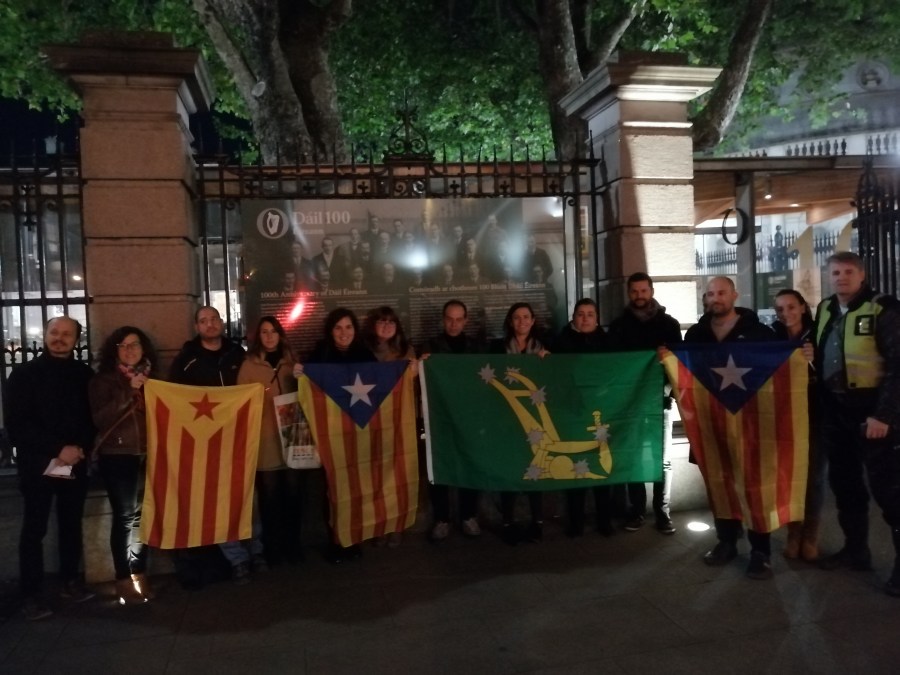
Section of Catalonia supporters in Kildare St. waiting to attend the Foreign Affairs Minister’s Question time.
(Photo: Rebel Breeze)

THE VOICES OF THE ESTABLISHMENT

This was Minister’s Question time, when Ministers (or their representatives) appear in the Chamber to answer questions about areas of the remit of their Departments and earlier, Ministers had been quizzed about areas of childcare, social care funding, local government funding ……

The Dáil chamber looked mostly deserted but in the public gallery sat a score of Catalans and some Irish, listening intently. Normally, these sessions are attended only by the TDs asking the questions and the relevant Ministerial spokesperson – and only for the question being asked. And of course also in attendance is the Ceann Comhairle, the presiding person acting as Chair – and secretaries. Sometimes by members of the media but by no means always, since reporters can monitor the televised broadcasts of the session.

The Minister’s reply on the question of Catalan self-determination delivered by Minister of State Helen McEntee TD followed a predictable pattern – predictable because it is so often trotted out: the Irish and Spanish Governments have a long history of good relations and friendly links, lots of Irish people go there on holidays, lots of people from there come to Ireland every year, Spain is a democracy, its constitution must be abided by, it would be wrong to interfere in its internal affairs. Inclusions to that in litany in recent times are that the question of Catalonia is emotive throughout the Spanish State and that Catalan society is divided over it, that the rule of law must be upheld and that violence has no place in politics.

The Fianna Fáil representative, Seán Haughey TD, echoed that line, adding also that the Spanish Constitution of 1978 is unitary and does not allow any part to become independent. He also quoted some survey results that he claimed indicated that support for independence was now in a minority among Catalans.

The Labour Party representative, Jan O’Sullivan TD, went further and specifically supported the present Government of her “sister party in Spain”, the PSOE and suggested that the “inflexible” previous government of Rajoy (of the PP) had helped to bring the current situation about and that Sanchez, the Prime Minister, would help calm the whole situation down. The only concessions she made were to suggest that the lengthy jail sentences were perhaps not the best way to deal with the issue and to include the police by mention in her call for “end to violence by all sides”. However, she went further than others in the Establishment parties with a specific condemnation of the jailed activists when she said that “it is not acceptable for politicians to lead citizens into conflict”.
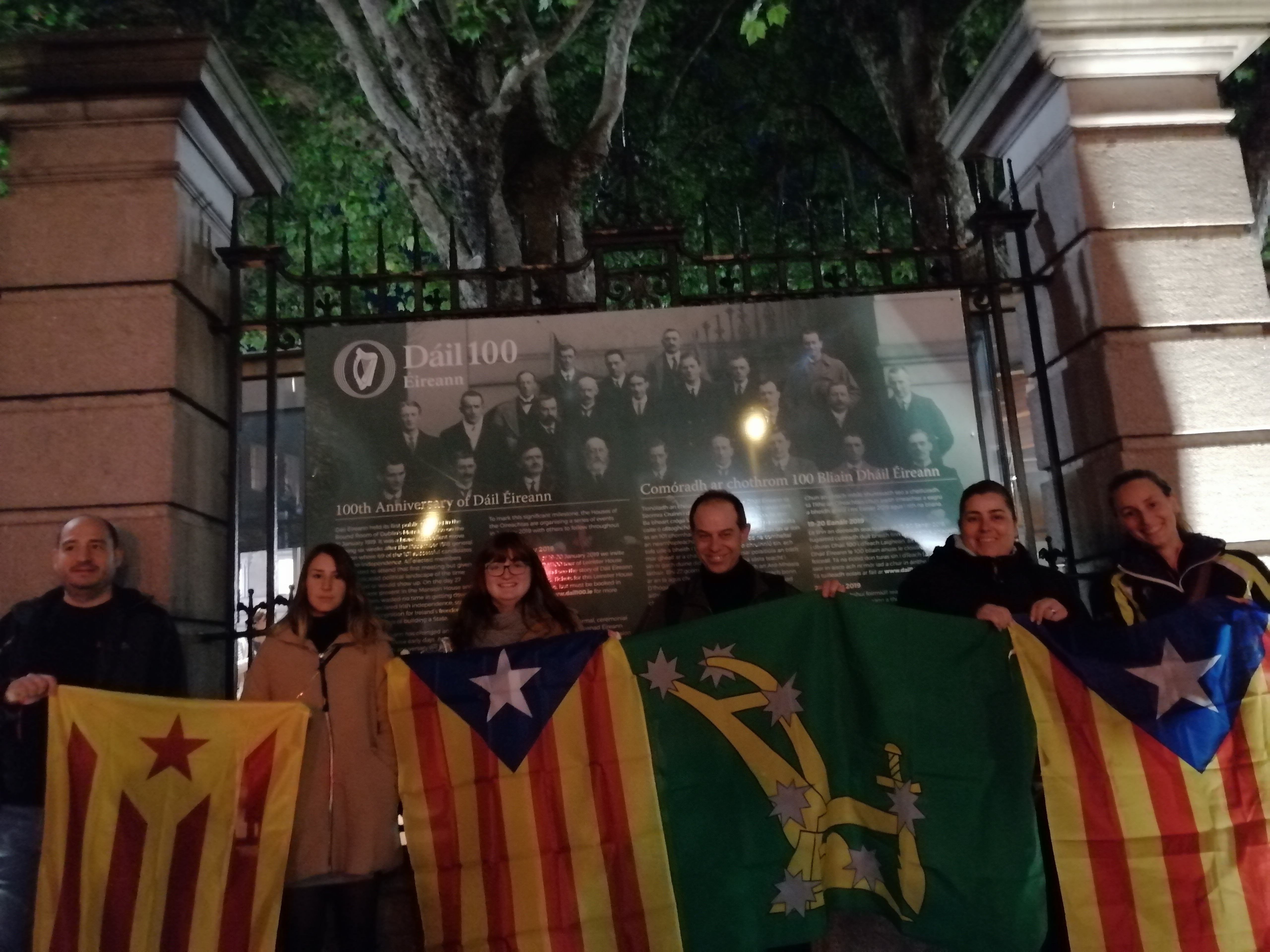
Early arrivals for the Minister’s Question time
line up in Kildare St. below a photo of the First Dáil 1919.
(Photo: Rebel Breeze)

THE OPPOSITION

“Reactionary Spanish nationalism”

          The first TD to speak in reply to the Establishment politicians was Eoin Ó Broin, a comparatively recent Sinn Féin Deputy (2016) for Dublin Mid-West. Ó Broin was in Catalonia as one of the international observers of the Catalan Referendum on Independence on 1st October, which was attacked by Spanish police with around 1,000 Catalans injured.1

Speaking about his experiences there, Ó Broin related his meeting with 83-year-old Antonio, bruised and with his fractured arm in a sling, beaten while trying to vote earlier that day, queuing again at a polling station in Barceloneta. The SF TD spoke about what he had seen there and the “increasingly reactionary Spanish nationalism”, then went on to list the elected politicians and their jail sentences. Denying it was an internal matter for Spain, Ó Broin said it was about human rights and required international independent mediation. The Dáil would be implicitly in collusion with the Spanish Government if it left the matter to internal resolution only.

“The working class are the incorruptible heirs …”

          Paul Murphy TD, a socialist activist2 who has recently left the Socialist Party of Ireland to form a platform called Rise, shared speaking time with Eoin Ó Broin. Calling for a “reality check” he said that jailing politicians and activists for organising a peaceful ballot could hardly be the work of a normal democracy. Responding to the Labour Party spokesperson with regard to the Spanish PSOE Prime Minister, he said that “Sanchez is in Government” and that he was “sending thousands of troops and police” to suppress the Catalan independence movement and mounting “a publicity campaign” to blame the convicted leaders.

The Spanish Government would one day come to be haunted, Murphy said, by the words of James Connolly in 19143 when he said:

“If you strike at, imprison or kill us, out of our graves or prisons we will still evoke a spirit that will thwart you, and perhaps, create a force that will rise up and destroy you. We defy you! Do your worst.”

Murphy said that the Catalan popular movement was impressive with their demonstrations, marches and the recent general strike. Against that, the Spanish police and army were carrying out “a campaign of terror” injuring hundreds and anyone who didn’t believe it only had to go on line and see the videos. “Francoism is baring its ugly head”, Murphy said and pointed out that the Spanish legal systems is riddled with a contempt for democracy, echoed by those at the top in the European Union.

The recent Catalan General Strike, according to Murphy, “showed the way forward” and he quoted again from Connolly, that “the working class are the incorruptible heirs of Irish freedom”. The Spanish State had a long history of suppression of national self-determination, including those of the Basques, Murphy said and the way forward would be for a voluntary socialist federation.

Catalan independence supporters gathering in Kildare St. waiting to attend the Foreign Affairs Minister’s Question time.
(Photo: Rebel Breeze)

“The judicialisation of politics”

          Next to speak was Thomas Pringle, Independent TD for Donegal since 2011, with a socialist Irish Republican background, a member of Sinn Féin for few years but who left the party in 2004. He opened his contribution by referring to “the judicialisation of politics” in the Spanish state and, in reference to the scale of the Spanish repression, mentioned the 700 Catalan town mayors who await judicial process due to their support for the Catalan Referendum in 2017.

Pringle said the Spanish Constitution purported to guarantee the rights of different people within the state, which would be a joke if the reality were not so grim. “The EU continues to ignore” what is going on in its member Spanish State, “as it did in the Six Counties,” he said.

“Catalonia in 2019 is Ireland  a century ago”

          “Self-determination is a human right,” said the next to speak: Peadar Tóibín, TD for Meath West since 2011, who left Sinn Féin in 2018 and went on to form Aontú in January 2019. Tóibín reminded all that the First Dáil had sent out a call to the world for recognition of Irish independence in 1919 and that most states had not done so then4.

“Catalonia in 2019 is Ireland a hundred years ago”, Tóibín said and went on to say that if the Irish Government remained silent on repression by the Spanish State then it shared culpability for it.

“ … a short memory in this House”

          “We sometimes have a short memory in this House” said Mattie McGrath when it was his turn to speak, a TD since 2007 who has been an Independent since he left the Fianna Fáil party in 2011. McGrath referred to the recent long war in the north-east of Ireland and said that conflict resolution process was the only way to resolve the issue.

McGrath referred to Clare Daly (elected MEP this year after being a socialist TD for some years) and her statements on the issue. “Self-determination is a fundamental human right”, McGrath said, and went on to speak about “the right of freedom of assembly”, which was under attack by the Spanish State.

“Ireland is a small island nation”, Mc Grath said, “very sympathetic to the rights of people” (apparently contrasting this to the attitude of the Establishment in the Dáil).

In the time allowed by procedure for final response from the Minister, her representative reiterated the position she had outlined earlier and, though she conceded that most of the Catalan demonstrations had been peaceful, said that some recent “scenes of violence” had been “of concern”.

Section of Catalonia supporters in Kildare St. waiting to attend the Foreign Affairs Minister’s Question time. Behind them, enlarged photo of the First Dáil, 1919.
(Photo: Rebel Breeze)

COMMENT

Fianna Fáil‘s origins are in the split with Sinn Féin led by De Valera in 1926 over the question of taking seats in the “partitionist” Irish parliament, the Dáil, and rapidly became the preferred party of the native Irish capitalist class, having been in government since more than any other Irish party.

The origins of Fine Gael, currently in minority Government at the tolerance of Fianna Fáil, has its origin in the setting up of the Irish State after the War of Independence and represents the victors of the Civil War against the Republicans. It was composed of a coalition of a right-wing Irish Republican party (followers of Michael Collins, Griffiths etc), a small right-wing farmer’s party and the fascist Blueshirts (a name by which FG are still often called by their enemies).

Hard to believe today, the Irish Labour Party was founded by, among others, James Connolly and is the oldest of the three parties. A progressive party in the early days, it was not a participant in the Civil War, during which its representatives criticised the Free State Government about its abuse of civil rights, repression, large-scale arrests, internment without trial, torture and murder. Over the years it lost more and more of its socialist credentials and has been in coalition government with the right-wing Fine Gael on two separate occasions. The main trade unions in Ireland retain connections to the Labour Party, with the possible exception of the rapidly-growing British-based UNITE.
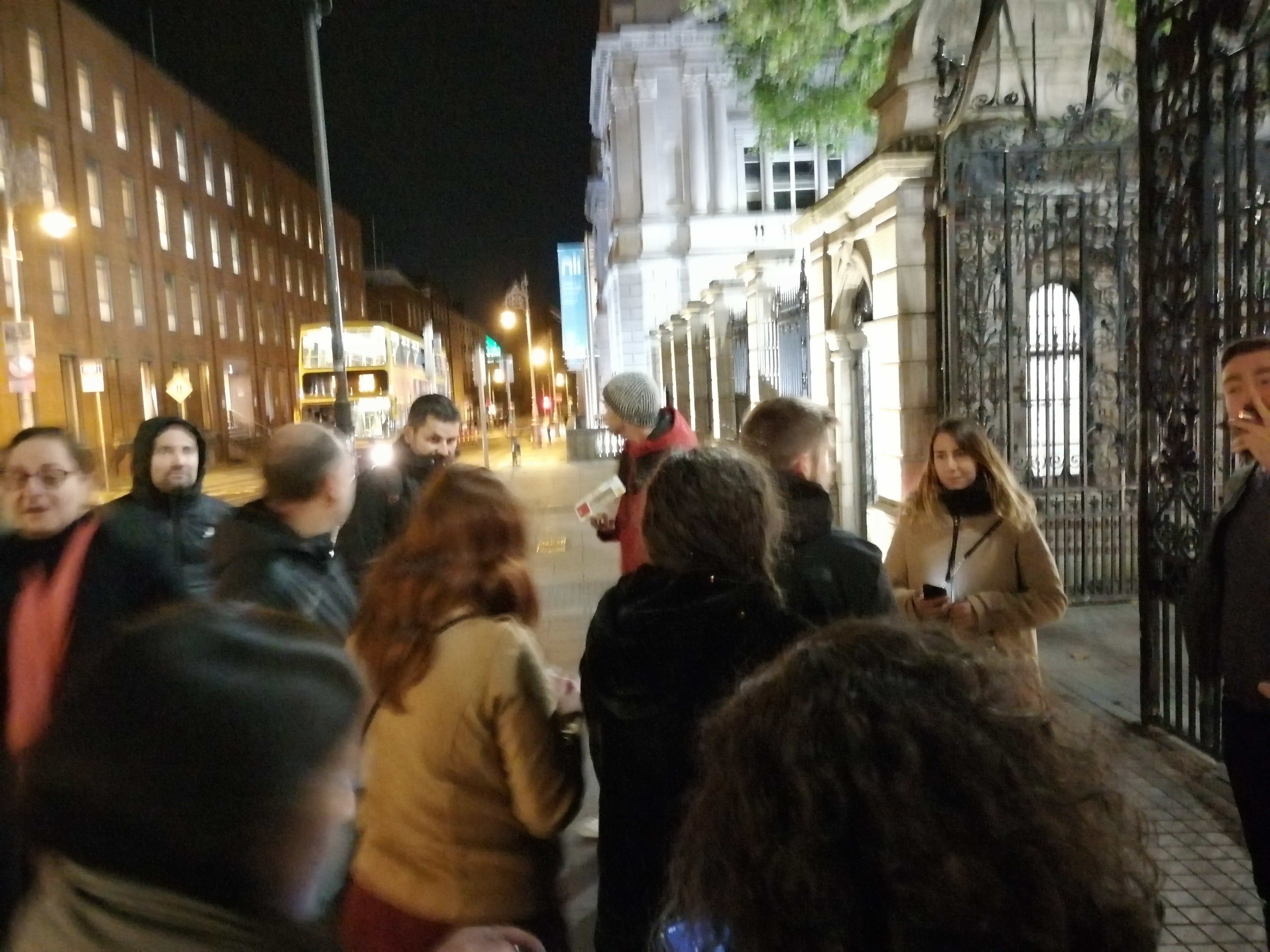
(Photo: Rebel Breeze)

The supposed inviolability of the Spanish Constitution of 1798 is one of the questions at the heart of the matter. The boast of the Spanish Government and its supporters abroad is that the majority of the people within the Spanish State voted for it. Well, so they did, except in the Basque Country – but what of it? If in a wedding, one of the partners says “I do”, does that mean that person is forever forbidden from leaving? Do we not have the right to divorce acknowledged now in most states around the world and certainly in “the democracies”? If one agrees to join a club or organisation, does that mean one can never choose to leave? Well, maybe in the Mafia, or the Cosa Nostra ….

Furthermore, that monarchist Constitution was put forward to a population that had endured four decades of fascist dictatorship, with the collusion of the allegedly socialist and republican PSOE and the allegedly communist and republican Communist Party of Spain, restraining their trade union and party members in the wave of state repression and murders during the Transition to “democracy”. Isn’t there something about the invalidity of agreements made under duress?

The issue of non-interference in the internal affairs of another state is a bogus one, since all governments do that at one time and another and Irish governments and political parties are no exception. In 1936, the representatives of Fine Gael loudly supported the military-fascist uprising led by Franco against the democratically-elected Government of the Spanish State. The Irish Government of Fianna Fáil did nothing to prevent the Blueshirts going off to fight for Franco and the Bishops of the Irish Catholic Church blessed them as they sailed off. The reality is that states that agree with one another generally do not interfere in one another’s internal affairs.

The constant mantra of reference to “the rule of law” and the condemnation of “violence in politics” is not only an irrelevance but turning truth on its head. It was not illegal according to the Spanish Constitution or laws to hold a referendum on independence 5. It is also against the Spanish law to use violence against others and even the police are not legally empowered to do so except in self-defence or in defence of others. On October 1st the actions of the Spanish police had 1,000 people requiring treatment and another few hundred have been injured in recent days. The Internet is full of videos of different incidents of gratuitous Spanish police violence, often the perpetrators showing no fear of being filmed – clearly because Spanish (and more recently, Catalan) police know they have impunity. Recently, however, it seems that some Spanish police have become sensitive to being filmed during their violent acts and have begun to target photo-journalists, both with personal violence and with rubber bullets.

A total of five people have now lost an eye from the impact of the rubber bullets of the Spanish police. Apart from the fact that these are banned in Catalonia, the bullets are supposed to be fired to ricochet and not directly at people, nor are they supposed to be fired at close quarters. Clearly, the rules are not being adhered to and nobody is enforcing them, granting impunity to the Spanish police.

When the representative of the Minister for Foreign Affairs acknowledged the overall peaceful nature of Catalan independence demonstrations but expressed concern over some recent scenes of violence, what was she really saying? It was this: that the violence of the police against the peaceful demonstrators could continue but the victims using force in defence or in retaliation is a cause for concern!

End.

FOOTNOTES

1  Eoin Ó Broin, often described as on the (small) left wing of Sinn Féin (a wing badly needed by that party) has in the past had relations with the Abertzale Left in the Basque Country and wrote a book on the movement there in his time, Matxinada – Basque Nationalism and Radical Basque Youth Movements. He is also author of Sinn Féin and the Politics of Left Republicanism.

2  Paul Murphy has been, while a Socialist Party TD, dragged by police out of a housing protest and with others faced serious charges arising out of a protest about Irish water against a Labour Party Minister, of which he and the others were acquitted by the jury after an infamous trial. He remains in the PBP-Solidarity parliamentary coalition.

3  James Connolly (1868-1916) was at that time active in the Irish Labour Party and leader of the Irish Transport & General Workers’ Union, which was struggling to recover from an 8-month fight against a group of employers that had set out to crush the union (Dublin Lockout). Connolly was a revolutionary socialist, republican, journalist, historian, author and organiser and was horrified by the very idea of the First World War which began in 1914. He was shot dead by British firing squad, along with other leaders and some others of the 1916 Rising.

4  This reference seems particularly appropriate. In January 1919 the majority of MPs elected in Ireland in the UK General Elections of December 1918, carried out the “Sinn Féin” platform’s election promise not to go to Westminster and convened a parliament in Dublin. This is known as “The First Dáil” even by the Irish State, which numbers its parliaments from then onwards. The First Dáil declared independence and called on the states of the world to recognise Irish independence (see References) but only the young USSR did so. Ireland had no legal right under British law to break away from the UK unless it were agreed by majority in Westminster (where the Irish MPs would always be outnumbered by the British). The First Dáil was banned by the British in September of that year and its members were arrested if they could be found.

5  Though possibly the declaration of Republic was – but that was suspended in less than five minutes.

REFERENCES & FURTHER INFORMATION

Clip of Eoin Ó Broin TD reply: https://www.facebook.com/EoinOBroinTD/videos/1138199326378630/

Clip of Paul Murphy TD reply: https://www.facebook.com/paulmurphytd/videos/424540844872189/?t=11

Clip of Thomas Pringle TD reply: https://www.facebook.com/ThomasPringleTD/videos/416766079224197/

Clip of Peadar Tóibín TD reply: https://www.facebook.com/740004202875853/videos/738458029959798/?t=124

(currently seeking remaining TD, also footage of the whole debate)

Text of all contributions to the debate: https://www.oireachtas.ie/en/debates/debate/dail/2019-10-22/34/

First Dáil’s Message to the Free Nations of the World: https://en.wikipedia.org/wiki/Message_to_the_Free_Nations_of_the_World

Some organisations of Catalan solidarity in Ireland:

ANC Ireland: https://www.facebook.com/IrlandaPerLaIndependenciaDeCatalunya/

CDR Dublin: https://www.facebook.com/CDRDublin/

With Catalonia/ Leis an Chatalóin: https://www.facebook.com/WithCataloniaIreland/
BASQUE DEFENDANTS PLEAD GUILTY IN EXCHANGE FOR LIGHTER SENTENCES – Spanish State avoids fighting on two fronts

Diarmuid Breatnach

(Reading time: 10 minutes)

The idea of having to fight a war of repression simultaneously against two or more nations within the borders of its state must give the Spanish ruling class nightmares – it was only successful in doing so in the Spanish Anti-Fascist War with the assistance of Nazi Germany and Fascist Italy.

So Spain’s rulers, blood-thirsty though they are, must have been happy to let off lightly the Basque pro-independence activists with a maximum of less than four years prison sentence. Not of course that three years in Spanish jail is a holiday, especially for political prisoners, who tend to get dispersed throughout the Spanish territory, hundreds or even a thousand kilometres from their friends and families – but it is way below the norm for activists accused of “assisting terrorism” in the Spanish state.

Most activities of the Basque pro-independence activists have been viewed by the Spanish State as “terrorism”, “assisting terrorism” or “exalting terrorism” at one time or another: producing a daily newspaper in the Basque language; running pro-independence radio stations or social media pages; managing pro-independence social centres; holding demonstrations and pickets; managing a prisoners’ solidarity campaign; organising an internationalist solidarity network1; commemorating martyrs; publicly welcoming political prisoners home after completion of their sentences; running pro-independence bars ….. etc, etc.

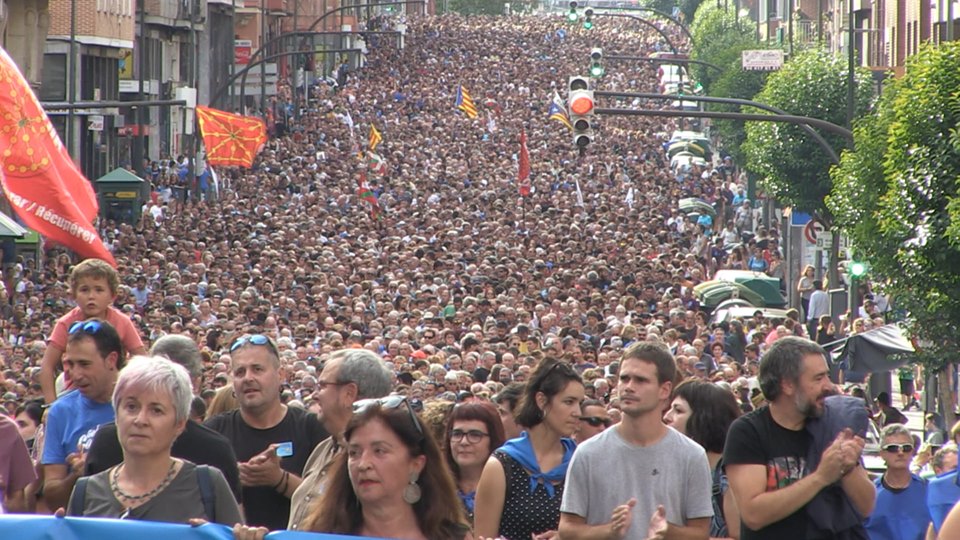
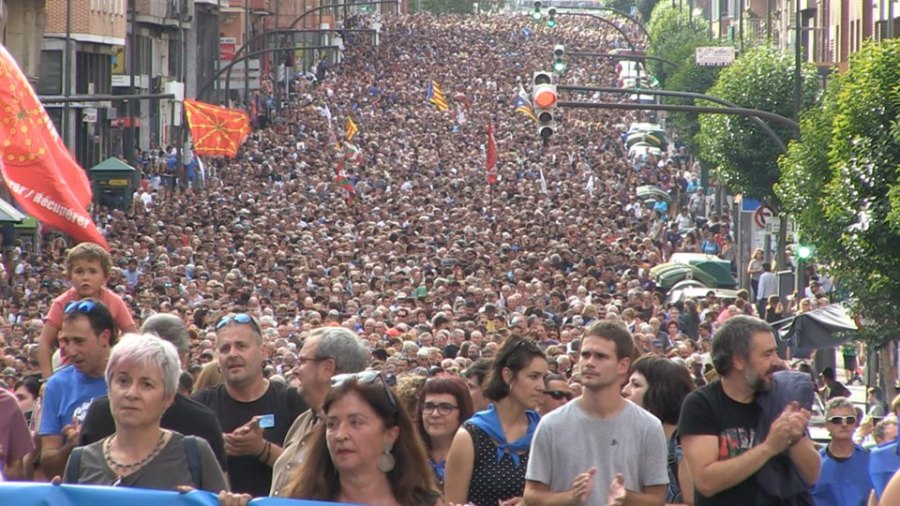
Huge demonstration in Bilbao on 14 September in solidarity with the 47 accused activists. Two days later, the accused pleaded guilty for lighter sentences.
(Photo source: Ahotsa) 


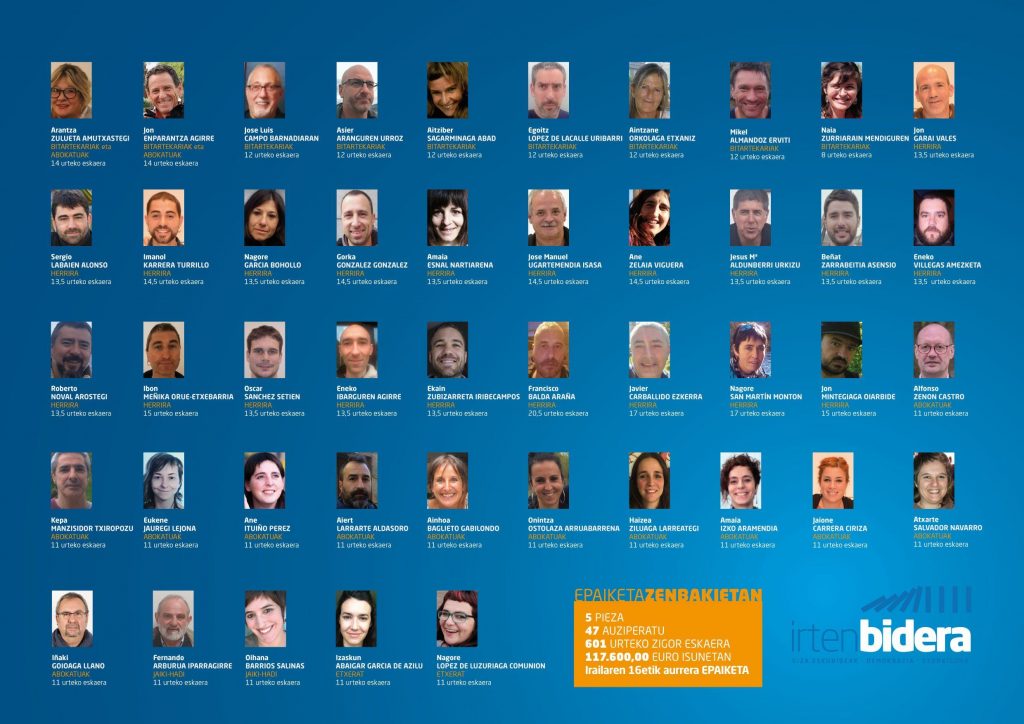
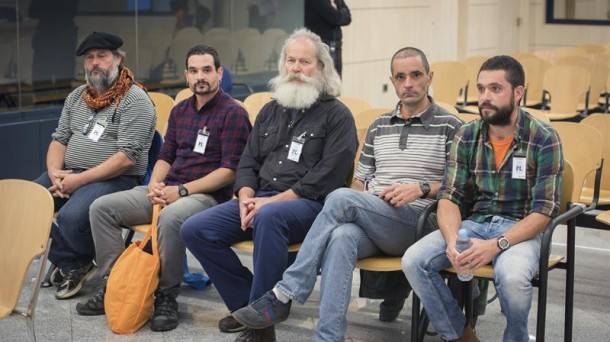
The Basque pro-independence activists before the Spanish National Court on 16th September had been accused in November 2013 of “assisting a terrorist organisation” but what they had done in actuality was to try to organise effective solidarity and legal representation for the Basque political prisoners who are part of the ‘official’ list2. Some of those charged are lawyers. All 47 of them in court on 16th September pleaded guilty and the judges handed down the sentences. It was clear that a deal had been agreed with the Public Prosecutor and Judge before they stepped into the Court. But not only with them – the virulent AVT (“Relatives of Victims of Terrorism”), most of them relatives of Spanish military or police, who were a party to the prosecution of the Basques3, stayed silent but afterwards stated they were happy with the outcome.

Reporting on the judgement, GARA, bilingual daily newspaper of the line of the official pro-independence movement’s4 leadership, seemed to see the settlement, despite the jail time, as some kind of victory and proclaimed that the proceedings had taken “not even five minutes” (perhaps the reporter meant per person, as the total was elsewhere reported as taking around 35 minutes).

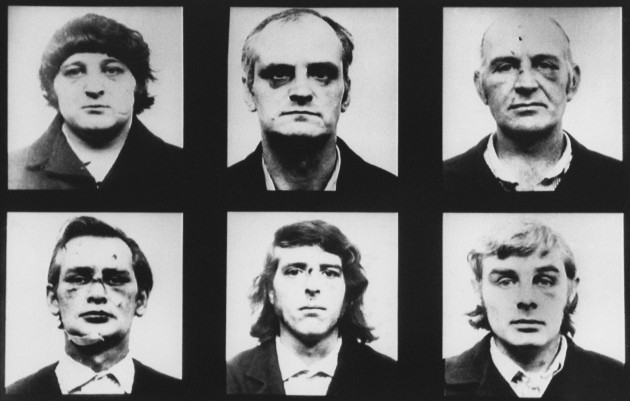
Faces and names of the accused in solidarity publicity issued days before the court case (Image sourced: Internet).

“SUPPORTERS WERE TRICKED …. SHAMEFUL”

          That is not how all Basque pro-independence activists see it, however. Discussing the case with one long-time activist she commented that “It was shameful. It was hard. I knew them, some of them especially. I had campaigned with them in the past and we had campaigned for them (after their arrest). To see them meekly plead guilty ….!” She might be expected to be critical as she is what some call a ‘dissident’, having parted company with the organisation with which she grew up and is now a member of Amnistia Ta Askatasuna (ATA — Amnesty and Freedom). That organisation that same day issued a statement in Basque and Spanish condemning the deal, stating that pleading guilty actually criminalised all the work done in solidarity with and to assist the prisoners on all fronts.

That the Basque ‘Autonomous’ Government moved within weeks to ban as criminal acts any public welcoming home of Basque political prisoners seems to bear out their analysis.  And the Spanish State has announced that no electoral publicity in the forthcoming elections may use the words “political prisoners” or “exiles”.

Another life-time activist with whom I spoke, this one still loyal to the leadership, agreed that the deal and the act of pleading ‘guilty’ was “shameful”. She is not likely to be the only one; many remain within the organisation but are critical of the leadership’s twists and turns for some years now. Those who are critical but remain inside the organisation and are still active do so because they don’t like the alternative – either the fact of leaving the ‘family’ or of going to the ‘dissident’ group. But apathy grows among others – they may remain notionally within the organisation but attend less events than they used to.

A veteran and leading theoretician of the movement, Iñaki Gil de San Vicentes, in an interview with on-line newspaper Noticias Canarias, commented that the 50,000 who had demonstrated in solidarity with the accused a few days before the court case had been tricked, as the deal had been done “behind their backs”. This was “not permissable”, according to the veteran activist, who was not reported in GARA and might not be published there again.

GARA and the leadership of the Basque pro-independence movement may see the court deal as a good one or even part of the “Basque peace process” for which they have long been waiting (and some even claiming it was already in existence). Whatever the criticisms of the “Irish peace process” (sic) people may have – and there have been many – once the weapons had been decommissioned and they signed up to the Good Friday Agreement, at least most of the Republican prisoners left the jails, albeit under licence. The Basque armed resistance group ETA called a truce in 2012, decommissioned its weapons and finally disbanded itself in 2014, for which it seems to have won not the slightest of concessions – not for the prisoners nor for Basque pro-independence society. In 2017 a brawl in the town of Altsasu (Nafarroa/ Navarra) in a late-night bar between some Basque youth and off-duty Spanish police resulted in jail sentences for the accused youth and, even though the judges had rejected the Public Prosecutor’s bid to have the youth tried under anti-terror legislation, they were condemned to terms of between two and 13 years (reduced this week on appeal to between 18 months and nine years).

The five leading activists of the Basque internationalist organisation Askapena, also accused of “assisting terrorism”, pleaded Not Guilty and defended their actions. They walked free of charges in 2016.

NEUTRALISING ONE FRONT BEFORE MOVING ON TO ANOTHER

          The Altsasu case generated outrage throughout the Basque Country but also came to the notice of the Catalan public when they were dealing with the effects of Spanish repression on their own independence movement during and after the October 2017 referendum there. Catalan people with a banner proclaiming their solidarity with the Altsasu youth marched in Basque demonstrations. And Basques have marched in Catalan pro-independence protests against Spanish State repression too. Though the numbers displaying solidarity in each case were comparatively small, the potential was there for a coming together of both movements and no doubt the Spanish ruling class, though not noted for its political sensitivity, became aware of the danger.

As commented earlier, the Spanish ruling class were no doubt wishing to avoid having to renew a war of repression against the Basques at the same time as their current war against the Catalan independence movement. Even worse things could happen to them while engaged in such a two-front war – such as elements in other nations, like Asturias and Galicia seizing the opportunity to mobilise. Or some outbreak of class resistance across the State’s territory.

In the recent Basque case, the Spanish State, while punishing the Basque activists, did so in a comparatively light manner and avoided that case being shouted in both Basque and Catalan nations as yet another example of Spanish State injustice and repression. But it required the cooperation of the accused activists – and no doubt the agreement of the official leadership of the Basque pro-independence movement, Arnaldo Otegi and company.

As I was writing these observations, the Spanish State arrested nine Catalan activists under “anti-terrorist” (sic) legislation and held them incommunicado in Madrid5. These activists allegedly from the CDRs (Comites de Defensa de la Republica, set up after the momentary declaration of the Catalan Republic by then President Puigdemont after the 2017 October referendum) are in addition to those 10 grass roots activists and elected politicians currently awaiting verdicts on charges of “rebellion, sedition” and “misuse of public funds”. In addition also to the various Catalan elected politicians in European exile and the 700 or so town mayors under investigation. The more recent Catalan arrested are not charged with anything they have done but with their alleged intentions.

Now that Basque problem has been tidied away ….

end.

FOOTNOTES:

1 Leading activists of Askapena, which coordinated the activities of solidarity committees in a number of European countries (including Ireland) and Latin America, were accused as part of the sweep against Basque political prisoner solidarity campaigners. They did not plead guilty, fought their defence and were, eventually, found not guilty.

2 Which some have left, including six who did so publicly and are now part of a ‘dissident’ network.

3 The Spanish legal system permits civil society groups to take out a prosecution or to join the State prosecutions with their separate prosecutors, a provision almost exclusively availed of by right-wing groups such as the AVT. When the family of Inigo Cabacas took a case under this provision against the Basque police who had killed their son with a rubber bullet, the Basque Government’s Prosecutor had cooperated with the defence counsel of the accused.

4 The ‘official’ Basque pro-independence movement is comprised of the political party EH Bildu (formerly Batasuna, Herri Batasuna etc), the official political prisoners’ collective, the official organisation of relatives and friends of prisoners, the Gara newspaper, LAB trade union and smaller feminist and ecological organisations. It is also represented in some political coalitions and a number of broad fronts.

5  Two of the nine arrested were released the following day and seven remained incommunicado. This nightmare journey to Madrid for political detainees has been well documented by many Basque political prisoners, including threats of death, torture and even rape (the latter for female prisoners), stress positions causing difficulty in breathing within the vehicle, blows etc. Spanish “anti-terrorism” (sic) legislation permits as standard up to five days without access to the detainees’ lawyer, doctor or family and despite EU Committee Against Torture criticism, the practice continues. “Confessions” tend to be extracted after two or three days, which the prisoners withdraw as soon as they are in court and out of the hands of the police, alleging water torture, forced stress positions, threats to self and family, sleep deprivation, etc. As a matter of course, the judges ignore the allegations without ordering even a cursory investigation and proceed as though the “confessions” were voluntary and factual.

BRIGADISTA PETER DALY COMMEMORATED IN HIS HOME TOWNLAND

(Reading time: 20 mins)

Clive Sulish

SPEAKERS WARN OF RISING FASCISM, CALL FOR UNITY OF ANTI-FASCISTS

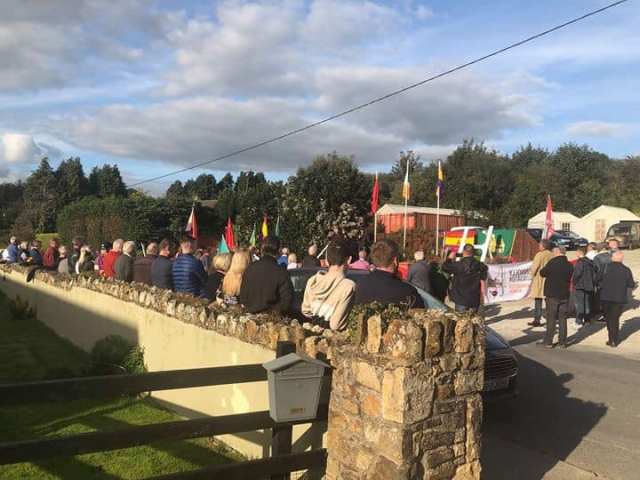
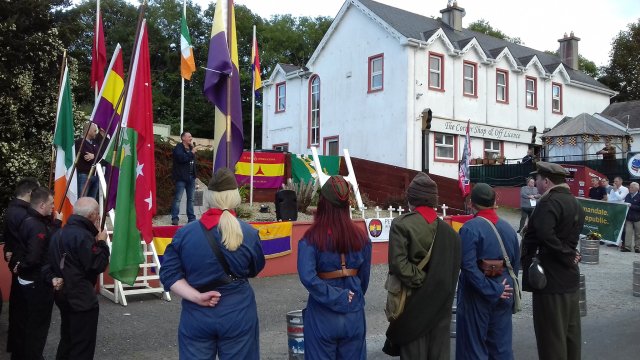
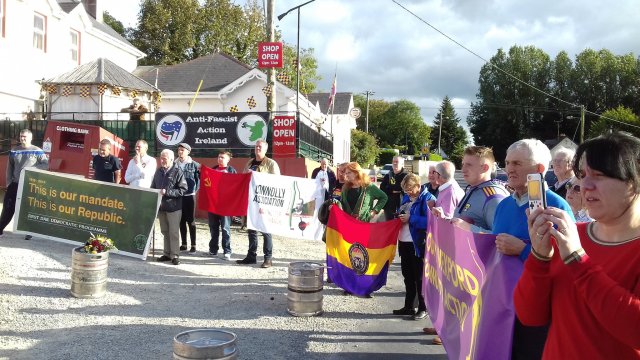
          Flags of various kinds flew above a gathering in Monagear, Co. Wexford on Saturday 7th September, while a number of banners were visible among the crowd: Peter Daly Society, Connolly Association Manchester, Wexford Community Action, Anti-Imperialist Action Ireland, Friends of International Brigades Ireland, Éirigí, Connolly Column. Also in attendance was a group of young men and women dressed to represent the International Brigaders and the POUM1 milita, organised by the Cavan Volunteers group. The event had been organised by the Peter Daly Society with support from the Peadar O’Donnell Forum.

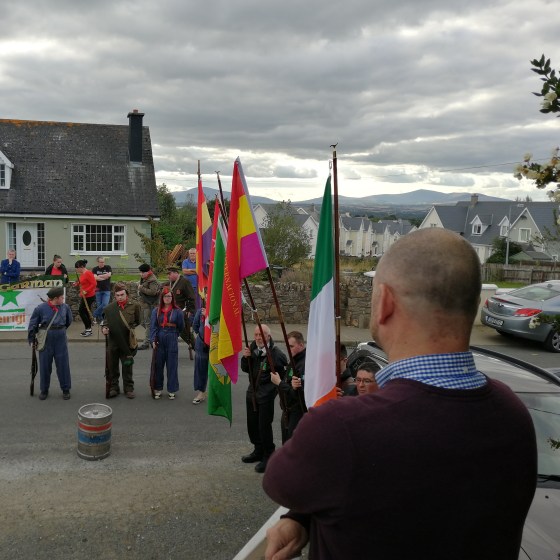
Monagear Commemoration from behind wall
Long view of Peter Daly commemoration seen from the back (Photo source: Peter Daly Society)
moin-na-gcaor-1798-banner.jpg
A reminder of even older struggles — banner inside the Monageer Tavern. (Photo source: D.Breatnach)

Monagear is a small village in the centre of Co. Wexford, a few kilometres north-east of Wexford town. Also known a Monageer, both words are, like most place-names in Ireland, from the original Irish language: Móin na gCaor, “the bogland of the berries” (probably of the Rowan or Mountain Ash, which in Irish is Crann Caorthainn). Not far from it are the historic place-names associated with the United Irishmen uprising of 17982 in that county, such as Boolavogue and Enniscorthy and indeed, a small commemoration garden in the village has memorial stones dedicated to that struggle and to others since.

sdr
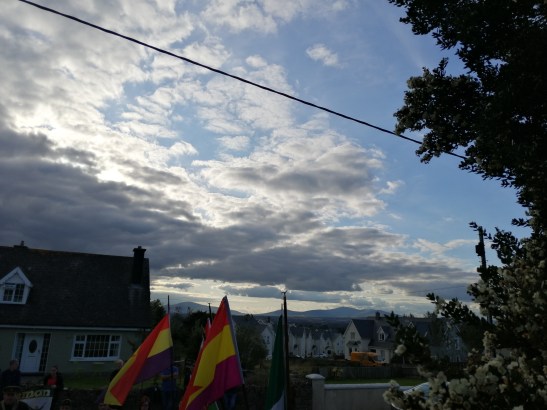
View in a cloud-darkened moment over the crowd, past the new houses in the village and to the hills and mountains in the distance. (Photo source: D.Breatnach)

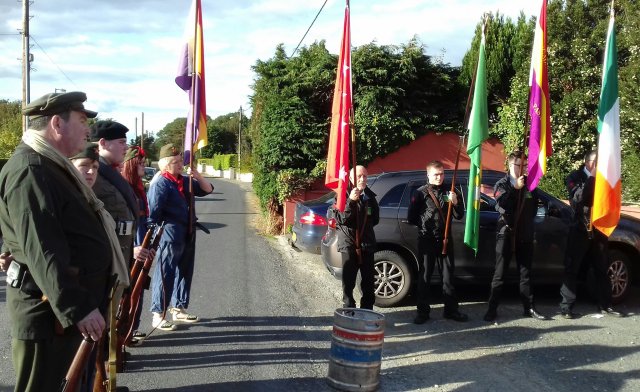
At a signal, the gathering of people with flags and banners, led by a colour party flying the Irish Tricolour, the flag of the 2nd Spanish Republic, a red starry flag and the Irish workers’ Starry Plough, moved in procession down into the village area and assembled outside the raised platform containing the tasteful simple memorial to Peter Daly, International Brigader killed in the War Against Fascism in the territory of Spain (1936-1939).

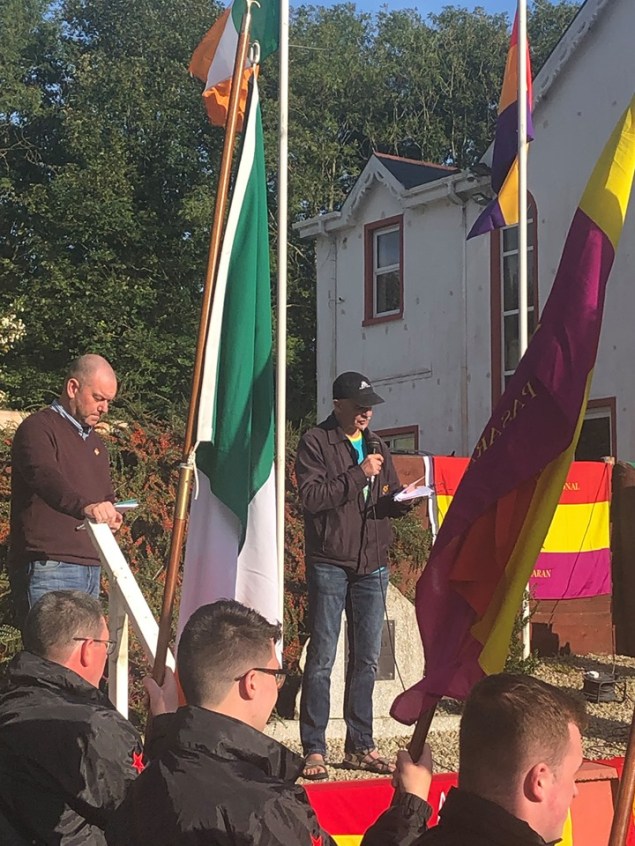
Steve McCann, Chairman of the Peter Daly Society, with another man beside him, opened the ceremony from the memorial platform by briefly outlining the history of the Peter Daly commemorations and of the Society (founded in 2011) which he said had from the beginning welcomed the involvement and participation of Irish Republicans, Communists, Socialists, Anarchists and plain anti-fascists. After outlining the program of speeches and songs for the day, he called Gearóid Ó Machaill to give the first speech, on behalf of the Friends of the International Brigades, Ireland.

sdr
Steve McCann addressing crowd with colour party and reenactment group visible below (Photo source: D.Breatnach)

“THE IRISH ARE NOT IMMUNE TO FASCISM”

          Ó Machaill opened his speech in Ulster Irish, thanking the organisers for giving him the opportunity to speak there at the cradle of Peter Daly, Irish Republican, socialist, anti-fascist. Continuing, he said that the conditions that gave rise to fascism in the 1930s are very similar to those of today. Speaking of the Republican Congress of 1936-1938, he said it had worked to overcome divisions in the working class and in the anti-imperialist movement. But it had fallen apart in disunity, unfortunately and in Ireland today, the anti-fascist forces are as divided too.

The Irish were not immune to fascism and had a strong fascist movement in the 1930s, supported for awhile by the State, X said. In the years since the defeat of fascism around most of the world, attempts to set up a fascist movement in Ireland had been smashed, said Ó Machaill but cautioned against complacency.

In some other parts of the world, workers betrayed by social democracy and hurt by capitalism, turned to hard right parties and outright fascists and it was entirely possible that such fascists would become popular while leading a campaign against bankers and even imperialism, pushing a line of “Irish for the Irish”.

“We cannot afford the divisions and need to unite ….. as Republicans and Socialists did in preventing the attempted launch of Pegida in 2016,|” said the speaker.

Colour Party & side view Militia GOM
Colour Party facing photographer, POUM and Brigader reenacters to the left. (Photo source: G. Ó Machaill)

MIGRANT DEPORTEES

          Steve McCann introduced the man beside him as Diarmuid Breatnach and called him to sing the first song of the selection for the ceremony and to say a few words about its content. Breatnach pointed out that migrants are often a prime target of fascists and the song he was to sing was about migrants and their treatment. On 28th January 1948, a DC-9 transporting Latino illegal migrants and “guest workers” crashed in the Los Diablos region of California and all 32 on board were killed. The radio news reported the crash but only gave the names of the crew members and the Immigration Department guard, saying the others killed were “deportees”. The names of the dead were known in their localities and were printed in local newspapers but were not deemed worthy of mention on the radio.

DB Reading Intro Song Platform Peter Daly Monageer Sep 2019
Diarmuid Breatnach reading introduction before singing a song. Steve McCann is standing to the left of the photo on the stage. (Photo source: Ado Perry)

Wood Guthrie wrote a poem called “Deportee” about the tragedy which was put to music by Martin Hoffman, the song since called Deportees or Plane Wreck at Los Gatos. Breatnach then sang the song, the chorus of which says:

Goodbye to my friends,

Farewell Rosalita

Adios mis amigos, 

Jesús y Maria;

You won't have a name 

When you ride the big airplane --

All they will call you 

Will be “deportees”.

LESSON OF HISTORY – NOT LIBERALISM BUT ROBUST ACTION IS NEEDED

          Mags Glennon was called to read a statement on behalf of Anti-Fascist Action. Moving on from the background to the fascist upsurge of the 1930s and the background of those who fought to defeat it, Glennon read: Far-right parties have risen from minor subculture to government across Europe in recent years, showing the glaring need for principled and active opposition to fascist and far right forces. The most concerning aspect of this political resurgence is the support it has received from young people and large sections of the traditional working class, due to the abandonment of these people by social democrats, and other parties who claimed to ‘represent’ them. Well meaning liberalism has never defeated fascism. It never will.”

Reading from the statement, Glennon called for a “re-energising” of the struggle to defeat those “aiming to distract our communities and young people from fighting their real enemy. Where there are fascists we must oppose them.”

Glennon concluded by reading: “Appeals to the police, to parliament or to Google to censor fascists have no place in anti-fascist struggle. History has shown that robust action against fascists in Ireland has always sent them running back to the gutters to think again. Long may it continue. La lucha continua!

Militia GOM
POUM militia and International Brigader reenacters seen from behind, centre photo. (Photo source: G. Ó Machaill)

“MUST ORGANISE IN WORKING-CLASS COMMUNITIES”

          The MC, Steve McCann, introduced the anti-fascist and community activist as well as Independent Dublin City Councillor, Ciaran Perry. Speaking without notes, Perry outlined the historical necessity of defeating fascism politically and physically.

Echoing a previous speaker’s comments, Perry too called for unity of the antifascist forces against fascism but also against capitalism and imperialism. He said that working-class communities, betrayed by social democracy and distracted by identity politics, had become prey to the propaganda of fascists.

ciaran-perry-speaking.jpg
Ciaran Perry speaking

Fascism is a facet of capitalism”, Perry said “and therefore the enemy of the working class.  The working class should be our natural constituency.”

Going on to suggest that if fascists build bases in working class communities it is because of the failure of the Left, he called on socialists and antifascists go into those communities and to build their bases there.

ESCAPE FROM DACHAU AND DEATH IN SPAIN

          Breatnach stepped forward to sing a combination of two songs from the German side of the anti-fascist struggle. The German political prisoners in the concentration camps were forbidden to sing socialist songs and had written their own, one of which became famous around the world was The Peat Bog Soldiers, lyrics written by Johann Esser, a miner and Wolfgang Langhoff, an actor and melody composed by Rudi Guguel.

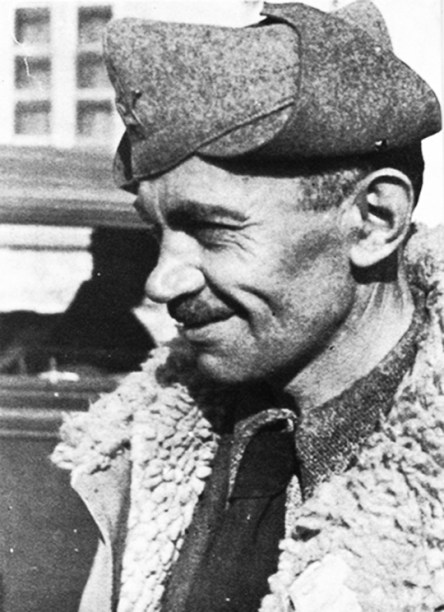
“Hans Beimler (1895-1936) was a WWI veteran, a Communist, a Deputy elected to the Reichstag in 1932,” said Breatnach. “In January 1933 Hitler came to power in Germany. The Communist Party was banned and in April 1933 Beimler was arrested and sent to Dachau extermination camp where, in May, he strangled his SA guard and, putting on the man’s uniform, escaped. He went to Spain where he was a Commissar with the International Brigades and was killed in the Battle of Madrid on 1st December 1936.”

He would sing two verses of the Peat Bog Soldiers, Breatnach explained, combined with the Hans Beimler song.

Hans Beimler Photo Spain maybe
Photo of Hans Beimler, WWI veteran, Communist, escapee from Dachau, International Brigader, killed in the Battle of Madrid 1936.                      (Photo source: Internet)

“THE NORM WAS FOR ALL CAPTURED INTERNATIONAL BRIGADERS TO BE EXECUTED”

          The sun sinking towards the west shone over the heads of the attendance on to the raised bed of the memorial stone and its flagpoles and, except when covered by clouds, into the eyes of those on the platform. Outside the nearby pub some locals gathered and behind those gathered around the monument, others in attendance lined a low wall while nearby other local people, mostly youth, congregated for a time. Occasionally a passing car drove carefully along the street past the crowd. House martins darted above, a wasp occasionally bothered the speakers and the smokey-blue soft curves of the Silvermine Hills and Knockmealdown Mountains rose to the west.

Harry Owens Speaking
Harry Owens speaking from the platform (Monagheer Tavern to the right of photo)

The Chair of the event called Harry Owens to speak.

Harry ‘s speech traced the history of world events that had led up to the fascist coup and war in Spain. He also spoke about the kind of people the Brigadistas had been, quoting from their comrades, journalists and opponents. That Captain Frank Ryan had his life spared was unusual, he explained, as the tendency was for all anti-fascist officers to be executed and all International Brigaders of all ranks. Whilst the Spanish fascists wanted to execute them, the Italian soldiers tended to keep them alive in order to exchange them for Italian prisoners of the Republican side.

The death toll among officers and men in the International Brigades had been higher than the norm in warfare and the average in the Irish contingent higher still, Owens said. The food and armament supply conditions of the Republican side had been poor in many areas but almost to a man they had fought on until death, capture or demobilisation. It was their conviction, that they knew what they were fighting for and believed in it that accounted for that.

After Owens’ speech, Breatnach stepped forward to sing, without introduction, Viva la Quinze Brigada3 (the song written by Christy Moore about the Irish who fought in the 15th International Brigade). The song mentions Peter Daly in the verse:

This song is a tribute to Frank Ryan,

Kit Conway and Dinny Coady too,

Peter Daly, Charlie Reagan and Hugh Bonner,

Though many died, I can but name a few.

Danny Doyle, Blazer Brown and Charlie Donnelly,

Liam Tumlinson, Jim Straney from the Falls,

Jack Nalty, Tommy Patton and Frank Conroy,
Jim Foley, Tony Fox and Dick O’Neill.

The words of Moore’s chorus rang out along the street:

Viva la Quinze Brigada!

No Pasarán!” the pledge that made them fight;

Adelante” is the cry around the hillside,

Let us all remember them tonight.

…. and concluded with the cry “Viven!” (“They live!”)

WREATHS, THE INTERNATIONALE AND AMHRÁN NA BHFIANN

          McCann called for those who wished to lay wreaths on behalf of organisations and the following came to lay floral tributes: John Kenny, activist of the Peter Daly Society; Mags Glennon for Anti-Fascist Action; Seán Doyle for Anti-Imperialist Action Ireland (who had provided the colour party); Connolly Association Manchester; and Gary O’Brien for Éirigí. Messages of support had been received from the CPI, IRSP and the Connolly Association Manchester.

Closeup Peter Daly Monument & Wreaths
Closeup of Peter Daily memorial with floral tributes laid. (Photo source: Peter Daly Society)

McCann then called Breatnach forward to sing the Internationale, the international anthem of the working class, the lyrics of which Breatnach explained had been composed by Anarchist Eugene Pottier of the Paris Commune, in 1871, the first time the working class had seized a city. It had been written to the air of the Marsellaise but later put to its own melody by worker-composer Pierre de Gayter.

“It was written in French”, said Breatnach, “which is why I propose to sing the chorus once in French at the start but it has been translated into many languages. Youtube has a post with 95 translations ….. and there are at least three versions of it in English and people are welcome to sing along in any version they know,” Breatnach concluded before singing the French chorus, followed by two English verses and chorus.

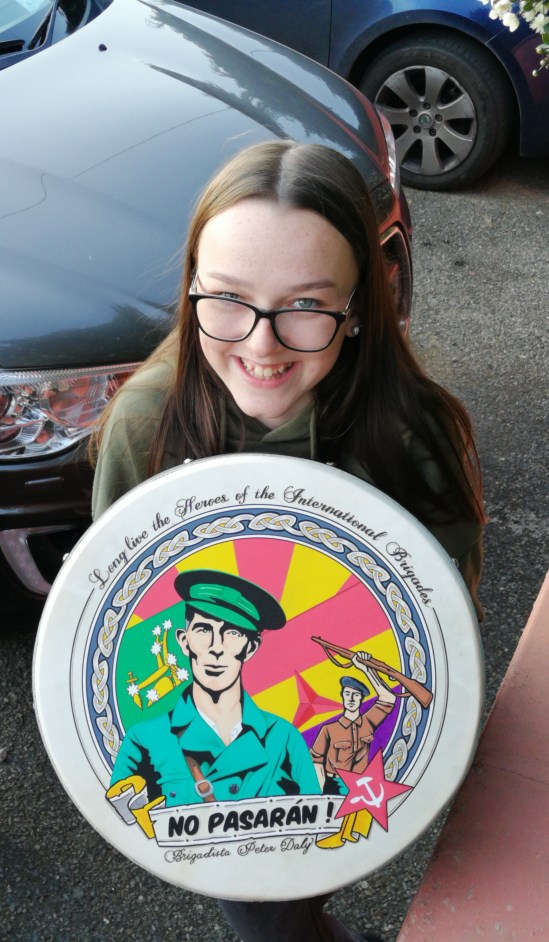
The MC Steve directed attention to a bodhrán decorated with a dedication to Peter Daly by Barry O’Shea which was displayed by Erin McCann and which would be raffled as a fund-raising exercise at the reception inside the pub.

girl-with-p-daly-bodhran.jpg
Ciara McCann with the bodhrán decorated by Barry O’Shea (Photo source: D.Breatnach)

Steve McCAnn then called Marie Kenny Murphy and Marilyn Harris up on to the stage, where they played the Irish national anthem on flutes, with many people singing along in its Irish translation4:

Anocht a théim sa bhearna baoil,

Le gean ar Ghael chun báis no saol;

Le gunnaí scréach, faoi lámhach na bpiléar,

Seo libh, canaig’ Amhrán na bhFiann.


Part Crowd Close GOM
Section of crowd around monument (Photo source: G. O Machaill)

REFRESHMENTS, EXHIBITION, RAFFLE, SONG AND CONVERSATION

          All the speakers had referenced the historical memory of the Anti-Fascist War on Spanish territory to the struggles of today and even of tomorrow and the selection of songs had been deliberately chosen to emphasise internationalism and workers’ solidarity from the past and needed today.

McCann thanked all the performers, speakers and participants and in particular welcomed the participation of the Connolly Association contingent from Manchester, encouraging them to attend again the following year. Inviting all to enter the local Monageer Tavern to view the Antifascist War memorabilia and to have some food, the MC brought the ceremony to an end.

Inside the local pub, the Monageer Tavern, food had been made available by the owners and the function hall was provided for the commemoration participants.

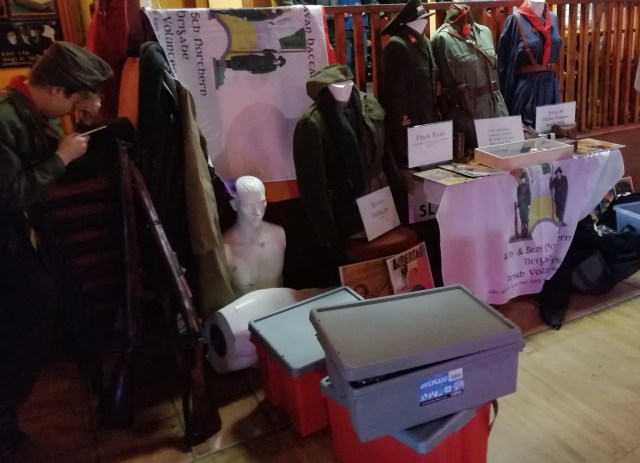
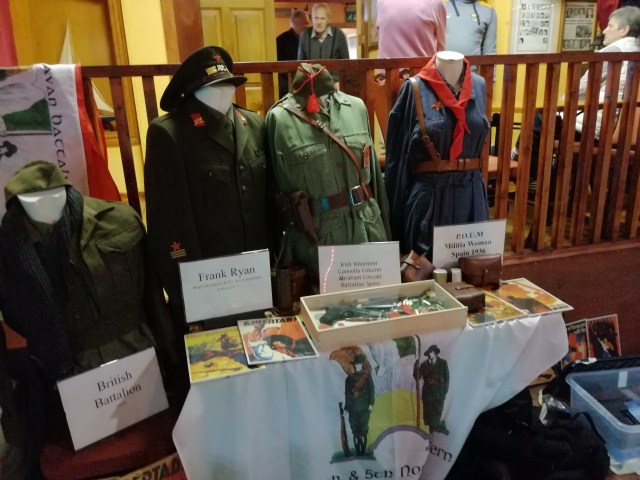
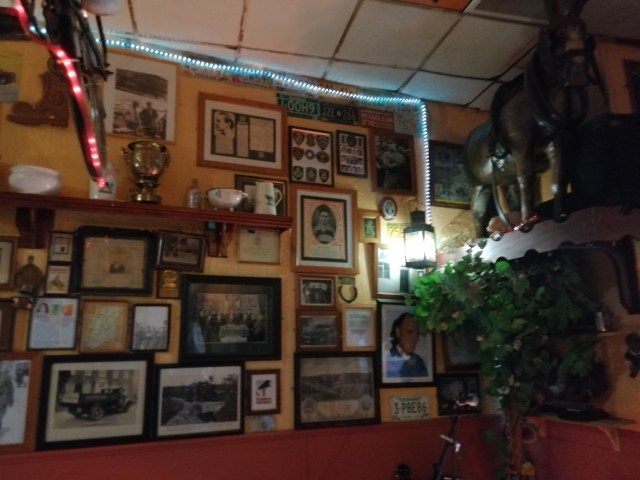
An interesting display of memorabilia of the Spanish Anti-Fascist War had been erected inside by the Cavan Volunteers history group. The walls of the function room on one side were also covered with permanent framed photographs and other images of Irish history, among which Joe Mooney, anti-fascist, community worker and activist of the East Wall History Group, spotted a photo of the Dublin docks with a docker well-known to his community in the foreground!

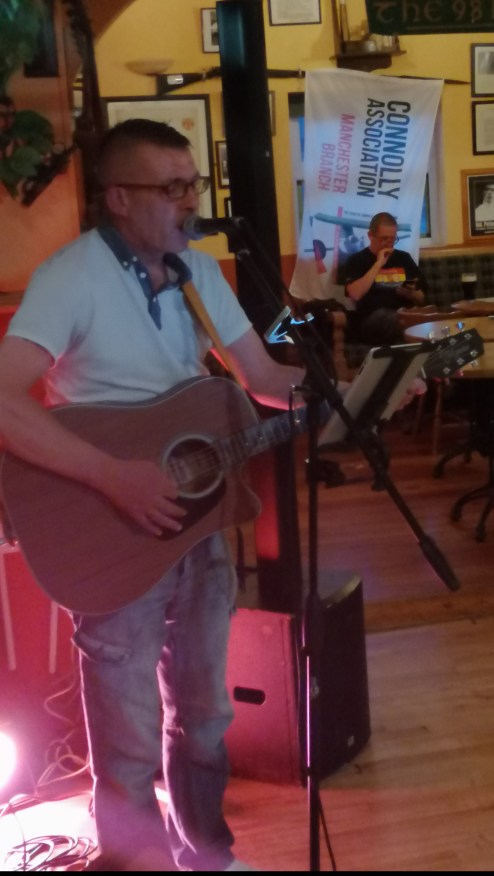
Music was provided by Tony Hughes with voice and guitar, singing a selection of songs including anti-racist and Irish Republican ballads, also Viva La Quinze Brigada.

solo-performer-pub.jpg
Tony Hughes playing and singing at the event inside the Monageer Tavern                                       (Photo source: D.Breatnach)
antif-war-memorabilia-wider.jpg
Spanish Anti-Fascist War memorabilia organised by the Cavan Volunteer history and re-enactment group (Photo source: D.Breatmach)

dav

When the raffle was held a search went on for the winning number ticket which eventually unearthed it in the possession of Helena Keane, seller of the tickets and who adamantly refused to take the prize. Another dip into the stubs brought Gearóid Ó Machaill’s ticket out, ensuring the decorated bodhrán would find a new home somewhere in the occupied Six Counties.

mde
Section of the function room wall in the Monageer Tavern. (Photo source: D.Breatnach)
mde
Another section of the function room wall. (Photo source: D.Breatnach)
lineup-people-banners-peter-daly-monument-7-aug-2019.jpg
(Photo source: Ado Perry)

FOOTNOTES

1The International Brigades were organised through the Comintern and Communist parties in various parts of the world but a number of International Volunteers came also through the mainly Trotskyist POUM, including Anarchists. One Irish volunteer went to join the Basque Gudaris and was killed fighting the fascists there.

2First Republican rising in Ireland, organised and led for the most part by Protestants, descendants of British colonists.

3Christy Moore called this “Viva la Quinta Brigada” (i.e the Fifth) but in later versions sang in English a line in the first verse calling it “the 15th International Brigade”. It appears that from different chronological perspectives one can call it either the Fifth or the Fifteenth but the mostly English-speaking brigade of the International Brigades is usually named the Fifteenth. Quinze is the Spanish word for “fifteen” and Viva la Quinze Brigada scans in the song while “decimoquinta Brigada” has too many syllables to fit.

4The Soldier’s Song was written originally in English by Peadar Kearney, an Irish Republican worker with socialist sympathies and put to music by worker-composer Patrick Heeny. It was translated to Irish by Liam Ó Rinn under the title Amhrán na bhFiann and published in 1923. Only the chorus became the anthem of the Irish State and that was not until later. The Irish-language version is the one most commonly sung at non-State occasions now.

LINKS FOR FURTHER INFORMATION:

Organisers
Peter Daly Association: https://www.facebook.com/PeterDalyCommemoration/

with help from the Peadar O’Donnel Forum: https://www.facebook.com/Peadar-ODonnell-Socialist-Republican-Forum-1538296709833402/

Colour Party by Anti-Imperialist Action Ireland: https://www.facebook.com/AIAIreland2/

Memorabilia and kitting out of POUM militia and International Brigade reenacters by Cavan Volunteers group: https://www.facebook.com/groups/242987949412133/

End .

THE BOARDING SCHOOLS OF FEAR

(Reading time: 10 minutes)
(
Translation by Diarmuid Breatnach of review in Castillian in 2016 of the book of that title and interview with one of the authors in El Confidencial).
Para versión original en Castellano mirase al enlace al fin.

Boarding school children in assembly being addressed by Catholic priest or religious order member (Photo source: original article).

‘The boarding schools of fear’ (Ed. Now Books) came into our hands a few days ago. We devoured the 300-page book in just three afternoons. Each page that we turned was leaving us more exhausted, confused and horrified. How is it possible that even today there are no consequences following what happened then?


We talked about sexual abuse, psychological abuse, physical abuse, experimental operations, baby theft and slavery, among other things, that thousands of children experienced during the Franco regime only because they were classified as ‘children of sin’. These children were children of single mothers, they came from poor families or, what was even worse at the time, their parents were Republicans.

The State ‘hunted’ these children and interned them in centres, of which the vast majority were managed by religious orders by government grant. Judging from the research in the book, in what more than boarding schools looked like prisons and torture rooms for minors. In the text we read a dozen testimonies of victims that leave us nauseous: boys raped by priests, nuns who mistreated hundreds of girls until they tired of it, Salesians who employed all kinds of torture, children who died of beatings, minors who were sold as slaves for 100,000 pesetas (600 euros today), young people locked up in psychiatric hospitals who were subjected to injections the nature of which remains unknown … A series of horrors that have never been recognized by the State (it was the entity in overall charge of the centres and had the judicial guardianship of minors), nor by the Church (according to the book, hundreds of Salesians, priests and nuns committed atrocities with children), much less by companies that benefited from the slave labour of these imprisoned children.

Boarding school children praying at night — cover of book being reviewed (Photo source: original article).

We have many doubts and we want to know more. We need someone to explain to us how even still this can be silenced. That is why we get in touch with Ricard Belis, one of the authors of the book, together with Montse Armengou, who offers us his view of the past, present and future of this situation. Ricard is an expert in Franco’s history, a subject to which he has dedicated decades of journalistic research. After chatting with him, we come to a valuable conclusion: the damage is already done, but to make known the history of these children and that those responsible for it be known publicly can heal the pain of many victims of the ‘boarding schools of fear’.

QUESTION: As soon as we begin the book we find a statement. You say that, contrary to what happens in other countries – from Argentina to South Africa through the Congo, Bosnia and other places – here in Spain there is no state agency responsible for investigating complaints that arise from people who, from one way or another, themselves suffered from the Franco dictatorship. Why is there no such body in Spain?

ANSWER: Everything is the result of the transition to democracy in Spain. It was done with a system that, although in the first years had its reason for being, decided not to look back at any time. In this way, one enters into a dynamic of many years of silence, which leaves all the victims of the regime forgotten and separated. That has done terrible damage to the victims themselves – for the fact of not being able to express their pain and having it remain inside them – and to Spanish society in general – because the fact of not knowing well what happened would be quite unthinkable in another democratic country.

Boarding school children marching (Photo source: original article).

Q: Do you think that at some point such a state agency could be created or do you consider it something utopian?

A: Well, I would like to see it … but I see it as impossible in near future. This book is the offspring of a documentary that was screened in Catalonia, where it was successful in terms of viewing figures, but nothing happened. There were signatures to a petition demanding that the Church ask for forgiveness, but nothing more. I think it is of greater importance that the Spanish State make these apologies, because it is ultimately responsible for the majority of these boarding schools, centres that were run by religious orders but by state concession. That task remains pending.

I will recount you an anecdote. We took this documentary to a very famous festival in France, in which reports from other countries were screened. After viewing our investigation, the French public did not understand how the Spanish State never apologised or accepted what happened to those interned. Then, by coincidence in the same room a Swiss documentary of a similar theme was projected (child abuse in Swiss boarding schools). The big difference is that this documentary began with the current Swiss Government asking for forgiveness for what previous governments had done.

Boarding school child in internal hospital bed — to what experiments were some of them subjected? (Photo source: original article).


TV3 DOCUMENTARY ON WHICH THE BOOK IS BASED

Q: In the absence of policies on historical memory, in a country denounced by different international organizations (UN, Amnesty International and the Council of Europe) and with a Partido Popular Government that fulfilled its electoral promise to close the office of Victims of the Civil War and Dictatorship, associations and the media are the only platforms to which those affected can go. Could this situation change with a new government? If, for example, a new political party like Podemos won the elections, do you think they would be willing to investigate all these cases and apply pressure for the creation of such an organization?

A: I am not optimistic for two reasons: first because there is no survey that predicts victory for Podemos, which, although it is one of the few parties presenting at state-level which contains this in its electoral program, it is hardly going to obtain an absolute majority to implement the policies they propose; and second, in this country we have had more years of left-wing than right-wing governments and both have been very shy and inactive on this issue, including the PSOE. It is true that Zapatero brought in a Law of Historical Memory, but it fell short and has hardly been applied. Anyway, I’m not very optimistic. I hope that some year something will happen, although at this rate I fear it will be when the victims are no longer alive.

Boarding school children marching
(Photo source: original article).

Q: Why does the Spanish Government not pronounce on this? Is it afraid of the reaction of society?

A: I don’t know very well how to answer that question, because its inactivity is incomprehensible. Because it does not matter if a government is right-wing or left-wing, what cannot be consented to is that the victims of a dictatorship are forgotten and the pain they have suffered is not recognised. I give the example of Angela Merkel, who strongly condemns the crimes committed in the Nazi era.

P: The children of these boarding schools were mistreated both psychologically and physically. They burned their bums with a candle, were forced to eat their own vomit full of insects, were subjected to sexual abuse … Is this perhaps the worst episode that has happened in the history of Spain?

A: The theme of childhood is one of the toughest episodes. When abuse, violence and ill-treatment is employed against a child, it is very traumatic. And not only the pain left inside them but also in their families. It is difficult to rank the hardest moments in the history of this country.

One of the things that has impressed me most doing this research, beyond the abuse, violence and ill-treatment is the fear and lack of affection felt by most children who lived in these boarding schools. Such was this lack of affection that many of those children came to confuse the first symptoms of sexual abuse as affection. I think it’s a terrible perversion. Some children who have never received a caress, accustomed to receiving beatings, when a priest arrives, touches them and that ends in sexual abuse … it has to mark them for a lifetime.

We always emphasise that this is not a historical investigation, but that it is current, because the damage that was done is still present. That the State does not recognize what happened only increases and magnifies the damage to the victims. The damage that the Dictatorship did is multiplied by the neglect of democracy.

Q: The Church played a great role in that drama. Do you think that with your research, like the one in this book, you will end up engendering a total rejection of the Church in the new generations?

A: I believe that the Church, on a global level, is beginning the process of acknowledging its guilt. The previous Pope, Benedict XVI, has already begun a firm policy against child abuse and sexual abuse, and in that sense it can be said that they are beginning to clean up their house. Late, yes, but we already know that the Church goes a little slower in everything. Here in Spain, there has not been any movement yet. The Church needs a modernization and many duties remain to be carried out, therefore it is normal for new generations to find it harder to believe in the Church.

We have testimonies of victims who ask that the Church apologize, because they are believers and for them it would be of great significance and even very restorative. Others, on the other hand, do not want to know anything about the religious orders, since they are never going to forgive them. In this regard, I think it would be good for the Church to ask for forgiveness, but I think it is more important for the Government to do so, because it is the one ultimately responsible. Although the Popular Party, which currently governs, has no responsibility for what happened, it is the heir of that State. It would be Mariano Rajoy who should ask for forgiveness, but not for anything on his own behalf but rather because he is the current President of Spain (since this was written Sanchez of the PSOE has been the President of the Spanish State – Trans.).

Q: If Mariano Rajoy recognized and apologized for what happened in those boarding schools, would it benefit him in any way with regard to public opinion?

A: In any case it would not hurt him. That a leader recognizes that the State did something wrong, but has no responsibility for it himself, is worthy of admiration. So I think it would mostly be to his benefit. I do not think that it would seem bad to any well-intentioned person that he apologized for the abuses that were committed at that time. Rajoy has no responsibility for it but he is the heir of that dictatorship.

Q: A lot of money was generated around the boarding schools. The Church received huge amounts from the State for the support of the little ones (and only a small part of it reached the minors, since they lived in subhuman conditions and were very hungry) and also pocketed millions of pesetas with the sale and labour exploitation of these children…

A: Yes, the Church took advantage of the situation and profited by it. The minors were a source of funding. The Church found a workforce to which they taught trades with the excuse of training, but the situation resulted in pure and hard exploitation. This situation reminds me of what happens in other countries, where thousands of children, such as from India or Asia, are exploited.

Q: In addition to the Church, large companies in our country also took advantage of the situation and hired this cheap workforce. In the book you mention El Corte Inglés – which at that time were the Almacenes Preciados (Precious Stores – Trans.) – and even Banco Popular and Caja Madrid. Did these companies know that they were hiring exploited children who lived as ‘prisoners’ in boarding schools?

A: I give you the example of El Corte Inglés (chain of shopping malls in the Spanish State – Trans.). They went to religious orders and paid the nuns for labour. They paid little, but they paid. They never hired a child directly. What happens is that, of course, we could say that they could suspect or intuit something with regard to the service being provided so cheaply. I could not tell you that these department stores are directly responsible, because they did not hire the children, although they have some social responsibility. They could imagine what was happening there.

Cortes Ingles, Marbella, one of a chain of shopping malls that profited from the work of the boarding school inmates.
(Photo source: Internet)

Q: You spoke with those responsible for El Corte Inglés about the subject. And, although at the beginning of the conversations they were pleasant, they ended abruptly with a total refusal on their part to collaborate with your investigation. Do you think that if it was shown that these department stores made use of these children for their business, it would affect their reputation or sales?

A: I think it has been a long time. They are tactics that are currently being used by numerous countries abroad. And, in addition, it could not prove more than than that the Cortes Inglés had a contract with religious orders. The company did not have to know what was done with these children or if they were paid. They could intuit what was happening, but they did nothing illegal. It would be more of a moral issue.

Q: As for you, after gathering so many testimonies and talking to more than 200 victims of these abuses, do you feel that this investigation has taken its toll in some way?

A: We are not made of stone. When you talk to a person who has suffered these abuses you are making her return to one of the worst episodes of her life. Sometimes you leave the interviews affected. But on the other hand it is very comforting, because the victims feel relief through having the opportunity to tell their story to their fellow citizens. In addition, these investigations are doing what the State should do, in the sense of making it known and recognizing it, which is the start of repairing the damage caused.

End.

REFERENCES:

Article in El Confidencial: https://www.elconfidencial.com/amp/alma-corazon-vida/2016-06-12/internado-miedo-abusos-sexuales-esclavos-victimas-horror_1214802/?fbclid=IwAR2t7DJU7DL25nec-KgIAphJG_Qn_ByzlQ9LR56p7yTbVUMaIrdwwWgWZmc

The book (The Boarding Schools of Fear), Now Books: Los internados del miedo

HOW TO WIN THE WAR – GETTING INTO POSITION

(Reading time: Introduction, one minute; Part One: 5 mins; Part Two 2 mins: Part Three: 3 mins; Part Four: 2 mins; Total: 13 mins.)

Diarmuid Breatnach

INTRODUCTION:

Although I often think about the big questions – and am generally guided by my philosophy on them, my mind and energy are usually too occupied with specific struggles to focus on them for long. Recently however I had the opportunity and the need to think about the war, the one we have yet to win.

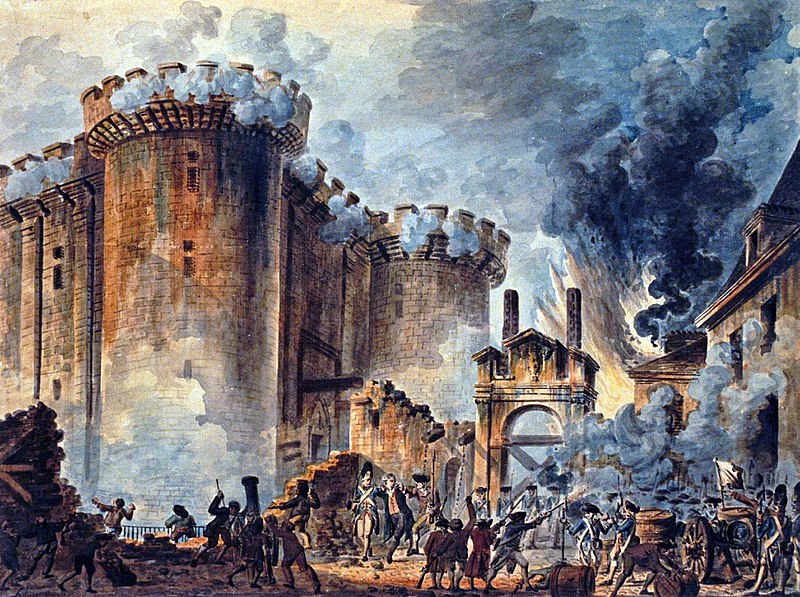
Storming Bastille Painting Jean-Pierre Houel
The Storming of the Bastille (translation), French Revolution, 1789 by Jean-Pierre Houel. (Image sourced: Internet)

But to which war am I referring? The Irish war of national liberation that has been flaring up for centuries, being lost each time before flaring up again? Or the class war, which has had a few sharp Irish episodes but has been, for the most part in Ireland, in abeyance? The answer is BOTH, though it may seem that my emphasis in the discussion, certainly in the early part, is on the national liberation war.

In order to imagine how we might win, it is helpful to examine past struggles and analyse what went wrong with them. Pessimists love to focus on those things I know – but in order to push us towards reformism or just surrender; my approach instead is from a revolutionary perspective.

Generally, Socialists analysing the class struggle don’t even ask themselves why we have not had a revolution yet. From week to week, month to month, they tend to focus on this or that particular trade union or social struggle but without going into the big picture. It seems as though they can’t even imagine a socialist uprising in Ireland, it’s just too far away to think about, apparently. But if one can’t even imagine such a revolution, how could one consider the necessary steps to get there?

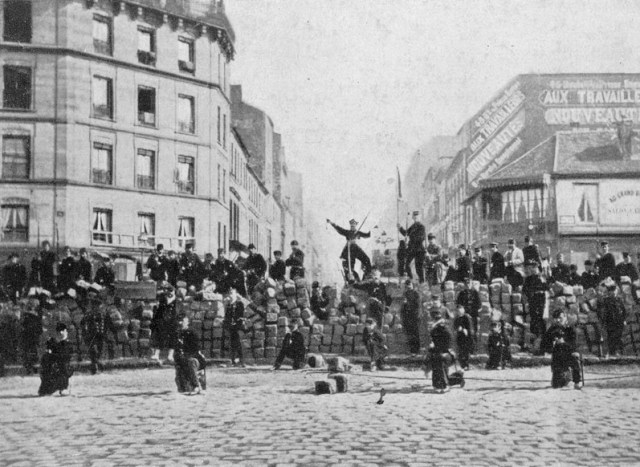
Communards Paris Barricade 1871
Communards at barricade, Paris Commune 1871. (Image source: Internet)

Irish Republicans on the other hand are often thinking in terms of revolution, usually including armed struggle. However it seems to me that Irish Republicans don’t like analysing past failures of the movement but when they do, their verdicts tend to be that the leaders betrayed the struggle or that taking part in public elections corrupted the movement; or that infiltration, spies and informers was the problem. And some other reasons. The thing is, although all those things played a particular part, they are not the fundamental reason.

Defeat Rebels Vinegar Hill Drawing George Cruikshank
“Defeat of the Rebels at Vinegar Hill” by George Cruikshanks, i.e United Irishmen last major position in Wexford overrun, 1798.

PART ONE: THE THIRTY-YEARS’ WAR – DOOMED TO LOSE

(Reading time this section: less than 5 minutes)

Free Derry Corner Gas Mask Images
Derry Monument and Mural of the Civil Rights struggle which preceded the armed struggle in the Six Counties. (Image sourced: Internet)

          The national liberation war that began in 1969 in the Six Counties and ended in 1998 (though some armed incidents continue from time to time) began as a civil rights struggle and changed into a war of communal defence and of national liberation. The military part of the struggle for the most part took place in the occupied Six Counties. The political element of the struggle was waged all over Ireland (and abroad) but in the main consisted of support for the struggle in the Six occupied Counties.

Fought in that way, the struggle was bound to lose. It could never win. How could anyone imagine that they could win a struggle fought against a world power in one-sixth of the country, where even the population there was divided against them? What could they have been thinking?

To my mind, there are only two possible sane replies to that question, which is that they believed: 1) that the British ruling class would get worn down by struggle and leave and/ or 2) that the Irish ruling class would intervene in some way to assist the struggle and make continued British occupation untenable.

1) ‘The British ruling class would get worn down and leave’: This theory must have depended on British repression being condemned abroad and being unpopular at home but had to rest fundamentally on the British having no great stake in continuing its possession of its colony there.

Anyone who thought that (and there were many who did and still many who do, not just Irish Republicans) made a fundamental error. Time and again the British ruling class has shown its determination to hang on to what might be considered its first colony, even as the ruling class’ composition changed from feudal-colonialist to capitalist-imperialist and as the world changed around it.

Collusion State Murder Mural
Mural in nationalist area in the Six Counties (Image sourced: Internet)

Even when the British ruling class, weakened by WW1 and facing an Irish guerrilla war which enjoyed the support of the vast majority of Irish people, with national liberation uprisings breaking out across its Empire and with its repression in Ireland increasingly unpopular at home, entered into negotiations with the Irish resistance, it held on to a foothold, the Six Counties.

Subsequently, it had that colony managed in a permanent state of emergency laws, with institutionalised sectarian discrimination at all official levels and outbreaks of pogroms in the street and workplace.

That became even more exposed during the civil rights struggle and the national liberation war that followed when the British State compromised whatever good international reputation remained to its Armed Forces, its judiciary, its legal establishment, its media and its very legal framework.

Even now, when many believe that the Good Friday Agreement means that a 50% plus-one-vote in favour in the Six Counties will be sufficient to end Partition, they do not realise that such a decision will have to also obtain a majority in the British Parliament and be endorsed by the British Monarch. They are also forgetting the broken promises that surrounded Partition in the first place.

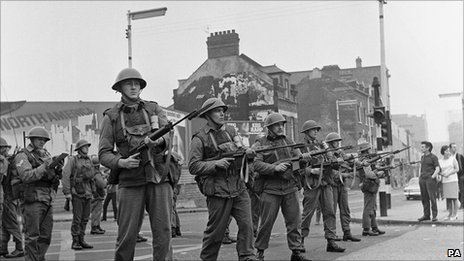
British Soldiers Helmeted Belfast 1969
British Army in Belfast 1969 (bayonets and guns pointed towards nationalist area). (Image sourced: Internet)

When analysing what holding on to the Six Counties has cost the British State in terms of reputation, military and financial contributions, one can only rationally assume that continuing to hold on to that foothold is of great importance to the British State. One may speculate as to the reasons underlying that but the central fact cannot be denied.

2) ‘The Irish ruling class would intervene in some way to assist the struggle and make continued British occupation untenable’:

There was some basis for this belief in that a section of Fianna Fáil, a party that had emerged from a split in Sinn Féin in the 1930s and had become one of the mainstream parties in the Irish state, had retained some traditional commitment to seeking a united Ireland. However it was a thin enough basis on which to depend in a national liberation struggle since that section had no majority within the party itself, to say nothing of the foreign-dependent nature of the Irish native capitalist class, the Gombeens, as a whole.

The question came to a trial of strength in the Arms Crisis of 1970, in which at least two Fianna Fáil Government Ministers were involved in secretly buying arms for the defence of nationalist areas in the Six Counties (since the IRA had insufficient weapons at the time) from rampaging Loyalist mobs and the Royal Ulster Constabulary (including the part-time B-Specials). The Ministers alleged that they had acted in the full knowledge of the rest of the Government. By the time the whole affair was over, two Ministers had been sacked and another two resigned in protest.

If it had not been clear before that the Gombeens, the native Irish capitalist class was no patriotic capitalist class but rather a neo-colonial one, it should have been clear after that. But the armed struggle in the Six Counties intensified, especially after the massacres of unarmed civilians carried out by British Paratroopers the following year, 1971 in Belfast and again in Derry in 1972. And the war lasted until 1998.

If, as had been demonstrated to be the case that the British ruling class were determined to hold on to the Six Counties and the Irish ruling class was not going to seriously challenge that possession, did the Republican movement have any other option than to fight on a war that they could not possibly win?

I am clear that it did.

Clearly, in order to have a chance of success, the war had to be extended to the other five-fifths of the country, which is to say into the territory under the control of the Irish native capitalist class. This class had seized power after the War of Independence (1919-1921) and had beaten and suppressed its opposition during and after the Civil War (1922-1923) and furthermore was supported by a powerful ally, the Irish Catholic Church. Since the founding of the first Irish Republican organisation, the United Irishmen of the late 1790s, the Catholic Church hierarchy had opposed Irish Republicanism; it had condemned four Irish priests who participated in the uprising of 1798, excommunicated the Fenians, had at first condemned the 1916 Rising and the War of Independence only to latch on to it at the end along with the Gombeen class.

The general Irish population likely would not have supported or sustained an armed struggle in the 1970s against the Gombeen class but that class could have been fought politically, through agitation and mobilisation, on many social, political and economic fronts. Without going into the specific details of each, these were:

  1. against the huge wastage of Irish youth through emigration

  2. to remedy the shortage of affordable housing (which in part contributed to the above)

  3. to end unemployment (also contributing hugely to emigration)

  4. to raise the level of wages and lower wage earners’ taxation

  5. for the right to divorce

  6. for equality for women in law

  7. for the right to contraception devices and medication for men and women

  8. against decriminalisation and for equal rights for gay and lesbians

  9. to halt the decline of the Irish language, in particular of the rural Irish-speaking areas

  10. to improve services for the rural areas

  11. to oppose the open-door policy for foreign multinationals to exploit Irish natural and human resources

  12. to secularise the education service

  13. and the health service.

  14. to remove the privileged status of the Catholic Church within the state.

Irish Womens Liberation Connolly Station
Irish women photographed at Connolly Station 1971, about to board train to Belfast to purchase contraceptives to bring back to the Irish state, illegal at the time. There was no right to abortion either or divorce and a husband’s signed permission was necessary to take out a hire purchase agreement. (Image sourced: Internet)

The Republican movement in general, with some exceptions, declined to take on any of those struggles. They did not organise in the trade union movement, left the social struggles to others and most of all, declined to take on the Catholic Church on any issue except its opposition to the national liberation struggle. Even there, it was happy to publicly avail of the services of members of the Church clergy who supported them. Republicanism was, from its very beginning, as well as anti-monarchist, about separation of Church and State but it was difficult to see that in the Irish Republican movement, particularly after the War of Independence.

A full half of those fourteen points above (nos. 5,6, 7, 8, 12, 13 and 14) would have meant taking on the Church head-on and no doubt the hierarchy would have hindered the struggle over most of the others too, due to its strong links with the State and its ruling class.

Because of its tactical and no doubt ideological refusal to take up those struggles, the Republican movement could do little more in the 26-County state than to agitate for solidarity with the beleaguered nationalist population inside the British colony.

Though this could be effective for a time it could not become a mass movement, nor survive a long struggle, without any remedy being sought for the issues facing the population within the state.

The wonder is not that the majority leadership of the Republican Movement threw in the towel on the military struggle in 1998 but that they had waited so long to do it. Of course, they never admitted the true nature of what they were doing: abandoning the armed struggle and revolution in total and instead, using their negotiating position to advance themselves politically – not in the economic, social and political struggle envisioned above but rather in a political struggle to find themselves a place among the Gombeen political class in the Irish state and as accomplices in the governing of the colonial state.

PART 2: COLLECTING THE FORCES FOR REVOLUTION

(Reading time this section: 2 minutes)

          A successful revolution in Ireland, as in most places, would require the involvement of a mass movement. That mass movement would be unlikely to be one that had national self-determination as its only aim – certainly not in the 26 Counties (the Irish state). Mass movements arise at times around different issues and exist as long as the issue does or instead until the movement gets worn down or broken up. Such movements arose around the Household Tax and, later, around the additional Water Charges.

Water Protest Long View 29 Aug 2015
Section of protest against water charges, O’Connell Street, Dublin, 29 Aug. 2015 (Image source: Internet)

Even though the objectives of such movements are often not revolutionary, the participation in them by revolutionaries is necessary if, in the future, there is to be a revolution. Revolutionary activists can make contacts and prove themselves by the way they participate whilst at the same time pointing out that a revolution is necessary in order to resolve all these issues completely and permanently. Such activists can also influence the movement (or sections of it) to act in more revolutionary ways, so that the movement can be guided by – and imbued with — revolutionary spirit.

Working people in struggles come up against concrete problems which need to be resolved in order to move forward. Prior to 1913 in Ireland, workers learned the need for unity in struggle which was emphasised by the employers’ attempts to break the Irish Transport and General Workers’ Union in August 1913. The attacks on them by the Dublin Metropolitan Police illustrated the need for organised defence and Larkin and Connolly called for the formation of what became the Irish Citizen Army, which later also fought prominently in the 1916 Rising.

Packed Workers Liberty Hall 1913
Members and supporters of the Irish Transport & General Workers’ Union cheering outside the union’s HQ, Liberty Hall, August 1913. Later the union formed the ICA to defend themselves from the DMP; the ICA took a prominent part in the 1916 Rising. (Image source: Internet)

Trade unions are the only mass organisations of the working class in Ireland and it is necessary for revolutionaries to be active within them. Currently, other than social democrats, it is mainly members of both trotskyist parties and independent activists who engage politically with the trade unions. Those members are mostly in clerical work and their political work tends to concentrate on employment demands around wages and working conditions. When they introduce politics it is generally to get some motion passed by their branch. Also at times, they will campaign to get a perceived left-wing candidate elected to some position within the trade union bureaucracy.

None of the above are without value but they remain disjointed in terms of program and often confined to just one trade union. Not only that, but often the Left party involved will engage in order to recruit some new members and in order also to retain their own members by providing them with activity. When broad front trade union groups are formed, they tend to become an arena where the dominant trotskyist parties compete for dominance.

If we are to have a successful revolution – and in particular a socialist one – participation in the struggles of workers in the trade union movement is absolutely necessary. But participation should be primarily among the rank and file of the trade union and also across trade unions, focused on providing solidarity to members of whichever union is in struggle – in addition to encouraging unorganised workers to organise and become active. The objective is not to help make one trade union or one section more militant but rather to create a militant workers solidarity movement within the whole trade union movement. It is essential to have members in the ‘blue-collar’ work unions or departments as well as in the clerical unions or sections. And the cross-union organisation I advocated should be independent — the preserve of no political party.

Participation in such struggles provides an opportunity for revolutionaries to make contact with people who are activists but not yet revolutionaries and to give those people an opportunity to evaluate the revolutionaries in terms of their actual practice. Revolutionaries can support the people struggling for worthwhile reforms while at the same time pointing to their partial and temporary nature. Revolutionary activists can play an educational role in the mass movements while at the same time becoming educated themselves by the daily reality faced by the masses in this system.

PART 3: THE ABSOLUTE NEED FOR UNITY – BUT WHAT KIND?

(Reading time this section: 3 minutes)

          It is, most people would think, a ‘no-brainer’ (i.e an obvious truth) that unity is necessary in the struggle to overthrow the current system. It might be thought surprising, therefore, that disunity is more the rule among those who aspire to revolution.

Generally, those who claim to be revolutionary socialists will not unite with Irish Republicans. In addition, those socialists of one party will often fail to unite with those of a different party. The same dynamic is to be seen among Irish Republicans also.

There have been many attempts to overcome this problem. In the 1930s the Republican Congress sought to unite Irish Republicans with revolutionary socialists. In the face of hostility within the mainstream Republican movement and also with divisions among the communist element in Ireland at the time, faced in addition with anti-communist hysteria whipped up by the Catholic Church, the experiment failed. The leadership of the Sinn Féin and the IRA of the later 1960s tried to combine socialism and republicanism within one party and military organisation, an attempt that crashed when it was discovered that the arms necessary to defend ‘nationalist’ community areas in the Six Counties, particularly in Belfast, were unavailable, leading to an acrimonious split in the movement. A subsequent attempt to combine the socialist and republican elements in another organisation survived a little longer but also failed for a number of reasons, some internal and also due to Irish State repression.

Shankhill Rd Republican Congress WT Commemoration 1934
Socialist Republicans, members of Republican Congress from Shankhill Road, marching to annual Wolfe Tone commemoration, Bodenstown 1934. They were attacked by conservative Republicans. (Photo source: Internet)

There have been some attempts to unite the non-republican Left itself also, which usually failed due in part to ideological differences but also to political sectarianism and personality clashes. Currently both trotskyist parties have an uneasy working relationship, the small grouping of Independents for Change exists also, the Communist Party is very small too and the anarchists are scattered and unable for years now, for the most part, to mount united action.

Attempts to unite the various parts of the Irish Republican movement have, in general, focused on creating a new organisation or absorbing activists unhappy with one organisation into another.

A frequent approach has been for some people to sit down and produce what they consider solid policy and a constitution, then to propose this format to others around which to unite. Even when accepting amendments from the elements they seek to recruit, these attempts too have largely failed.

It seems a rational approach: if we want unity, surely first we have to agree on what for, how, etc, etc before we can go into action? I believe, contrary though it may seem, that actually we should unite in action first. Uniting in action tends to break down barriers of mistrust that are built on hearsay or suspicions fostered by sectarian elements. Action also tends to clarify certain questions that until then are theoretical only. Of course, at some point, action will need to be guided by worked out policy but initially the action itself can be sufficient guide, especially since approaching the question the other way around has been so generally unproductive.

Unity Is Strength Image copy

The question then arises: with whom to unite? In general, I would say that the answer is: with all with whom we can, in actual practice, unite: different types of revolutionary socialists (including anarchists), Irish Republicans, Left social democrats, human and civil rights activists.

There are some exceptions I think necessary to mention: fascists, racists, religious sectarians and parties that participate in Government. Fascists seek to impose an undemocratic regime completely hostile to the interests of working people and, far from our uniting with them, need to be defeated; racists and religious sectarians seek to divide the movement along lines of ethnicity or religious affiliation. Revolutionaries need to draw a clear line of distinction between the movements of resistance and those who participate in a native capitalist or colonial government, i.e the management organisations of the enemy.

Many issues lend themselves to united action but perhaps none more so, and none are more essential, than against repression.

PART FOUR: UNITY AGAINST REPRESSION

(Reading time this section: 3 minutes)

          All revolutionary movements – and many that are progressive but not revolutionary – face repression at some point in their existence. Not to recognise that fact and to have some kind of preparation for it, even if very basic, is indicative of a non-revolutionary attitude to the State. Nor have we any reason in Ireland to be complacent on this question.

The Irish State turned to military suppression in the first year of its existence as did also the colonial statelet. Detentions, torture, murders and official executions were carried out by Free State forces over a number of years, followed by censorship and arrests, all facilitated by emergency repressive legislation. In the Six Counties, in addition to similar even more repressive legislation, there were two sectarian militarised police forces and sectarian civilian organisations.

After a change of government, the Irish State introduced internment without trial during the Emergency (1939-1946), the Offences Against the State Act in 1939, Special Criminal (sic) Courts in 1972 and the Amendment to the OAS in that same year.

Bloody Sunday march Derry 2014
Poster for 2014 Commemoration of Bloody Sunday massacre, Derry 1972. The poster calls for unity. (Image source: Internet)

The Six County statelet had the Special Powers Act (1922) and brought in internment without trial in 1971 (the Ballymurphy Massacre that year and the Derry Massacre the following year, both by the Parachute Regiment, were of people protesting the introduction of internment). The statelet also introduced the Emergency Provisions Act and the no-jury Diplock Courts in 1973 and, though technically abolished in 2007, non-jury trials can and do take place up to today.

The British state targeted the Irish diaspora in Britain in 1974 with the Prevention of Terrorism (sic) Act and that same year and the following, framed and convicted nearly a score of innocent people of bombings in five different cases – had the death penalty not been previously abolished for murder, most of them would have been executed. It took the victims over 15 years to win their freedom, by which time one had died in jail. Brought in as a temporary measure, the PTA continued in force until 1989 but a general Terrorism Act was brought into British Law in 2000 and remains in force today.

Birmingham Six Photos Bruises
Photos of the Birmingham Six, Irishmen resident in England, showing bruises from police beatings after their arrest in 1974; they were also beaten by jailers. Also arrested, brutalised, framed and convicted were the Guildford Four, Maguire Seven and Giuseppe Conlon and Judith Ward. (Photo source: Internet)

State repression rarely targets the whole population and, particularly in a capitalist “democracy” focuses on particular groups which it fears or feels it can safely persecute. However, we should also recall Pastor Niemoller’s words about the creeping repression which even the German Nazi state instituted, going after first one group, then another, and another …. Among the list of groups targeted eventually by the Nazis were Jews, Roma, Communists, Socialists, Anarchists, Social Democrats, Jehova’s Witnesses, Free Masons, Gays and Lesbians, Mentally Ill or challenged, physically challenged ….

It is in the interests of the vast majority of the population to oppose repression of different groups, whether those groups be based on ethnicity, gender, sexuality, citizenship status or democratic politics. Not everyone recognises this of course but one might expect that political activists challenging the status quo would do so. Sadly, experience shows that they do not in practice (though they may acknowledge it intellectually).

Lineup Clenched Fists & Banner
Anti-Internment and political prisoner solidarity picket September 2016 at Kilmainham Jail, Dublin (a former place of detention and execution for political prisoners under both the British occupation and the Irish State, now a museum). (Photo source: Rebel Breeze)

With some periodic exceptions, socialist groups in Ireland do not support protests against repression of republicans. Furthermore, some republican groups will not support others when the latter are subjected to repression. Yet at any time, Republicans of any group can be and are regularly harassed in public or raided at home; their employers may be warned about them by the political police; they may be detained on special repressive legislation, denied bail, effectively interned; they can be easily convicted in the non-jury Special Criminal Courts or Diplock Courts; ex-prisoners released on licence in the Six Counties can be returned to jail without any charge or possibility of defence.

The Irish State’s non-jury Special Criminal Court is a tempting facility for putting away people whom the State finds annoying and it is widely thought it was considered for the trials of the Jobstown protesters. The result of the trial, where the jury clearly took a different view to the presiding judge, may well have justified the opinion of those in the State who considered sending the defendants to the SCC.

solidarity woodcut

Unity against repression is a fundamental need of a healthy society and of movements that challenge the status quo. Practical unity in any kind of action also tends to break down barriers and assists general revolutionary broad unity. Unity against repression is so basic a need that agreement with this or that individual is unnecessary, nor with this or that organisation in order to defend them against repression. Basic democratic rights were fought for by generations and have to be defended; in addition they give activists some room to act without being jailed. On this basis, all must unite in practice and political sectarianism has no place in that.

Without some basic unity in practice across the sector challenging the status quo, there can be no revolution. But more than that: we stand together against repression ….. or we go to jail separately.

End.

Diarmuid Breatnach is a veteran independent revolutionary activist, currently particularly active in committees against repression, in some areas of internationalist solidarity and in defence of historical memory.

ANDALUSIAN CITY COUNCIL TO DIG UP MASS GRAVE OF FRANCO VICTIMS

(Reading time entire text 5-10 minutes)

Report by RAÚL BOCANEGRA in Publico.es (translation and comment by Diarmuid Breatnach).

Mass grave of victims of Francoist repression, Burgos.
(Photo source: Internet)

“The City Council of Seville has guaranteed on its own to provide the necessary funding — 1.2 million euros — to exhume the Pico Reja pit, in which historians believe that there are at least 1,103 bodies of of victims of the repression, led by the General Queipo de Llano, following the military coup of July 18, 1936.

This exhumation will be the largest ever to be undertaken in Spain, following that which that was carried out in Malaga, in the San Rafael Trench, between 2006 and 2009, and may indicate the path to take for the other capitals (of Spanish state regions – Trans).

The Mayor of Seville, Juan Espadas (PSOE), guaranteed that the grave will be exhumed throughout the mandate of the current Council. “It is a truly historic step in Seville and one of national importance, since it is perhaps the biggest mass grave that [at this moment] has a definite project for its exhumation,” the Councilor said at a press conference.

“And, therefore, it is also one of the most important projects in terms of Historical Memory to be undertaken in our land, due to the importance and volume of the Pico Reja mass grave. It was a commitment that this Government (i.e of the Andalusian region) gave during the past mandate to relatives and memorial groups and today it is made a reality with this tender,” added Espadas.

“Next Friday the City Council of Seville, through the Governing Board will approve the specifications and, therefore, the public tender for a technical service for the exhumation and genetic identification of the bodies of the Pico Reja mass grave, in the Cemetery of San Fernando,” reads a statement issued by the City Council. “The ultimate goal [of the exhumation] is to dignify the memory of the people who were thrown there, give them a dignified burial and attend to the requests of their families,” adds the Council (statement – Trans).”

Militia Women of the Anarchist FAI -CNT in Catalonia, early years of the Spanish Anti-Fascist War. Women in areas captured by the Franco forces were exposed to endemic rape and many female prisoners were shot after being raped.
(Photo source: Internet).

BEGINNING AND COMPLETION OF WORK

          “Accordingly, Espadas will not wait for the Council of Andalucía or the Regional Government to sign the agreement, to which they had committed themselves. Confirming now, at the start of the mandate, the works, the Mayor ensures that the exhumation will not be delayed and will be carried out throughout this term. Municipal sources assured Público of their belief that both the Council and the Andalusian Government will collaborate with the exhumation, the Andalusian Council not before September.

Should they contribute money, the amount would be deducted from the 1.2 million that the Council calculates as necessary to carry out the works. Espadas recalled that the signing of an agreement in this regard with the Board and the County Council to finance these works is still outstanding. “And let’s hope that it is signed as soon as possible.”

“This contract guarantees the beginning of the work and its conclusion, without waiting for the remaining public administrations –- provincial, Andalusian and national — to finalise their contributions,” reads the Council’s note.

Espadas and the Delegate for the Department for Equality, Education, Citizen Participation and District Coordination, Adela Castaño, related the details of this contract to relatives of the victims and to the different organisations involved in the area of Historical Memory in Seville. “Do not fear, the exhumation and the identification of bodies will be done,” the Mayor assured them.

THE DETAILS

          The company that gains the contract must include at least one historian, five professionals in Forensic and Physical Anthropology, five in Archeology and 10 auxiliary support workers. “With the maximum guarantees of scientific rigor, a survey will be performed, material collected on the surface, excavations made in the pit, exhumations and recovering of bodies and remains,” says the City Council in the note. “Likewise, it must preserve and safeguard, also with all scientific guarantees, the samples of bone remains and biological samples taken from the family members until delivery to the University of Granada for genetic identification,” the City Council insists.

The project will be be completed in three phases, explained the Council. The first concerns the exhumation itself and the identification of the bodies, along with works including: the archaeological excavation; dealing with the remains found (the excavation and the direct and individualized identification of these bodies will determine whether or not they are relatives); exhumation (identification, recording of traces of violence and individual extraction of each body or remains); forensic anthropology (that is, determining sex, age, pathologies or anomalies); anthropological analysis in a laboratory manner; and conservation and protection to preserve these skeletal remains and DNA analysis.

The second phase will consist of the presentation of a final report as a logical contribution to the history of Franco’s repression. And the last phase will be the final destination of the remains.

The City Council will respect at all times the wishes of relations about the identified remains. The unidentified remains and those which the relatives wish to remain in the same place, “will be buried in an authorised space with appropriate technical indications for future identification”.

After finishing the works, “the area will be restored as an expository and explanatory site of the historical significance of the Pico Reja pit”. The successful bidder must submit a proposal for reconstruction of the current site that includes a columned monument to honor the victims.

Exhumation work on mass grave of Franco’s victims in Burgos.
(Photo source: Unai Aranzadi)

COMMENT:

(Diarmuid Breatnach)

          According to official figures, 120,000 victims have been identified (not exhumed) from 2,591 unmarked graves around the Spanish state. The areas with the largest number of graves are Andalusia in the south and the northern regions of Aragón and Asturias – in Andalusia alone, 55,000.

Map of grave sites of victims of Francoist repression in Andalucia (Photo source: Internet)

A mapping work undertaken by the Council of Andalusia region, which was presented publicly in the regional capital in 2011, illustrates 614 mass graves in 359 Andalusian municipalities. Only around half of the 47,000 bodies that were discovered have been identified due to there being no relatives available for DNA tracing or because calcium oxide (quicklime) had been thrown over the bodies.1

In Malaga province alone there are 76 mass graves in 52 towns, containing the remains of 7,471 people who were killed by General Franco’s forces. The largest of these mass graves was discovered in Malaga city’s San Rafael cemetery. 2,840 bodies were exhumed in early 2010, although more than 4,500 are registered as having been buried there”.2

The usual figure given for the total of non-combat killing by Franco’s forces is 150,000 and which does not include those who died of malnutrition and lack of adequate medical care in prisons and “penal battalions” or through confiscations, or economic and financial sanctions in areas occupied by his forces. Nor does it include the civilian victims of bombing by military-fascist air force, whether of cities or of refugee columns.

Against that, the total figure for non-combat killings by the forces against Franco are estimated at around 50,000. Also, while the latter killings for the most part took place in the early months of the military uprisings, before Republican Government control could be established, most of the non-combat killings by Franco’s forces were carried out after they had beaten the resistance and occupied the area and much of it also after the war was over. Typically too, according to Paul Preston (The Spanish Holocaust (2012), Harper Press), women were routinely raped before they were shot.3

The issue of the executed after a cursory military trial or simply taken out and murdered by Franco’s forces is a live one in the Spanish state today. Before Franco’s death it was not even possible to discuss it publicly and bereaved relatives were not permitted to mourn publicly – to hold a funeral or to have a mass said for their souls according to Catholic custom or even to mark their graves.

The Transition process to convert Franco’s Spain into a “democracy” accorded legal impunity to the perpetrators of even the worst atrocities during the Civil War but unofficially extended beyond, to the years afterwards and even to murders carried out during the “Transición” itself. And why not, when all the upper echelons of police, army, judiciary, civil service, Church, media and business were and are for the most part the same people as before or their sons and daughters? When the Head of State and of the Armed Forces, the King Juan Carlos, was specifically chosen by Franco to be his successor and even after the Dictator’s death glorified him and his political trajectory.

‘LET THE DEAD STAY BURIED’

          The fascists and their descendants want the dead and their stories to stay buried and even when a very senior judge like Baltasar Garsón, who presided over the repression and torture of many Basque and Catalan political detainees (but is incredibly lauded as “a foremost human rights defender” by liberals!) decided to play a power and publicity game and and became a problem by authorising the opening of some mass graves in 2012, he was slapped with legal appeals, charges of wire-tapping and disbarred from office for 11 years.

The other graves they don’t want opened are the mausoleum of Franco himself and of Rivera, founder of the Spanish fascist Falange, who lie in the memorial park built by political prisoner slave labour to honour Dictatorship and Fascism, a shrine for fascists today. The order of the PSOE Government to exhume and transfer them to a family graveyard has been paralysed by the Spanish Supreme Court after protests by Franco’s descendants.

If the Pico Reja exhumation in Seville goes ahead and is properly documented, it will be as the PSOE-controlled Seville City Council says, of huge historical — but also of huge political – importance. Can this happen in the same region where the corrupt PSOE administration has lost power after decades without se

The “Valle de Los Caidos” memorial park, constructed by slave prisoner labour, which contains the mausoleum containing the bodies of Franco and Rivera
(Photo: Paul Hanna, Reuters)

rious challenge and is now ruled by a de facto coalition of all the main parties descended from Franco, the Partido Popular, Ciudadanos and Vox? The Seville City Council says it can and that if necessary they will fund it all themselves. We can hope.

End.

FOOTNOTES:

1See “Mass graves in Andalusia” in References.

2As above.

3See Review of Paul Preston’s book in References.

REFERENCES AND SOURCES:

Main article: https://www.publico.es/politica/memoria-publica-alcalde-sevilla-garantiza-dinero-exhumar-mandato-fosa-pico-reja-hay-1100-represaliados.html

Review Paul Preston’s The Spanish Holocaust: https://elpais.com/elpais/2011/04/04/inenglish/1301894444_850210.html

Mass graves in Andalusia: http://www.surinenglish.com/20110107/news/andalucia/mass-graves-201101071754.html

Map of mass grave sites in Andalusia: https://www.theolivepress.es/spain-news/2011/01/14/terror-map/
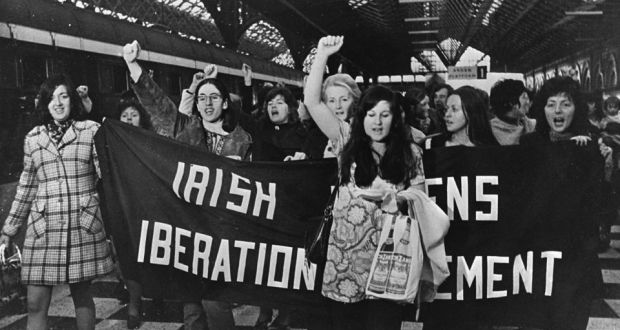
PRAISE OF FRANCO IN ARCHIVE OF FORMER SPANISH KING’S SPEECHES

About Franco: “I pay homage to his memory; and I believe that the best way to interpret his legacy is to march without stopping towards social justice objectives, that give strength and unity to our people.”

Translation by Diarmuid Breatnach from article in Castillian by DANILO ALBIN @danialri BILBAO 06-30-2019 08:17 AM Updated: 06-30-2019 08:17

Franco with leading German Nazis. He was greatly admired by the former Spanish King, father of the current one.
(Photo source: Internet)

          There are things that time cannot erase. Words and phrases that seem forgotten but, nevertheless, are still there. Written and permanent. The Royal House offers the collection of speeches by Juan Carlos de Borbón in its digital archive. In those archives, available for those who wish to find them, are the Francoist statements that the now emeritus king pronounced in the first steps of his reign and about which, according to what different historians emphasise, he never made any self-criticism.

November 22, 1975. Two days after the death of the Dictator, Juan Carlos offers his message of remembrance: “An exceptional figure enters history. The name of Francisco Franco will be a milestone of Spanish events and a milestone to which it will be impossible not to refer in order to understand the key to our contemporary political life,” the King proclaimed.

There he showed his “respect and gratitude” towards he who “for so many years assumed the heavy responsibility of leading the government of the State”. “His memory will be for me a demand for behavior and loyalty to the functions I assume in the service of the country. It is a feature of great and noble peoples to know how to remember those who dedicated their lives to the service of an ideal. Spain will never be able to forget who, as a soldier and statesman, consecrated all his existence to its service,” he added.

Hitler and Franco reviewing invader Nazi troops in Hendaye, French Basque Country.
(Photo source: Internet)

The file on the website of Casa Real offers another speech by the King of that same day, in that case addressed to the Armed Forces. “I express my gratitude and gratitude to our Generalissimo Franco, who with so much dedication and commitment has led you until now, giving us a unique example of love for Spain and a sense of responsibility,” he said then.

Twenty-four hours later, Juan Carlos went to the National Brotherhood of Combatants, another self-declared Francoist entity. He promised them “to march forward with determination on the path traced, perfecting and complementing the work Franco did“. “Today, before you, who were his soldiers, I pay homage to his memory; and I believe that the best way to interpret his legacy is to march without stopping towards social justice objectives, that give strength and unity to our people,” he said.

For the historian and researcher Pablo Sánchez León, these speeches by the monarch “show a preconstitutional legitimacy (? Trans) of the Royal Household”. In any case, Sánchez León believes that if they are available in the digital archive, the monarchical institution “has an opportunity to tell a different story of itself”. How? “If they want to preserve those speeches there, something must be added,” he says.

In his opinion, these historical documents should be accompanied by a “furious criticism”. In that sense, he points out that there is a “repository” of Juan Carlos as former monarch, and that “the speeches that speak of Franco should be accompanied by a text in which he is allowed to say that it is abhorrent that there was been a king who once said those things”.

Juan Carlos, crowned by Franco, seen here with his mentor shortly before the latter’s demise.
(Photo source: Internet)

None of that is in the list of of the king’s speeches. “The year that ends has left us with a stamp of sadness, which has had as its centre the illness and the loss of what was our Generalissimo for so many years”, can be read in the Christmas speech of 1975, which also highlighted “the enormous human qualities and feelings full of patriotism” on which Franco “wanted to base all his performance at the head of our nation.”

For Emilio Silva, president of the Association for the Recovery of Historical Memory (ARMH), the Royal House should also include in its file “the video of King Juan Carlos swearing to uphold the principles of the Movement” (i.e the Spanish fascist Movement – Trans). “If there were an exercise in real transparency, it would be told where that (Head of State – Trans) succession comes from,” he told Público.

“The reality is that the king was installed as successor by Franco”.

“Surely it is not the best thing for a democratic system to see texts extolling Franco on the website of of the Head of State,” says Julián Sanz, professor of Contemporary History at the University of Valencia. In any case, he remarks that “the reality is that the King was installed as successor by Franco and Juan Carlos’s relationship with the dictatorship has never been officially reviewed, nor has he abjured it.”

“Generalissimo” and “Head of State”

          “My memory of the Generalissimo, who presided over this Military Passover for so many years and so much satisfaction when he met his comrades-in-arms,” reads the document “Words of His Majesty the King on the occasion of the Military Passover“, dated six January 1976. The following month, in Berga (Catalonia) he took advantage of the inauguration of the Baells Reservoir to argue that “the transformation that Spain has had in recent years of Franco’s mandate, cannot be stopped and all steps will be taken to allow this process to continue. “

The King kept referring to Franco as “Generalissimo” in July 1976, when he went to Santiago de Compostela to make the offering to the Apostle St. James. “Generalissimo Franco, who preceded me in the leadership of the State, personally presented this offering to you on several occasions,” he said then. Something similar happened that same month in Ferrol, where he recalled that this Galician town “was the birthplace of the Generalissimo, a great figure of our history, to whom I am honored to renew a public tribute in this city whose egregious name is forever linked to that of the most illustrious of his children. “

In February 1977 – just four months before the first democratic elections – the king took advantage of a visit to the General Military Academy to “pay tribute to the efforts of two great soldiers who had already gone down in history and who were the architects of the event that we celebrate: General Primo de Rivera, creator of the General Military Academy, and Generalissimo Franco, its first director”. (Primo de Rivera was also the founder of the fascist Falange organisation, which murdered unknown multitudes during and after the Anti-Fascist War, also known as the “Spanish Civil War” – Trans.)

In fact, the official biography of Juan Carlos de Borbón presented by the Royal House on its website also avoids referring to Franco as a dictator. “After the death of the former Head of State, Francisco Franco, Don Juan Carlos was proclaimed King on November 22, 1975, and delivered his first message to the nation in the Cortes, in which he expressed the basic ideas of his reign: democracy and to be the King of all Spaniards, without exception, “says the text.

“Reflects the past”

          For Sánchez León, the inclusion of these discourses without nuances is nothing more than “another example of the thin line of shadow that separates the absolutely abject and unconstitutional, typical of a criminal regime, from a constitutional order.”

The historian José Babiano does not object to the fact that “there is a set of discourses”, since “it reflects a past without twisting it”. In fact, he maintains that “it can help to contradict a sweetened version of the period, its role and of its transition”. “The first speeches are linked to the origin, and the origin is that it was Franco who appointed him. It would have been worse to remove them, because it would have been an attempt at a whitewash,” he said.

In this context, Babiano points out that while “he never repeated the praise (of Franco–Trans) of 1976, there was no self-criticism” about this type of discourse on the part of the King. “He did it when he had no choice in order to be the Head of State and once he gets there, all that is forgotten,” he said.

Público also contacted the Royal House to know if the possibility of contextualizing these speeches has ever been considered. To date we have received no response.

Franco with leading German Nazis. He was greatly admired by the former Spanish King, father of the current one.
(Photo source: Internet)

COMMENT — A SUPREME IRONY

Diarmuid Breatnach

Taking the history of the current Spanish monarchy into account (as referred to above) along with the judgement of the Supreme Court in June last, it is abundantly clear from the mouths of the executives of the State that the “Transition” to democracy, as many of its critics have said, was only ever the drawing of a veil over the fascist essence of the State. Of course, the actions of the State down through the years, whether under social-democratic government of the PSOE or right-wing of the PP, have given ample evidence of its nature.

In a judgement delivered last month (4th June), the Spanish Supreme Court halted the planned exhumation of Franco’s remains and their transfer from the mausoleum in the Monument to the Fallen built by prisoner labour during the Dictator’s regime. In justification of its halting the operation that was to take place on June 10th by order of Government, the Supreme Court declared that General Franco had been the Head of State since 1st October 1936, that is to say, two months after the date on which he and other Generals, with the aid of military transport, armaments and personnel from two foreign powers (i.e Nazi Germany and Fascist Italy), launched their military-fascist armed coup against a democratically-elected government of the Spanish State, resulting in a bitter war of over two years with huge loss of life.

General Franco on 1st October 1936, having just been made Generalissimo and Head of the Fascist coup forces. The Spanish Supreme Court in June 2019 claimed he was then the legitimate Head of the Spanish State!

This decision of the Supreme Court constitutes a supreme irony. A dozen Catalan social and political activists have been on trial for months and are now awaiting verdict – the main charge against them is of “Rebellion”, which entails an attempt to overthrow the State through violent uprising. The Catalans in question called, not for the overthrow of the Spanish State but rather for independence for Catalonia — and did so peacefully; nevertheless they were charged with rebellion, kept in jail awaiting trial and are still there, awaiting verdict. In answer to a legal challenge by the Catalans’ Defence team, the Supreme Court decided the Catalans did have a case to answer on “rebellion”. Now the same court, in the same year, decides that Franco, who DID lead a violent overthrow of the State, was the legitimate Head of State barely two months after the coup he led and while the the democratically-elected government he was rebelling against still had another two years to go before it was overthrown.

end. 

SOURCES REFERENCE:

Original article in Castillian: https://www.publico.es/politica/casa-real-ofrece-matices-discursos-franquistas-rey-juan-carlos.html

Decision of Supreme Court re Franco “Head of State”: https://www.publico.es/politica/supremo-reconoce-franco-jefe-1-octubre-1936-plena-guerra-civil.html

Talk: “Struggle Against Racism & Fascism In The 21st Century”

Diarmuid Breatnach

(Report reading time: 3 minutes)

The above was the title of an event as part of the James Connolly Festival 2019 and was held in the Bohemians FC Members’ Bar in Dalymount Park, Phibsborough, Dublin on 7th May. The event was chaired by Spark Podcast and had three speakers, one from a Direct Provision asylum seeker’s hostel, another from a Brazilian immigrant community and a third from Kerala state in India but resident in Ireland.

Poster commemorating Bob Marley and the Wailers concert in Dalymount Park, July 1980.
Section of Bohemians’ supporters bar with memories of games played int the past.
Memorials of past games played by Bohemians FC
Bohemians’ supporters’ bar with posters for the JCF and one for the specific event of the night.

The first speaker was Bulelani Mfaco who introduced himself as a South African, gay and an asylum seeker. Speaking about racism, he said that it was necessary to stand up to it and quoted the example several times of Mary Manning, who was one of eleven strikers (“Ten Young Women and One Young Man”, song by Ewan McColl) in Dunne’s Stores in Dublin in pursuance of their union’s policy (IDATU) not to handle South African goods while the white racist regime was in power.

Bulelani said that fascists mean what the say in their threats about their targets, blacks, gays, asylum seekers, women who won’t act as the fascist think they should …. and so they should be prevented from coming to power. He said that as a black man he is aware of racism often on the street.

Speaking about the conditions of asylum seekers and the conditions imposed on them, including being asked to prove that he was gay (!!!), he said they do not come as freeloaders but are prevented from working while their cases are examined, which can take years, therefore the Government’s system forces them to be recipients of aid. Once a judgement is given, which in 9 out of 10 cases is a rejection of the application to stay, they can appeal and racists say they are just doing that to delay the process of their expulsion. In reality, many cases are successful on appeal as the reasons stated for rejection at the first stage were so irrational.

He also pointed out that seeking asylum has no necessary link to war but is about a person “having a reasonable fear of persecution because of their race, religion, nationality, membership of a social group or political opinion and is expelled or chooses to leave their country because of one of those factors”. A “social group” under threat could mean and often does, being one lesbian, bisexual, gay or transgender.

Eloquent and with wide knowledge about people seeking asylum in different countries, Bulelani was at times in danger of leaving the other speakers without enough time for their own contributions.

Rafaela Ferracuti (Brazilian Left Front) spoke about the fascist and racist policies of the current regime in Brazil and the harmful reforms of workers rights’ and open justification of attacks on indigenous people. Ferracuti spoke also about the situation of Brazilian migrants working in Ireland and referred to a fairly recent attack on some of them by Travellers. Asking for people to support Brazilian workers here, Rafaela also spoke about links with the Workers’ Party (which I assumed incorrectly at the time to be a generic term or a Brazilian party I had not heard of).

Manoj Mannath (of Kranthi organisation) talked about the slow climbing to power in an Indian state of a fascist party and talked about the process they had followed to do so, using Hindu religion in a supremacist way and also targeting those of the “untouchable” (sic) class.

Both Ferracuti and Mannath were speaking with difficulty in a language other than their own and I found it quite hard to follow them at times.

Framed photograph of birds-eye view of the Dalymount football stadium (apologies for the shine off the glass in the frame).

During questions and contributions, the following points were made or clarified:

  • The attack on Portuguese migrants by Travelers was wrong but some of the response by Portuguese migrants had been to leave racist graffiti, which would not help matters.

  • Irish Travelers are or have been for a long time the most discriminated-against section of Irish society with hard living conditions and high infant mortality and as often happens with people pushed to the bottom, some of them have turned to drugs and feuds are breaking out between rival gangs.

  • One person opined that the Government does not want to stop immigration but to control it and keep migrants insecure and with little rights, the easier to exploit them. The trade unions should recruit migrants to help them and also to prevent them being used as cheap labour to undermine any conditions won by Irish workers.

  • The Irish have been migrants to many countries and some had joined the oppressors while others became prominent in workers’ resistance.

  • Another ascertained that Rafaela had been referring to the Irish organisation the Workers’ Party and she stated that it is an anti-immigration party.

  • Another contribution stated that as well as the work of attacking racist policies and statements, fascists had to be prevented from establishing themselves and referred to the prevention in Dublin a few years ago of the launch of Pegida, a Europe-wide fascist organisation targeting Muslims. The Irish and Polish components had been physically prevented from holding their rally and anti-fascists are currently being taken through the courts on serious charges. He felt that these people should be supported.

  • Yet another responded that although that action was good, when one got to that stage, it was already too late.

  • The use of religion to divide people in India was compared to its use by the British occupation in Ireland but also by the same British colonisers in India and in some other lands.

  • Another said that the real target of fascists was the indigenous mass of people and that the other targets were being put up as diversions. As the economic situation worsens, the capitalists need to suppress the struggles of the working class and sections are targeted in order to divide the opposition.

  • There was general agreement that the various targeted sectors and the Irish working people needed to support one another.

The James Connolly Festival is an annual week-long event of talks on political events and sometimes cultural performances organised in the month of May in Dublin by the Communist Party of Ireland and open to the public. There is a program of other events continuing every day until Sunday: http://jamesconnollyfestival.com/#about

COMMENT:

Overall, I felt quite disappointed. I had assumed the talks and the meeting would concentrate on the practical and ideological struggle against fascism and the rise of the far-right in Ireland and perhaps in Europe, with some lessons from further afield. Or possibly even on concrete actions that might be taken to support asylum seekers. Perhaps that was an unwarranted assumption but in any case, apart from the contribution of Bulelani Mfaco, the South African asylum seeker, the examples (as far as I could understand them), though of interest, seemed to have little direct relevance to the struggle here in Ireland.

End.

HORROR FASCISTA EN VILLORUELA — BORRADO?

Una historia de crímenes del fascismo espanol, si nos hacia falta recordarnos de nunca jamás dar les la oportunidad de alcanzar el poder de nuevo.  Y nos demuestra además que el fascismo nunca fue vencido en el Estado espanol, sin hablar de haberlo despedido.  Sin entender esa verdad no es posible arreglar las problemas del ahí.

He traducido este relato al inglés y subido separadamente. 

Diarmuid Breatnach

El miedo asoló Cantalpino, donde las hordas falangistas mataron a una mujer y a 22 hombres; donde se robó y violó. La señora Alejandra cuenta la historia y sus ojos parecen mirar hacia dentro de si misma: “ Aquí asesinaron a muchos y a la Eladia Pérez, la Jaboneta, también. Fueron a buscar a su hijoGuillermo, a quien «pasearon» más tarde, y ella no quiso abrirles; así que el Cagalubias le disparó y la mató; luego la llevaron al cementerio y su cuerpo no cabía en la hoya y el Cagalubias le cortó la cabeza con la pala…los asesinos fueron gente del pueblo y forasteros, falangistas, curas, frailes y hostias. El cura, era de lo peor, daba la bendición a los «paseos»..También les cortaron el pelo al cero a unas cien mujeres y, lloviendo y todo, las sacaron en procesión, la música tocando y los falangistas gritando arribaespaña y vivafranco y… ¡me cago en la madre que los parió!..”

Alejandra sigue con su relato: “..A mi me hicieron muchas, a otras las violaron..A mi me violaron 5 falangistas, sacaron de la cama a mi marido, que en paz descanse, el pobre, y le plantaron una pistola en el pecho, y allí, delante de él, me violaron. Unos me tenían cogida por los brazos y otros, por las piernas, y aquí Santa Inés, a lo que quieran hacer, y las pistolas encima de la cama en presencia de mi Desiderio ¡El pobre Desiderio! Además nos robaron todo lo que pudieron..Si, si, eran de aquí, de Cantalpino. Por desgracia, esta violación no fue un hecho aislado. En Poveda de las Cintas, a pocos kilómetros de Cantalpino, la historia se repitió, esta vez con la mujer del secretario del ayuntamiento..”

El 24 de agosto de 1936 la sangre no paró en Cantalpino, la impunidad de los asesinatos animó a los franquistas. Esa misma tarde se presentaron en Villoruela, a menos de 10 kilómetros de Cantalpino, 3 falangistas acompañados por fascistas vecinos del pueblo: Detuvieron a las siguientes personas: Eustasio Ramos (51 años), Elías Rivas (43), los hermanos Leonardo (43), y Leoncio Cortés(41), Daniel Sánchez (35), Esteban Hernández (29) Francisco García (25) y Benigno Hidalgo (18).

Los fascistas dieron contestaciones de carácter criminal a los familiares de los detenidos cuando iban a buscarles a sus casas: A la mujer de Leonardo Cortés le preguntaron que dónde estaba su marido; ella respondió que no sabía y le contestaron: “No se preocupe, que aunque esté bajo tierra le encontraremos”. Daniel Sánchez había estado jugándose la vida para salvar la de otras personas con sus mulas y su carro para cruzar la riada de la era, sin tener en cuenta de qué color ni de qué partido eran. Cuando le fueron a buscar a casa les dijo la mujer: “Esperen ustedes, que se está quitando la ropa, está todo calado”; la contestación fue: “No se preocupe usted, que lo mismo le va a dar”. Cuando fueron a la casa de Esteban Hernández, les dijo su madre: “esperen, que no tiene calcetines”; la contestación fue: “no se preocupe, que no le van a hacer falta”. Cuando fueron a buscar a Benigno Hidalgo, les dijo su madre: “le tengo que poner una inyección”; “no se preocupe usted, se la vamos a poner nosotros”, le contestaron.

Una vez capturados, quedaron arrestados en el Ayuntamiento atados de pies y manos con cuerdas. Los componentes del Ayuntamiento convocaron una reunión y decidieron que los 8 detenidos debían ser fusilados. Así amarrados, los hicieron subir a un camión en Villoruela, ya pasada la medianoche, y los trasladaron al término de Salvadiós, un pueblo de la provincia de Ávila. Allí, en un cruce de caminos, los fusilaron y los dejaros tirados en una cuneta. Allí mismo los enterraron unos vecinos de Salvadiós. Los asesinos fueron 7 del pueblo, el que llevaba el camión y los 3 falangistas forasteros.

Dos de las mujeres de los detenidas, María Engracia Cortés y Angeles del Pozo, se fueron a pedir ayuda a las monjas del convento. Contaron a las monjas lo que estaba pasando y ellas contestaron que aquello era una cruzada, y que si no habían hecho nada por qué habían estado huyendo, a lo que muy acertadamente las vecinas citadas contestaron: “A Jesucristo también lo persiguieron y por nada lo crucificaron”.

Jaime Cortés, hijo de uno de los fusilados contaba que “..después del sufrimiento que causaron, los fascistas nombraron entre los vecinos del pueblo una guardia llamada cívica para controlar nuestras salidas de casa, las demostraciones de sufrimiento. Nos pasábamos las noches enteras llorando con mi madre y mis abuelos en la cocina..hace falta tener mucha paciencia y resignación para convivir toda una vida con los criminales que fusilaron a tu padre..tuvimos que pasar por calamidades y sufrimientos..he tenido siempre muy presente una frase que mi madre nos decía con mucha frecuencia: “Hijos, no quiero veros nunca con las manos manchadas de sangre”…los únicos motivos por los que los fusilaron tuvieron fueron la forma de pensar diferente al franquismo, es decir, por defender la libertad, los derechos de los trabajadores, la seguridad social y la educación..los fusilaron por defender el derecho más grande de toda persona: la libertad..”

Desde la fecha 15 de agosto de 1936 al 16 de junio de 1939 no existe ningún documento, ni libro de actas de los archivos de Villoruela ¿Quiénes fueron los que hicieron desaparecer dicha documentación? En el libro de actas de defunciones aparecen con fecha 13 de marzo de 1937 inscritos por el juez Iñigo de la Torre estos 8 fusilados como personas como desaparecidas.


Originales de Ángel Montoro en Jiminiegos36 y Foro por la memoria (Intervíu nº 177, 4-10 octubre 1979). Foto de Xavier Miserachs

Documento original:

https://documentalismomemorialistayrepublicano.wordpress.com/2019/01/27/el-inmenso-rompecabezas-del-horror-fascista-entre-cantalpino-y-villoruela-salamanca/?fbclid=IwAR2Ha_X552tk86E3B4b5WVoA9m1_1gMZc8xnaThBs__Dv2N7eUZ31wr6KUI

FASCIST HORROR IN WESTERN SPAIN

A brief account of the fascist horror between Cantalpino and Villoruela (Salamanca) during the Spanish War, forwarded to me for translation from Castillian (Spanish).  I will post the original separately.  

Diarmuid Breatnach

Comment: If another reason were ever needed to ensure we crush fascism before it gets strong!  Stories like this illustrate how fascism was not defeated, much less rooted out in the Spanish State and remains at its heart to this day.  No progress can be made towards democracy in that state without taking that fact into account.  DB.

(Translator’s note: Villoruela is a municipality located in the province of Salamanca, Castille and León, in western Spain).

Alejandra, the interviewee, who was raped in front of her husband, next to her while a gun was held to his chest.

Fear ravaged Cantalpino, where the Falangist hordes killed a woman and 22 men; where they robbed and raped. Mrs. Alejandra tells the story and her eyes seem to look inside herself: “They murdered many here and Eladia Pérez, the Jaboneta, too. They went looking for her son Guillermo, whom they “took for a walk” later, and she did not want to open for them; so the bastards shot and killed her; then they took her to the cemetery and her body did not fit in the hole and the bastards cut off her head with the shovel … the murderers were people from the town and strangers, Falangists, priests, friars and that kind. The priest was the worst, he gave his blessing to the “walks” .. They also cut the hair of about a hundred women to the scalp and, in the rain and everything, they took them in procession, the music playing and the Falangists shouting “Up Spain!” and “Long live Franco!” and … I shit on the mother who gave birth to them! “

Alejandra continues with her story: “… they did a lot to me, they raped others. Five Falangists raped me. They took my husband out of bed, may the poor man rest in peace, and they pushed a pistol against him, in the chest, and there, in front of him, they raped me. Some had me by the arms and others, by the legs, and here, Saint Ines, to what they wanted to do, and the guns on the bed in the presence of my Desiderio. Poor Desiderio! They also stole everything they could. Yes, yes, they were from here, from Cantalpino. Unfortunately, this violation was not an isolated incident. In Poveda de las Cintas, a few kilometers from Cantalpino, the story was repeated, this time with the wife of the secretary of the town hall .. “

On August 24, 1936 the blood did not stop in Cantalpino, the impunity of the murders encouraged the Francoists. That same afternoon they appeared in Villoruela, less than 10 kilometers from Cantalpino, 3 Falangists accompanied by fascist neighbors of the town: They arrested the following people: Eustasio Ramos (51 years old), Elías Rivas (43), the brothers Leonardo (43) , and Leoncio Cortés (41), Daniel Sánchez (35), Esteban Hernández (29) Francisco García (25) and Benigno Hidalgo (18).

The fascists gave criminal replies to the families of the detainees when they went to look for them at home: Leonardo Cortés’ wife was asked where her husband was; she replied that she did not know and they answered: “Do not worry, even though he were underground, we will find him”. Daniel Sanchez had been risking his life to save the lives of other people with his mules and his cart to cross the flood, regardless of what color or what party they were. When they went to look for him at home, the woman said to them: “Wait, he is taking off his clothes, he is all wet”; the answer was: “Do not worry, he will get it all the same”. When they went to Esteban Hernández’s house, his mother told them: “wait, he does not have socks”; the answer was: “Do not worry, he will not need them”. When they went to look for Benigno Hidalgo, his mother told them: “I have to give him an injection”; “Do not worry, we’re going to give it to him,” they replied.

Once captured, they were arrested at the City Hall tied hand and foot with ropes. The members of the City Council called a meeting and decided that the 8 detainees should be shot. So bound, they were put on a truck in Villoruela, after midnight, and they were moved to the end of Salvadiós, a town in the province of Ávila. There, at a crossroads, they were shot and left lying in a ditch. Right there they were buried by neighbors from Salvadiós. The murderers were 7 from the town, the one that drove the truck and the 3 outsider Falangists.

Two of the detainees’ wives, María Engracia Cortés and Angeles del Pozo, went to ask for help from the nuns of the convent. They told the nuns what was happening and the nuns answered that this was a crusade, and that if they had not done anything why had they had been fleeing, to which the neighbors correctly answered: “Jesus Christ was also persecuted and though had done nothing, was crucified. “

Jaime Cortés, the son of one of those shot, said that “after the suffering they caused, the fascists appointed among the townspeople a policeman, allegedly civic, to control our movements from home, the demonstrations of suffering. We spent the whole night crying with my mother and my grandparents in the kitchen .. it takes a lot of patience and resignation to live a lifetime with the criminals who shot your father .. We had to go through calamities and sufferings … I always remembered very well a phrase that my mother told us very often: “Children, I never want to see you with blood on your hands” … the only reasons for which they were shot were their way of thinking differently from the Franco regime, that is, to defend freedom, the rights of workers, social security and education … they were shot for defending the largest right of all person: freedom .. “

From the date August 15, 1936 to June 16, 1939, there is no document or record book of the Villoruela archives. Who were the ones who made that documentation disappear? In the book of death certificates for March 13, 1937 the entry inscribed by the judge Iñigo de la Torre these 8 people shot dead are listed as missing.

Originals by Ángel Montoro in Jiminiegos36 and Foro por la memoria (Intervíu nº 177, 4-10 October 1979). Photo by Xavier Miserachs