POLICE RIOTS — THE BIRTH OF THE IRISH CITIZEN ARMY

Diarmuid Breatnach

(Reading time main text: 2 mins.)

The Dublin police played a fundamental role in the creation of the first workers’ army in the world, the Irish Citizen Army.

The Dublin employer syndicate’s offensive against the working-class “syndicalism” of the Irish Transport & General Worker’s Union1 began with the 1913 Lockout, in turn triggering strikes on August 26th, when workers were presented with a document they were to sign declaring that they would leave the ITG&WU or, if not a member, would refuse to support it in any action2. Most workers of any union and none refused to sign and 20,000 workers were confronted by 400 employers.

However, the employers’ numbers were added to by the Dublin Metropolitan Police and the Royal Irish Constabulary, backed up by the judiciary. Morally and ideologically the Irish Times and Irish Independent (the latter owned by W.M. Murphy, leader of the employers) backed the employers as, to a large extent, did the Irish Catholic Church hierarchy3.
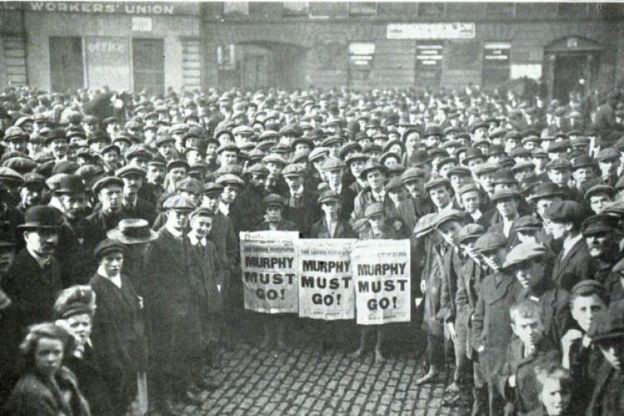
Workers’ demonstration with newsboys (WM Murphy owned the Irish Independent newspaper). (Source image: Internet)

The national (non-workers’) movement was divided in its opinion: many of Redmond’s Irish Parliamentary Party representatives were employers or landlords and their sympathies were naturally not with the workers. But for example Seán Mac Diarmada, a republican and national revolutionary, organiser for the secret Irish Republican Brotherhood4, opposed the strike on the basis that foreign business interests would profit by the paralysing of Irish business concerns5. On the other hand, Mac Diarmada’s mentor and head of the IRB in Ireland, Tom Clarke, was sympathetic to the strikers.

POLICE RIOTS

Unlike the gendarmerie6 British police force throughout Ireland of the Royal Irish Constabulary, at this time the constables of the DMP were unarmed except with truncheons but even with those they managed to kill people. On 30th August 1913 the DMP baton-charged a crowd in a street meeting on Eden Quay, outside Liberty Hall, HQ of the union7. Among the many injured were James Nolan and John Byrne who died 31st August and 4th September respectively, both in Jervis St. Hospital. (see also other riots and police attacks in Sources & Further Reading below).

On the 31st Jim Larkin went in disguise to address an advertised public meeting, banned by a magistrate, in Sackville (now O’Connell) St., Dublin. In view of the behaviour of the police, most of the IT&GWU activists went instead to their rented facilities at Fairview but a large enough crowd of the committed and the curious were assembled in O’Connell Street, along with large force of the DMP. Larkin, disguised as an elderly Protestant minister arrived by horse-drawn carriage and, as befitted a man made infirm by age, was assisted by Nellie Gifford8 into the Clery’s building which housed the Imperial Hotel restaurant, which belonged to W.M. Murphy (as did the Dublin Tram Co.). In order that Larkin’s strong Liverpool accent should not give him away, Nellie Gifford did all the talking to the staff inside. Shortly afterwards Larkin appeared at a restaurant window on the first floor and, top hat removed, spoke briefly to the crowd below but, as DMP rushed into the building, tried to make his getaway.
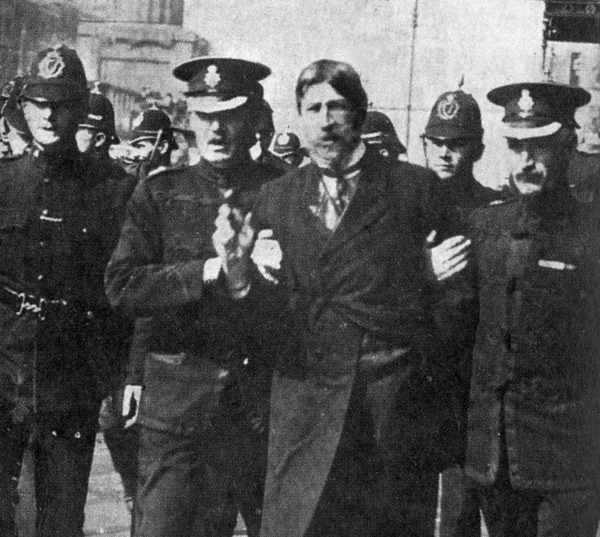
The arrest of Jim Larkin on 31st August 1913, being removed from the Clery’s building (see plinth of the Nelson Pillar behind and to the left) in O’Connell Street, just before the Dublin Metropolitan Police attack on the crowd. (Source image: Internet)

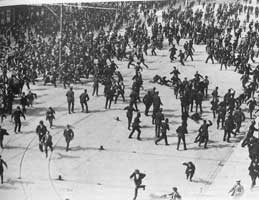
The DMP arrested Larkin and when the crowd cheered him (led by Constance Markievicz), the DMP baton-charged the crowd, striking out indiscriminately, including knocking unconscious a Fianna (Republican youth organisation) boy Patsy O’Connor who was giving First Aid to a man the police had already knocked to the ground. Between 400 and 600 were injured and Patsy suffered from headaches thereafter; though active in the Republican movement (he was prominent in the 1914 Howth guns collection9) he died in 1915, the year before the Rising. Among those beaten were journalists and casual passers-by. Those caught in Princes Street10 between DMP already in that street and the police charging across the main street were beaten particularly savagely.

The police attack became known as “Bloody Sunday 1913” (though two workers had been fatally injured on Eden Quay the day before and are often wrongly listed as having been killed on that day).
A photo of the police riot taking place on 31st August 1913 in O’Connell St; police can be seen striking with their truncheons even those on the ground. (Source image: Internet)

Also on that day the DMP attacked the poor working-class dwellings of Corporation Buildings (in “the Monto”, off Talbot St11), beat the residents and smashed their paltry furniture. The raid was a revenge attack for the reception of bottles and stones they had received on the 30th, when they were chasing fleeing workers from Liberty Hall (others crossed Butt Bridge to the south side and a running battle took place along Townsend Street and almost to Ringsend.
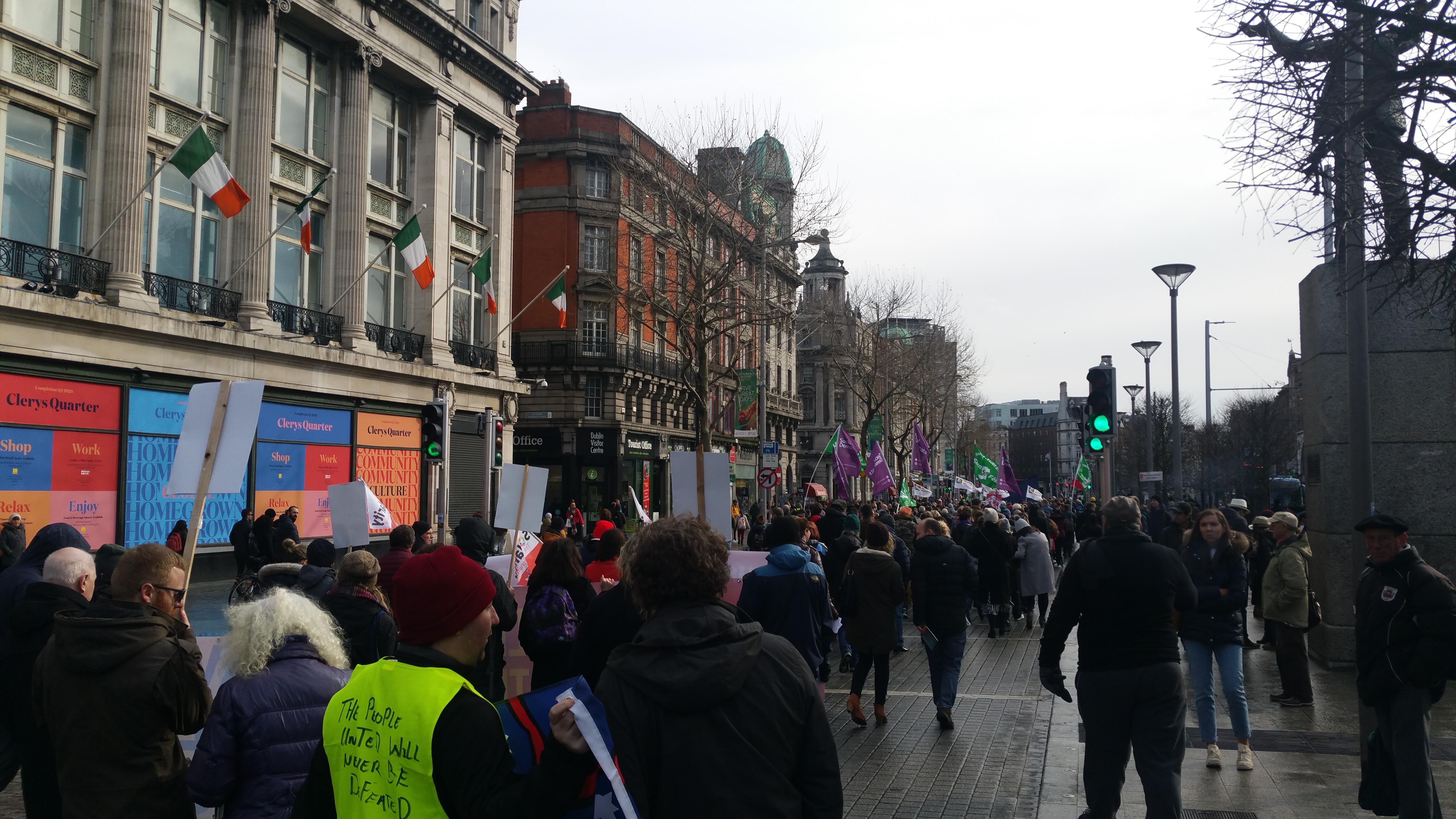
Protest march goes past closed-down Clery’s to the left in 2016 while Larkin looks down from his pedestal to the right. (Photo: D.Breatnach)

THE IRISH CITIZEN ARMY 1913 AND 1916

Very soon after those attacks, Larkin and Connolly each called publicly for the formation of a workers’ defence force, which became the Irish Citizen Army. Around 120 ICA, including female members fought with distinction in the 1916 Rising and raised their flag, the Starry Plough on the roof of WM Murphy’s Imperial Hotel on the upper floors of Clery’s building, opposite the GPO13. A number of its Volunteers were killed or wounded in action and two of the ICA’s leaders, Connolly and Mallin, were executed afterwards; another, Constance Markievicz, had her sentence of death commuted.
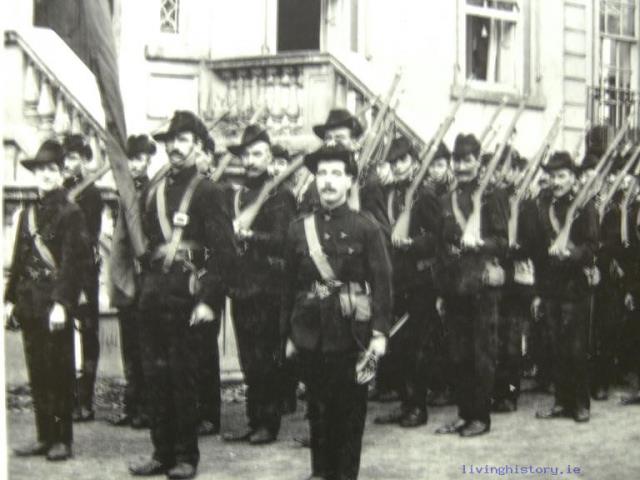
Irish Citizen Army on parade at their facility in Fairview. (Source image: Internet)

A much-diminished ICA took part in the War of Independence.

The end of August 1913 on Eden Quay and in O’Connell Street may be seen as the period and birthplaces of the ICA, the “first workers’ army in the world” and the first also to recruit women, some of whom were officers.

The Jim Larkin monument stands opposite the Clery’s building, which is now under renovation but without a mention on the monument or on the building of Bloody Sunday 1913 or its background and result. Sic transit gloria proletariis

end.
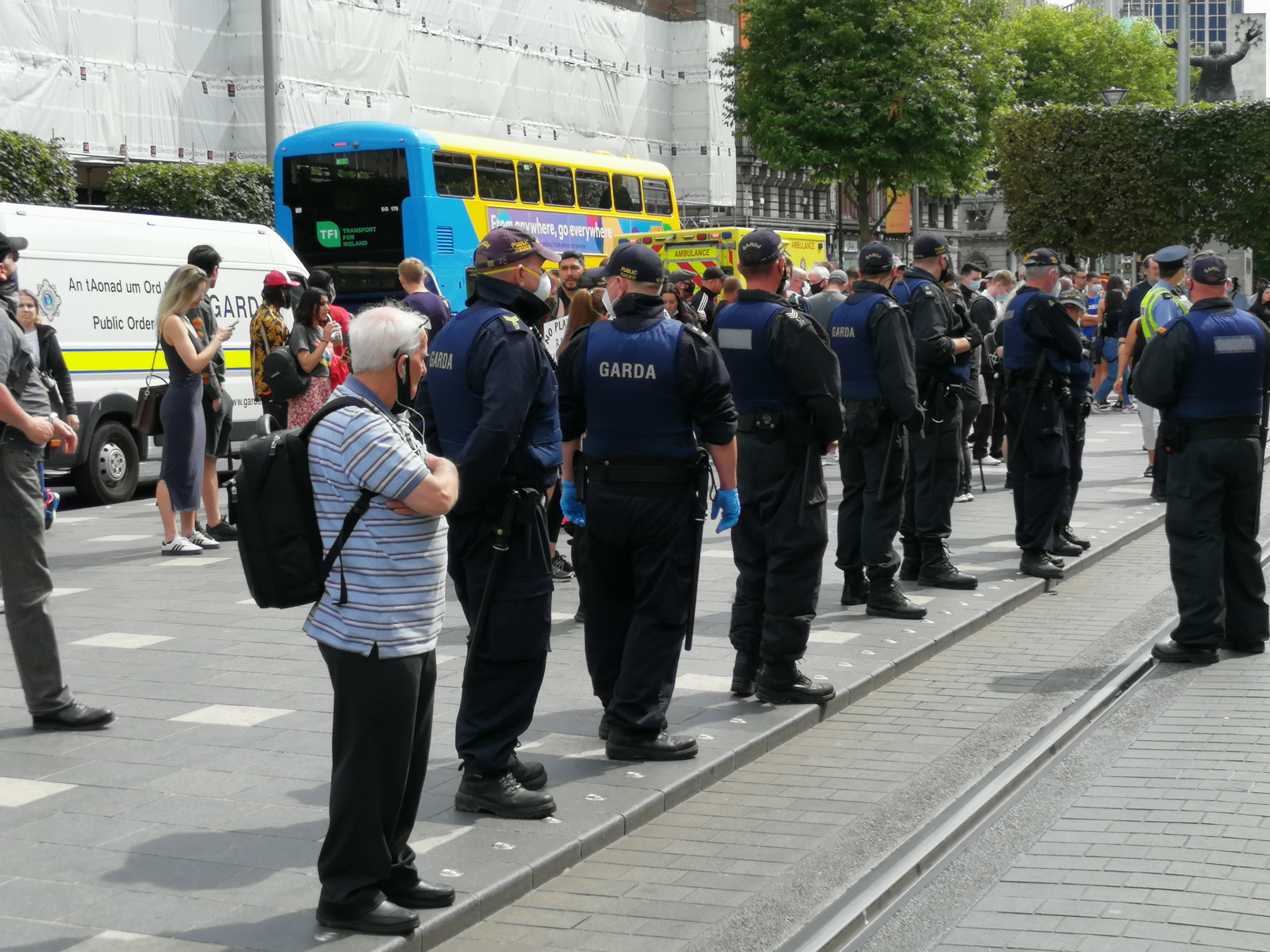
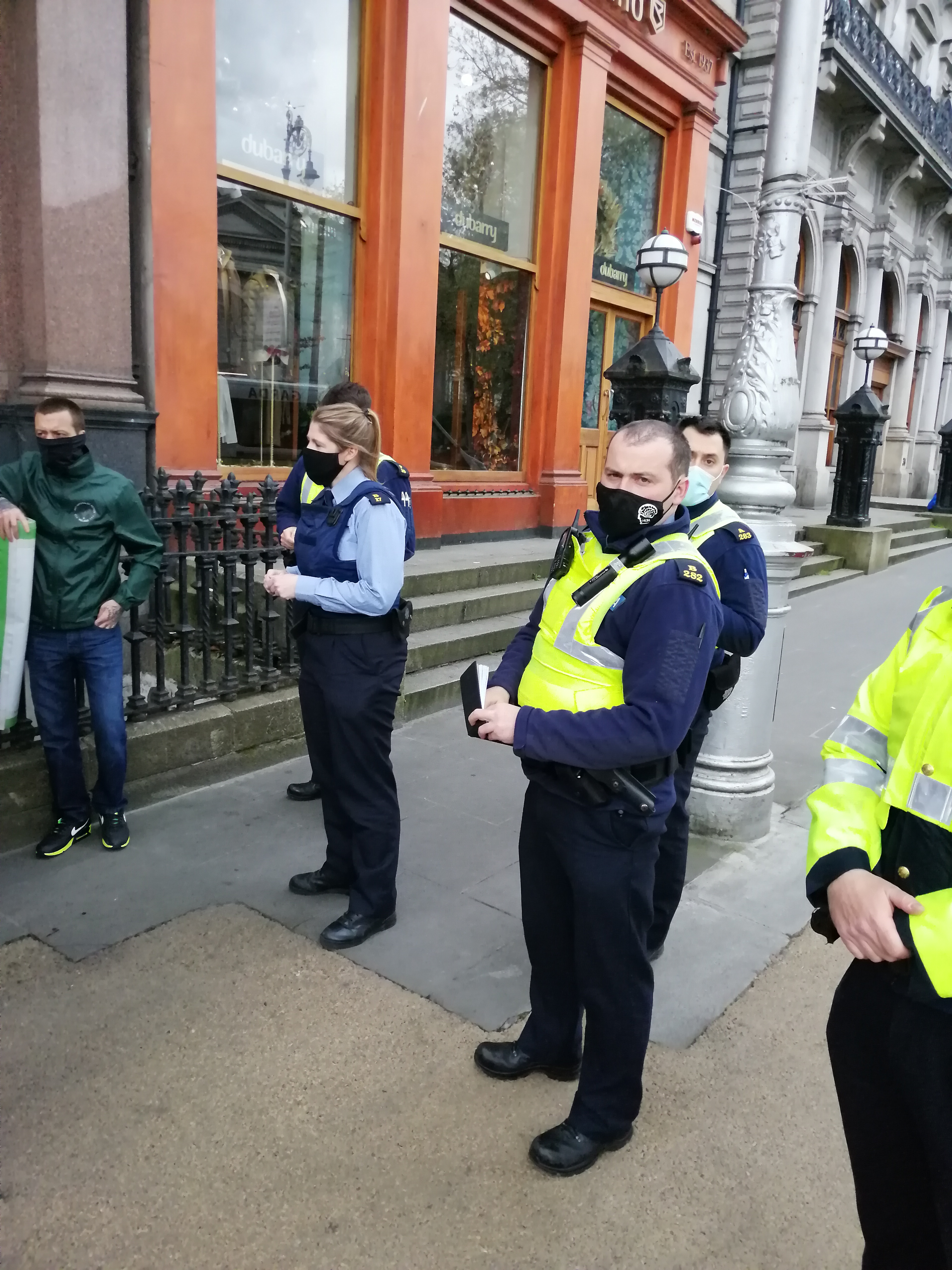
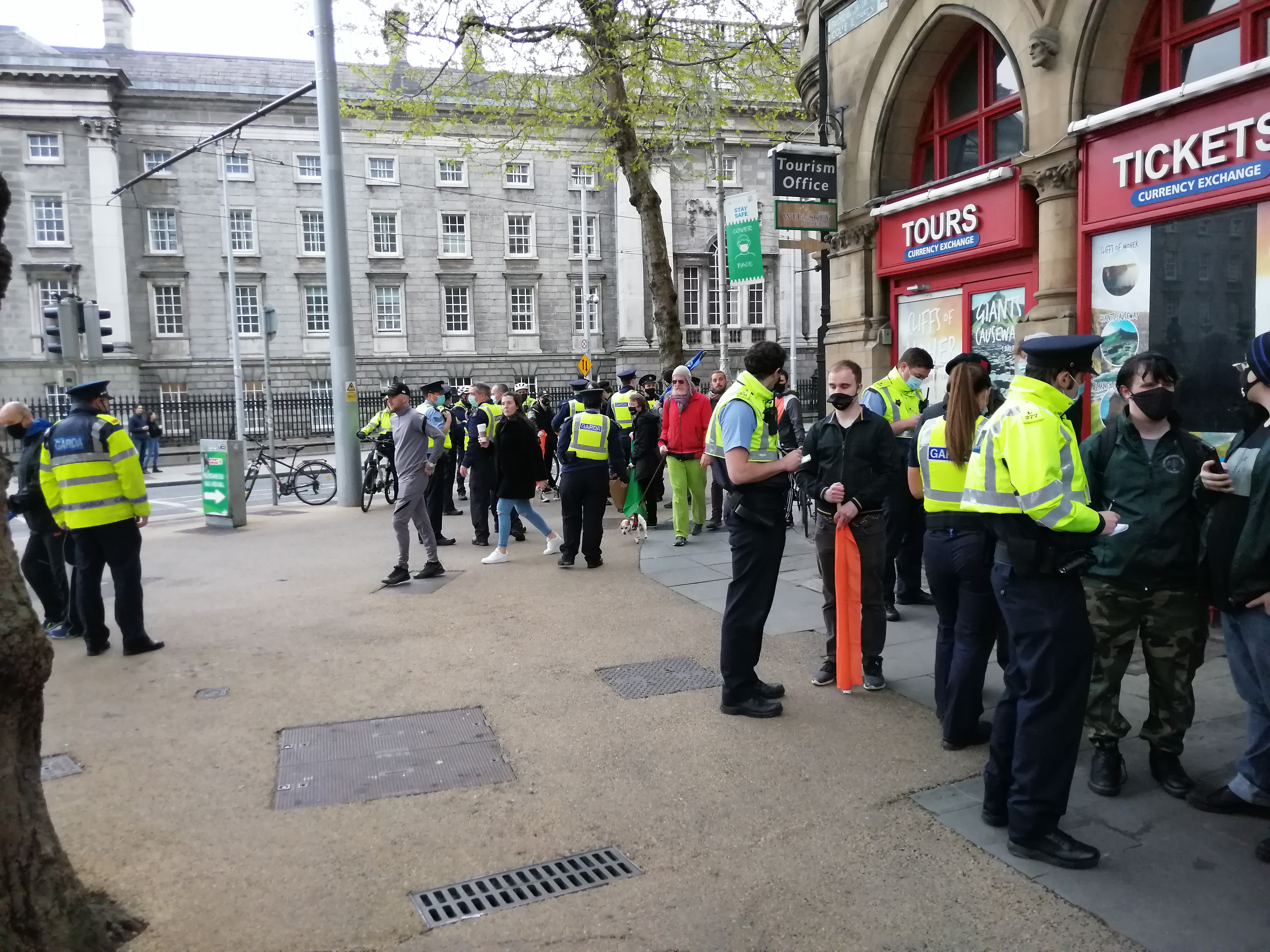
Today’s DMP, Garda Public Order Unit guarding far-Right gathering in O’Connell Street in 2020 (facing them, out of photo view). The Larkin monument can be seen in part at the top right-hand corner. (Photo: D.Breatnach)

FOOTNOTES

1The ITGWU was formed in 1909 by James Larkin, former organiser for the National Union of Dock Labourers after his bitter departure from that union. Most of the members Larkin had recruited for the NUDL, with the exception of the Belfast Protestant membership, left the NUDL and joined the IT&GWU.

2The provision in the declaration for members of unions other than the iT&GWU was necessary for the employers because of the general credo in Irish trade unionism that one did not cross a picket line, whether of one’s own union or of another, a credo that persisted in Ireland until the 1980s when the Irish Trade Union Council joined the “Social Partnership” of the State and the employers’ Federation. In addition, Larkin had added the principle that goods from a workplace on strike, even if strike-breakers could be got to bring them out, were “tainted goods” and would not be handled by members of the IT&GWU, nor should they be by any other union either.

3 Apart from any statements by bishops and priests, the religious charity organisation, the St. Vincent de Paul, refused assistance to families of strikers.

4 The IRB was founded simultaneously in Dublin and New York on 17th March 1858 and became known as “the Fenians”. In 1913 the movement had declined but was being rebuilt under the leadership of Tom Clarke, who went on to become one of the Seven Signatories of the 1916 Proclamation of Independence, all of which were executed b y firing squad after surrendering, along with another nine. Both were signatories of the Proclamation of Independence.

5It is one of the many ironies that on May 12th 1916, the last of the of the 14 surrendered leadership executed in Dublin (another two were executed elsewhere, one in Cork and the last in London) were Mac Diarmada and James Connolly, shot by British firing squads in Kilmainham Jail; the one an opponent of the workers’ action and the other one of its leadership.

6The gendarmerie is a particular militarised type of police force, armed and often operating out of barracks, like the Carabinieri of Italy, Gendarmerie of Turkey and Guardia Civil of the Spanish State. It is an armed force of state repression designed to control wide areas of potentially rebellious populations and it is notable that the parallel of the RIC did not exist in Britain, where the police force was mostly unarmed except by truncheon.

7Liberty Hall is still there today but a very different building (the original was shelled by the British in 1916) and SIPTU is a very different union too.

8Nellie was one of 12 children of a mixed religion marriage and was, like all her sisters (unlike the six unionist boys), a nationalist and supporter of women’s suffrage. Her sister Grace married Volunteer Joseph Plunkett hours before his execution and is, with Plunkett, the subject of the plaintive ballad “Grace” and Muriel married Thomas McDonagh, one of the Seven Signatories of the Proclamation, all of whom were among the 16 executed after surrendering in 1916. Nellie Gifford was the only one who participated in the Rising; she was a member of the Irish Citizen Army and was active in the Stephen’s Green/ College of Surgeons garrison, jailed and continued to be active after her release.

926th July 1914, when the yacht Asgard, captained by the Englishman Erskine Childrers, delivered a consignment of Mauser rifles and ammunition to the Irish Volunteers.

10Those may have been heading for Williams Lane which even today leads out from Princes Street to Middle Abbey Street (the junction of which is where James Connolly received the impact to his ankle in 1916).

11Corporation Buildings as one might expect housed working class people and the “Monto” (Montgomery Street) was a notorious red light district.

12The police station is still there, staffed by the Garda Síochána but in 1913 it housed also a British Army garrison.

13This flag, one of at least four different flags flown during the Rising, is now in the Irish National Museum at Collins Barrack. Shortly after the Rising it was noted by a British Army officer still in place upon the gutted Clery’s building and taken by him as a trophy to England. In 1966, the 50th anniversary of the Rising, the officer’s family returned the flag to the Irish people.

SOURCES AND FURTHER READING

Nellie Gifford: https://en.wikipedia.org/wiki/Nellie_Gifford

The Fianna boy who suffered a head injury: https://fiannaeireannhistory.wordpress.com/2014/12/

http://multitext.ucc.ie/…/Report_of_the_Dublin

1913 Ringsend Riot: http://comeheretome.com/…/04/07/1913-the-riot-in-ringsend/

WWII AGENT “GARBO” WAS ACTUALLY A HUSBAND AND WIFE TEAM

Many people know of “Garbo”, the Catalan spy who passed false information to the Nazis but few know of his partner, the Galician woman from Lugo who changed history.

By IVÁN FERNÁNDEZ AMIL06: 00 · 12/06/2020

(Translated from Castillian https://www.elespanol.com/quincemil/articulos/cultura/araceli-gonzalez-la-espia-gallega-que-engano-a-hitler? by D.Breatnach)

(Reading time: 5 mins.)

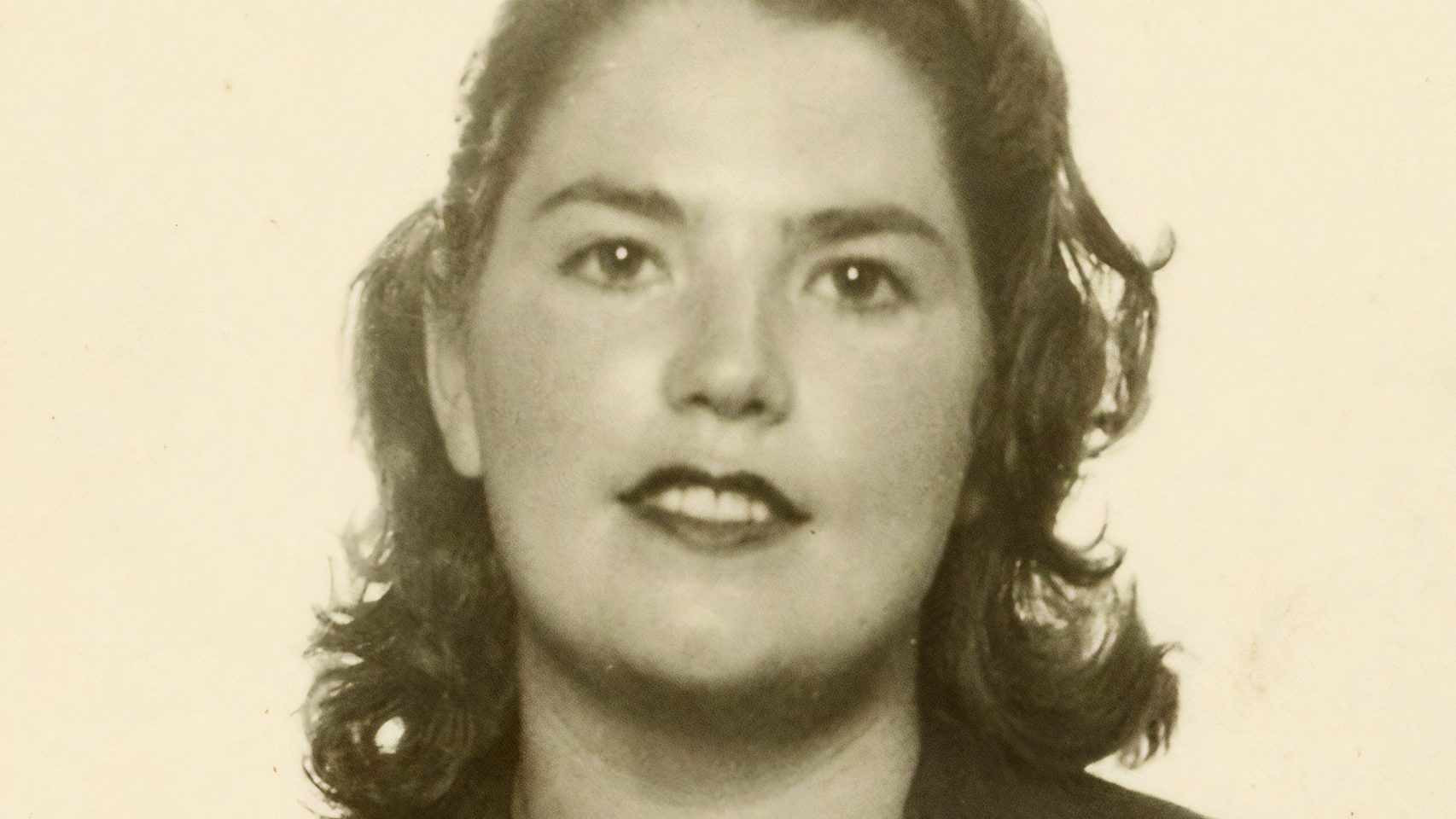
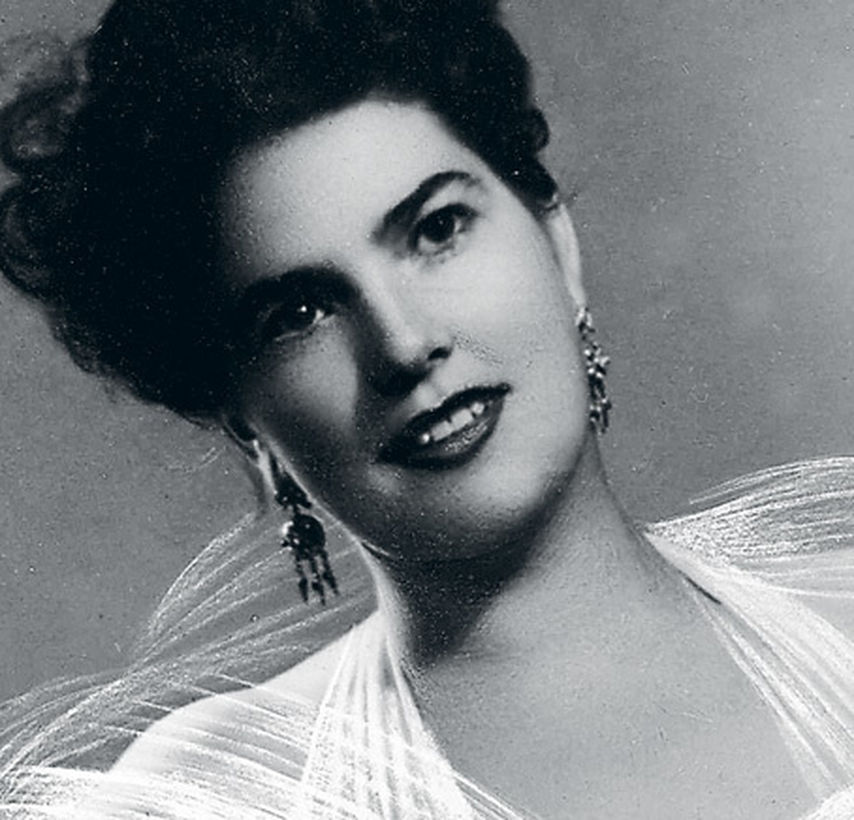
Araceli. https-//blog.nationalarchives.gov.uk

On June 6th 1944, a flotilla of more than 4,500 ships would transport 130,000 soldiers, and 20,000 vehicles across the English Channel, becoming the largest movement of people and material in the history of mankind. Known as D-Day, the Normandy Landing was the beginning of the end for Nazi Germany, but it would not have been possible without the key participation of a Spanish double agent, Juan Pujol, alias “Garbo,” who led Hitler to believe that the invasion would take place in Calais, 300 kilometers away. Garbo became a legend but recent investigations seem to indicate that perhaps the spy was not he but rather his beautiful wife. Today we know of a film-like story, the story of Araceli González Carballo, the Galician who deceived Hitler and who changed the course of a war1.

Araceli was born in Lugo in 1914, into a wealthy family. In the middle of the Civil War she volunteered to work in a blood bank hospital, until in 1938 she decided that she wanted to leave her hometown. Her father got her a position in Burgos, where she would work as secretary to the Governor of the Bank of Spain.

A young Araceli https-//www.garboespia.com

In February 1939, she met Juan Pujol, a young Catalan officer who had started the war on the Republican side and later switched to the National2 side, although he no longer believed in it. They get married and move to Madrid.

Juan Pujol Garcia in his uniform as a lieutenant in the Spanish Republican Army. https-//www.npr.org.jpeg

The two were of the opinion that Hitler would eventually lead Europe into disaster so they decided to offer themselves to the British to act as spies on the Germans in Madrid.

The British turned a deaf ear to her offer, so, in a risky decision, Araceli suggests to her husband that if they win the trust of the Third Reich, then they will be accepted by the British. Pujol, an officer in Franco’s army, appears at the German embassy in Madrid and offers himself to the Nazis. The ploy works and he begins working for the Third Reich’s Secret Services, the Abwehr. He is christened “Arabel” (from Araceli bella) and Friedrich Knappe is assigned as his contact.

Admiral Wilhelm Canaris https://es.wikipedia.org

Without knowing a single piece of information of interest, they pass reports to the Nazis, making them believe that they reside in London and that they have a network of informants when, really, they live in Lisbon and all they share with the Germans are inventions and rumors.

Declassified MI5 Index card for Araceli https://www.elespanol.com

Knowing that their cover was really weak, Araceli travels to Madrid to fake a fit of jealousy in front of Knappe. She shows up at the Embassy to tell him that she knew the German had held meetings with her husband and to ask him if he knew anything about Pujol, since she had left for London unannounced and had no news from him, fearing that he has abandoned her. Knappe succumbs to Araceli’s tears and beauty and reveals to her that Juan Pujol is doing essential work for the Third Reich. The deception had worked.

Juan’s identification card declassified by MI5. https://elpais.com

After that meeting, Pujol sent Germany highly valuable information about a British fleet that had left for Malta. He had learned the details by chance and considered it to be as false as the rest of the information he sent to the Nazis. But this time he was right, and the Abwehr took the information as a sign of Pujol’s skill.

That report was intercepted by the British and made their Secret Services very nervous so Araceli, without informing Pujol, decided that it was time to try again. And for this she turned to the North American Naval Attaché in Lisbon, Edward Rousseau, who got her an interview with the English. Araceli drops the bomb: “The spy you are looking for is my husband.” British Intelligence recruits Pujol and that is how “Garbo” was born, one of the most important and decisive double agents of the Second World War who, from London, and with a network of 27 false spies, misinformed the Nazis from the year 1942 until the end of the war.

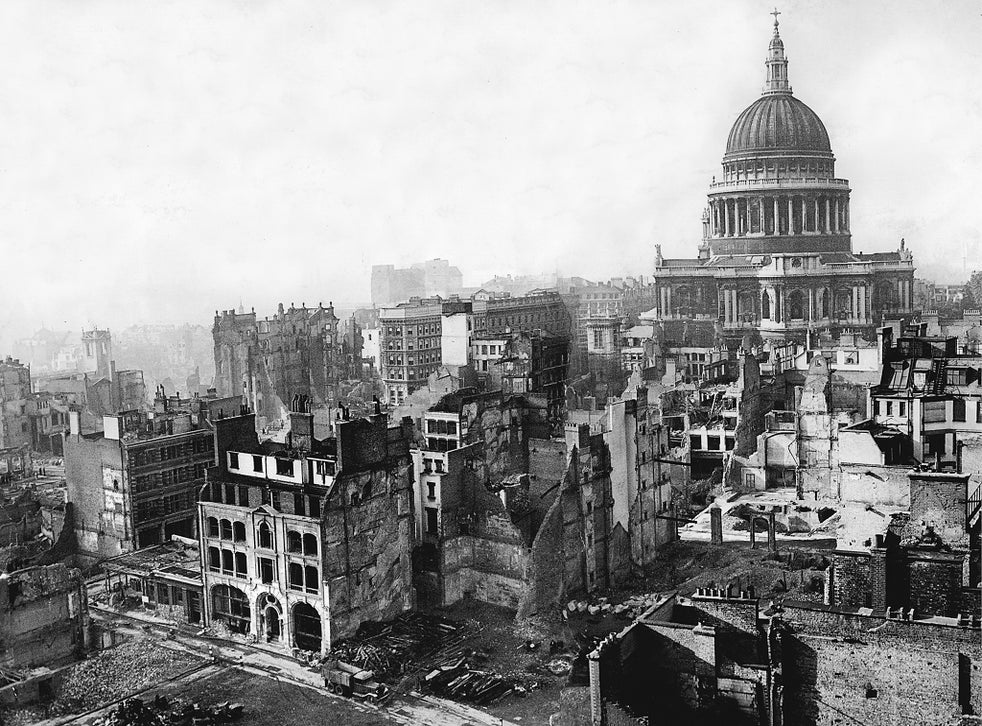
At the orders of MI5, the British Secret Service, they transmitted information to the Germans about which areas should be bombed by their air force, the Luftwaffe, without the Nazis knowing that they were unpopulated targets and without strategic interest. To confuse them, they sent them doctored photos of ruins and corpses, making them believe that the bombings had been a success.

London bombed WWII. https://www.independentespanol.com

But it is in 1944 when his performance becomes so decisive that there are those who consider that thanks to this couple the Allies won the Second World War3. With their fake spy network, they informed German Intelligence that the D-Day invasion would take place at Calais and not on the beaches of Normandy. That information delayed the German response long enough for the invasion to be a success. The same morning of June 6th, Pujol sent a message to the Germans in which he told them that the real landing was not the one that was taking place, but that it would be in Calais, days later. Hitler bought it.

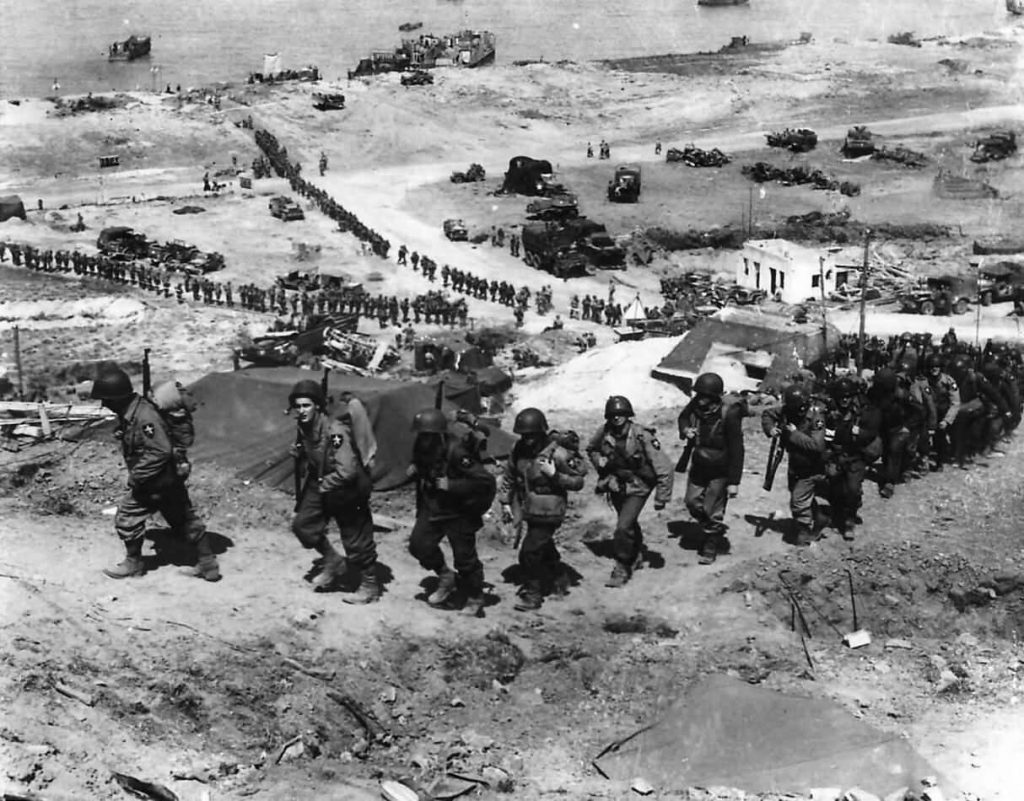
Normandy’s landing. https://www.worldwarphotos.info
USA troops moving inland from Normandy landing beaches. https-//www.worldwarphotos.info

What is surprising is that, according to declassified MI5 reports, Araceli almost ruined the entire operation. In 1943, Pujol was keeping his wife and his two children confined and controlled at home, which eventually enraged Araceli. “I don’t want to live another five minutes with my husband. Even if they kill me, I’m going to the Spanish Embassy to reveal the truth about him”. To avoid this, the British deceived the Galician woman into believing that her husband had been arrested because of her, so that she would come to her senses, which she finally did.

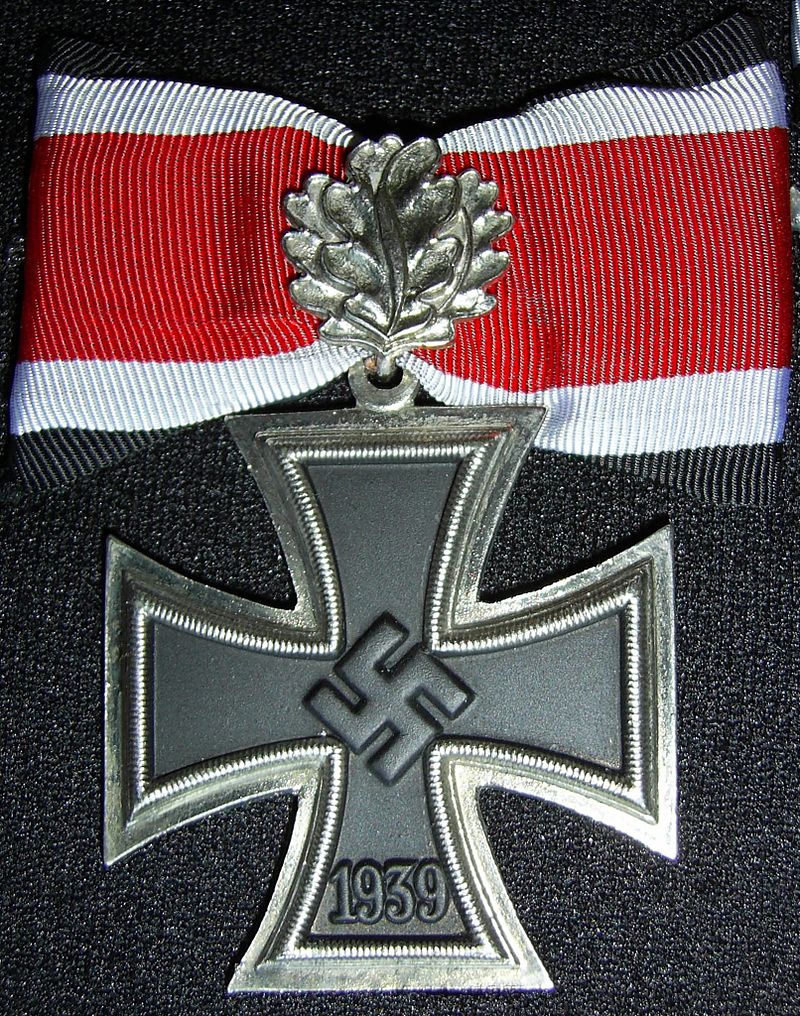
Despite the collapse of Germany, the Nazis never suspected Garbo, and Hitler would award him the Iron Cross, the highest decoration of the Third Reich.

Iron Cross, Nazi military decoration awarded to Pujol
. https://es.wikipedia.org

He would also receive the Order of the British Empire, becoming the only person decorated by both sides of World War II, but was unable to collect it, since he returned to Madrid with his family before he could receive it. In Madrid he was summoned by the Abwehr but it was Araceli who attended for fear that it was a trap. However the Germans just wanted to give him a monetary bonus for services rendered to the late Reich.

Order of the British Empire — Pujol is the only person to have received both the OBE and the Iron Cross. https://es.wikipedia.org

Now separated from MI5, they moved to Venezuela but Araceli did not adapt to that life, so she returned to Lugo with her children and separated from Pujol. Three years later, in a precarious financial situation, she settled in Madrid, where the British remembered that Garbo’s wife also got them to win the War, so they helped her with a job as an interpreter for the British and American embassies.

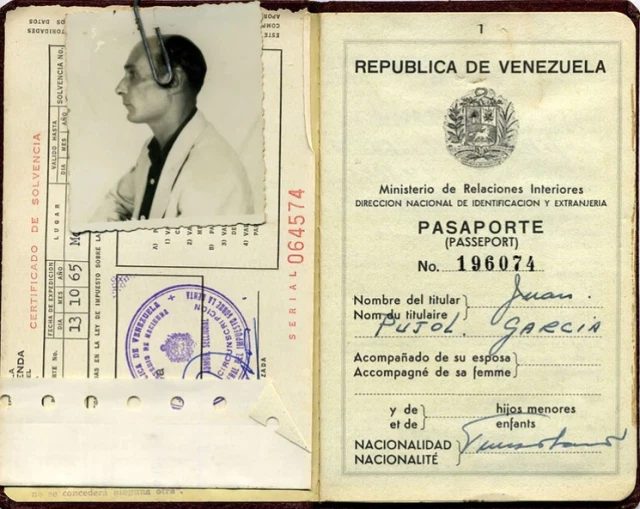
Venezuelan passport of Juan Pujol. https://albertonews.com

In 1956 news reached her that her husband had died in Angola4 from malaria and she married Edward Kreisler, with whom she maintained a hectic social life in the capital, where they received the most illustrious guests from the United Kingdom and the United States, and they founded an art gallery that would eventually have branches in New York and Miami and which is still in operation today.

However, a twist in this real-life film script was still missing. In 1984 the writer Nigel West met Pujol on the shores of Lake Maracaibo and convinced him to return to London and receive formal recognition of his achievements during the war. It turns out that his former boss at MI5 had spread a rumour that he had passed away in order to get the spy out of circulation. All the British and Spanish newspapers and different European television stations presented him as the hero that he was. And Prince Philip of Edinburgh publicly paid tribute to him in a commemoration of the 40th anniversary of the Normandy Landings.

Juan Pujol with the Order of the British Empire outside Buckingham Palace in 1984. https://www.xlsemanal.com

The former spy traveled to Spain and, after asking Araceli for permission, he was reunited with his children and met his grandchildren. The Spain-based family also traveled to Venezuela where Pujol had rebuilt his life and had three other children.

DEATHS

Juan Pujol died in Venezuela in 1988, in Choroní where, in one of his residences, can be read: “Here was the greatest spy in history.” Araceli would die too just two years later, in Madrid, following a stroke. Her remains rest in the Sacramental Cemetery of San Isidro.

San Isidro Cemetery, Madrid. https://www.pasionpormadrid.com

No one knew her true story until MI5 declassified a large part of the files that revealed Araceli’s true participation in her husband’s adventures, and writers and journalists such as José de Cora, director of Progreso de Lugo, Ben Macintyre, editor from The Times, Javier Juárez or Edmond Roch (winner of a Goya for his documentary on Garbo), began to investigate.

But Garbo was not a person, it was a team. It would not have existed without Pujol, but neither would it have existed without the help and courage of Araceli. One has to wonder which of the two was really the spy. The answer is not as clear as it might seem.

The Garbo spy team – Araceli and Juan https-//www.garboespia.com

This is the story how a Galician from Lugo allied herself with a Catalan from Barcelona to have an adventure that would change the course of history, in which they would deceive the Third Reich, the Nazis and Hitler himself. Without them the history of Europe and of the world would have been very different.

End.

FOOTNOTES

1Certainly the Nazi focus on Calais allowed the the US, British and Dominion troops to fight their way ashore and eventually establish a beachhead. But most analysts would say that it was the Battle of Stalingrad that was the real turning point in the War and sealed the fate of the Nazi’s military plans and of the regime.

2The military-fascist side called themselves the “Nationalists” and much of the world’s media used that description in their reporting and many historical references continued that description. They were engaging in a coup against a democratically elected government and in so far as they were “nationalists” they were Spanish nationalists but suppressing the nationalist aspirations of the Basques, Catalans and Galicians, also doing so with foreign military forces of Nazi Germany and Fascist Italy. They should be called what they were: military-fascist coupists.

3This is obviously an inflated claim, if it is indeed true that historians are of that opinion; there is rarely one point other than the final battle which can be said to “win” a war (see also earlier footnote with reference to Stalingrad).

4Angola was then a Portuguese colony

SOURCES AND REFERENCES

  • MACINTYRE, B. La historia secreta del Día D: La verdad sobre los superespías que engañaron a Hitler. Editorial Crítica, 2013
  • JUÁREZ, J. Juan Pujol, el espía que derrotó a Hitler. Ediciones Martínez Roca, 2004
  • DE CORA, J. El estornudo de la mariposa. Editorial Edhasa, 2016
  • es.wikipedia.org
  • elpais.com
  • elprogreso.es
  • lavozdegalicia.es
  • farodevigo.es
  • galiciaunica.es
  • elespanol.com
  • radiomitre.cienradios.com
  • garboespia.com
  • blogs.20minutos.es
  • laopinioncoruna.es
  • elpais.com
  • finanzas.com
  • lasexta.com


GUNSHIPS IN THE MERSEY, ARMED TROOPS ON THE STREET — LIVERPOOL 1911

Diarmuid Breatnach

(Reading time: 6 mins)

As part of a general rise in workers trade union militancy in the UK (including then Ireland), a general transport strike was called in August 1911. This involved train operators, dockers, sailors, carters and other types of worker. At one point the British State drafted extra police into Liverpool and, eventually, armed soldiers (as had been done against striking miners in the Rhonda Valley, Wales) and Royal Navy gunboats were sent up the Mersey river. On 12th August a massive police charge on workers attending a rally in Liverpool resulted in nearly two hundred injuries and became known as the city’s Bloody Sunday1.

BACKGROUND

1888 is seen by many labour historians as the point at which the weight of importance in the trade union movement shifted from the craft unions with their guild traditions, to the general workers, the “unskilled” (sic) and “semi-skilled” and when trade union actions began to be more militant and sustained. Over the following years, the working class built up its strength through many industrial struggles, many of which it lost but the general impetus was forward.

The great areas of need for capitalism were coal extraction for power, factory production for producing commodities and machines, along with transport to convey the coal to the factories and the commodities from the factories to the country and to the world. In 1911 transport involved trains and shipping, as well as horse and cart (motor transport had yet to generally oust the horse), the unions being those of train workers, ship-builders, carters and sailors. Factory workers were in engineering, textile and other unions. Miners unions recruited the coal-diggers and sorters. Construction workers were needed to build housing for workers, factories for them to work in, roads, railways and canals to transport goods and fuel.

In general, workers were becoming more militant and more politicised, more aware of ideas about the situation of their class and its future. Increasingly, workers in one union would support those of another on strike (although it was not until 1914 that three unions formed the Triple Alliance: The Miners Federation of G. Britain, The National Union of Railwaymen and The National Transport Workers’ Federation).

LIVERPOOL

In Liverpool on May 11th 1911 there was a huge demonstration in the port city of Liverpool as part of the seamen’s strike led by the Transport Workers Federation. The strike being total and with difficulty in employing trained scabs, the employers were obliged to agree new terms with the union.

Mass workers meeting, Liverpool August 1911 (Sourced photo: Gunboats article)

“Hearing of the victory of the seamen, 4,000 dockers immediately walked off the job on June 28 demanding improved pay and conditions. The dockers, many of whom had refused to load ships during the national strike, were quickly followed out by the scalers and coal heavers, and by the end of the day 10,000 men were on strike. Seeing this, the seamen walked out on strike again purely in support of the dockers. Mass meetings were held, and the largely un-unionised dock workers began to flock to the National Union of Dock Labourers (NUDL2).” (Libcom)

“It was the Transport strike during August that was to see matters escalate even further and near pushed the country to revolution. This incidentally was a national dispute with the railways going out on strike. This in turn was supported by dockers and other transport workers that saw the transportation of goods being brought to a grinding halt.

“Tensions were rising with the shipping companies stating that the dockers were in breach of their contract and declaring a lockout. To add fuel to the fire they also tried to call the military in as strike breakers.” (Gunboats up the Mersey)

As the rail strike began to spread across the country, a mass demonstration in Liverpool was declared as a show of support.

Support for the strike cut across the sectarian lines existing in Liverpool. “Reading Fred Bower’s account of workers marching from all over Liverpool must have shaken the establishment. ‘From Orange Garston, Everton and Toxteth Park, from Roman Catholic Bootle and the Scotland Road area they came. Forgotten were their religious feuds. The Garston band had walked five miles and their drum major proudly whirled his sceptre twined with orange and green ribbon.’

‘Never in the history of this or any other country had the majority and might of the humble toiler been so displayed. A wonderful spirit of humour and friendliness permeated the atmosphere.’ ” (Gunboats etc)

Tom Mann addressing a mass meeting in Liverpool August 1911 (Sourced photo: Gunboats article)

“Taking place on August 13 at St George’s Plateau, 100,000 workers came to hear speeches by workers and leaders of the unions, including Tom Mann. The demonstration went without incident until about 4 o’clock, when, completely unprovoked, the crowds of workers suddenly came under attack from the police. Indiscriminatedly attacking bystanders, the police succeeded in clearing the steps of St George’s Hall in half an hour, despite resistance from strikers who used whatever they could find as weapons. Fighting soon spilled out into nearby streets, causing the police and troops to come under attack as workers pelted them with missiles from rooftops. Becoming known as Bloody Sunday, the fighting resulted in scores of injuries on both sides.” (Libcom)

Mounted Police escorting material with armed troops marching behind them, Liverpool August 1911 (Sourced photo: Gunboats article)

“There are no records of why the Police decided to charge a peaceful crowd which resulted in a mass panic with 186 people being hospitalised and 95 arrests. Fred reports how after the carnage caused by the Police that it resembled a battlefield with wounded men, women, and children, lying singly in heaps over a vast area.” (Gunboats etc)

(Police with prisoners, Liverpool August 1911 (Sourced photo: Gunboats article)

“Fighting across the city continued for several days, coming to a head when a group of workers attacked a prison van carrying some arrested strikers. Two workers were shot dead by troops during the ensuing struggle, one a docker and the other a carter.

“A general strike of all transport workers in Liverpool was arranged for the night of August 14, and the next day saw the city come to a complete halt. Any movement of goods was closely guarded by troops, most of whom were drafted in from outside of Liverpool as the territorials of the city had largely been confined to barracks, the authorities wary of their loyalty3.” (Libcom)

Liverpool August 1911 (Sourced photo: Gunboats article)

“Following Bloody Sunday a convoy of prisoners who had been arrested on that day were being escorted by thirty-two soldiers of the 18th Hussars on horseback fully armed with live ammunition along with mounted Police. A magistrate was also present carrying a copy of the riot act. However before it could be even read a disturbance broke out on Vauxhall road with troops opening fire, injuring five people, two fatally. The victims were John W. Sutcliffe and a twenty-nine year old docker Michael Prendergast. Five days later, on the 19th August two more civilians were shot by troops in Llanelli. These are the last occasions in history when British soldiers have killed civilians on the streets of mainland Britain.” (Gunboats etc)

Troops ride a lorry load of material, Liverpool August 1911 (Sourced photo: Gunboats article)

“However, the strike’s days were numbered. Under intense pressure from the government to end the dispute, the railway employers and moderate leaders of the railwaymen’s union began a series of talks. A deal was struck ensuring that all strikers would be reinstated, and the railwaymen returned to work on August 21, with a general return to work ordered for the next day. Sporadic rioting occurred in working class districts throughout the end of August.” (Libcom)

Troops bearing rifles, Liverpool August 1911 (Sourced photo: Gunboats article)

“The show of strength displayed by the transport workers of Liverpool in 1911 clearly demonstrated the material gains that could be won through cross-industry solidarity. Paving the way for the massive industrial revolts by British workers during 1910-1914, the strike movement inspired similar action throughout the pre-war years.” (Libcom)

COMMENT:

Some historical commentary from the Left criticises the union leadership for their actions in settling the strike but I find it hard to see the justification for this. They got reinstatement of all sacked and locked-out workers (which is a lot more than the union leaders did in 1926 as, under the influence of the Labour Party, they scrambled to call off the General Strike). The alternative would seem to have been to go for revolutionary insurrection (which would certainly have impeded the later carnage of WWI 1914-1918) but: a) is it reasonable to expect revolutionary leadership from trade union leaders and (b) were conditions such that a significantly large section of the workers in Britain would have answered the call to revolution?

A different question is perhaps that of preparation for a possible police charge, of which there had been enough examples. Workers could have been encouraged to prepare pieces of timber as placard holders and staffs as flag and banner-poles. A defeat of a police attack is both a welcome defensive action as well as a confidence-building one for oppressed people.

The role of Churchill is striking in this period, particularly in the midst of recent disputes about his racism in general and his encouraging the setting up of the terror units of the Auxiliary Royal Irish Constabulary (Black and Tans) and the Auxilliary Division in Ireland. Although it must be remembered that Government Ministers generally act as representatives and in the interest of the ruling class, Churchill was a particularly imperialist and capitalist reactionary and had in January of that same year sanctioned the burning of an East End building in which anarchists had taken refuge in the Siege of Sidney Street.

In fact, Churchill was so reactionary and bellicose that during the 1926 General Strike he was kept away from any operational control in the Cabinet and entrusted with editing and producing eight editions of the virulent anti-striker British Gazette. The challenge to the adulation of the British ruling class and sycophantic historical cheerleaders of the historical person of Churchill does not lack for material to justify that challenge.

The fact that local troops in Liverpool could not be trusted by the ruling class is interesting and occurred again during the Glasgow General Strike in 1919 when, arguably a revolution should have been called for. By then the soldiers had been conscripted into a horrific imperialist war and were being prevented from demobilisation because they were going to be needed to suppress the national liberation struggles breaking out across the Empire. And one of those struggles was the War of Independence in Ireland which one can confidently predict would have allied with a British insurrection both from class solidarity and from opportunism. One of the leaders of the Glasgow workers, Willie Gallacher, of Irish descent (so was Tom Mann, by the way), member of the Independent Labour Party and later a Communist, commented later that the workers were ready but that the leaders were not. A revolutionary outlook should alert one that if the ruling class does not trust a part of their repressive forces, the least revolutionaries should do would be to call on those to join the struggle.

Liverpool’s son Jim Larkin was already in Ireland as an organiser for the NUDL and by 1911 leading the breakaway Irish Transport & General Workers Union, with the great struggle of the Lockout still to come in 1913. Then with Edinburgh-born-and-raised James Connolly, he went on to initiate the first workers’ army in the world, the Irish Citizen Army.

The 1911 martyrs of Sutcliffe and Prendergast were recorded as being A contingent of Liverpool city’s Irish diaspora would join the Irish Volunteers and embark for Dublin to take part in the 1916 Rising, when a Royal Navy gunboat would sail up a different river and open fire on what was considered a British city. Later, sailors and dockers operating from Liverpool would be sending consignments of arms to the IRA for their War of Independence.

But in Britain, the workers of Liverpool fought some great battles and those of August 1911 were a harbinger of others to come.

End.


FOOTNOTES

1 (NB: I remember reading about this many years ago and as the anniversary is with us decided to write it up however briefly. I have used material from some articles rather than the articles themselves because some lacked detail, others were more general or I did not agree with descriptions of workers’ motivations being solely about wages and good working conditions. However I hope this article encourages people do their own reading on the events or at the very least raises their awareness of the history of the working class and of its enemies.)

2This was the trade union that employed Jim Larkin as an organiser and also sent him to organise in Belfast. Subsequently Larkin was sent to Dublin where he led the building up the NUDL up very successfully with a number of successful strikes. Subsequently Larkin and the NUDL’s Irish leader, Sexton, parted company after the latter had Larkin tried in court. After that, Larkin founded the Irish Transport & General Workers’ Union and most of the Dublin members of the NUDL left that union to join the ITG&WU, of which James Connolly also became a leader.

3This is similar to the situation of the 1919 Glasgow General Strike, when the locally-garrisoned troops were confined to barracks for fear they’d support the workers.

REFERENCES AND SOURCES

https://en.wikipedia.org/wiki/1911_Liverpool_general_transport_strike

https://libcom.org/history/1911-liverpool-general-transport-strike

Send the gunboats up the Mersey.

https://en.wikipedia.org/wiki/Triple_Alliance_(1914)

REILIG NAOMH CHANNAITHE I BHFIONNGHLAS – “LEAG FREAGRACHT A CÚRAIME ORAINNE”

Diarmuid Breatnach

(Achar ama léite: 2 nóim)

Tá reilig i mBaile Átha Cliath a bhfuil breis agus míle bliain aici, agus crois ann a tartháladh ó loiteadh Chromail. Ach tá cuid de mhuinntir na h-áite mí-shásta leis an saghas cúram a bhfuil Comhairle Cathrach Bhaile Átha Cliath ag tabhairt di agus táid ag iarraidh iad féin a bheith freagrach as cúram na reilige.

Tá Reilig Naomh Channaithe suite díreach siar ón débhealach a ghearrann trí Fhionnghlas agus shéipéil.

“Tá uaimheanna ann do na h-uaisle áitiúla — teaghlach Maffett — atá daingnithe anois”, adeir Joe Lynch ag caint i mBéarla, “chun cosaint a dhéanamh ar robálaithe uaighe. Tá tuamaí cófra ann do na sagairt a fuair bás agus easpaig, agus cinn cloiche simplí do na comóntóirí.”

Bhí athair Joe Lynch mar airíoch ar an reilig agus bhí teaichín aige cois reilige dá bharr; b’ann a tógadh an clann páiste, Joe san áireamh. “Thugtaí isteach mé chuig an reilig i mbarra rotha,” adeir Joe, ‘agus mé ceithre bliain d’aois. Agus bheinn ag iarraidh cabhrú nuair a ligfí amach mé.”

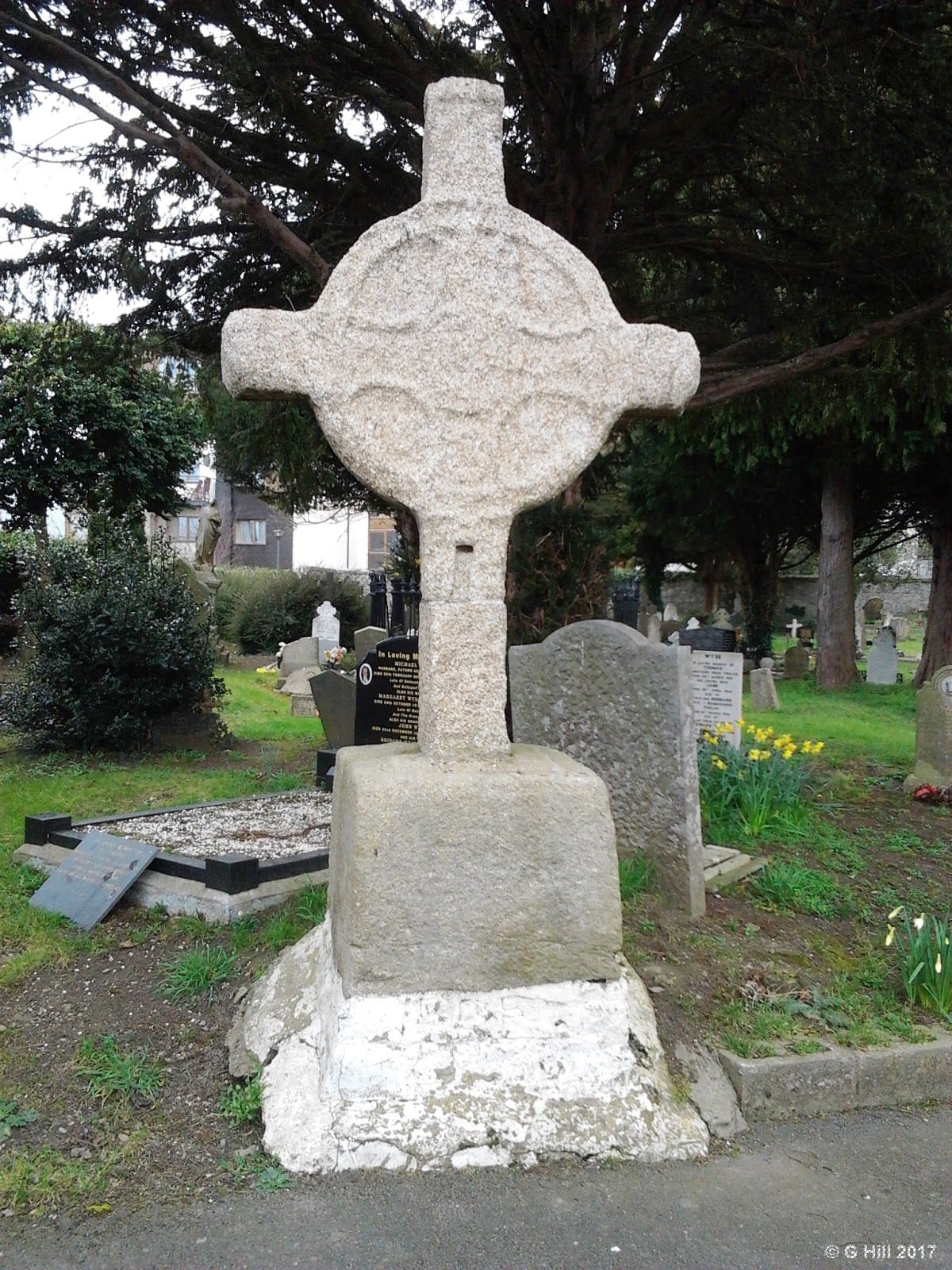
An crois Críostaíoch ársa sa reilig (Griangraf: G. Hill)

NAOMH CAINNECH

B’ab, sagart agus misinéir Éireannach é Cainnech (515 / 16-600) as Achadh Bhó ins an Condae ainmnithe ar a shon, Cill Chainnigh chomh maith le bunaitheoir mainistreach i rith na luath-mheánaoise. Tugtar “Saint Canice” air i mBéarla in Éirinn, “St. Kenneth” in Albain nó “St. Kenny” agus i Laidin “Sanctus Canicus”. Tá an Cainneach ar cheann de Dháréag Aspal na hÉireann agus rinneadh sé seanmóireacht ar an gCríostaíocht ar fud na tíre agus ar na Cruithnigh in Albain. Scríobh sé tráchtaireacht ar na Soiscéil, ar a tugadh Glas-Chainnigh nó “Lock Kenneth” nó “Slabhra Chainnigh” ar feadh na gcéadta bliain.

Tá an chuid is mó dá bhfuil scríofa faoi shaol Cainnech bunaithe ar thraidisiún, ach measadh go raibh sé ina fhear le dea-cháil, le solabharthacht mór agus le léann. I 544 rinne sé staidéar faoi Mobhí Cláraineach i scoil Ghlas Naíon, le Ciarán as Cluain Mhic Nóise agus Comgall de Bheannchar. Nuair a scaip plá an pobal sin, chuaigh sé go mainistir Cadoc i Llancarfan i Glamorganshire sa Bhreatain Bheag, áit ar ordaíodh ina shagart é i 545.

Tá tagairt dá ainm luaite i sé logainm déag ag Wikipedia: in Éirinn, sa Bhreatain Bhig, in Albain, ins na SAM, san Astráil agus sa Nua-Shéalainn. Déantar comóradh ar a lá féasta an 11ú Deireadh Fómhair san Eaglais Chaitliceach Rómhánach agus in Eaglais Cheartchreidmheach an Oirthir de réir a gcuid féilirí faoi seach (Gregorian nó Church Julian) le laethanta féasta breise an 1d nó 14ú Lúnasa in Eaglais Cheartchreidmheach an Oirthir.

(Griangraf: D. Breatnach)

MEITHEAL OIBRE

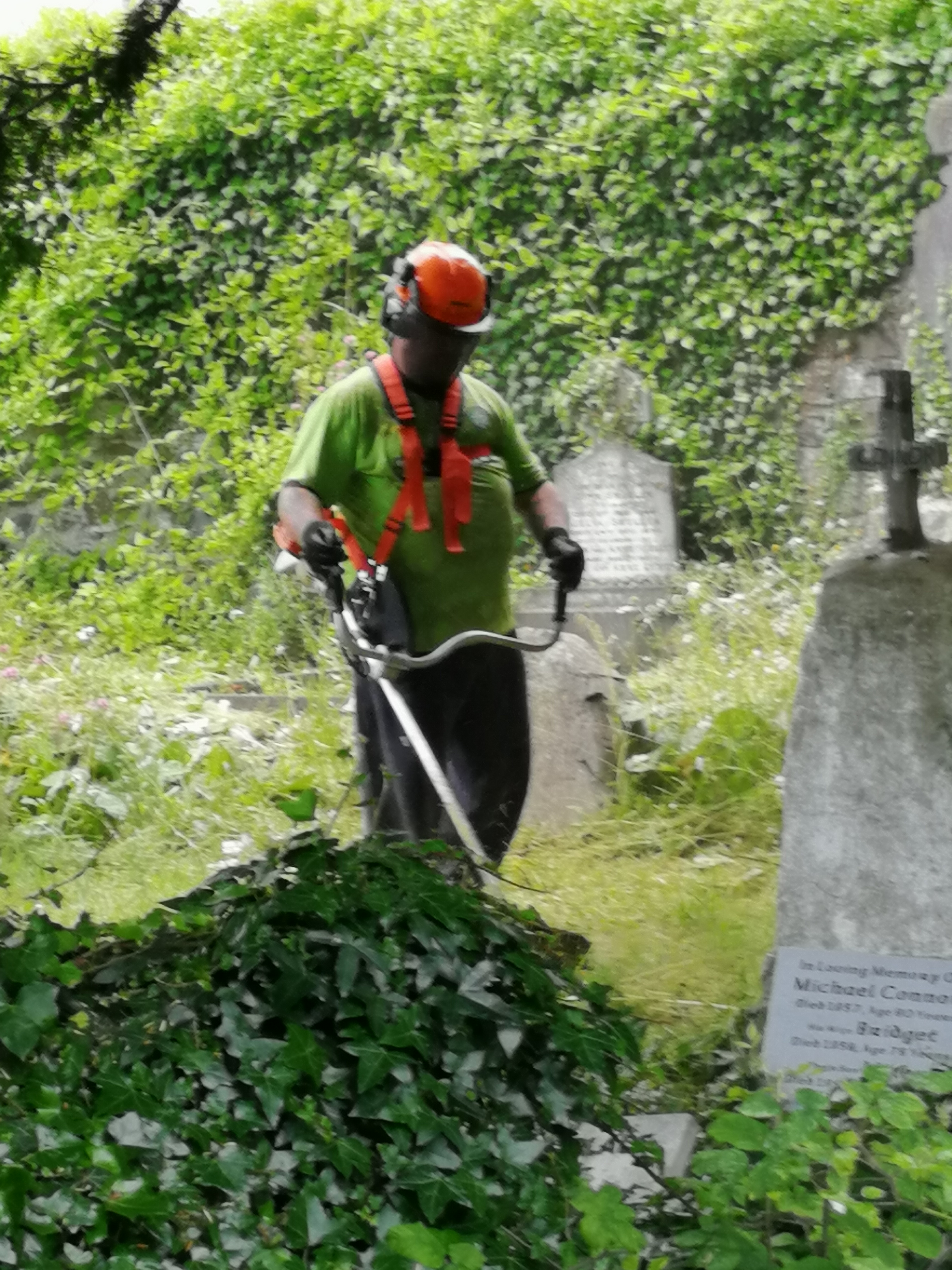
Bhí meitheal oibre ann sa Reilig trathnóna Déardaoin seo chaite agus iad ag baint fiadhaile agus féir, ag gearradh driseacha, eidhneáin is a leithéid. Bhí na préamhacha go doimhin in áiteanna agus ba léir nach ndearna cóiriú ceart le tamall fada. “Tá an eidhneán ag clúdú ballaí an fhothrach agus de réir a chéile ag déanamh dochar dó. Is ón 10ú nó 12ú Céad an cill agus ba cheart na ballaí a chaomhnú,” adúirt ball den chumann staire áitiúil.

Joe Lynch i mbun oibre. (Griangraf: D. Breatnach)

“D’úsáid teaghlaigh Protastúnacha agus Caitliceacha an reilig,” adeir Joe, “lucht creidimh amháin ag teacht isteadh geata amháin agus an geata eile ag an gcreidimh eile. Ach ní gá dúinn an dá gheata anois agus táim ag tathant ar an gComhairle an geata eile a tháthú le fada.”

Deir lucht an chaomhnaithe go ndearnadh an crois ársa a roinnt i gcodanna sa 17ú Céad ionnas go bhféadfaí a chur i bhfolach nuair a chuala go raibh fórsaí Chromail le teacht thríd an dúiche, de fhaitíos go ndéanfadh siad an siomból a scrios mar a bhí á dhéanamh acu ar fud na tíre (ag iarraidh “íoldadhradh” a ruaigeadh). Thóg na fórsaí céanna bóthar eile ach d’fhan píosa na croise i bhfolach go ceann breis agus 160 bliain, go dtí go ndeachadh an t-urramach Walshe á lorg thrí bhéaloideas na h-áite agus tháinig air, ach níor fuarthas bun na croise go dtí seo.

Tá an crois céanna sa Reilig anois agus glacadh ag cumainn áitiúla mar siomból na dúiche. De réir Joe Lynch tá an Comhairle Cathrach ag iarraidh an crois a bhailliú as an reilig ach tá sé féin agus daoine eile ag iarraidh go bhfágfaidh ann é agus cúram na Reilige a fhágáil ag muinntir na h-áite.

Tá meithil eagraithe chun oibre ag an reilig trathnónta Sathairn agus oícheannta Déardaoine agus tuilleadh eolais ar leathanach Facebook na reilige.

Duine den mheithil i mbun oibre. (Griangraf: D. Breatnach)
Ball eile den mheithil. (Griangraf: D. Breatnach)

FOINNSÍ:

https://en.wikipedia.org/wiki/Cainnech_of_Aghaboe

In Finglas, Residents Push for Better Maintenance of a Historic Graveyard

https://www.facebook.com/St-canices-graveyard-105954865096973/

APPENDIX:

English translation:

ST CANICE’S CEMETERY IN FINGLAS – “LET US HAVE THE RESPONSIBILITY”

Diarmuid Breatnach

(Reading time: 2 mins)

There is a cemetery in Dublin that is over a thousand years old, containing a cross that was salvaged from Cromwell’s destruction. But some locals are unhappy with the kind of care that Dublin City Council is giving it and want to take responsibility for the care of the cemetery.

St. Canice’s Cemetery is located just west of the dual carriageway which cuts through Finglas and churches.

“There is a crypt for the local esquires, the Maffett family – now cemented,” says Joe Lynch, “to protect it from grave robbers. There are chest tombs for the dead priests and bishops, and simple headstones for the commoners. ”

Joe Lynch’s father was caretaker of the cemetery and had a cottage next to it; it was where Joe was raised as a child. “I was taken to a cemetery in wheelbarrow,” says Joe, “when I was four years old. And I would want to help when I was let out.”

(Griangraf: D. Breatnach)

SAINT CANICE

Cainnech (515 / 16-600) was an Irish abbot, priest and missionary from the county named after him, Kilkenny, and the founder of an early medieval monastery. He is called “Saint Canice” in English in Ireland, “St. Kenneth” in Scotland or “St. Kenny” and in Latin “Sanctus Canicus”. Canice is one of the Twelve Apostles of Ireland and preached Christianity throughout the country and to the Picts in Scotland. He wrote a commentary on the Gospels, known as “Lock Kenneth” or “Chain of Canice” for centuries.

Most of what is written about Kenny’s life is based on tradition, but he was considered a man of good repute, great eloquence and learning. In 544 he studied at St. Mobhi’s in Glasnevin, with Ciarán of Clonmacnoise and Comgall of Bangor. When the plague spread, he went to Cadoc Abbey in Llancarfan in Glamorganshire, Wales, where he was ordained a priest in 545.

Wikipedia connects his name to sixteen placenames: in Ireland, Wales, Scotland, the USA, Australia and New Zealand. His feast day on October 11th is commemorated in the Roman Catholic Church and the Eastern Orthodox Church according to their respective calendars (Gregorian or Church Julian) with additional feast days on the 1st or 14th of August in the Eastern Orthodox Church.

WORKING GROUP

A “meitheal”, a cooperative work party was at work last Thursday afternoon pulling weeds, cutting grass, brambles and ivy. The roots were deep in places and it was clear that site had not been properly tended for a long time. “The ivy is covering the walls of the ruin and gradually damaging them. The church dates from the 10th or 12th Century and the walls should be preserved,” said a member of the local historical society.

“The cemetery was used by Protestant and Catholic families,” says Joe, “one group entering one gate and the other faith at the other. But we don’t need both gates now and I’ve been at the Council to weld the other gate for a long time. ”

Larry agus ball eile den mheithil. (Griangraf: D. Breatnach)

Conservationists say the ancient cross was divided into parts in the 17th Century so that it could be hidden when they heard that Cromwell’s forces were coming through the area, for fear of their destroying the symbol as was being done all over the country (to banish “idolatrous worship”). The same forces traveled another route instead but the pieces of the cross remained hidden for over 160 years, until the reverend Walshe investigated local folklore and found it, but the base of the cross has not been found to date.

The same cross is now in the Cemetery and has been accepted by local societies as a symbol of the district. According to Joe Lynch the City Council is trying to remove the cross from the cemetery but he and others want it to remain there and the care of the Cemetery to be left to the local people.

The cemetery has a working group organized on Saturday evenings and Thursday evenings, more information on the cemetery ‘s Facebook page.

Cuid de bhallaí fothrach na cille agus duine den mheithil. (Griangraf: D. Breatnach)
Ina luigh ach ag obair.
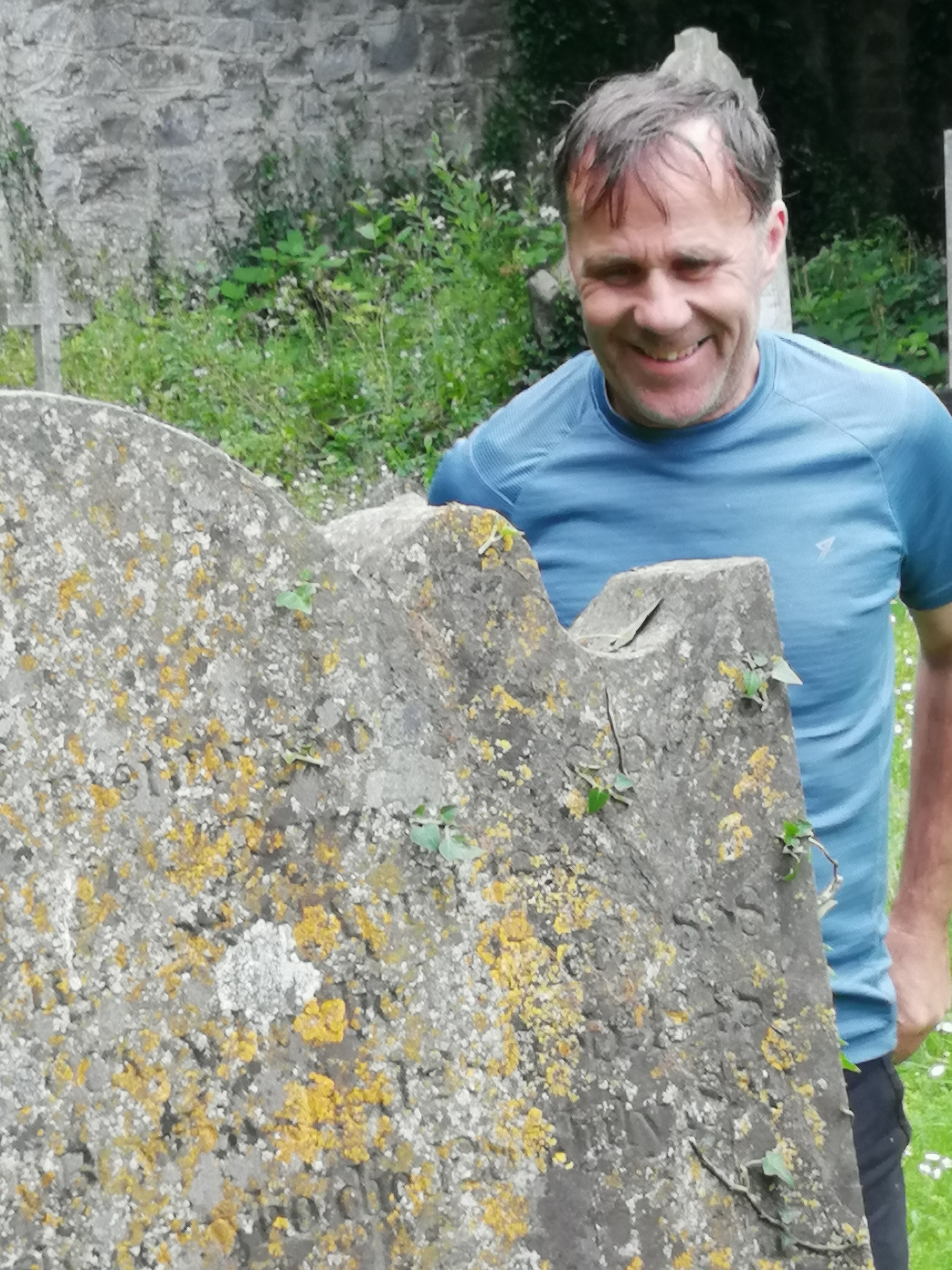
Darmuid Ó Dubhghlais agus sean-leac uaighe. (Griangraf: D. Breatnach)
An príomh-gheata agus an crois ársa in aice leis. (Griangraf: D. Breatnach)

ANTI-RACIST IRISH-AMERICAN WAS “THE QUINTESSENTIAL PRIEST”

By Geoffrey Cobb (Reprint from The Irish Echo 23 June 2021)

(Reading time: 2 mins.)

The Rev. Bernard Quinn faced opposition from the Ku Klux Klan on Long Island.

In 1983, African-American priest Fr. Paul Jervis was assigned to the parish of St. Peter Claver in Brooklyn, which had been founded in 1921 by Fr. Bernard Quinn, as Brooklyn’s first black Catholic parish. Speaking with his parishioners, Jervis was amazed to hear the stories of so many older people who still spoke of Quinn with profound reverence, even though he had died 43 years earlier.

Intrigued, Jervis began to research his predecessor and was so taken with Quinn’s life that he decided to write a biography of Quinn calling it: “Quintessential Priest, The Life of Father Bernard J. Quinn.” Jervis’s biography is an inspirational tale of a man whose love for his black congregation defined him and forged a unique community of faith.

Quinn was born in 1888 in Newark, N.J., into a large Irish Catholic family. His father, who was from County Cavan, and his County Offaly mother sent him to parochial school and young Bernard felt such a strong vocation that he entered the seminary in 1906, where he developed a lifelong deep sympathy for the poor and the downtrodden. Ordained in 1912 in Brooklyn, Quinn was assigned to diocesan parishes such as St. Patrick’s in Bay Ridge and St. Gregory the Great in Crown Heights.

SHOCKED BY RACISM IN US ARMY DURING WW1

When World War I erupted, Quinn volunteered to serve as a chaplain for front line troops. Commissioned as a First Lieutenant, Quinn served as chaplain of the 333rd infantry. Serving at the front, he became a victim of mustard gas. Though he recovered, Quinn suffered from the gassing for the rest of his life. In France, Quinn was shocked by the racism in the American army. When a white American Protestant chaplain refused to pray with a dying Black soldier, Quinn intervened and prayed with the dying soldier, but the troubling incident lingered with Quinn.

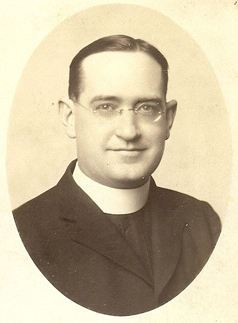
Fr. Bernard J. Quinn, c.1930 (Photo sourced: Wikipedia)

The war ended, but Fr. Quinn remained in France to minister to the wounded soldiers. After a chance reading of “The Story of a Soul, the life of St. Therese of Lisieux,” in the barracks library, Fr. Quinn discovered a spiritual hero. Learning that he was stationed in the vicinity of Alencon, not far from St. Therese childhood home, Quinn obtained permission to visit it and became the first priest to celebrate Mass there before it became a popular shrine. Intense devotion to St. Therese would define Fr. Quinn’s faith for the rest of his life.

BACK TO BROOKLYN FROM THE WAR

Quinn returned to Brooklyn in 1919. While preparing two black women for baptism, he was inspired to create an apostolate to African Americans, but his concern for Blacks was not shared by all Brooklyn’s Catholics, some of whom did not want African Americans praying in their churches. After repeated appeals, Quinn finally received permission from Bishop McDonnell to begin his mission to the Black people of Brooklyn, but finding Black Catholics proved difficult. Quinn went to the streets, asking every African American he met where he could find Catholics.

Finally, Quinn found Mr. Jules de Weever, the leader of the dissolved Colored Catholic Club, which had met from 1915-1916, seeking in vain to establish a church for Black Catholics in Brooklyn. Frustrated by the church’s indifference to their quest, the group disbanded. Quinn revived the CCC and inspired them to persevere in founding Brooklyn’s first Catholic church.

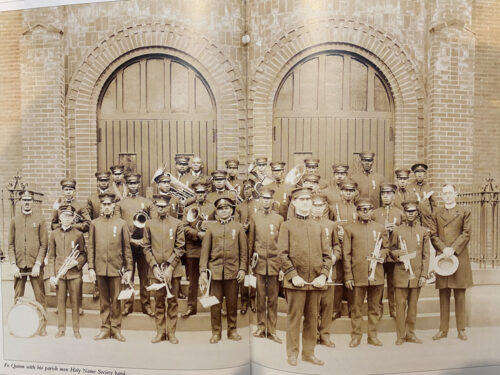
The Holy Name Band and Fr. Quinn (to far right). (Photo sourced: Internet)
The Rev. Bernard Quinn with young parishioners of St. Peter Claver during a religious festival. (Photo sourced: Internet)

Quinn incessantly petitioned the bishops for permission to establish an African-American parish, reminding them that Black Catholics were being excluded from worship at Italian, Irish and German churches, but instead of agreeing, the bishops ignored Quinn’s pleas. Finally, thanks to his perseverance, they authorized the founding of Brooklyn’s first African American Catholic Church, St. Peter Claver Church, in 1921, naming Quinn pastor.

The Irish-American priest now needed a church building and the parish soon found a warehouse for trunks and baggage that had once been a Congregationalist church on the corner of Ormond Street, now Peter Claver Place, and Jefferson Avenue, in the expanding black community of Bedford Stuyvesant. Quinn and the congregation enthusiastically set to work on the herculean task of transforming the warehouse back into a house of worship. The church’s decoration celebrated black faith with murals of early Black saints, and of St. Peter Claver’s work with enslaved Africans in Cartagena, Colombia.

On Christmas Day, 1921, the cornerstone for St. Peter Claver, named for the patron saint of African peoples, was laid. By 1922, the church was ready and blessed by Bishop Thomas Edmund Molloy. Quinn soon proved to be a model pastor and quickly the kindhearted priest endeared himself to his rapidly growing flock. Brooklyn’s Black Catholics were attracted to a church that didn’t just tolerate them, but even welcomed them with open arms. The parish became more than a place to pray, helping the parish’s poor, while also setting up a clinic, a credit union, a parish school, and adult education classes. St. Peter Claver soon became famous for its large children’s choir and its band. Legendary entertainers Lena Horne and Pearl Bailey both started their singing in the church’s choir. Reputedly, it was the first African-American choir ever to sing at the prestigious Brooklyn Academy of Music.

THE LITTLE FLOWER NOVENA BUSTOP

Fr. Quinn began a temporary daily novena, a series of prayers, to his inspiration, St. Thérèse, called the Little Flower Novena, but he never could have imagined the massive reaction the novena received. People begged for the novena to continue and an estimated that 10,000 of all races a week poured into St. Peter Claver’s. Within five years an amazing 2.2 million people had attended the novena, stirring the envy of nearby white Catholic pastors who complained that it drew away their parishioners. The novena was such a hit that the drivers on the bus line near the church would call out “Little Flower Novena stop.” The Brooklyn Daily Eagle soon did a feature article on the amazing success of the novena.

The novena proved to be a huge money maker for the parish, allowing Fr. Quinn to fund some of the parish projects he envisioned including a $300,000 school building, a convent, a recreation center and a Long Island orphanage that would ignite the bitter flames of racism. In 1929, Msgr. Quinn founded the Brooklyn Diocese’s first orphanage for Black children in a farmhouse in Wading River, Long Island, which at the time was still part of the diocese. A cross was burned in front of the Quinn family home in Mineola, but the priest defied the threat. Outraged racist locals contacted the Ku Klux Klan, which was very active on Long Island in the 20s and 30s, and the orphanage burned in an act of arson. The orphanage was rebuilt but burned again in the same year.

THE KLAN AND RACISM IN THE CHURCH

Undeterred, Father Quinn rebuilt the orphanage yet again, this time in stone and brick. The Brooklyn Eagle announced this with a headline, “New Fireproof Orphanage Will Defy Incendiary.” The KKK gave up, and the orphanage, called the Little Flower Orphanage, in honor of St. Thérèse, was dedicated as the Little Flower House of Providence Oct. 26, 1930. Today that organization survives as the Little Flower Children and Family Services of New York, offering adoptions and other social services in Brooklyn, Queens and Long Island.

Quinn became an outspoken defender of Brooklyn’s Blacks against the pervasive racism of his day. He denounced institutionalized racism and invited the Urban League, an African American advocacy group, to speak at his church. Some Brooklyn Catholic clergy spoke out against Quinn’s embrace of Black Catholics. In 1929, Msgr. John L. Bedford wrote in his Brooklyn parish newsletter that “Negroes should be excluded from this Roman Catholic Church if they become numerous.” Quinn vehemently defended his flock writing in the Brooklyn Tablet, “It seems to me that no church can exclude anyone and still keep its Christian ideals. The Constitution guarantees the freedom of religion and this, plus the fact that church property is tax exempt, ought to mean that anyone can go anyplace to worship.”

St. Peter Claver Church, Brooklyn, New York. (Photo sourced: Internet)

The strain of his herculean labors took a physical toll on Quinn. In the spring of 1940, Msgr. Quinn went into nearby St. Mary’s Hospital for surgery for an abdominal problem. He never came back to St. Peter Claver’s, dying on April 7. Brooklyn’s Black Catholics were in shock. They had lost a dear friend and their most vocal advocate. Eight thousand grieving mourners attended his funeral at St. Peter Claver, which was reported in all the New York papers including the New York Times.

In 1992, a movement to canonize Msgr. Quinn received the blessing of the Catholic Church and the long and difficult path to Quinn’s canonization has started. Decades before the founding of the Black Lives Matter movement, Fr. Quinn dedicated his life to serving Brooklyn’s Black Catholics and his life remains a shining example of the power of love to defeat hatred and bigotry.

End.

Author and teacher Geoffrey Cobb will lead a walking tour on Saturday, Aug. 7, of sites associated with the Tipperary-born Paddy “Battle Axe” Gleason, who was the last mayor of Long Island City before its 1898 incorporation into New York City. The event is sponsored by the New York Irish Center, 10-40 Jackson Ave. “Rebel Breeze” will shortly publish an article about the same Gleason by Geoffrey Cobb.

WHO FEARS TO SPEAK OF ‘98? REVULSION AT ETHOS OF O’CONNELL’S REPEAL

Diarmuid Breatnach

(Reading time main text: 2 mins.)

In 1843 the lyrics of In Memory of the Dead were published anonymously in The Nation but it seems to have been an open secret in Dublin political circles that the author was John Kells Ingram. As often happens, the song became known by its opening line “Who Fears to Speak of ‘98” and years later Ingram admitted having written the lyrics. Though it never once mentions Daniel O’Connell, taken in context of its subject, time and where it was published, the song was a blistering attack on the politician and his Repeal of the Union organisation. Yet while Kells Ingram was many things, he was no revolutionary — unlike the editors of the Nation and many of its readers.

Plaque indicating former location of The Nation newspaper in Middle Abbey Street, Dublin, premises bought out ironically by The Irish Independent. (Photo: D.Breatnach)

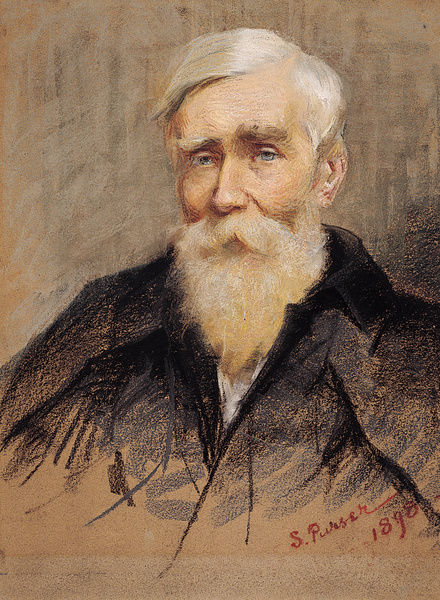
John Kells Ingram was a mildly nationalist mathematician, economist, philosopher and poet who was selected to write expert entries for the Encyclopedia Britannica. But although he was no revolutionary it is clear that he felt a distaste for O’Connell’s distancing himself from the memory of those who had risen in rebellion four decades earlier.

John Kells Ingram 1823-1907 (1890) by Sarah Purser (1848 – 1943). (Photo sourced: Internet)

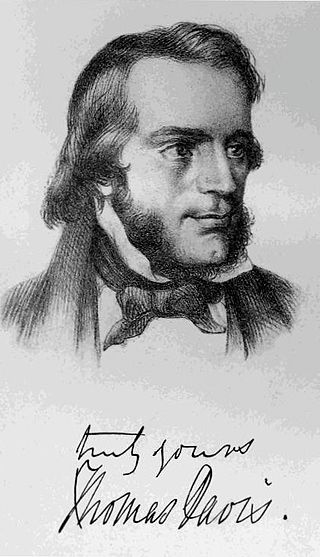
Supporting O’Connell initially, The Nation sought to create a patriotic and indeed revolutionary culture through its pages. One of The Nation’s founders and editors, Thomas Davis was perforce also one of the periodical’s contributors and his compositions The West’s Awake and A Nation Once Again are still sung today, the latter very nearly becoming Ireland’s national anthem. The lyrics of Who Fears to Speak celebrated historical memory of resistance and lamented death and exile, the latter to the USA, where many of the surviving United Irish had gone (“across the Atlantic foam“). Davis’ In Bodenstown’s Churchyard, commemorated and celebrated Theobald Wolfe Tone, remembered as the father of Irish Republicanism and martyr.

Portrait of Thomas Davis (Sourced on: Internet)

Three years after co-founding The Nation, Thomas Davis died of scarlet fever in 1845, a few months short of his 31st birthday. Two years later, in “Black ‘47”, the worst year of the Great Hunger, the Young Irelanders finally and formally split from O’Connell’s Repeal Movement and in 1848 had their ill-fated and short uprising – again jail and exile for the leaders followed. Just under a score of years later, 1867 saw the tardy and unsuccessful rising of the Fenians with again, resultant jail sentences and exile (in addition to the executions of the Manchester Martyrs).

Two years following the rising of the Young Irelanders, in 1850 Arthur M. Forrester was born near Manchester in Salford, England (the “Dirty Old Town” of Ewan McColl) and in 1869 his stirring words of The Felons of Our Land appeared in Songs of a Rising Nation and other poetry (Felons reprinted by Kearney Brothers in a 1922 collection including songs by Thomas Davis). Songs of a Rising Nation was a collection published by the militant and resourceful Ellen Forrester from Clones, Co. Monaghan, who struggled to raise her children after the early death of her husband and included poems by her son Arthur and daughter Cathy.

Felons of Our Land indeed contains some of the themes of Who Fears to Speak (of which Arthur was doubtless aware) but in addition those of jail and death on the scaffold. By that time, the Young Irelanders had been added to the imprisoned and exiled, some in escape to the USA but others to penal colony in the Australias. And Forester added the theme of pride in our political prisoners:

A felon’s cap’s the noblest crown

an Irish head can wear.

and

We love them yet, we can’t forget

the felons of our land.

Twenty years after the publication of The Felons of Our Land, in 1889, another Irishman, Jim Connell, writing in SE London, would contribute the lyrics of the anthem of the working class in Britain, The Red Flag. Although commonly sung to the air of a German Christmas carol, Connell himself put it to the the traditional Jacobite air of The White Cockade. Connell, from Crossakiel in Co. Meath, also invoked historical memory and included the theme of martyrdom in explanation of the flag’s colour:

The workers’ flag is deepest red —

it shrouded oft’ our martyrs dead,

And ‘ere their limbs grew stiff and cold

their life’s blood dyed its every fold.

Jim Connell (Sourced on: Internet)

The traditions and themes of resistance and struggle are handed from generation to generation and song is one of the vehicles of that transmission. But songwriters borrow themes not just from history but from the very songs of the singers and songwriters before them. In 1869 Arthur M. Forrester wrote in Who Fears to Speak of ‘98:

Let cowards mock and tyrants frown

ah, little do we care ….

Jim Connell, three decades later, took up not only the themes but also that line:

Let cowards mock and traitors sneer,

we’ll keep the red flag flying here.

End.

APPENDIX

References in lyrics to themes

of exile:

In Who Fears to Speak of ‘98 (1843)

Some on a far-off distant land

their weary hearts have laid

And by the stranger’s heedless hands

their lonely graves were made.

But though their clay

be far away

Across the Atlantic foam …

In The Felons of Our Land (1869)

…We’ll drink a toast

to comrades far away …

and

…. or flee, outlawed and banned

In The Red Flag (1889)

None.

of imprisonment:

In Who Fears to Speak of ‘98 (1843)

None.

In The Felons of Our Land (1869)

(Apart from the title and refrain)

… though they sleep in dungeons deep

and

Some in the convict’s dreary cell

have found a living tomb

And some unseen unfriended fell

within the dungeon’s gloom …

also

A felon’s cap’s the noblest crown

an Irish head can wear……

In The Red Flag (1889)

Come dungeons dark or gallows grim ….

of martyred death:

In Who Fears to Speak of ‘98 (1843)

Alas that might should conquer right,

they fell and passed away …..

In The Felons of Our Land (1869)

….. Some on the scaffold proudly died …

In The Red Flag (1889)

….. their life’s blood dyed its every fold ….

and

….. to bear it onward til we fall;

Come dungeons dark or gallows grim,

this song shall be our parting hymn.

of cowards and/ or traitors:

In Who Fears to Speak of ‘98 (1843)

Who fears to speak of ‘98,

who blushes at the name?

When cowards mock the patriot’s fate,

who hangs his head for shame?

He’s all a knave or half a slave

Who slights his country thus …

In The Felons of Our Land (1869)

…. And brothers say, shall we, today,

unmoved like cowards stand,While traitors shame and foes defame,

the Felons of our Land.

and

Let cowards mock and tyrants frown,

In The Red Flag (1889)

. ..Though cowards flinch and traitors sneer (repeated in the chorus, sung six times)

and

It suits today the weak and base,
Whose minds are fixed on pelf and place
To cringe before the rich man’s frown,
And haul the sacred emblem down.

of the higher moral fibre of revolutionaries:

In Who Fears to Speak of ‘98 (1843)

Repeated reference in every verse to such as

a true man, like you man and you men, be true men etc.

Alas that Might should conquer Right ….

In The Felons of Our Land (1869)

… No nation on earth can boast of braver hearts than they ….

also

And every Gael in Inishfail,

who scorns the serf’s vile brand,

From Lee to Boyne would gladly join

the felons of our land.

In The Red Flag (1889)

The banner bright, the symbol plain,
Of human right and human gain.

and

With heads uncovered swear we all
To bear it onward till we fall;
Come dungeons dark or gallows grim,
This song shall be our parting hymn.

of eventual victory:

In Who Fears to Speak of ‘98 (1843)

… a fiery blaze that nothing can withstand …

In The Felons of Our Land (1869)

None – but inferred.

In The Red Flag (1889)

It well recalls the triumphs past,
It gives the hope of peace at last;
The banner bright, the symbol plain,
Of human right and human gain.

SOURCES AND REFERENCES

John Kells Ingram: https://en.wikipedia.org/wiki/John_Kells_Ingram

https://www.britannica.com/biography/John-Kells-Ingram

Arthur Forrester: https://www.irishtimes.com/opinion/the-felons-ofour-land-frank-mcnally-on-the-various-lives-of-a-republican-ballad-1.4185803

Ellen Forrester https: https://en.wikipedia.org/wiki/Ellen_Forrester

Lyrics Felons of Our Land: https://www.workersliberty.org/story/2010/10/12/felons-our-land

Jim Connell and The Red Flag: https://www.historyireland.com/20th-century-contemporary-history/jim-connell-and-the-red-flag/
Monument to Daniel O’Connell in Dublin’s main street, now named after him. (Photo sourced: Wikipedia)

INTERNATIONALIST SOLIDARITY – THE DIVIDING LINE BETWEEN THE PEOPLE AND OUR RULERS

Diarmuid Breatnach

(Reading time: 12 mins.)

The oppression of the Palestinians led to an outbreak of active resistance recently in Jerusalem, to which the Israeli Army reacted with increased repression, timed to harass Palestinian Muslims during the period of Ramadan.

At the height of devotees attending the Al-Aqsa mosque, this escalated into attacks on worshippers within the temple itself. At the same time, Israeli Zionist settlers threatened dozens of Palestinian families with eviction from their homes in East Jerusalem.

Reacting to these events, one of the Palestinian organisations fired home-made rockets into officially Israeli territory, to which the Israeli armed forces responded in turn with drone missiles and missiles from its air force jets on Gaza.

The Zionist military fired on protesting Palestinians in the West Bank with live ammunition. The death toll has climbed to 200 Palestinians, according to Gaza’s Health Ministry, including 59 children and 35 women, with 1,305 people wounded. Ten Israelis have been killed, two of them children.

The casualty figures once again show the gross disproportion between what the Palestinians and their Zionist masters experience: in civil and human rights, citizenship, in land ownership, electricity and clean water supply, heating, fishing, education facilities, building materials …

… in freedom to travel inside and outside the state, in depth and breadth of surveillance, in arms and defence capability, in states that support them.

And in city structural damage: despite the many home-made rockets launched against the zionists, there has yet been no significant damage in Israeli towns, while their armed forces have effected large-scale structural damage in Gaza and bodies are still being pulled from the rubble.

In only one area perhaps do the Palestinians have the advantage over the Israeli Zionists: in support among the people around the world.


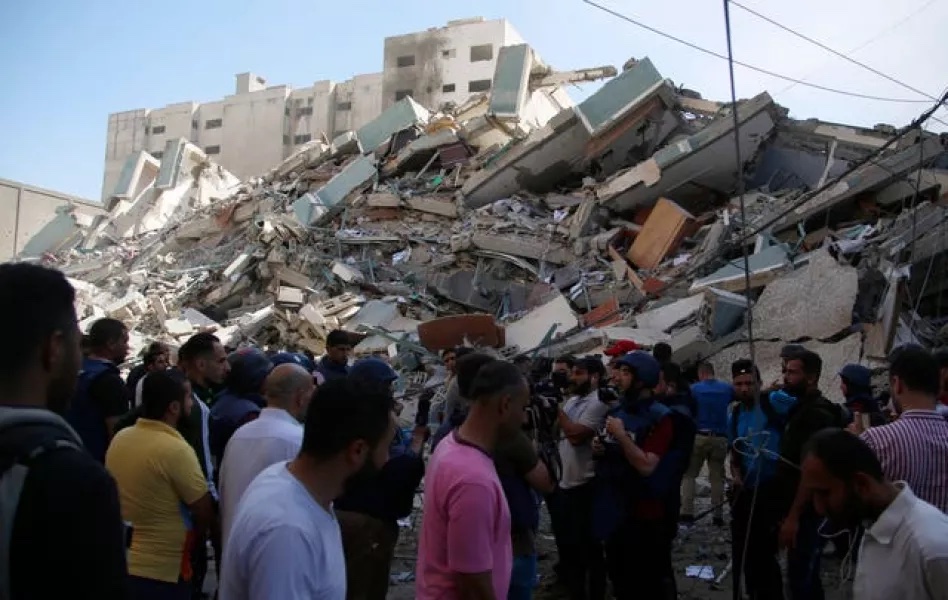
Israeli Zionist missiles strike the tower housing many media services, including Associated Press and Al Jazeera, which drew broad criticism from the mass media for a change. But families also lived here. Everyone was given ten minutes to get out. The Israeli Occupation Force has not yet bothered to explain its rationale for targeting this building. (Photo source: Internet)

PALESTINIAN SOLIDARITY MARCH DEFIES POLICE THREATS

Responding to these attacks on Palestinians, the Ireland Palestine Solidarity Campaign, the main organiser of Palestinian solidarity action in Ireland, called for solidarity demonstrations and in particular advertised a solidarity rally to take place in Dublin’s city centre for 2pm on Saturday 15th May.

The organisation asked those in attendance to comply with measures against Covid19 infection, to wear masks, maintain social distancing and comply with stewards’ instructions.

However the IPSC was contacted by the Irish police force, the Gardaí, who told them not to go ahead with the event, that if they did they would intervene to stop it and also made threats of €5,000 fines and prison against the organisers.

In a later public statement the Gardaí declared that they “have no role in permitting or authorising marches or gatherings. There is no permit/ authorisation required for such events”!

But there is apparently an ability and power to intimidate and threaten progressive organisations to deter them from organising solidarity events.

Or to kettle socialist and socialist republican Mayday marchers and demand all their names, addresses and dates of birth before threatening them with arrest if they did not disperse.

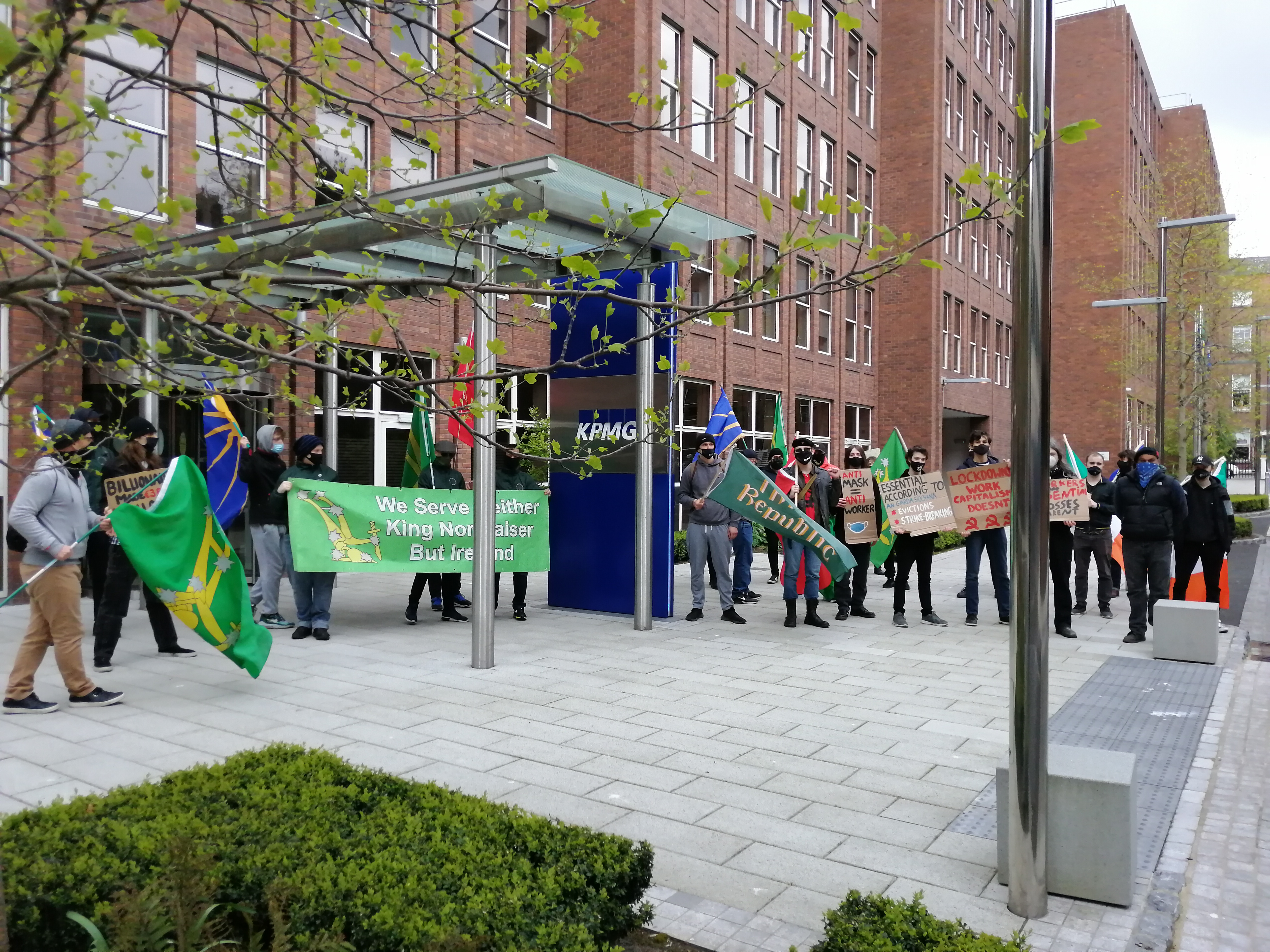
Or to threaten Debenham workers and their supporters, assaulting some of them while escorting KPMG forces in to evaluate stocks during pandemic restrictions.

A Palestinian policeman stands among the rubble of the tower in Gaza recently occupied by families and media agencies. (Photo source: Internet)

The predicament of the IPSC exposed the vulnerability to this kind of intimidation of a broad organisation that seeks to win friends in ruling circles. The leaders and organisers are placed in a position of not only personal but also of organisational vulnerability.

Even should they be prepared to defy the State to fine and/or imprison them, would they also be prepared to damage their organisation or to lose some friends they are cultivating in the circles of political influence?

What was one of the strengths of a broad organisation thus becomes a weakness; a more radical or even revolutionary organisation, with less influence in influential circles can decide on defiance, risk fines and jail with however perhaps less possibility of influencing official opinion and ultimately, action.

Fortunately in this case one such organisation did step forward and took up the baton: the Trinity College BDS group expressed its solidarity with the IPSC on its treatment by the Gardaí and called their own rally for the exact same place and time as the original one called by the IPSC.

https://www.irishtimes.com/news/ireland/irish-news/thousands-attend-rallies-in-irish-cities-in-solidarity-with-palestine-1.4566435

Video of rally at end of demonstration, near Israeli Embassy

Despite concern over Covid19 transmission and Garda threats – and the extremely short notice and much smaller circle of contacts of the TC BDS group — the response was magnificent, both in internationalist solidarity and in maintenance of the right to organise such progressive events.

Before the appointed hour, people began to gather in large numbers at the Spire in O’Connell Street, Dublin’s main street and north city centre.

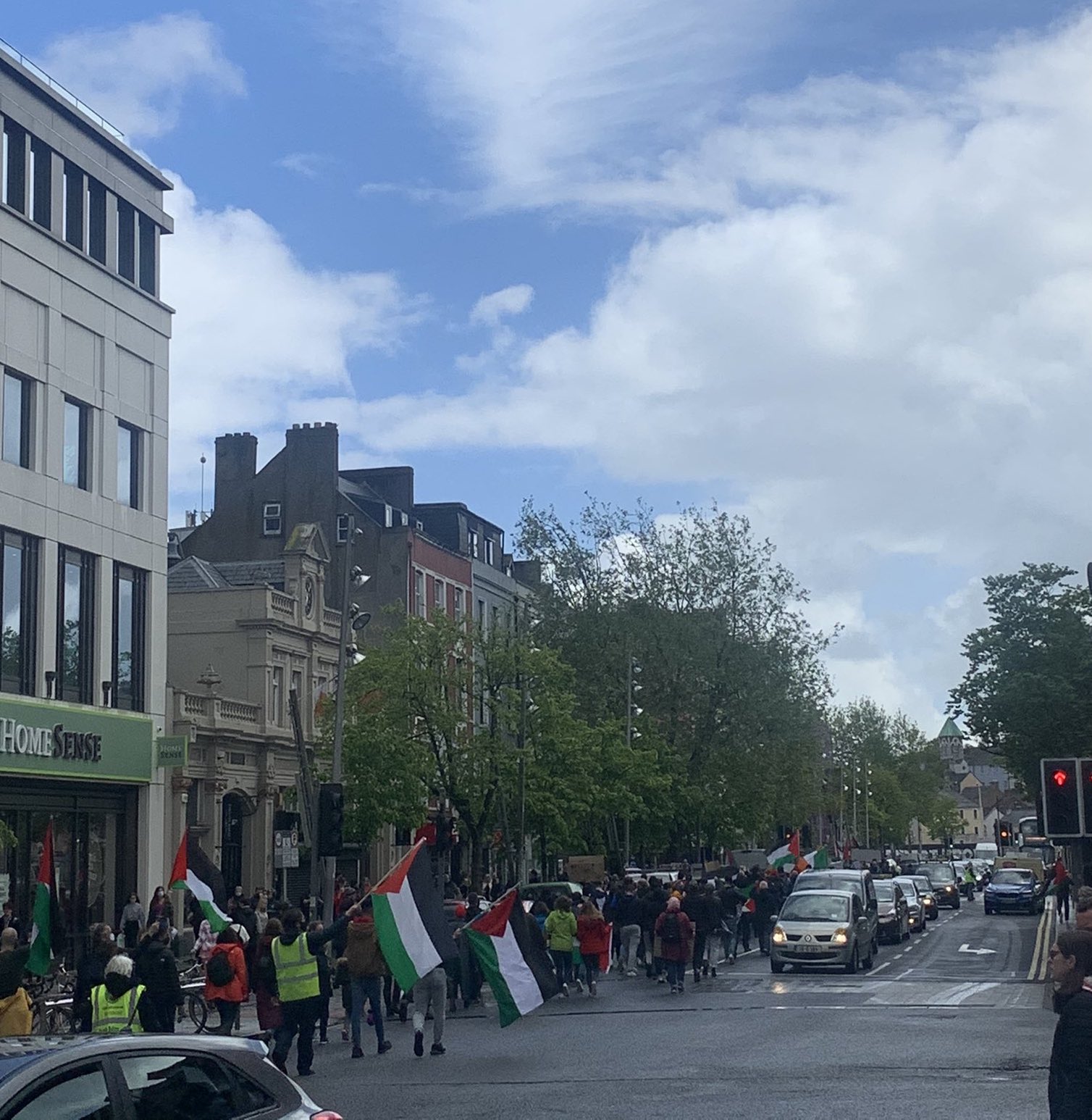
After being addressed by a number of speakers, they set off in a march towards the Israeli Zionist Embassy near Ballsbridge, beyond the south city centre. As they marched their numbers grew until, approaching the Embassy, they numbered several thousand.

Along the way, bystanders applauded the marchers and passing vehicles blew their horns in solidarity.

A section of the Dublin rally in solidarity with Palestine photographed outside the GPO in the city’s main street before they set off on the 5.5km march to the Israeli Embassy (Photo credit: PA, Breaking News)

Marchers shouted slogans of solidarity with the Palestinians, calling for the freedom of Palestine and the expulsion of the Israeli Ambassador as a mark of the Irish people’s objection to what is being done to the Palestinians.

Near the Embassy, a number of speakers addressed the crowd and after dispersing, a number of demonstrators boarding public transport to return home were congratulated by the drivers.

LESSONS FOR US

The situation regarding calling and holding the demonstration in Dublin outlined some of the weaknesses of a broad organisation when it faces repression from the State and the greater resilience of a smaller organisation in being able to defy the State.

It may be necessary in future to maintain support for both types of organisation, each being appropriate for particular situations.

Also demonstrated was the necessity to openly defy unjust laws and prohibitions at times and particularly around the right to organise, to protest and to show solidarity, which the demonstrators did so well on Saturday.

Such situations also reveal the difficulty for the Gardaí in carrying out repressive actions and they are reduced to threatening individuals.

THE FAR-RIGHT MARCHES TOO – FOR WHAT?

Meanwhile, a couple of hundred of the far-Right also marched in Dublin, allegedly in defence of civil liberty. Not in solidarity with the Palestinians’ civil liberties and not in defence of our civil liberty to organise to show solidarity with people in other struggles.

No, they marched in defence of the right to defy health protection regulations, in proclaiming the Covid19 pandemic to be a) a hoax or b) greatly exaggerated and in claiming that wearing masks damages one’s health and even intelligence(!).

They were insisting that vaccinations are a) dangerous to one’s health or b) means of injecting nano-machines into people’s bloodstream in order to control them.

A clip posted by Ireland Against Fascism showed one of the QAnon Saturday screechers for months outside the GPO, Dolores Webster, aka Dee Wall, lately self-declared “digital journalist” (don’t laugh) posting her reactionary propaganda.

In apparent total ignorance of the actual reality (but when has that mattered?), she broadcasted a claim by video from her studio (her car), accompanied by the strains of Abba from the headphones of her head-bobbing passenger.

She claimed that the “scum in the Dawl” had allowed the Palestinian solidarity march to go ahead to distract from the alleged general removal of freedom and in particular from the far-Right group Irish Yellow Vests to hold their rally on May 1st!

When all the Covid19 precautionary restrictions are removed, what will these elements have to march about? The will need to return to the topics that engaged many of them in the recent past: racism, anti-immigrants, islamophobia, homophobia and anti-socialism, along with their false patriotism.

None of that is welcome of course but at least it will be without this false concern for “civil rights and freedom” and closer to the reality of what the far-Right in general – and fascists in particular — stand for.

SUPERPOWER BACKING AND IMPUNITY

The current atrocities of the Zionist State, which it carries out with impunity, along with its history, starkly reveals the effect of its main backing power, the USA, and the imperialist alliance dominated by that Power.

The USA backs Israel with military aid to the tune of $10 Million daily, which is aside from other direct and indirect aid. Israel is the only state in the Middle East which is not only very friendly to the USA but totally dependent on the support of that superpower.

For the ruling class of the USA, Israel is the only state in the Middle East which is totally safe forever from fundamentalist Muslim revolution or from left-wing anti-imperialist revolution and is therefore an extremely important factor in the USA’s plans to totally dominate the Middle East.

Solidarity marcher in Dublin on Friday with a home-made placard (Photo Credit: PA, Breaking News.ie)

This imperialist alliance finds reflection not only in the action/ inaction of governments in Europe, for example but also in the reporting of the mass media.

One of the latter’s tropes is the constant emphasis on the numbers of Palestinian missiles fired, without revealing their general ineffectiveness in delivering destruction, in total contrast to the Israeli missiles. Another is their constant repetition of a lie, that “Hamas seized power in Gaza”.

The truth is that Hamas swept the board in the 2006 elections for the Palestinian Authority. The “seizing” that was done was by Al Fatah, which usurped the results in the West Bank and installed themselves there; they tried to do the same in Gaza and, in a short fierce struggle, were beaten.

But the Western powers decided that Hamas was illegitimately in power, seized funds due to it and supported its blockading – by both Israel and Egypt.

No explanation is offered in the general mass media as to how a generally politically-secular Palestinian public would turn from its decades of allegiance to Fatah to vote for the fundamentalist Muslim Hamas.

The main reason was Fatah’s surrender of the goals of Palestinian independence and freedom and the return of the refugees, in exchange for running a colonial administration with opportunities for living off bribery and corruption and Fatah’s settling down to that status quo.

CASTING A GIANT DARK SHADOW

It was not only in Dublin and in towns across Ireland that Palestine solidarity demonstrations were held on May 15th but by people across much of the world, generally in opposition to the wishes of their governments and ruling elites.

It is worth thinking about how this has come about, in particular in contradiction to a mass media hostile to the Palestinians.

Palestinians come to view the remains of the tower block that was home to families and that housed a number of media agencies. (Photo source: Internet)

The Zionist state of Israel was declared in 1948, its anniversary actually only three days ago – May 14th, the first states to recognise it being the USA and the USSR. In Ireland at the time, there was general support for the new state which continued to the “June War” of 1967 and somewhat beyond.

The general Irish population were horrified by the history of the Nazi-organised Holocaust and sympathised with the Jewish survivors.

Irish nationalists and even Republicans empathised with the Zionist civil and armed struggle against the British (who, ironically, had begun the process of Zionisisation of Palestine).

The 1966 film Cast a Giant Shadow purporting to show that struggle, starring Kirk Douglas and a cameo appearance by Frank Sinatra, was widely enjoyed and cheered in cinemas across Ireland.

Though some of the film’s characters were based on real-life counterparts, the general narrative was a grotesque distortion, hiding the massacres of Palestinians and the expulsion of thousands as the Zionist state was created.

Many Irish language supporters admired how the new state had brought the Hebrew language, for centuries only spoken in religious contexts, back into everyday usage.

Solidarity marcher in Dublin on Friday with a home-made placard and a thought-provoking message (Photo Credit: Sam Boal, The Journal)

Yet, by a few years ago, general pro-Palestinian sympathy across Ireland had become so strong that Israel’s Ambassador to Ireland declared the country “the most anti-semitic in Europe”. That of course is the Zionists term for anyone who supports the Palestinians or criticises the Israeli state harshly.

Only a few days ago, the current Ambassador accused some politicians of spewing hate towards Israel. He was responding not only to Left and Sinn Féin TDs who criticised the actions of Israel towards the Palestinians, but also to the Tánaiste (Deputy Prime Minister equivalent) Leo Varadkar!

Varadkar had commented that Israel’s actions are “indefensible” and Government Minister for Foreign Affairs Simon Coveney said at an EU conference that the EU had “fallen short” and failed to project its influence in agreeing a position in against illegal activity by the Israelis against Palestinians.

Palestinian solidarity march in Cork on Saturday (Photo source: Internet)

The fact that establishment right-wing/ conservative politicians feel obliged to take a public stand, however ineffectively, against actions of the Israeli Zionists is a strong indication of how much Irish public opinion has changed over decades.

Implicitly such stands reflect against the Zionists’ biggest international backer and world superpower, the USA. Since the Cast a Giant Shadow film, the state’s shadow of which we are aware now is indeed frighteningly giant and very dark.

In response, the natural cultural and historical feelings of the Irish people have stirred in sympathy with the oppressed Palestinians – and in defiance of threatened police repression at home.

end.

SOURCES

Coverage of events in Ireland: https://www.thejournal.ie/peacful-protests-solidarity-with-palestine-5438356-May2021/

https://www.irishtimes.com/news/ireland/irish-news/thousands-attend-rallies-in-irish-cities-in-solidarity-with-palestine-1.4566435

https://www.breakingnews.ie/ireland/protests-held-around-the-country-in-support-of-palestine-1127787.html

Recent reports on the conflict: https://www.nbcphiladelphia.com/news/national-international/weary-gaza-marks-muslim-feast-as-violence-spreads-in-israel/2812715/

https://www.bbc.com/news/world-middle-east-57138996

Israeli Ambasador to Ireland clashing with politicians: https://www.irishtimes.com/news/politics/israeli-ambassador-accuses-some-tds-of-spewing-hate-towards-jewish-state-1.4564184

IN DUBLIN HONOURING THE SIXTEEN MARTYRS

Clive Sulish

(Reading time: 5 mins)

On a gloomy wet and windy day today, Republicans and other anti-imperialists held a commemoration in Dublin’s Arbour Hill of the 14 executed martyrs in Dublin and the remaining two: Thomas Kent shot in Cork and Roger Casement hanged in Pentonville Jail, London. A heavy downpour interrupted the speaker but the event resumed after the cloudburst eased off though it was still raining. Sixteen lilies were laid on the grave patch and a song was sung that named seven of the martyrs, the signatories of the Proclamation.

The event was organised by Irish Socialist Republicans and Anti-Imperialist Action Ireland. In addressing the attendance Pádraig Drummond, chairing the event, pointed out that they were commemorating the Sixteen executed Martyrs of the 1916 Rising but that 15 of them had been murdered. Those had been tried by military court and even the British reviewing the actions later had agreed that the executions had been illegal; therefore Drummond said those 15 had been murdered and General Maxwell1 was a war criminal.

The 1916 Proclamation being read in Arbour Hill, 3rd May 2021. (Photos from AIA with thanks)

In addition, the chairperson continued, Maxwell had refused the relatives access to the bodies and had them buried without coffins in a quicklime pit in order to prevent their graves becoming martyrs’ shrines2.

When it came to the executions, Drummond said, Maxwell gave firing party duties to soldiers of the Sherwood Foresters, who had been decimated by Irish Volunteers at the battle of Mount Street Bridge on 26th April, seemingly to encourage them to avenge themselves for their regiment’s dead on unarmed prisoners condemned to die.

Pádraig Drummond called on one of the attendance to read out the Proclamation and, after he had done so, sixteen single Cala Lillies were laid on the plot above the quicklime pit.

Single lillies for each of the 14 martyrs buried here in Arbour Hill, 3rd May 2021. And two beneath the photos of the other two 1916 executed martyrs, Thomas Kent, shot by British firing squad in Cork and Roger Casement, sentenced to hang by British judge with sentence carried out by British hangman in Pentonville Jail. (Photos from AIA with thanks)

Diarmuid Breatnach was then called forward to address the attendance; speaking first in Irish and then in English, Breatnach said that he had been asked to make some remarks on the history of Irish uprisings in relation to assistance given from abroad but in doing so, he was not laying down any dictates or anything of the sort, only some reflections. “We should learn from our successes,” Breatnach said but also from our failures and perhaps to focus even more closely on the latter.

Breatnach had not been speaking long when the rainfall intensified. He was protected by umbrella but others in attendance were not; he faltered and looked for guidance to the chairperson of the event when the heavens seemed to burst open and with a nod, the whole ensemble headed for the shelter of a nearby horse-chestnut tree.

ALLIES

When the rain had eased off somewhat Breatnach returned to his theme, recounting how (Hugh) Aodh Ó Néill and Aodh Rua Ó Domhnaill (Hugh Roe O’Donnell) had waged a guerrilla campaign in Ulster but relied on help from imperial Spain to free the whole country from England. Later the Irish resistance had sided with English monarchs against the English Parliament in the mid and late 17th Century, when they believed the monarchs would give them religious freedom and perhaps some of their lands back. The Papacy had supported the Irish in opposition to Cromwell and Imperial France gave military assistance against William of Orange later in the same century.

Diarmuid Breatnach addressing the gathering in Arbour Hill, 3rd May 2021; Pádraig Drummond, who chaired the event, standing to his left. (Photo from AIA with thanks)

The United Irishmen in the 1790s had looked for help to Republican France, Breatnach recalled but the flotilla under Hoche failed to land in 1796 and after the Rising was provoked prematurely by the British, by the time General Humbert landed in Mayo with not enough troops, the rising was nearly finished. In 1803, Emmet’s rising took place without the expectation of foreign assistance but was quickly over.

The Young Irelanders apparently believed in 1848, the Year of Revolutions all over Europe that an insurrectionary mobilisation could be achieved peacefully in Ireland and did not look for help from abroad — but were quickly suppressed, the speaker said.

On St. Patrick’s Day 1858 the Irish Republican Brotherhood was founded simultaneously in Ireland and in the United States. In 1866 the Fenians invaded Canada and in 1867 carried out a campaign in Britain, then had a brief unsuccessful rising in Ireland. They had not asked for troops from outside but in their Provisional Proclamation called on the English working class to rise against their exploiters.

The IRB was reformed and re-energised at the beginning of the last century and intended to lead a rising when England was in a war, which was expected soon. WW1 began in 1914 and in 1916 the Irish rose expecting help from Imperial Germany (which they received in armaments but nothing else) and from the USA in political support of which they received little.

The speaker remarked that looking back on all these instances in Irish history, those risings which had not had help from abroad, as with Emmet’s and the Young Irelanders, had lasted the least time.

It would be unrealistic, Breatnach continued, to expect to defeat a powerful enemy such as the UK with its army, navy and air force, without help from an external force. Unless of course the rulers of the UK were struggling with insurrectionary struggles from their own working class.

SOLIDARITY

Looking ahead, the closest areas from which help could come to an Irish insurrection are Britain and the European mainland. In looking for allies it would be necessary to evaluate the benefits and costs of particular alliances. Breatnach felt that when a part of the Irish leadership accepted the deal they were offered in 1921, they had an alternative option of linking with the struggles of the working class in Britain. In 1926 there was a general strike throughout Britain and earlier, in 1921 there had been strike struggles including one in Glasgow, where the local military unit was under lock and key by their own officers in fear that they would join the resistance. Large numbers of British soldiers who wanted to be demobbed after the War were being held back because their rulers knew they would need them to suppress liberation struggles throughout the world. These soldiers were rioting in some areas in Britain. Breatnach remarked that it is difficult to be certain but that if the Irish resistance had combined with the British workers in that period our whole history might have turned out very differently.

Some of the attendance in Arbour Hill, 3rd May 2021, standing in homage to the 16 executed 1916 Martyrs, 14 of whose bodies were buried in a quicklime pit (located underneath the green stretch. (Photo from AIA with thanks)

In conclusion Breatnach went on to talk briefly about internationalist solidarity, which can be a different issue than alliances; solidarity can be a moral issue but it can also be a practical one, as it is workers that would be required to produce material and load ships being sent against us. He had also noted, he remarked, that often internationalist solidarity would be the first thing dropped by those intending to abandon the revolutionary path; Breatnach exhorted the attendance to treat internationalist solidarity as a duty, a pleasure and a practical help.

Pádraig Drummond thanked Breatnach for his remarks and asked him to sing the Larkin Ballad as a conclusion to the event, which Diarmuid did.

In Dublin City in 1913,

The boss was rich and the poor were slaves ….”

The lyrics were written by Donagh Mac Donagh, orphan son of one of the executed Signatories of the Proclamation. The narrative begins with the union militancy under Larkin’s leadership, followed by the Dublin Lockout of 1913 and ends with the execution of the Signatories. The participation in the Rising of the workers’ defence militia, the Irish Citizen Army, along with James Connolly being one of the Seven Signatories of the Proclamation, provided an organic link between the Lockout and the Rising.

After the event people took photos and socialised briefly before heading for their homes through persistent rain.

FOOTNOTES

1. General John Maxwell, a veteran of colonial wars, was the officer charged with the suppression of the Rising; he set up the martial tribunals that handed down nearly 100 death sentence to participants, of which 15 leading revolutionaries were actually put to death, the others having their death sentences commuted to prison sentences.

Wikipedia: “Maxwell arrived in Ireland on Friday 28 April as “military governor” with “plenary powers” under Martial law, replacing Lovick Friend as the primary British military commander in Ireland. He set about dealing with the rebellion under his understanding of Martial law. During the week of 2–9 May, Maxwell was in sole charge of trials and sentences by “field general court martial”, in which trials were conducted in camera, without defence counsel or jury. He had 3,400 people arrested and 183 civilians tried, 90 of whom were sentenced to death. Fifteen were shot between 3rd and 12th May. H.H Asquith and his government became concerned with the speed and secrecy of events, and intervened in order to stop more executions. In particular, there was concern that DORA (Defence of the Realm Act, wartime legislation –CS) regulations for general courts martial were not being applied. These regulations called for a full court of thirteen members, a professional judge, a legal advocate, and for the proceedings to be held in public, provisions which could have prevented some of the executions. Maxwell admitted in a report to Asquith in June that the impression that the leaders were killed in cold blood and without a trial had resulted in a “revulsion of feeling” that had emerged in favour of the rebels, and was the result of the confusion between applying DORA as opposed to Martial law (which Maxwell had actually pressed for from the beginning). As a result, Maxwell had the remaining death sentences commuted to penal servitude. Although Asquith had promised to publish the court martial proceedings, the transcripts were not made public until 1999.”


However, it is known that Maxwell insisted on executing two more after Asquith’s caution and these were Sean Mac Diarmada (McDermot) and James Connolly, to which Asquith agreed.

2 In that, Maxwell was signally unsuccessful and between 1955 and 1966 the Arbour Hill site was developed as an important Irish historical monument and at this time of year will be visited by organisations and individuals, precisely in commemoration of the 1916 Rising.

MAYDAY DUBLIN – PICKET ON KPMG — GARDA HARASSMENT AND ARRESTS

Clive Sulish

(Reading time: 5 mins.)

A cross-section of mostly independent activists from across the Communist, Republican and Anarchist continuum held a small march today to celebrate May 1st, International Workers’ Day. All wearing masks against spreading the virus and marching from the north city centre to the south, they held a momentary picket outside the HQ of the KPMG financial group which has carried out evictions of people from their homes as well as raids on Debenham’s stores to inventory stock, led by Gardaí attacking Debenham workers’ pickets and their supporters. At the close of the march the participants were surrounded by a large force of Gardaí and all had their names and addresses recorded under Covid19 legislation while a number were arrested and others were threatened with arrest under the Public Order Act.

May 1st was agreed as the international day of the working class after the police massacre of demonstrators in Chicago in 1886 on a demonstration for the 8-hour day and the subsequent framing of anarchists leading to the judicial martyrdom of five activists.

Gathering outside the Garden of Remembrance (Photo: R.Breeze)

Just after noon today the march set off in two columns from outside the Garden of Remembrance and proceeded down O’Connell Street (Dublin’s main street). The leading banner recalled that on Liberty Hall prior to the 1916 Rising: “We serve neither King nor Kaiser but Ireland”. Many of the marchers were young and led by a banner with a red flag showing the design of the hammer and sickle, followed by a number of Fianna Éireann flags (orange sunburst on a blue field) and Starry Ploughs (gold ursa mayor and plough on a green field) of the Irish Citizen Army. There were also some other red flags and flags of Antifascist, Cumann na mBan flag (name in peach with brown rifle on a blue background), “Irish Republic”, the Irish Tricolour and the Starry Plough (ursa mayor in white on a blue background).

“WE ONLY WANT THE EARTH”

Initially a lone voice on the march sang verses of James Connolly’s satirical song Be Moderate1 to the air of Davis’ A Nation Once Again with other voices joining in on the chorus:

We only want the Earth,

We only want the Earth

And our demands most moderate are:

We only want the Earth!

View of marchers being addressed across the road from the GPO, Dublin city centre (in the far distance, figure with arms raised is part of the Larkin monument). (Photo: R.Breeze)
Placards and two of the flags outside the GPO in Dublin city centre (Photo: R.Breeze)
Beside James Connolly Monument (to the left, out of shot; the HQ of Ireland’s biggest union SIPTU is visible to the right). Gardaí may be seen gathering also plainclothes ‘Special Branch’ officer turned away (dark jacket, blue jeans). (Photo: R.Breeze)

The marchers gathered briefly outside the GPO, where a couple of speakers addressed them before re-forming to march again, turning into Abbey Street and gathering again at the James Connolly monument in Beresford Place, where they were briefly addressed again, then marching on past the Bus Áras and across the river, a heavy screen of Gardaí between the marchers and Custom House Quay, where a far-Right “May Day” rally has been advertised by the Irish Yellow Vests2, opportunistically and hypocritically using the image of Martin Luther King!

The Mayday marchers proceeded to Pearse Street, around by Trinity College and into Grafton Street. There were a number of shouts and slogans, including:

Happy May 1st, International Workers’ Day! Up the workers!

The workers, united, will never be defeated!

Whose streets? Our streets! Whose history? Our history!

When under attack, stand up, fight back!

Housing for need, not for profit! Housing for all, not for profit!

There were also a number of slogans shouted against the two main Coalition parties, Fine Gael and Fianna Fáil, who were accused of being robbers. A number of shouts also pointed out that the workers are the creators of all wealth.

Proceeding along the west side of Stephens’ Green, a voice called out that this area had been held under the Irish Citizen Army in 1916 and called attention to the marks of bullet impact on the exterior of the College of Surgeons building. In Harcourt Street the march turned into Stokes Place and, as the security guard at the barrier challenged them with “Excuse me!” a marcher replied: “You’re excused!” Outside the KPMG building the marchers paused briefly before leaving again and retracing their steps, folding up their banner and rolling up flags.

Inside the complex where the KPMG has their Dublin HQ. (Photo: R.Breeze)

GARDA HARASSMENT, THREATS AND ARRESTS

At the bottom of Grafton Street the leading group of marchers, all flags and banner now folded, turned left into Dame Street prior to dispersing and were there halted by a large group of Gardaí with a number of Garda vans and cars in attendance.

Garda officers proceeded to harass the marchers, asking them their purpose in being in the city, requiring replies under Covid19 regulations, along with names, addresses and dates of birth. When a man shouted “Shame on you! Shame!” at the Gardaí as they were arresting a young man, a Sergeant threatened him with arrest under the Public Order Act. “For what?” asked the man, denying that he had used threatening or abusive words, the Garda insisting he had and cautioning him.

Some of the Gardaí harassing marchers in Dame Street (Photo: R.Breeze)
More Gardaí harassing May Day marchers at end of march in Dame Street (Photo: R.Breeze)
Some of the Garda vehicles used in harassment of the May Day marchers at the end of their march in Dame Street (Photo: R.Breeze)

Four Gardaí were around another marcher accusing him of having an offensive weapon (a pair of scissors to cut the cable ties on the groups’ flags!). When another marcher pointed out to them that they were just using excuses to harass the marchers and asked were they going to do the same to the Irish Yellow Vest crowd on Custom House Quay, he too was threatened for using “threatening and abusive words” and ordered to disperse.

It is believed that three were arrested but difficult to confirm due to Gardaí ordering others to disperse under threat of further arrests.

Two of the bicycle Gardaí who were keeping tabs on the marchers, seen here in Dame Street, looking back towards the concentration of Gardaí harrassing May Day marchers. (Photo: R.Breeze)

DEMOCRATIC RIGHT TO PROTEST AND PICKET UNDER ATTACK

Despite Covid19 legislation under Level Five forbidding non-essential work, last week KPMG employees entered Debenham’s stores in cities of the Irish state while Gardaí forcibly removed Debenham workers and supporters’ pickets.

On Thursday this week, taxi drivers in Dublin were intimidated by Gardaí from holding a protest although they would have been isolated within their taxis and perforce practicing social distancing. According to information given in the Dáil by some TDs (members of the Irish Parliament), the taxi drivers were threatened with hefty fines and impact upon their license renewals (a department of the Gardaí manages the verification and renewal of taxi drivers’ licenses).

Yet all throughout the Level Five restrictions, Far-Right groups have held marches and rallies protesting against the Lockdown, without wearing masks or practicing social distancing, without enduring Garda threats and without mass taking of names and addresses. It remains to be seen what action if any the Gardaí took or will be taking on Custom House Quay today3. What the charges against the May Day marchers arrested today might be remain to be seen too and how long they are (or were) detained.

The Garda actions against legitimate and peaceful protests and pickets seem to harbinger more attacks on rights to protest as the Gombeen capitalist class and their government endeavour to make the workers pay for the financial cost of the Covid19 crisis and ‘recovery’.

End.

FOOTNOTES

1One of the songs published in Connolly’s songbook “Songs of Freedom” in 1907 in New York.

2A Far-Right organisation led by an Islamophobe that has joined with openly fascist organisations in the past.

3According to reports received, in Dublin Gardaí prevented the IYV entering on to Custom House Quay and moved them on a number of times after that. However in Cork the Gardaí facilitated the Far-Right (around 350, according to the Irish Times) in holding a march and rally in which they were addressed bty former Aontú Councillor Anne McCloskey from Derry (despite travel restrictions) and Dolores Cahill, 2nd-in-command of the fascist Irish Freedom Party. Cahill has been withdrawn by UCD from her lecture course after petition by 133 students and debunking of her theories but is still receiving her salary from the institution. On St. Patrick’s Day she told a rally the wearing of masks would mean that children would “never reach their IQ and job potential because their brains are starved of oxygen,” adding that the reason “globalists” are “putting down the masks” is due to the fact “oxygen-deprived people are easier to manipulate”. McCloskey told the crowd in Cork that people were dying of other illnesses untreated because the authorities wanted to to ascribe the deaths to the “mild” Covid19 virus so their freedom could be restricted. She said that people should take off their masks and embrace.

SOURCES

Origins of International Workers’ Day: https://libcom.org/history/1886-haymarket-martyrs-mayday

Debenhams pickets attacked by Gardaí: https://www.irishtimes.com/news/social-affairs/former-debenhams-workers-in-shock-after-removal-from-picket-1.4546092

https://www.dublinlive.ie/news/dublin-news/ex-debenhams-workers-forcibly-removed-20305262

https://www.limerickleader.ie/news/home/625500/gardai-intervene-following-protest-outside-former-limerick-store.html

Taxi protest stopped by Gardaí: https://www.thejournal.ie/taxi-driver-protest-called-off-5423729-Apr2021/

FASCIST REPRESSION IN GALIZA

Argimiro Rodriquez


(Translated by D.Breatnach; la versión en castellano al fondo)


(Reading time: 8 mins.)


To this day, many people, both from the Spanish state and foreigners, believe that Franco’s repression only occurred in areas where the coup failed and war followed. But this is not the case for in areas such as Galicia (1), the Canary Islands, Castilla y Leon, Ceuta, Melilla, where the coup d’état triumphed in just a few days, the repression was equally brutal.

Photo of the executions taken from a distance by a Guardia Civil
Photo montage of original photo of the executions in 1936 and the memorial monument there today.

I am going to expose the events that occurred in my Galician homeland, which is what I know best. There was not a single battle there, so that some historians say that there was no war in Galicia; there are also those who think that the majority of Galicians were Francoists because Franco was born in Galicia. This is another myth, which is refuted by the fact that on June 28, 1936 its Statute of Autonomy was voted and approved by a large majority with almost one million votes in favor of the Statute. One of the main promoters of the Statute was Daniel Castelao, father of the Galician nation, writer, politician, draftsman, painter, etc., who was luckily in Madrid presenting this Statute in the courts, which is how he was able to save his life. The other was Alexandre Bóveda, shot in A Caeira, Pontevedra, on August 15, 1936, which is why every August 15th we Galicians commemorate the day of the GALIZA MARTIR, in memory of all the acts of repression.

“The fascist ‘stroll'” (Daniel Castelao) [The Falange, who carried out many of the non-judicial killings, would round up people and say “We’re going for a stroll.”- DB]
“That will teach them to have ideas” (Daniel Castelao)


The reason why the coup triumphed in Galicia has nothing to do with the Galicians supporting the coup but rather that in Galicia, as in many of the communities where the coup triumphed, it had more to do with the four civil Governors: Francisco Pérez Carballo, Gonzalo Acosta Pan, Ramón Garcia Nuñez and Gonzalo Martín March, who decided not to hand over arms to the people. They thought that the coup was not going to take place, or that in any case it would be easily controlled. They were very mistaken and they paid for it with their lives, because the Francoists, despite this, shot them. I should highlight here also the story of Juana Capdevielle, wife of the civil Governor of A Coruña, who was raped, shot and her breasts torn off. (2)

“All for Country, Religion and Family” (Daniel Castelao)


The repression that I know best about occurred in my city, A Coruña, where in a place near the Tower of Hercules, called Campo De La Rata, about 700 people were shot and thrown into the sea and where veritable mass meetings of fascists were convened to attend the shootings. Here is told the sad story of the brothers known as “La Lejia”, because their father had a bleach factory (3); of these brothers it is told that Bebel de la Lejia was a player of Deportivo de A Coruña (4) and a socialist, like his four brothers — when he went to be shot he lowered his pants and urinated on his murderers. Pepin de la Lejia was the only one of the brothers who managed to escape, he did so on a fishing boat to Asturias where he joined the Republican army and in the subsequent bombardment he lost a leg but managed to escape to France and from there into exile in Argentina. There is a beautiful song that tells his story. (5)

GUERRILLA ORGANISATION IN GALICIA POST-ANTIFASCIST WAR


In Galicia, one of the first guerrilla resistance organisations was also formed, the guerrilla army, part of the Leon-Galicia Guerrilla Federation and formed mostly by refugees who fled to the mountains, people who simply hid in the mountains but that the Communist Party managed to turn into a guerrilla organisation, one of the most numerous in the state, in order to deliver economic blows to the landowners or to carry out sabotage on the Tungsten mines, a mineral that was sold by the Francoists to the Nazis to make cannons for tanks. The guerrilla organisation ended up being abandoned by the Allies who recognized the Franco regime, but even so the last guerrillero was shot in 1968, a Galician they called “O Piloto”. The best known was Benigno Perez Andrade, known as “Foucellas”, an avid fan of the DEPOR, who went every Sunday in disguise to the stadium to see Deportivo A Coruña after which he posted the tickets to the civil Government.


We should also note that of the last five officially shot by the Franco regime (6,) two were Galicians: Xose Humberto Baena and Jose Luis Sanchez Bravo, both members of the FRAP (Frente Revolucionario Antifascista y Patriota) tried in a farce of a trial in which the Defence lawyers were even threatened beforehand by pistols aimed at them and all the evidence presented by the Defence was denied.

PLUNDER BY FRANCO AND FAMILY

And to conclude, I cannot end on the Francoist repression in Galicia, without mentioning something very recent that only occurred a few months ago, when the Department of Justice recognised that the State was the legitimate owner of the Pazo de Meiras (pazo in Galician means “palace”) which was literally usurped, stolen, etc by a series of Francoist characters to give to Franco, supposedly as a gift from the Galician people. The reality was that they created a kind of revolutionary tax (and I know this because my mother is from the same town where the pazo is located), in which whoever did not give money to buy the pazo for the Dictator was called “a Red”, which we all know entailed imprisonment and one could even be shot. After much struggle, there was success in getting the Justice Department to return the pazo to the State, originally without any compensation but the Dictator’s family appealed and once again the Court declared that the State had to pay one million euros, allegedly for a series of repairs they had made. However this has been appealed again by the State and in addition there is another series of processes underway, for other properties confiscated by the Franco family, such as the Casa Cornide, various statues of the Santiago Cathedral, several medieval baptismal fonts of many other churches etc.
End.

“They killed her son” (Daniel Castelao)
“Final lesson from the schoolteacher” (Daniel Castelao). [Non-fascist teachers, as intellectuals, were high on the list for execution by fascists – DB]
“They could not be buried in consecrated ground”. (Daniel Castelao)


FOOTNOTES

  1. Galicia is a nation of Celtic origin with a coast on the north-west of the Spanish state but speaking a Romance language very similar to Portuguese. It is bordered by Asturias (another Celtic nation) and Castilla y León to the east, Portugal to the south and otherwise the Atlantic Ocean. It is recognised as a historic nationality by the Spanish State and is governed as one of the “autonomous communities”.
  2. “According to Carlos Fernández Santander, at least 4,200 people were killed either extrajudicially or after summary trials, among them republicans, communists, Galician nationalists, socialists and anarchists. Victims included the civil governors of all four Galician provinces; Juana Capdevielle, the wife of the governor of A Coruña; mayors such as Ánxel Casal of Santiago de Compostela, of the Partido Galeguista; prominent socialists such as Jaime Quintanilla in Ferrol and Emilio Martínez Garrido in Vigo; Popular Front deputies Antonio Bilbatúa, José Miñones Díaz Villamil, Ignacio Seoane, and former deputy Heraclio Botana); soldiers who had not joined the rebellion, such as Generals Rogelio Caridad Pita and Enrique Salcedo Molinuevoa and Admiral Antonio Azarola; and the founders of the PG,Alexandre Bóveda and Victor Casas as well as other professionals akin to republicans and nationalists, such as the journalist Manuel Lustres Rivas or physician Luis Poza Pastrana (Wikipedia).
  3. “Lejia” is “bleach” in the Castillian (Spanish) language.
  4. Real Club Deportivo de La Coruña (‘Royal Sporting Club of La Coruña’), commonly known as Deportivo La Coruña, Deportivo or simply Dépor, is a professional soccer club based in the city of A Coruña, Galicia, in the Spanish state. They currently play in the third tier of the League in the Spanish state. Founded in 1906 as Club Deportivo Sala Calvet by Juan Parra Rois, the Blue and Whites were a regular in top positions in La Liga for some 20 years, from 1991 to 2010, finishing in the top half of the table in 16 out of 19 seasons, and are 12th in the all time La Liga table. As a result, the club was a regular participant in European competitions, playing in the UEFA Champions League five seasons in a row, reaching the quarterfinals twice and reaching the semi-finals in the 2003-04 season (Wikipedia).
  5. https: //youtu.be/ywhOfjNEuZY
  6. The other FRAP member was Ramón García Sanz; also executed on the same day 27th September 1975 were two ETA members, Ángel Otaegi and Juan Txiki Paredes Manot.

SOURCES, ADDITIONAL MATERIAL


Galician Statute of Autonomy: https://es.m.wikipedia.org/
Wiping out of the Republican authorities in Galiza: https://documentalismomemorialistayrepublicano.wordpress.com/2018/02/23/el-exterminio-de-autoridades-republicanas-en-galicia-por-fascistas/
Murders of the “Lejia” brothers: https://youtu.be/93VlSccyLxE
FRAP & ETA trial and executions: https://youtu.be/ha4SJMgVdvU
Franco plunder ownership challenge: https: //www.lavanguardia.

LA REPRESIÓN FRANQUISTA EN GALIZA

Argimiro Rodriquez

A dia de hoy, mucha gente, tanto del estado español, como extranjeros, creen que la represión franquista sólo se dio en las zonas en donde el golpe de estado fracasó, esto no es asi, zonas como Galicia, Canarias, Castilla y Leon, Ceuta, Melilla, donde el golpe de estado triunfó en apenas unos pocos dias, la represión fue igualmente brutal, yo voy a exponer, los hechos que ocurrieron, en mi patria gallega, que es lo que más conozco, donde no hubo ni una sola batalla , tanto es asi que algunos historiadores dicen que en Galicia no hubo guerra , también hay quienes piensan que la mayoría de gallegos eran franquistas porque Franco nació en Galicia, es otro mito, que no es real.

Para demostrar esto decir que Galicia , el 28 de junio de 1936 voto y aprobó su estatuto de autonomia ( https://es.m.wikipedia.org/ ) por una amplia mayoria con casi un millón de votos a favor del estatuto, cuyos principales impulsores fueron Daniel Castelao, padre de la Patria gallega , escritor, politico, dibujante, pintor etc . , quien por suerte se encontraba en Madrid presentando este estatuto en las cortes, por eso pudo salvar su vida, y Alexandre Bóveda, fusilado en A Caeira , Pontevedra , el 15 de Agosto de 1936, por eso todos los 15 de Agosto los gallegos conmemoramos el dia de GALIZA MARTIR, en homenaje a todos los represaliados . Coleccion de cuadros pintados por Castelao sobre la represión en Galicia https://youtu.be/ljyuasmr9iY  

El motivo por el que el golpe triunfó en Galicia , no tiene nada que ver con que los gallegos apoyaran el golpe, si no que en Galicia, como en muchas de las comunidades donde triunfó el golpe tiene más que ver con que los 4 gobernadores civiles : Francisco Pérez Carballo, Gonzalo Acosta Pan,  Ramón Garcia Nuñez y Gonzalo Martín March , decidieron no entregar armas al pueblo , pensaban ellos que el golpe no se iba a producir, o que en todo caso , seria facilmente controlado, estaban muy equivocados e incluso lo pagaron con sus vidas, porque los franquistas, pese a esto, los fusilaron : https:// , destacar aqui tambien la historia de Juana Capdevielle, mujer del Gobernador civil de A Coruña , a quien violaron, fusilaron y arrancaron los pechos.

La represión que mas conozco ocurrió en mi ciudad, A Coruña, donde en un lugar próximo a la Torre de Hercules , llamado el CAMPO DE LA RATA, se fusilaron y arrojaron al mar a cerca de 700 personas y donde se organizaban autenticas multitudinarias reuniones de fascistas para asistir a los fusilamientos. Aqui contar la triste  historia de los hermanos conocidos como de LA LEJIA , porque su padre tenia una fábrica de lejia, de estos hermanos contar que BEBEL DE LA LEJIA , era jugador del DEPORTIVO DE A CORUÑA y socialista , como sus 4 hermanos , cuando iba a ser fusilado se bajó los pantalones y orinó a sus asesinos : https://youtu.be/93VlSccyLxE Pepin de la Lejia fue el unico de los hermanos que consiguió escapar, lo hizo en un barco pesquero hasta Asturias donde se enroló en el ejercito republicano y en bombardeo perdió una pierna , pero consiguió escapar a Francia y exiliarse en Argentina , esta es una linda canción que cuenta su historia :https://youtu.be/ywhOfjNEuZY

En Galicia también se constituyó una de las primeras formaciónes guerrillera de resistencia, el exercito guerrilleiro, integrado en la Federación de guerrillas Leon-Galicia y formado en su mayoria por huidos al monte, personas que simplemente se escondieron en el monte , pero que el partido Comunista logró convertir en guerrilla, una de las mas numerosas del estado, con el fin de llevar acabo golpes economicos a los terratenientes o de realizar sabotajes a las minas de Wolframio, mineral que era vendido por los franquistas  a los nazis para fabricar cañones para tanques. La guerrilla acabó al verse abandonados por los aliados que reconocieron al regimen de Franco, pero aun asi el ultimo guerrillero fue un gallego al que llamaban O PILOTO, fusilado en 1968. El más conocido fue BENIGNO PEREZ ANDRADE, conocido como FOUCELLAS , reconocido seguidor del DEPOR , que iba todos los Domingos al estadio a ver al DEPORTIVO A CORUÑA , disfrazado y luego enviaba las entradas al gobierno civil por correo

También comentar que de los últimos 5 fusilados por el franquismo, 2  eran gallegos :Xose Humberto Baena y Jose Luis Sanchez Bravo , ambos militantes del FRAP ( Frente Revolucionario Antifascista y Patriota ) juzgados con una farsa de juicio en el que incluso encañonaron en la previa a los abogados defensores con pistolas y fueron denegadas todas las pruebas presentadas por la defensa

Y para acabar, no puedo terminar sobre la represion franquista en Galicia, sin mencionar algo muy reciente que tan sólo hace pocos meses cuando la justicia reconocia que el estado era el legitimo propietario del Pazo de Meiras ( pazo en gallego significa palacio ) que fue literalmente usurpado, robado , etc por una serie de tipos franquistas para regalarselo a Franco, supuestamente como un regalo del pueblo gallego a los Franco , cuando la realidad fue que crearon una especie de impuesto revolucionario, y esto lo sé porque mi madre es del mismo pueblo donde esta el pazo , en el que quien no daba dinero para comprarle el pazo al dictador , se le llamaba rojo, lo que todos sabemos que conllevaba prision y hasta podia ser fusilado. Despues de mucho luchar, se consiguió que la justicia devolviera el pazo al estado, en un principio, sin ninguna indemnizacion, pero la familia del dictador recurrió, y otra vez la justicia declaró que el estado debia de pagar 1 millon de euros , ellos alegan por una serie de reparaciones que hicieron, pero esto ha vuelto a ser recurrido por el estado , al margen de que hay en marcha otra serie de procesos , por otras propiedades confiscadas por los Franco , como la Casa Cornide, diversas estatuas de la catedral de Santiago, varias pilas bautismales medievales de otras tantas iglesias etc: https://www.lavanguardia.

FIN.