The media announces that “the population of Ireland has reached 5 million … for the first time in 170 years”. Interesting – and a barefaced lie! The population of Ireland passed 5 million some time ago and is actually around 6.5 million now.1
Ireland remained with negative population growth until near the end of the last century – mismanaged for most of the population first by the British occupiers of the whole of the island, then by a combination of the native neo-colonial bourgeoisie and of the settler colonial ruling class.
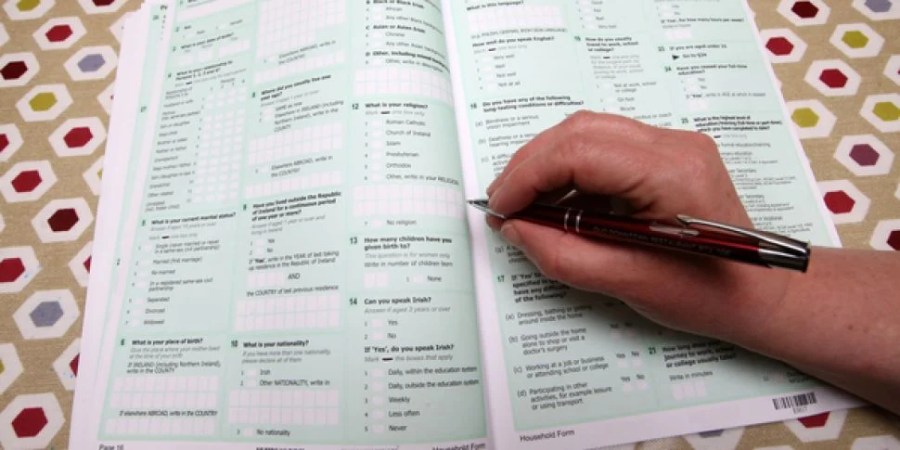
Filling in a census form from which population statistics can be extracted (Photo sourced: Internet)
For more than a century the population of Ireland stood at around 5 million, static despite a high birth rate. This was mathematically possible only through continual massive emigration – mostly to English-speaking regimes: Britain, USA, Australia, New Zealand and Canada.
But it is true that 170 years ago it was more than 5 million – in fact it was around 8.5 million. And it is worth reflecting on how they were able to produce enough food domestically to feed that entire population while now, with a smaller population, we import as much as 80% from abroad.2
It was the Great Hunger that wiped out much of the earlier population, statistics somewhat hiding the pain and sorrow of millions of Irish in death, disease and emigration — and the great transfer of land for cultivation (and rent) to pasturage, with its dangerous environmental impact.
It provided an opportunity for growth of the Catholic Irish capitalist class, the Gombeens, huckstering money-lenders buying up the lands of afflicted neighbours.
The kind of class that the British could depend on in 1921 to manage the neo-colony and to murder and jail those of national liberation3.
Emigration kept population stats steady and, combined with unemployment, ensured a low internal home market for development. An educated workforce and natural resources could be developed but the Gombeen class opened it all to foreign multinationals rather than develop it themselves.
Even with foreign exploitation of the workforce at home, the education system turned out mostly emigration fodder: the Irish tax-payers funded an education system to provide a literate and numerate English-speaking workforces for capitalist exploitation abroad.
No wonder the Irish political class declined to give the Irish abroad a vote in the Irish state – unlike for decades any other state in the European Market. Yet during the 1930s through to the 1960s, money sent home by Irish migrants accounted for an estimated 30% of the Irish State’s economy.4
The Irish state remains a neo-colony with low taxation and other incentives for foreign companies to take over our few industries5 and local and foreign property speculators to rake in profits out of the despair of homelessness or of struggling to meet rent or mortgage payments.
A neo-colonial market for produce of foreign companies and to plunder not only our labour force, not only our natural resources on land, sea and wind and but even our infrastructures in transport and communication, energy, health service, water supply and even our city sanitation.
TRUNCATED
The announced statistics were truncated, appropriate perhaps for a truncated country, with the history behind those statistics not so much truncated as obliterated.
That is our present and our past but not how the future has to be – we can write our own future but we won’t do it by putting a mark on a ballot paper.
3The Irish Civil War or Counterrevolution, 1922-1923.
4I have read this in the past but am unable now to find the reference; however I have posted some references on the figures of remittances from Irish emigrants.
5 For a few examples of foreign takeover: Irish stout, beer and lagers (Guinness, Smithwicks, Harp); Irish whiskey (Paddy, Jameson, Bushmills); cigarettes (Afton); preserved vegetables (Erin); aviation (Aer Lingus); public transport (Transport for Ireland; LUAS); sugar (Irish sugar beet replaced by subsidised cane sugar from the USA); woodlands (Coillte).
An organisation by the name of Anti-Imperialist Action yesterday held an anti-monarchist march and rally in Dublin, including a mock execution of royalty, where their speaker was arrested by Gardaí.
The protesters met first at the James Connolly monument in Beresford Place and after some words marched up Abbey Street to Dublin’s main street and to the General Post Office building to hold their anti-monarchy rally.
Royalty and guillotine beside James Connolly monument at start of event (Photo: AIA)
At the GPO the gathering of socialist republicans, socialists and anarchists had grown. As the mock-up guillotine carried out mock execution of the dummy representing royalty, a large force of Gardaí arrested the speaker. Participants then went to Store Street Garda station to demand his release.
At Store Street the protesters were met by a line of Gardaí1 drawn up in front of the entrance to the police station. In speeches and slogans, the protestors denounced the police for the arrest of the speaker at the GPO, also denouncing the monarchy and the State.
Line of Gardaí barring entrance to Store Street Garda Station (Photo:Rebel Breeze)View of protesters outside Store Street Garda Station (Photo: Rebel Breeze)
Some speakers criticised also the national broadcaster RTÉ which was devoting four hours to the coronation.
The most frequent chants were: When Republicans are under attack – stand up, fight back!2 One, Two, Three, Four – Occupation no more; Five, Six, Seven Eight – Smash the Free State!3 Brit King – Guillotine! No democracy – under a monarchy! No democracy – in the Free State4!
One of the protesters, accompanying himself on guitar, sang the Republican ballad popularly known as “Come Out Yez Black ‘n Tans”, the attendance joining in on the chorus. They displayed a banner with a slogan from Liberty Hall5 in WW1: We serve neither King nor Kaiser but Ireland.
Using a loudhailer, another protester read out James Connolly’s6 1911 denunciation of the monarchy. Yet another speaker quoted Garda Commissioner Drew Harris’ recent words saying the Gardaí were the “biggest gang”, the protester calling them “an MI5-directed gang”.
Eventually news of the release of the arrested man reached the protestors and they marched up Talbot Street with Starry Plough7 flags and a Basque Ikurrina flying, back to the GPO, outside of which they held an impromptu rally.
Along with portraits of Irish hunger-strike martyrs of 1981 there was a portrait of Palestinian martyr Khader Adnan carried also in recognition of the international role of British imperialism and its Head of State.
Many looked on in interest while some applauded them, both in Talbot Street, where a taxi driver enquired the reason for the protest and wished them well and also outside the GPO. Gardaí arrived and stood across from the building to watch the protesters but in smaller numbers than before.
The protestors return to the GPO for an impromptu rally in place of the planned one interrupted by the Garda attack and arrest of speaker (Photo: Rebel Breeze)
Another speaker said the protesters were “health workers, working to rid Ireland of a dangerous disease affecting politicians, media and State forces, a disease that makes them go to their knees in front of royalty and a foreign state, extending their tongues to lick a certain part of the anatomy.”
Interest from the pedestrian reservation in O’Connell Street across from the GPO, including much smaller number of uniformed Gardaí (Photo: Rebel Breeze)
The speaker said they were working “to rid Ireland of this dangerous disease, to enable the people to stand up straight once more, to claim their Republic, celebrate their history and speak out against foreign domination and monarchy”.
He drew attention also to arrest of a Republican speaker outside the iconic GPO, headquarters of the 1916 Rising8 and which still bears the scars of British bullets9.
Reference was also made a number of times by protesters to the arrests of English Republicans in London who were prevented by from holding a protest against the monarchy.
The victim of the police attack returned from police custody and briefly spoke thanking those who had demanded his release; people who had stopped to listen applauded and the group dispersed without further arrest.
End.
Photo taken at GPO before police attack (Photo: AIA)
2This seems adapted from a slogan often chanted by Irish socialist groups.
3This too seems an adaptation but from the Palestine solidarity movement.
4The new state of 26 Counties (missing six, which are in the British colony) and which fought a Civil War against the Republicans was called “the Free State” and though the name was changed (and to a ‘republic’) Irish Republicans and many nationalists in the British colony call it the “Free State” in irony and in negation of its legitimacy.
5Liberty Hall is a very tall building housing SIPTU but the trade union’s ancestor, the ITGWU had purchased the previous building on the same site which was destroyed by the British during the 1916 Rising. The slogan “We serve neither …” etc had been displayed across the front earlier during WWI.
6Revolutionary socialist leader, trade union organiser, writer and historian who brought the Irish Citizen Army to participate in the Rising, during which he was made Dublin Commandant, afterwards being shot by British firing squad.
7Originally flag of the Irish Citizen Army, the first workers’ Army in the world, formed to defend the workers in 1913 Lockout against police attacks and which also took part in the 1916 Rising.
8The rising 24-29 April 1916 was the first against world war and contained many other ‘firsts’ – six different organisations played a prominent part in it, including women. The Rising is regarded as leading to the War of Independence 1919-1922.
9One of many buildings in Dublin that bear the scars of conflict, this one is an imposing building in the city’s main thoroughfare, O’Connell Street. With the building in flames from British artillery on Easter Friday, the garrison, including five of the Seven Signatories of the Proclamation of Independence (which was read out at the start of the Rising) relocated to nearby Moore Street, where the decision was taken to surrender.
Useful link and Reference:
"We confess to having more respect and honour for the raggedest child of the poorest labourer in Ireland today than for any, even the most virtuous, descendant of the long array of murderers, adulterers and madmen who have sat upon the throne of England." – James Connolly pic.twitter.com/o8inKRr5Fi
— Anti Imperialist Action Ireland (@AIAIreland) May 6, 2023
Kontxi Arana, code name “Rita”, was a fighter of the Basque armed organisation ETA and also of the Sandinista movement. A ceremony of homage to her memory on 22nd April was also the occasion of an antifascist conference with representatives from a number of European countries.
The event took place in Gernika, the SW Basque town infamously bombed by German and Italian Nazi and Fascist squadrons during the Spanish Civil/ Ant-Fascist War, the act which inspired the Catalan painter Picasso´s famous piece on the event (which he called by its Spanish name, “Guernica” (sic)). The venue was the disused Astra factory, formerly manufacturer of handguns.
The Origins and Nature of Fascism
The day-long anti-fascist conference began with a talk on the origins and basic nature of fascism by Iñaki Gil de San Vincente, Marxist theoretician and veteran of the Basque Left Patriotic Movement from which leadership of however he has broken for a number of years.
Speaking in Castillian, he declared the essential nature of fascism to be authoritarianism, deriving from the development of the bourgeois family. The central authority figure in that family, later reproduced in other social classes including the working class is the Father, represented in capitalist society by the employer and the Church.
It is an authority to which all are required to submit: patriarchical, homophobic and intolerant of criticism or deviation.
De San Vincente spoke at length about this development and about early descriptions of fascism, for example by Clara Zetkin and Lukacs and described it as a production of capitalism and imperialism and therefore represented today most clearly in the actions of US Imperialism and the NATO over which it exercises hegemony.
The speaker also highlighted the development of NATO and its recruitment of Nazis as well as the development of its Vatican route for Nazis to leave Europe and enter Latin American countries where they would form fascist centres.
This talk was followed by a representative of Ezkerraldea Antifaxistako (Antifascist Left) who, speaking mostly in Castilian, outlined the history of the development of fascism in the Spanish state following the military-fascist uprising and the four decades of dictatorship, and how the organisation he represented responded to that.
The final speaker of the morning session was from Mugimendu Socialistako (the Socialist Movement – organisation with a large membership, according to a participant) who spoke entirely in Euskera (Basque language). Although simultaneous translation was provided into Castilian (Spanish), the volume of such was too low to be understood by many.
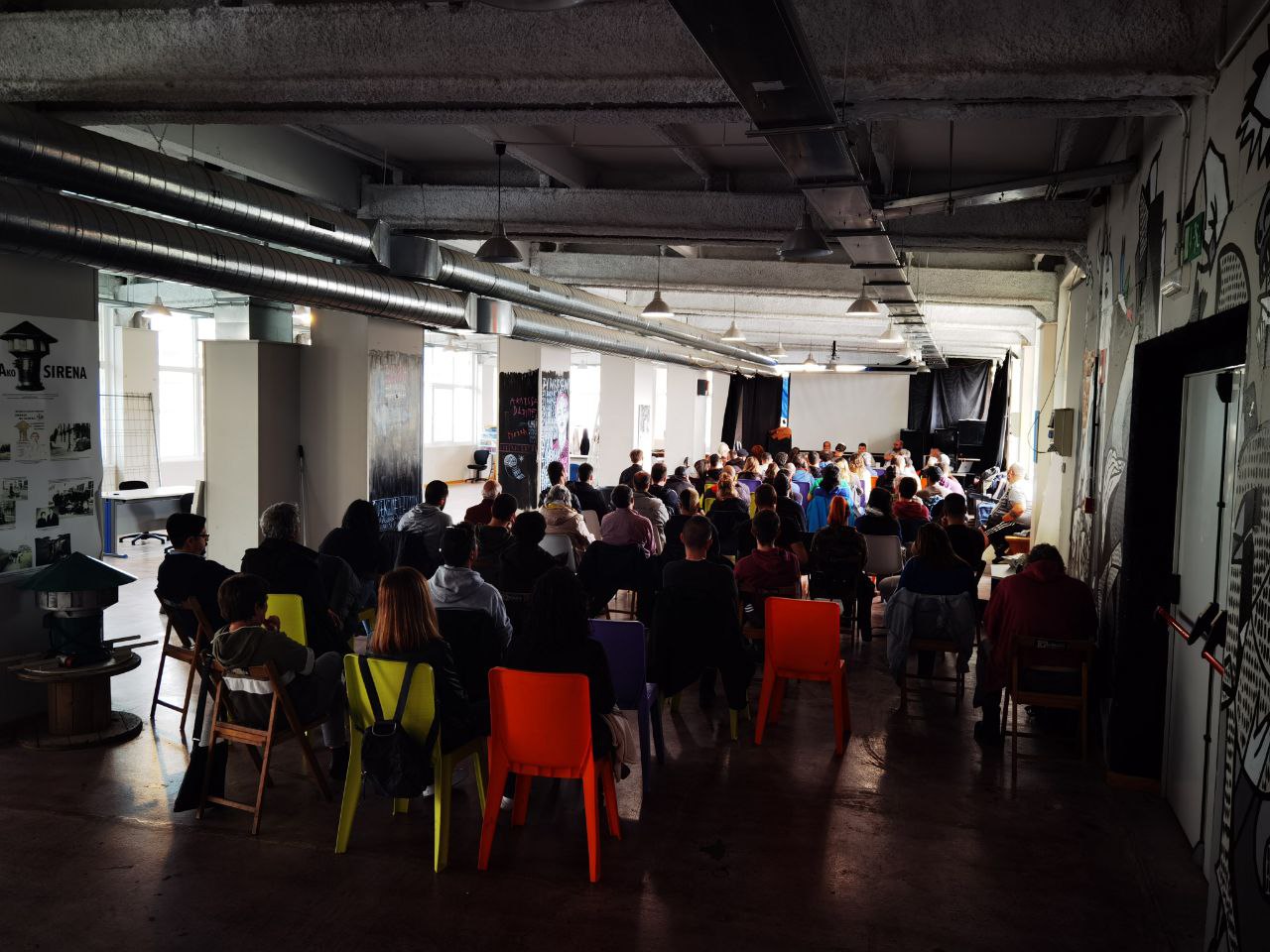
Morning session of the anti-fascist conference in Gernika (Photo: DRAF)
According to a participant, the content of that speaker´s contribution was similar to that of the previous speaker, although he mentioned the existence of Frente Obrero (Workers´Front), a Basque organisation which, despite its name, is a fascist organisation. The existence of that latter group appeared to be news to many present.
These talks were followed by a break and, upon resumption, there were some contributions from the floor and some responses from the panel, after which all repaired to the green outside the Astra building to where the ceremony of respect to the memory of Kontxi “Rita” Arana was to take place.
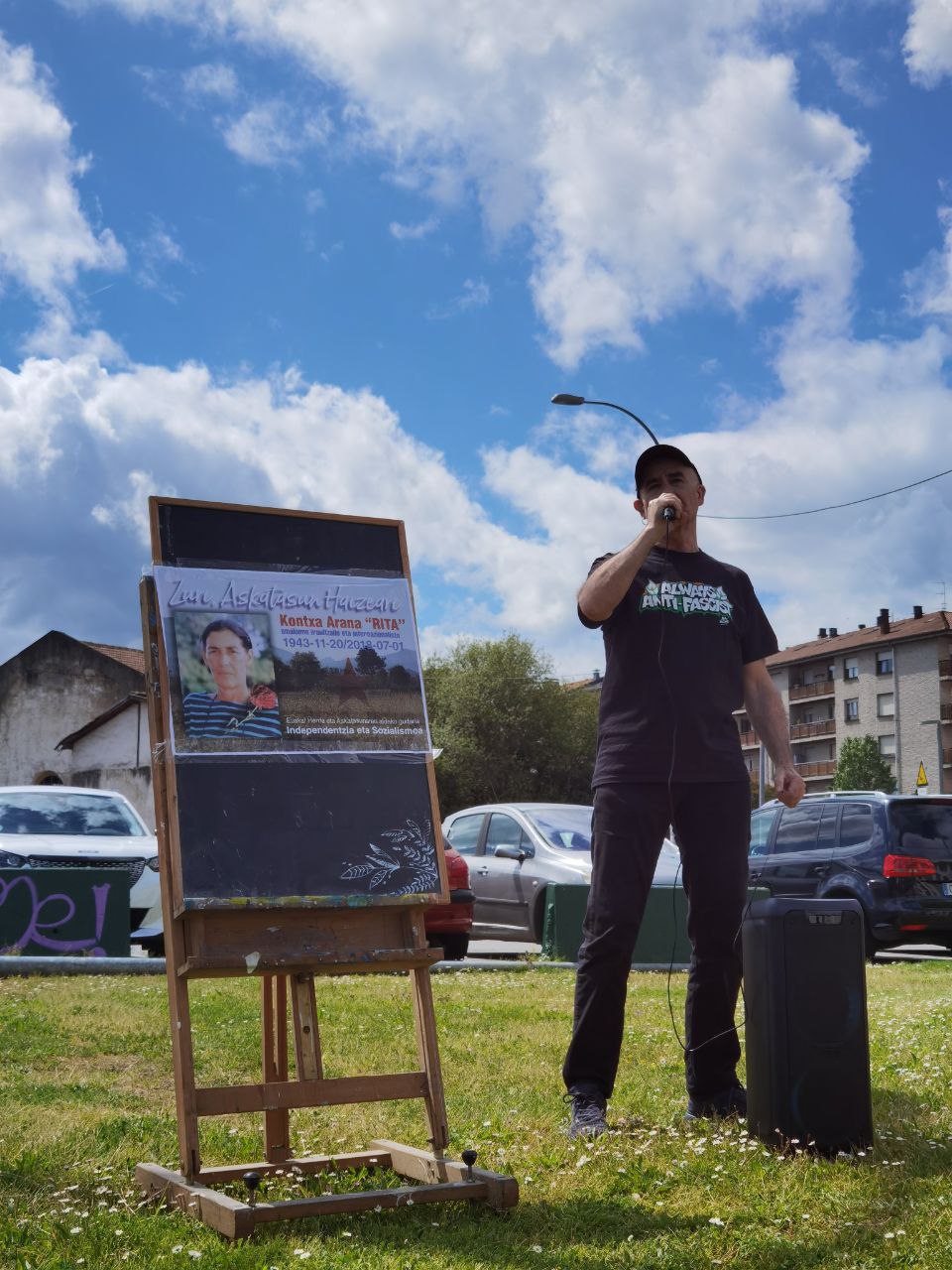
Kontxi Arana: A leading Basque liberation fighter who also joined the Sandinistas in the liberation struggle of Nicaragua
A Basque woman of the independent Patriotic Left movement blew the traditional cow or bull horn to summon attention, while the speaker in the Basque language introduced the program and speakers along with a short history of this internationalist anti-imperialist and anti-fascist fighter.
Kontxi Arana was an active member of the Basque armed liberation organisation ETA who avoided capture while on operations in the Spanish State but was arrested in the French state and exiled to an island, from which she and others escaped. Sometime later she surfaced in Nicaragua, where she had joined the Sandinista armed liberation movement.
Around the end of the 1990s, the leadership of the Basque Patriotic Left asked some exiles to return to the Basque Country to help push the pacification process and release of prisoners but the Spanish State refused to play, though they did not arrest Kontxi (however according to reports arrangements were not well organised to support her).
Most of the crowd present at the Gernika commemoration and homage to Kontxi “Rita” Arana, with the Astra building in the background and the railway line fence just visible in the left background.
The homage to her memory
A man formerly of the official patriotic Left movement spoke in Spanish about the need for internationalist solidarity, through which however mistakes can be made (e.g. in supporting corrupt leadership) which however does not alter the importance of such solidarity, without which the revolution cannot advance.
This was followed by a man from Dublin Republicans Against Fascism who briefy explained in Castilian (Spanish) the history behind Christy Moore´s “Viva La Quince Brigada“, which the Dubliner then sang in its original English.
Dublin Republicans Against Fascism representative singing Christy Moore’s Viva La Quinze Brigada.
The homage event concluded with red carnations being laid by members of the audience in front of a portrait of Kontxi “Rita” Arana. Two ex-political prisoners played the ´txistu´ (Basque three-hole flute), one of them also beating a rhythm on a small drum (´tamborina´). A young woman stepped forward and danced the ´aurresku´, a traditional honour dance.
Crowd queuing to lay red carnations in front of a portrait of Kontxi Arana
This dance was traditionally danced by a male, then by male dancers, then by male and female dancers until today, when it may be performed by any of those combinations or by a lone female, as in this case, and often enough in ordinary clothing as was the case on this occasion, though she did wear dancing shoes laced to the ankles.
The young woman performing the honour Aurresku dance in one of the high kicks of the dance with, to the far right, the ex-political prisoner txistulari (players of the Basque flute). In the immediate background, participants and organisers. (Photo: DRAF)
The musicians then played the air of The Internationale, which most could be heard singing in Euskera, followed by Eusko Gudariak (“Basque Soldiers”), the Basque national resistance song, similar to the Soldiers’ Song/ Amhrán na bhFiann of Ireland in content. Many had raised clenched fists as the songs were sung.
Suddenly, a wild high-pitched yodelling cry rang out from a female throat, the Irrintzi, traditional Basque battle-cry which probably echoed around the mountains in olden days.
All the audience then repaired to the Astra building where a hot meal was served to all on long tables with a bottle of wine to share among each group of several people (those present had purchased tickets to the event either in advance or upon attendance).
Afternoon session: Presentations from Turkish, Irish and Catalan antifascists.
The afternoon session started a little late as people straggled in. The chairperson, speaking in Euskera, introduced the theme of the session which was for antifascists from Turkey, Ireland and Catalonia to describe the situation with regard to fascism in their countries and how it was being confronted.
Turkey
Two people from the Turkish-based revolutionary organisation Anti-Imperialist Front presented their contribution while using a video of images, some subtitled in Castilian but where not, spoken by the woman in English while her comrade translated simultaneously into Castilian.
Overall, the presentation was about the development of state fascism in Turkey and the failed military coup of 2016. The DHKP/C organisation had resisted this on the streets but a major struggle with the Erdogan government took place in trials and in the jails.
Through hunger strikes and physical resistance in the jails, hundreds of martyrs had lost their lives, said the speaker but had remained undefeated. Also martyred had been members of the Group Yorum music group which has played revolutionary songs heard by millions.
Another struggle was carried out through public hunger strikes by elderly relatives seeking the uncovering of mass graves in the bodies of fighters, their sons, had been thrown by the Turkish military.
As a result two mass graves had been eventually disinterred, permitting the remains of fighters of the DHKP/C and of the PKK (Kurdish patriotic socialist organisation) to be returned to their families for respectful re-burial.
The Turkish speakers concluded by stating the necessity for anti-fascism to be anti-imperialist and calling for internationalist solidarity and victory to peoples’ struggles.
Section of audience at afternoon session of the anti-fascist conference in Gernika, Basque Country.
Ireland
The next speaker was from Dublin Republicans Against Fascism, explaining that eight centuries of occupation of his country by England has ensured that the dominant struggle had been one of national liberation and that all armed struggles since 1798 had been led by Republicans of various kinds: 1801, 1848, 1867, 1882 and 1916.
The Irish State that came into being after the War of Independence in 1921 had been a client of the UK, conceding over one-fifth of its national territory as a direct colony. The armed forces of the State had formally executed over 80 of the IRA and instituted a wave of repression including kidnappings, torture, murders including of prisoners.
In keeping with the rise of fascism across 1930s Europe, Ireland saw the Blueshirt movement, led by former police chief Eoin O’Duffy. The Republican movement and socialists fought these on the streets, the speaker said.
The Dubliner recounted briefly the history of Irish Republicans and socialists going to fight Franco in the Spanish state and the Irish diaspora fighting the British fascists, the Blackshirts, in British cities and in defence of Eastern European Jews in famous Battle of Capel Street in the East End of London against over 7,000 police.
He went on to recount some more recent successful physical attacks by joint Republican groups against fascist organisations, the Pegida group in 2016 and even more recently the National Party. Recently too, Republican ex-prisoners had released a video stating the opposition of Republicanism to fascism with a growing list of signatures.
In conclusion, the speaker said that Ireland’s history made it difficult for fascism to advance in Ireland (except in the Loyalist areas) but as long as capitalism exists so too does the danger of fascism, particularly if the progressive forces do not fight effectively against the attacks of Capital on working people.
Catalonia
The representative of the Anti-Repression Platform of Catalonia, speaking in Castilian (Spanish), explained their organisation had come into existence after the repression of the Independence Referendum in 2017 and the subsequent frame-ups and allegations of terrorism against the Committees for the Defence of the Republic.
The speaker alluded to the jailing of the revolutionary socialist rapper Pablo Hasel and comrades who were charged with terrorism merely for expressing and organising solidarity for those being repressed.
“Don’t try to frighten us with threats of a fascist party getting into government”, he said in a reference to the growth of the Spanish fascist party Vox, because we have had a fascist government in the Spanish state since 1939!” (The year that the military-fascist forces defeated the Second Republic and founded four decades of dictatorship).
The Catalan went on to denounce the social-democratic party PSOE (currently in coalition government with Podemos Unitas), pointing out that it has had more political prisoners in jail and fatal victims than any other party in Spanish government (he was probably including the sponsoring the GAL terrorists of the 1980s).
“There has not been a year in which there were no political prisoners in the Spanish state”, he went on to say but also denounced the current Catalan Government, led by the allegedly pro-independence and leftist ERC party and its repression of socialists and independence activists.
He pointed out that fascists would make no distinction between communists and anarchists and asked “so then why should we?” He declared that all who resist repression now, regardless of before, are welcome to take part in their organisation.
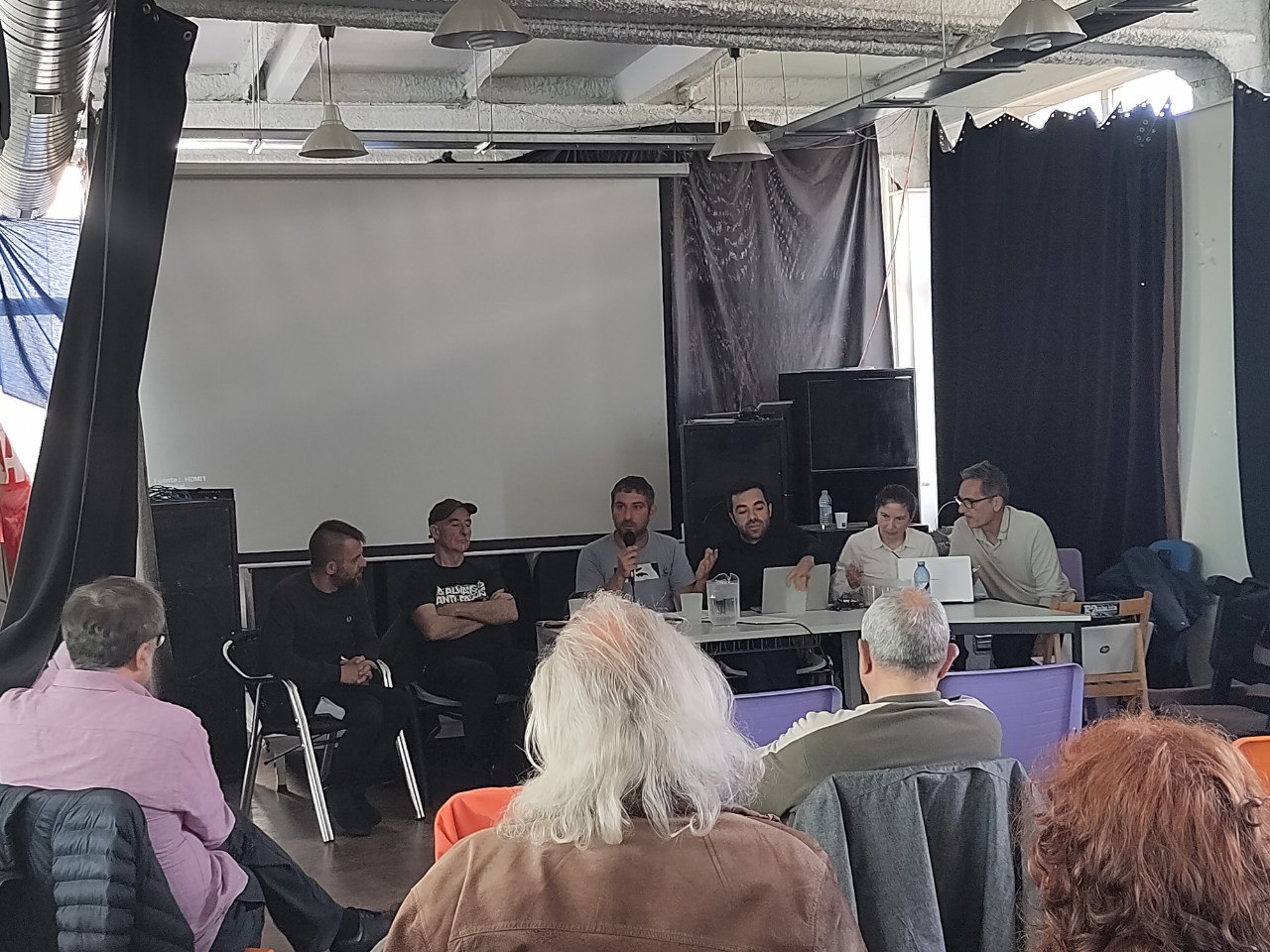
The panel at the afternoon session: from left to right: speakers from Catalonia and Ireland, Basque chairperson, Turkish speakers and translator.
Prisoners on hunger-strike
The chairperson of the panel thanked the speakers and drew together elements from each of their presentations.
He went on to announce the declared intention of a small group of Basque political prisoners to embark on a hunger strike and to outline solidarity events being organised. The prisoners concerned are in the non-compliance minority of Basque political prisoners with a regime that forbids them referring to themselves as political prisoners.
The prison authorities intended to make the prisoners share a cell with other political prisoners who are however in compliance, intending to undermine the resistance of the small group and also posing the danger of conflicts within the cell. (A few days later news came that the hunger-striking prisoners had won their demands).
Amnistia organisation solidarity poster announcing forthcoming hunger-strike of political prisoners, now over because they won their demand.
Summary
The conference in its organisation and content of contributions drew anti-fascism together with imperialism and internationalist solidarity, all from an anti-capitalist perspective. It also drew connections between solidarity with political prisoners and resistance to repression.
All of the Basque organisations represented are in opposition to the trajectory of the leadership of what had been the Basque Left Patriotic movement, now represented by the EH Bildu party led by Otegi (with daily newspaper GARA, its trade union organisation LAB) and many of the older people were ex-supporters of that leadership.
That included some prominent ones such as Inaki Gil de San Vincente and the speakers and organisers of the conference and of the homage to the memory of Kontxi “Rita” Arana. The younger participants might have included ex-members or had come into political consciousness in opposition to that leadership.
Taken together, they are what many call ‘dissidents’ though some reject that term, saying that they are in fact sticking to the original line of independence and socialism and that it is the official leadership and their followers who have deviated. Their numbers are comparatively small at the moment but they are growing.
Currently the International Court of Justice1 has accused Premier Vladimir Putin and the Russian Commissioner for Children’s Rights of responsibility for the “forced abduction” of Ukrainian children and their adoption by Russian couples.
The charge implies ethnic cleansing and forced assimilation taking place during war and therefore would be classed a war crime. The Russian side denies the charge saying that instead what has taken place has been voluntary evacuation of families and evacuation of children from orphanages.
The western mass media (wsm) confines itself to repeating the charge and accusatory statements from western politicians, mostly from countries that are part of the NATO military alliance and briefly stating that the Russian leadership denies the charge. Is anyone actually investigating?
Well, Associated Press, a western media agency, says it has and that Russia is guilty. In that case, let’s see the evidence. And we’d have to wonder why a spokesperson for United Nations Childrens Fund (UNICEF) states that it has seen no evidence of Russian abduction of children.
The wsm has only informed us of UNICEF’s position recently in the course of reporting an informal UN Security Council meeting where Maria Lvova-Belova not only denied the charges of abduction but gave actual hard figures on whole family and orphanage children evacuation2.
Ms Lvova-Belova, said that since February 24th, 2022, Russia has taken in more than five million Ukrainians, including 700,000 children — all with parents, relatives or legal guardians except for 2,000 from orphanages in the eastern Donbas.3
To date, she said, about 1,300 children have been returned to their orphanages, 400 were sent to Russian orphanages and 358 were placed in foster homes4.
Lvova-Belova speaking at the informal UN Security Council meeting (Photo sourced: Internet)
Ms Lvova-Belova said her office has met with representatives of UNICEF, Refugees International and the International Committee of the Red Cross and “provide all available information about the situation of children” and are “coordinating with the Red Cross on reunification,” she said.5
The NATO countries declined to send their ambassadors to the meeting while chief NATO state representatives present, e.g. of the USA and UK, walked out of the meeting without listening, accusing Russia of using the situation for propaganda purposes.
Well maybe, UK and USA representatives, but everyone has been issuing propaganda in this war! Anyway why not answer the Russian case with your own counter-evidence? If you actually have a viable case that stands up to scrutiny?
Some war-time children’s evacuation examples
The war damage inflicted in the Donbas region by both sides in this war since 2022 — and by the Ukrainian state alone since 2014 – would make concern for children’s lives a natural motivation for relatives anxious to get their children to somewhere safe.
During the anti-fascist war in Spain, sympathetic families in Britain took in children from the Republican side for their safety from the advancing Spanish military-fascist forces and allied German Nazi and Italian Fascist military.
Later, as defeat loomed for the Spanish Republic, families with children fled to many countries (a few even to Ireland) and yes, to the Soviet Union. In fact a Basque descendant of that evacuation has passed a year in Polish jail accused of spying for Russia without presentation of any evidence.6
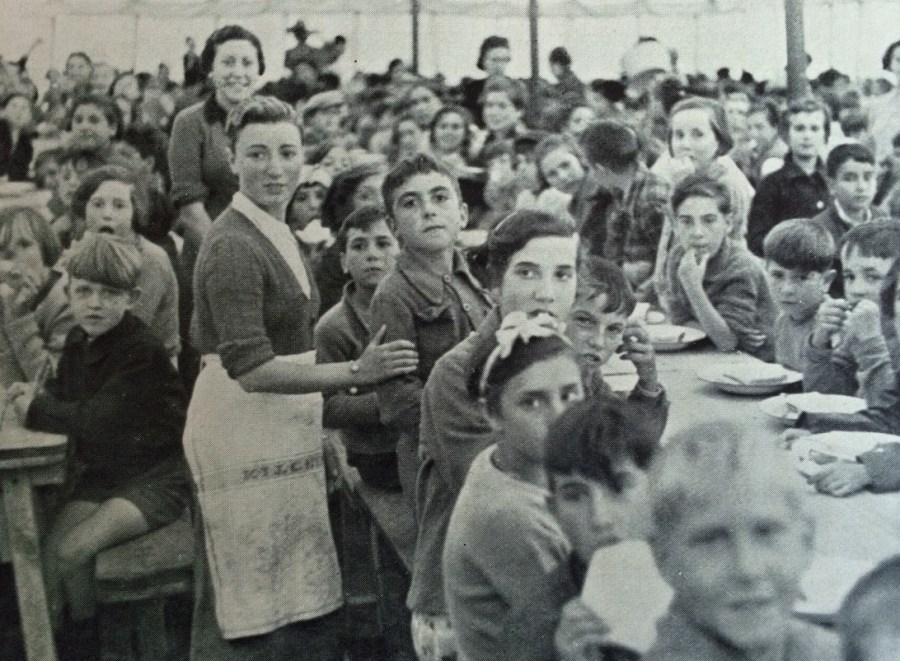
Basque and Spanish children, refugees from Spanish Anti-Fascist War (Photo sourced: Internet)
During WW2, children from British cities were sent to homes in rural areas for their safety. Whatever the issues around how they were treated in their new or temporary homes, nobody speaks of “abduction” of Basque, Spanish or British children7.
Well, actually, some children were abducted in Spain, from their murdered Republican parents or from working class women who were told their baby had died in childbirth. The fascist State and the Catholic church presented these children for adoption to rich and loyal childless couples.8
One of the reasons for abduction of children in those cases was to satisfy the needs of childless couples loyal to the regime and required the massive collusion of a number of health and social care agencies, all of which were exposed later. Does this seem a likely risk for Russia to take?
Ukrainian families with children evacuating to Russia (Photo crdt: Wall Street Journal)
Well what about the other objective, social engineering, of creating fascist children, or for example “Germanisation” but in this case “Russification”?
Hardly, the children are from the Donbas region, an area already largely Russian in language and culture and, since attacks of the Ukrainian forces on it since 2014, already hostile to the Kyiv regime and mostly sympathetic to Russia.
The Ukrainian State leadership, one of the main accusers of Russia’s alleged abduction of children, frequently issues population figures of towns and cities in the Ukraine War zone, comparing pre-war with current figures, showing a huge drop between both sets.
Presumably the fall in numbers of inhabitants in towns under their control could not have been carried out by Russia. So are we to accuse the Kiyv regime of the “abduction” an “ethnic cleansing” of thousands of Ukrainians, its own citizens? Or more reasonably, of their evacuation?
Returning to the question of actual evidence, an issue of apparent little importance to the wsm and NATO country states, surely an international agency responsible for children would be expected to have a reasonable handle on this?
Or is UNICEF to come under the accusation regularly thrown at those of us who don’t swallow everything NATO says, i.e. of being “putinistas?
The Target of the Propaganda
It’s worth considering who the targets in this propaganda war might be and the reasons therein. The state intelligence agencies of NATO countries presumably have a fair idea of which are truths and which are lies. So the target is not the heads of states.
THE MAIN TARGET OF THE PROPAGANDA IS US, i.e. the ordinary people in the western world, whether in NATO (which most are) or not. The objective being that we should support our governments in backing US/NATO’s confrontation with Russia.
And that if it should come to world war, which seems increasingly likely, that we support our governments and suffer the consequences, including dying in millions to support their objectives. Without rebelling.
End.
FOOTNOTES
1The western mass media makes a point of telling us that Russia does not recognise the authority of the ICC but rarely adds that nor does the Ukrainian regime. And nor does the USA!
2An interesting exercise to evaluate wsm bias is to put “Russia denies abduction of children” in a mainstream search engine and see how many hits one gets for UNICEF’s statement.
6Pablo Gonzalez, a journalist working for Spanish media, was born in Russia, grandson of such a refugee. He was covering the Ukraine war when detained by their state intelligence service and advised to leave the country; meanwhile Spanish state security visited and interviewed his family, his mother and friends. He left Ukraine but went to Poland and was arrested by their state intelligence service as he was accompanying other journalists crossing back into Ukraine. To this date well over a year later Gonzalez has had no evidence of spying presented against him. Unlike a journalist detained in Russia whose case elicited public concern from western politicians within days, none of them have mentioned the case of Pablo Gonzalez.
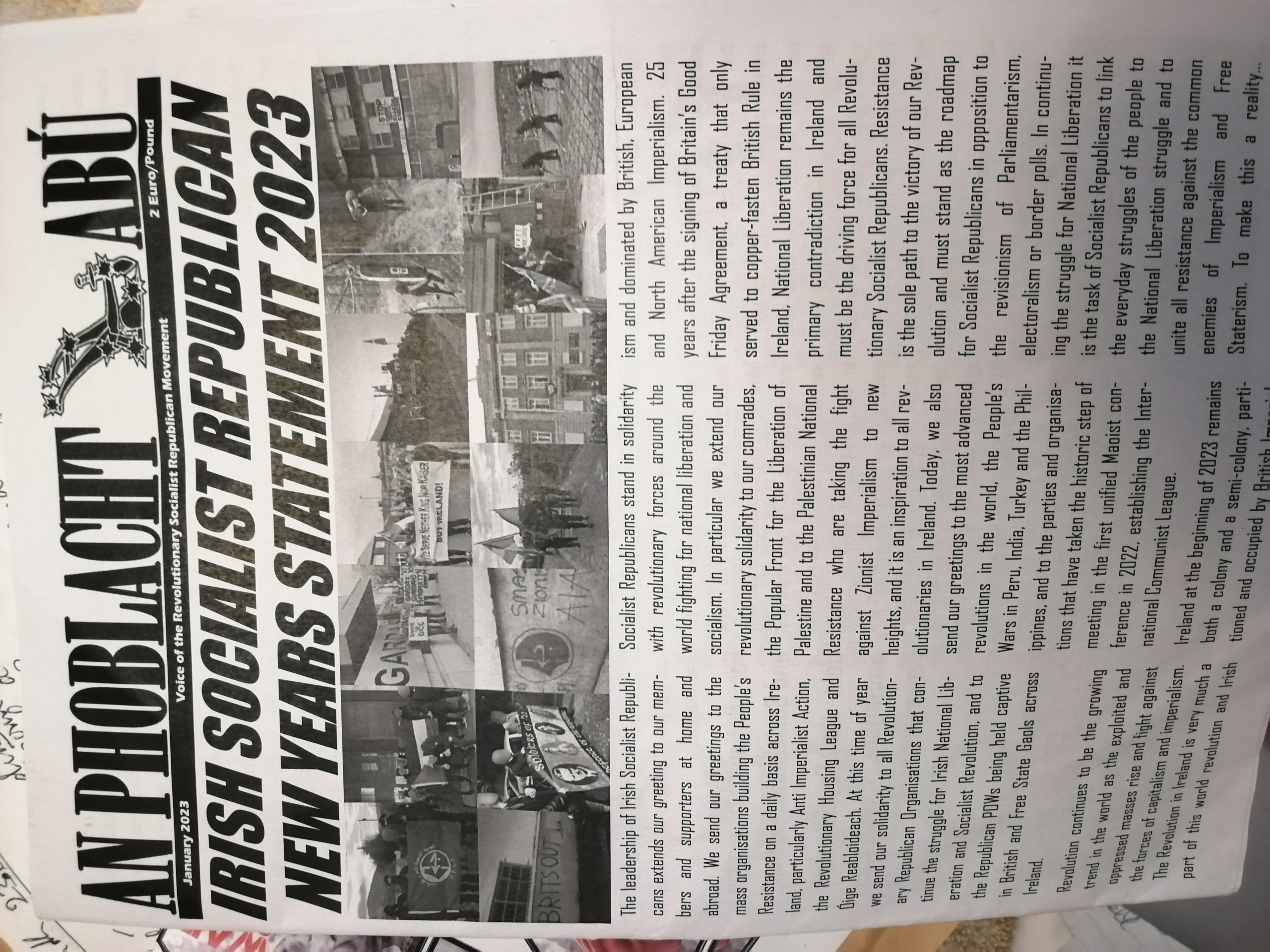
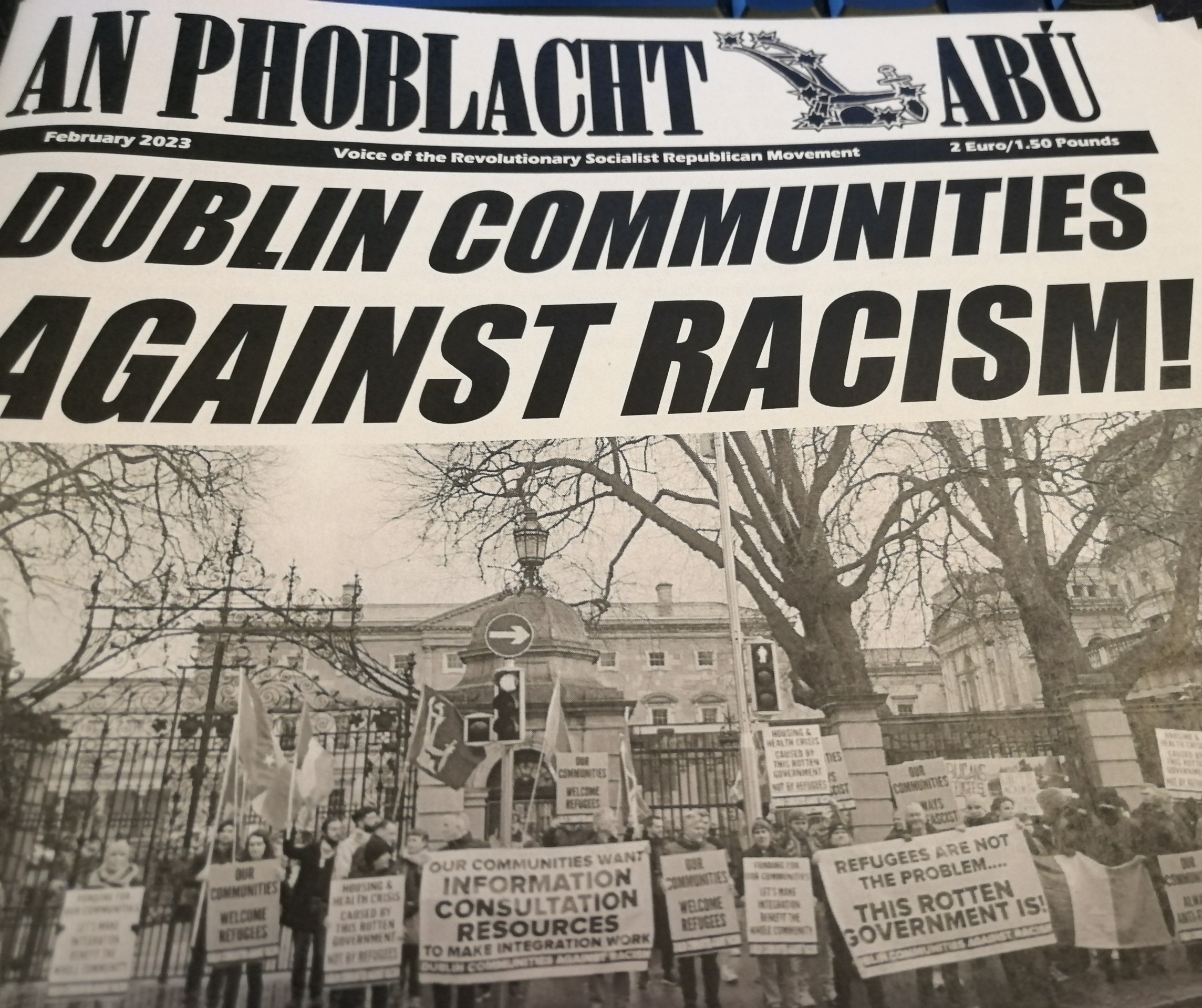
A new socialist Irish Republican hardcopy newspaper has appeared in Ireland in recent months. January and February 2023’s editions, believed to be nos. 3 & 4 are reviewed here.
HARD-COPY NEWSPAPERS
While today, at least in the developed world, the production of Internet media is of great importance for the revolutionary movement as much as it is for the capitalist system, the hard-copy newspaper disseminated by hand still has an important role.
Hardcopy newspaper distribution entails contact in the real world with real people, answers given to questions asked and challenges made, contacts made between the potential organisers and potential activist supporters, can go from hand to hand and be left for a random reader.
Online media has no equivalent to this.
Lenin observed that the revolutionary newspaper is an organiser, not only in its calls to action but in the necessary tasks of production and distribution. Ireland has very few revolutionary newspapers and not even one weekly one, to say nothing of daily editions.
An Phoblacht Abú is produced and distributed by Irish Republican Socialists, whose activist manifestations have been seen in the Revolutionary Housing League’s occupation of empty buildings and its calls for a general emulation of such actions.
Another manifestation has been the activities of Anti-Imperialist Action, notably in protest pickets against imperialism and neo-colonialism, antifascist actions and anti-spiking campaigns, also in commemorations of Republican martyrs, often supported by sticker and leaflet campaigns.
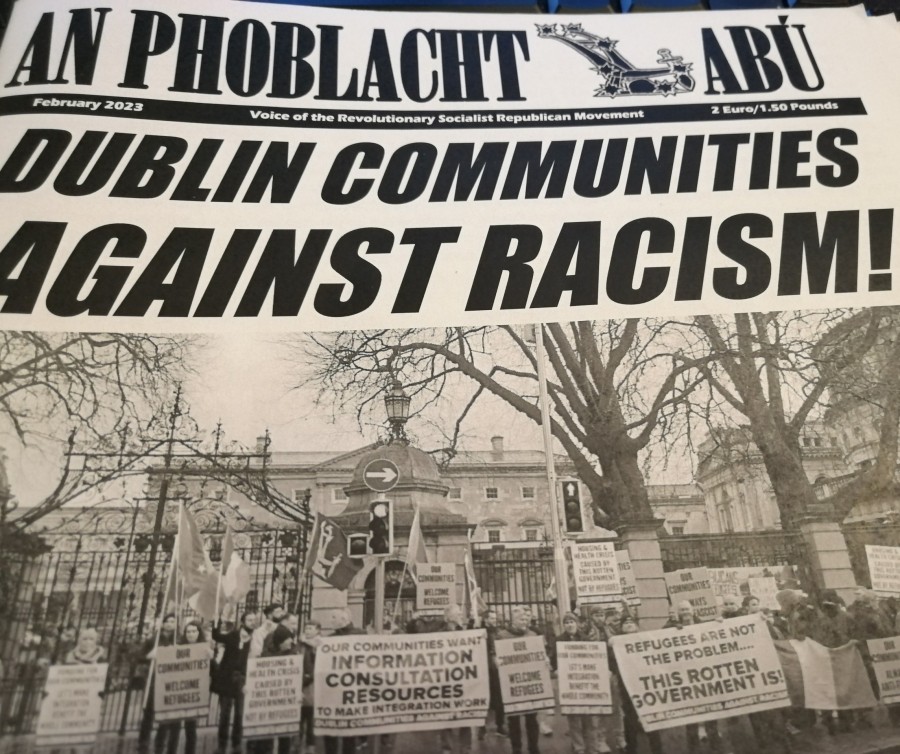
An Phoblacht Abú Front January 2023, front page.
CONTENT, FORM AND PRICE
Both issues reviewed contained 16 sides of A4 pages, composed of two A3 sheets folded in half, one inside the other. They sold at 2 euros per issue – less than one-third the price of most pints in Dublin and much longer to consume!
In general the articles are well-written and with few typographical errors. The editions reviewed here covered national and international news and the overall line in the content is of revolutionary overthrow of the ruling class and eschewing electoralism.
With regard to coverage of national issues, anti-fascism, anti-racism, building a broad front, opposition to NATO and the British occupation of the Six Counties and the neo-colonial and neo-liberal ruling class of the Twenty-Six Counties have figured prominently.
Apart from such regular themes, January’s issue documented the struggle against student fees and treachery of the student union executive in Maynooth and reported a joint Republican Prisoners’ solidarity picket in Dublin along with the release of a known Loyalist sectarian murderer.
Commemorations of Irish Republicans murdered by the Free State during the Irish Civil War/ Counter Revolution (1922-1923) figured in both issues.
In foreign news coverage, actions of peoples’ guerrilla forces in the Philippines and India, for which one would search the main dailies in vain, are covered in both issues and, in January’s, Scottish independence and John McLean and Israeli expulsion of Palestinian campaigner Salah Hamouri.
The environmental struggle in Germany figured in February’s issue.
Regarding economic questions, the rise in “cost of living” and housing crisis attacks on working people were addressed in short articles. Wider pieces on action were included on class struggle and community representation and action in the February edition.
LOOKING AHEAD
The appearance of An Phoblacht Abú is welcome and it is hoped can be sustained. Hopefully further issues will deal with questions of culture and the Irish language, the war in Ukraine (on which the Left seems deeply divided), historical-cultural conservation, trade union organisation and education of the people.
AVAILABLEat 2 euro per copy (back issues sometimes free) from sellers and supporters or from irsmedia@protonmail.com
Gearóid Ó Loingsigh (with kind donation of photos)
(Reading time: 7 mins.)
08 March 2023
Photo Coca Plants Northern Colombia: G.O.L.
The drugs issue in Colombia supposedly occupies the time of and is a concern to the government.
It has been an important issue for all the governments and as was to be expected it is one that has come up again in the dialogues with the ELN, despite this organisation denying any links to the drugs trade.
The author (left) and Pablo Beltran, the ELN negotiator (centre) and representative of social movement in Ecuador (right) in 2017 conference in University of Simon Bolivar, Quito, Ecuador. (Photo: GOL)
In the peace process with the FARC, agreement was reached on the issue. What was agreed to in Point 4 of the Havana Accord was abysmal and showed that the FARC did not understand the problem nor the possible solutions.
Of course, there could be a difference between what the FARC understood and what it agreed to, as at the end of the day the state won the war and imposed the greater part of what the FARC signed up to.
Following the agreement in the declarations of the main FARC commanders there is nothing to be seen that indicates that they really understood the problem. Will it be any different with the ELN?
One of the main concerns of the ELN has been to put a distance between themselves and the drugs trade.
Whilst it is true that the ELN is not the FARC, it is also true that in their areas of influence or those contiguous there are coca and poppy crops and the USA is not going to believe them that they have nothing to with it, whether they like it or not. The ELN accepts that it places taxes on economic activities and for the USA that is drug trafficking.
So, some time ago, the ELN issued a statement where they restated that they have nothing to do with drugs and invited an international commission to visit the country to see the reality for itself.(1) They ask that a UN delegate take part in the delegation. They also make a series of proposals in relation to the issue as such.
On the first point, the ELN feels sure of itself regarding its ability to show in practice that they are not drug traffickers. The ELN correctly states that:
When the Colombian government and the USA accuse the ELN of having an active role in the trade, they are lying, but above all they are covering up for those really responsible and the deep-seated problems, which indicate their unwillingness to take real and effective measures.(2)
ELN guerrilla camp, Colombia (Photo: GOL)
But for the USA, it is not about whether they are guilty or not, it is a political tool and weapon and to give them a voice and vote in the affair is extremely dangerous. When the USA accuses the ELN of being drug traffickers, it is not making a mistake.
A mistake on their part would be to say something they believe and be wrong about it, but they accuse the ELN for political reasons on the basis of their strategic needs and the legal basis to their accusations is the least of it: it is just propaganda. By inviting them into the country, the ELN falls into their trap.
The UN participated in the commissions of investigation for supposed weapons of mass destruction in Iraq. The lack of evidence of such weapons wasn’t of much use.
The USA played around with supposed or real non-compliance by Saddam and did what they always wanted to do: invade Iraq. In this they counted on the explicit support of Great Britain and the tacit support of others.
There is a myth in Colombia that the only baddies are the USA and that other imperialist powers such as Canada (a country that is not seen as imperialist by many sections of the “Colombian left”), and other countries of the European Union are good, or at least not really that bad to the point they are friends of the Colombian people.
In the case of Colombia, the EU competes with the US in almost everything. The EU is Colombia’s second commercial partner and its companies are dominant in sectors such as mining, health and oil, amongst others.
The ELN also asks for the legalization of drugs. The demand is justified and quite opportune, but their counterparts i.e. the Colombian state is not sovereign in the matter and furthermore there is a need to clarify what is understood by legalization.
If by legalization they mean legalizing production for medical purposes, the bad news is that medical production is already legal. The thing is, that it is controlled. In fact, in many jurisdictions they don’t talk of illegal drugs but rather controlled substances.
Cocaine is a controlled substance. Its production for medical reasons is authorized by the International Narcotics Control Board (INCB) and production is almost exclusively carried out in Peru. And the market is quite small, not even reaching 400 kilos per year as I pointed out in an earlier article.(3) It solves nothing in relation to Colombia.
If on the other hand, they are talking about legalizing recreational use, something which could positively impact the Colombian countryside, then it is a matter of international jurisdiction. Colombia cannot legalise it on its own.
Colombia is a signatory to the Single Convention of 1961 that holds sway in the matter and in addition there are power relationships at play.
It doesn’t matter whether it legalises production for recreational use, it will never be able to legally export it, not only without the consent of the other country, but also the whole setup of the UN and its bodies such as the INCB i.e. at the end of the day, the USA.
Even if it is legalized for internal consumption, there are other problems that have already arisen in countries such as Uruguay which legalised recreational use of marijuana or some of the states in the USA.
The banking system dare not receive funds from those legalised markets and the producers resort to old methods more akin to money laundering to deposit legal funds in legal accounts in a legal banking system.
Even in the hypothetical case of the USA and the EU agreeing, the legalisation of cocaine would go far beyond Colombian cocaine and would include other drugs such as opium and its derivatives such as heroin. It is worth looking at the drugs market and its production.
According to the UN, cocaine is produced directly or indirectly in eight Latin American countries (Colombia, Peru and Bolivia account for almost all of it), whilst 57 countries produce opium, the Asian countries being the largest producers (Afghanistan, Myanmar and Mexico dominate the market).
A bucket of opium poppy seed (Photo: GOL)
Cannabis, which is the most widely consumed drug in the world is produced in 154 countries.
For 2020, the UN calculated that there were 246,800 hectares of opium and 234,000 of coca.(4) They also calculate a production of 7,930 tonnes in 2021(5) and 1,982 tonnes of cocaine in 2020.(6) We are not talking about small quantities of production or land. Almost half a million hectares between these two drugs and 64 countries.
Any proposal of legalisation has to include these countries and their peasantry.
The number of drug users is also large. The UN calculates that in 2020 there were 209 million cannabis consumers, 61 million people who had consumed opiates, 24 million amphetamine users, 21 million cocaine consumers and 20 million users of ecstasy.(7)
They say that in 2020, they had calculated that 284 million people between the ages of 15-64 years used drugs, i.e. one in every 18 people in this cohort.(8)
There are consequences to this, in economic but also cultural terms regarding the use and abuse of substances. But there also consequences in terms of health. Some 600,000 people received some treatment for drug problems.(9)
So when the ELN says that “Drug addicts are ill and should be cared for by the states and not pursued as delinquents”(10) their idea is correct, however, the size of the problem is greater than the real capacity of the health systems in the countries that have large numbers of users.
Photo Opium Poppy Nariño Colombia: G.O.L.
The total number of people injecting drugs is 5,190,000 in Asia, 2,600,000 in Europe and 2,350,000 in the Americas (almost 75% of which is in north America).(11)
Of those who inject, 5.5 million have Hepatitis C, 1.4 million are HIV positive and 1.2 million are HIV positive and also have Hepatitis C.(12) These are not minor problems and are high-cost illnesses.
Of course, these figures do not include the unlawful abuse of legal pharmaceuticals. In the USA almost 80% of the overdoses are from the consumption of legal opiates such as fentanyl, which caused 78,238 deaths in 2021 in that country.
But the issue does require legalisation and not other means that the FARC aimed for. The peasants of Colombia did not make a mistake in choice of crop when they planted coca. Coca was and continues to be a very profitable crop, despite all the difficulties that it generates.
There is no need to substitute it with another crop such as cocoa or African palm etc. It is not about the crop but rather the production model and the political and economic context.
The increase in coca production in Colombia, is not due to subjective factors such as the decisions of peasants, not even of the drug barons and less still of the insurgencies but rather objective economic factors.
This is a key point. It was the decisions of northern countries that impacted the countryside and pushed thousands of peasants around the world to grow opium poppy and coca. The neoliberal cutback policies in the north also contributed to the dramatic rise in problem drug use due to the increase in misery in those countries.
Bedding, equipment and reading material in an ELN guerrilla camp, Colombia (Photo: GOL)
In any discussion we should distance ourselves from the idea that the drugs problem can be solved in a negotiation with the ELN, although they could negotiate some points that would contribute positively to a solution.
But the problem is political and the free trade agreements and other measures that had a negative impact on the countryside have to be looked at again.
Also, they have to reach an agreement with the Colombian government, not for some perks for peasants nor corrupt projects and budgets such as those the FARC agreed to, but rather a political agreement where the government argues and campaigns for the derogation of the Single Convention of 1961.
We began the previous manifesto talking about emergencies. We said that it was essential to reclaim an anti-imperialist and internationalist Euskal Herria2.
And that urgency, that need, is what has brought together comrades from all corners of Euskal Herria here today. Well done all of us!
Capitalism is going through a systemic crisis. They speak to us of a “extraordinary period” but the truth is rather that we find ourselves in a permanent crisis. As we have supposedly departed one, they have already placed us in another.
As of 2020, moreover, we have entered a phase of exceptionality in which States take advantage to impose economic, social and disciplinary policies that point towards a war scenario. Therefore, we cannot separate the capitalist decomposition from the increase in repression and censorship.
Banner reading “Condemning us to war and misery” and section of the anti-NATO march in Bilbao 11 March. (Photo sourced: organisers)
The rise of fascism that is taking place throughout Europe is a direct consequence of the bourgeoisie’s fear of losing the control it exercises over an increasingly exploited and angry population.
In the field of international relations, we are also witnessing the increasing loss of hegemony of the Empire that has controlled the world practically without opposition for the last 30 years.
The bloc led by the United States and NATO, far from accepting the end of its historical cycle, seems determined to increase armed conflicts. In addition to giving a boost to the arms industry, they intend to hinder the growth of emerging powers such as China or Russia.
For this phase of confrontation, they have finally achieved the support of the lobby led by Ursula Von der Layen, the “gardener” Borrell3 and company.
NATO and the EU, together with the Zionist entity that redoubles its attacks on the Palestinian people, are today the main props of this dark period in history.
As far as NATO is concerned, we have to understand that its role goes beyond being a mere military organization. It is true that it is mainly the army of the bourgeoisie (and it is demonstrating this in Donbass, as it has also demonstrated in Yugoslavia, Libya or Syria).
But it has the superior function of being the military arm against anyone who opposes the policies of capital. Today these translate into the over-exploitation and precarity of the working class (especially women and people of colour).
And changes in labour rights to deprive us of material concessions wrested through class struggle, change of laws to increase the repression of those struggles, etc.
A clear example of this is the latest General Budget of the Spanish State, supported by all the social democratic parties4.
The budget supports the deterioration of the material conditions of working peoples to benefit NATO, giving it more control capacity and recognizing their right to appropriate civil infrastructures to defend the interests of the bourgeoisie.
The support for these militaristic policies, at the dawn of a world war, is a real shame and demonstrates the total lack of commitment of the leadership of these parties to the future of the Working Peoples of the world.
In Euskal Herria we are well aware of what NATO represents:
in addition to the military training industrial estate in Las Bardenas or the military exercises carried out at the Araka base (Gasteiz), we have recently witnessed blatant support from the Government of Gasteiz for war industries such as SENER or SAPA.
Nor can we forget the historical support of NATO, through the Gladio network, to the Spanish and French States in their legal and illegal repression5 against the struggle in Euskal Herria.
If we add to this the economic and social exception measures imposed on us by Brussels (private pension funds, increase in the retirement age, dismantling of public health) …
It becomes increasingly clear to us that neither as a nation nor as working class do we have a future within NATO or the EU. The need to destroy these instruments of domination by the bourgeoisie, as well as the Spanish and French States, is more than evident if we aspire to build a future in freedom.
These are not good times, of course not. The situation is becoming more and more complicated throughout the world. And that is why we here today are calling for the activation in each town and each neighborhood of the anti-imperialist Euskal Herria.
Today, we not only reaffirm this rejection, but we once again make an urgent call to join forces with the rest of the working peoples and oppressed nations of the world to stop the imperialist offensive promoted by this criminal organization along with its allies in the European Union.
From Chile to Donbass, passing through Laos, Mali or Vietnam…
LONG LIVE THE STRUGGLE OF THE WORKING PEOPLE!
AN ANTI-IMPERIALIST BASQUE COUNTRY!
Front of march heading towards the Bridge across the Nervión river and the old city (Photo sourced: organisers)
COMMENT: A GIANT STEP FORWARD
Diarmuid Breatnach
(Reading time:One min.)
The estimated 2,000 turnout in support of this demonstration must have exceeded the expectations of the organisers and greatly encouraged them. Two thousand is not a huge number in the highly-politicised Basque Country, even with a total population of less than three million, north and south.
But this is a nation which has for decades been under a political leadership, the surviving members of which have now taken the road of pacificaction, of accommodation to capitalism and the Spanish and French states, of social-democratic ‘opposition’.
This movement had a united national political leadership, an armed guerrilla movement, a daily newspaper, a trade union and smaller affiliated groups; it had café/bars/social centres throughout the southern provinces.
Though in decline and fragmented with the leadership’s embracing of the pacification process (through which, unlike the Provos, they did not even gain the release of their hundreds of imprisoned comrades), it still exercises a heavy influence on politics in the Basque Country.
That is today the ambit of Otegi, EH Bildu and Geroa Bai and neither did their parties participate in Saturday’s demonstration nor as an individual any of senior responsibility in their structures, though certainly individuals in their social and cultural sectors were seen in the march.
In that context and after 25 years of pacification, 2,000 in open attendance is a giant step forward for the Basque resistance. ‘Tús maith, leath na hoibre‘, it is said in Irish: ‘A good beginning is half the work’ and indeed, a beginning is how the organisers view the event.
“Dissident” groups such as Amnistia ta Askatasuna, Amnistia Garrasia, Tinko and Jardun have arisen in the last decade and youth have been very prominent in these and others disparate groupings, which is important for any revolutionary movement.
The photos and videos of Saturday’s demonstration show older and mature faces too, veterans of the struggle and also those active during the pacification period and this too is important, for it brings a certain continuity to the movement and the awareness of mistakes made in the past.
More than 50 organisations in the Basque Country supported the call for this demonstration.
The road ahead will not be easy (when has it ever been for the Basque nation or the working class in general?) but a giant step forward has been taken.
End.
FOOTNOTES
1Askapena is the internationalist arm of the Basque movement for independence and was responsible for a number of years for maintaining a network of Basque solidarity organisations (which in some cases it founded) in Mexico and across a number of European cities, including Belfast, Dublin and Cork. In 2011 five of its leading activists were arrested on charges of supporting the guerrilla organisation ETA, through Askapena’s solidarity with political prisoners. The five defended their right to work with prisoner and internationalist solidarity and were finally acquitted in 2016 earning much admiration for their stance (in stark contrast to the 47 activists in a number of prisoner support organisations who apologised for their activity in a Spanish court in September 2019 in exchange for non-custodial sentences for the majority).
2The current Basque name for their nation, “the Basque-speaking country”, replacing the former “Euskadi”, now used to refer only to the three-province ‘autonomous’ region of Bizkaia, Araba and Gipuzkoa.
3Josep Borrell, Foreign Minister of the EU Parliament who has described the EU as “a garden”. A Catalan member of the PSOE, hostile to Catalan independence who after five minutes stormed out of an English-language interview by Tim Sebastian on the German TV program Conflict Zone regarding the struggle in Catalonia.
4This is a reference not only to the social-democratic coalition government of the PSOE and Podemos but also of the Basque EH Bildu and Catalan ERC, the votes of which MPs supported the Budget.
5A reference not only to banning of parties, organisations and demonstrations but also to routine torture and the kidnapping and assassinations of the State-sponsored GAL of the 1980s.
6In the 1986 Referendum on whether the Spanish state should join NATO, the southern Basque Country gave a majority vote against, the only region to do so (though the vote against was high in some regions), the total vote being 52.54% in favour.
The Irish State nominally rules over the 26-Counties land territory and its corresponding sea and airspace. Yet these have been and are repeatedly violated by the US and UK military with Irish ruling class secret collusion.
Now a Senator in Leinster House is seeking a hearing in the High Court to have the behaviour of successive Irish Governments in allowing UK military overflights declared unconstitutional.
The Sea, oh the sea … and the air!
As stipulated by international law, a sovereign state’s area includes the sea up to 12-miles from its border1 and therefore Ireland has a 12 mile territorial sea, a 200 mile exclusive economic zone before any additional claims are made to the continental shelf including the Rockall Bank.2
According to media report, a comprehensive survey of the Irish State’s territorial waters was not undertaken until 2014, i.e nearly a century after its foundation, which in itself is an indictment of an allegedly independent island state.
According to The Geological Survey of Ireland (GSI) says potential territorial waters stretch to 898,442km sq – an area bigger than the oil rich North Sea.3
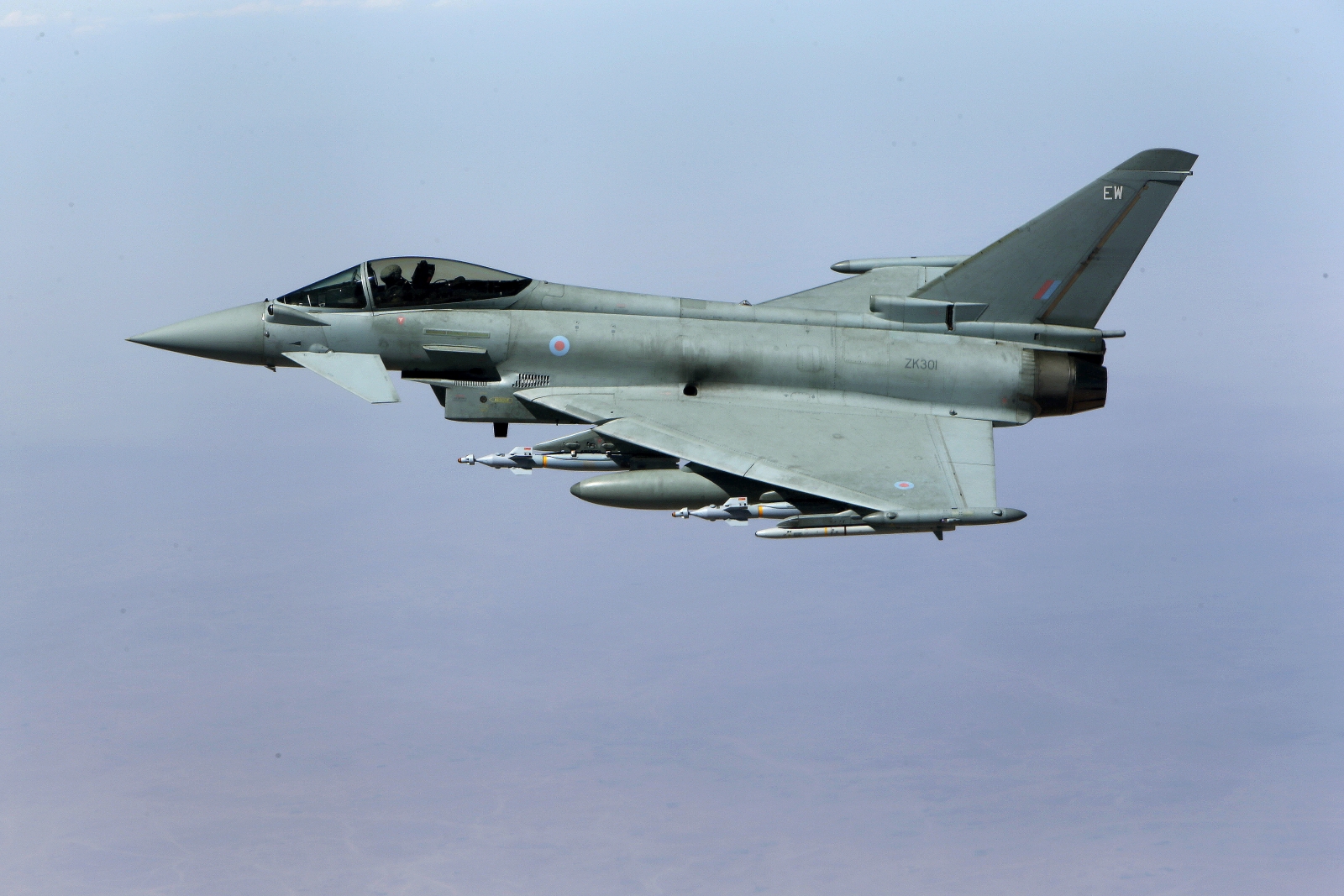
Royal Air Force fighter jet – the Irish State is reported to have secretly agreed to allow these to overfly Irish airspace (Photo sourced: Internet)
Through the decades when Ireland was a fishing nation and fresh fish was eaten weekly in most homes, Irish fishing boats had to compete with those from many other states fishing illegally inside Irish sea limits.
The Irish Navy was the only policing enforcement agency and through much of that time it had only three corvettes to patrol 12 miles out from the whole coastline of the Irish state. Subsequent EU legislation then left Irish seas more open to foreign-based fishing than it did to Irish boats.
The sovereign air space of a state corresponds to that over its land and 12-miles out to sea from its coastline.4
The use of Shannon airport by the US military in transit of troops, weapons and prisoners has long been known and protested.
Shannon Airport protests
Over the years there have been many highly-publicised protests over the US military use of Shannon, ranging from mass protests outside the airport buildings to deliberate trespass and even damage to a US warplane.
The response from the Government Minister to questions in Leinster House is always that the US is not violating Irish sovereignty, arms, military and prisoners are not being transported through there – because the US authorities have assured the Irish Government that they are not.
In February 2003 five members of the Catholic Workers’ Movement under the name Pitstop Ploughshares gained access to a hanger in Shannon Airport and damaged a USAF warplane there. They were Deirdre Clancy, Nuin Dunlop, Karen Fallon, Ciaron O’Reilly and Damien Moran.
They were jailed for up to 11 weeks awaiting committal for trial to which they were finally sent in Dublin Circuit Court in March and October 2005 on two counts of criminal damage, €100 and US $2.5 million. The faced a maximum 10 years if convicted.
Two aborted trials followed as one judge after another revealed their bias and partiality. In July 2006 after twelve days a mixed male and female jury acquitted the accused on all charges on the grounds that they had taken the action to save lives in Iraq and were justified in doing so.
In October 2012 dramatist, writer, former Republican prisoners and veteran activist Margaretta D’Arcy was arrested with Niall Farrell for scaling the fence and entering the grounds of Shannon Airport.
Four convicted Shannon Airport protestors, L-R Mick Wallace, Margarett D’Arcy, Niall Farrell, Clare Daly. (Photo sourced: The Journal.ie)
In June 2014 at the age of 80 and suffering from Parkinson’s disease D’Arcy was jailed for two weeks in Limerick Prison for refusal to pay the fine and remained defiant.
In July 2014 then members of the Irish Parliament Clare Daly and Mick Wallace5 used a rope ladder to climb over a perimeter fence and enter the grounds of Shannon Airport and made no attempt to avoid arrest.
They were both fined by a court for trespass in February 2015 and refused to pay the fine, eventually being taken to Limerick jail by Gardaí in December 2015 and released less than two hours later.
On 25 April 2017 anti-war activists Edward Horgan, a retired Irish soldier of 78, and civil servant Dan Dowling, 39, were arrested in the airport grounds and charged with criminal trespass and malicious damage (felt-tip graffiti slogan on a warplane).
In a very low-level publicity case in January this year (2023), a jury in Dublin found both guilty of trespass but not of criminal damage at the airport and were ordered to pay €5,000 each to a women’s refuge in Co Clare.
On St. Patrick’s Day 2019 two ex-USA military Ken Mayers and Tarak Kauff, now anti-war campaigners of the US chapter of Veterans for Peace, cut a hole in the airport’s perimeter fence, entered Shannon airfield with a banner and were arrested.
In May last year, a majority jury verdict found Mayers (85) and Kauff (80) guilty of interfering with the running of the airport but unanimously not of criminal damage to an airport perimeter fence and of trespassing the airport with the intent to commit an offence or interfere with property.
Ex-USA military Kauf and Mayers of Veterans for Peace (US) protesting US military use of Shannon Airport (Photo sourced: Internet)
The judge fined the anti-war activists 5,000 euro each. Both had spent 11 weeks in prison and had been required to spend nine months in Ireland awaiting trial, despite clear indications that they had no intention of absconding and indeed were looking forward to the trial to publicise the issue.
Senator Craughwell’s case to the High Court.
Less well-known is that successive Irish governments have for decades by secret agreement permitted permitted UK air force planes to fly over Irish airspace and to interdict, i.e. force or shoot down other aircraft. This is what has led to Senator Craughwell’s taking a case to the High Court.
The Independent Senator maintains that although not the case of a formal military alliance, granting permission to fly over Irish State airspace, unless validated by referendum, is a violation of Ireland’s neutrality and sovereignty and is seeking a number of declarations from the Court.
Craughwell, who is a former member of the Irish Defence Forces and the British Army, as well as being an ex-President of the Teachers Union of Ireland, said that his belief in the existence of a secret agreement is based on a reply from then Taoiseach Brian Cowen to Enda Kenny in 2005.
The Senator seeks High Court declarations including that the agreement between Ireland and the UK allowing armed British military aircraft to intercept aircraft over Irish airspace amounts to an impermissible dilution and breach of Articles 1, 5, 6, 13, 15, and 28 of the Irish Constitution.
He also seeks a declaration that the Government’s failure to exercise control over Ireland’s territorial waters, airspace and exclusive economic zone breaches Article 5 of the Constitution which declares that Ireland is a sovereign independent democratic state.
Craughwell further seeks an order restraining the government from bringing in legislation to give effect to the agreement, unless it has been passed by a referendum.
Aerial view of Ireland (Image sourced: Internet)
Irish State Neutral?
Most Irish people mistakenly believe that Ireland’s military neutrality is specifically enshrined in Bunreacht na hÉireann, the Irish Constitution. However Article 29, section 4, subsection 9° underlines the neutrality of the Irish State in respect of a military force of the EU:
The State shall not adopt a decision taken by the European Council to establish a common defence pursuant to Article 42 of the Treaty on European Union where that common defence would include the State.6
“This was originally inserted by the 2002 amendment ratifying the Treaty of Nice and updated by the 2009 amendment ratifying the Treaty of Lisbon. An earlier bill intended to ratify the Treaty of Nice did not include a common defence opt-out, and was rejected in the first Nice referendum, in 2001.”7
It is fairly clear that the citizens of the Irish state are generally in favour of retaining Irish neutrality but there are elements within the state frequently trying to undermine that policy, chiefly the native Gombeen ruling class.
The Irish State has never been truly independent; it came into existence agreeing to the partition of the nation and in waging war against the forces of national liberation, during which it executed more Irish Republicans than the British had during the War of Independence.
Subsequently, the Irish State has been characterised as neo-colonialist, dominated firstly by British capital, then by the US and finally by the EU.
There are elements within Irish upper circles who long to join the EU military and political club while some others share a nostalgia for the British Empire and Commonwealth and the kind of supporting and sharing role to which John Redmond and his Irish Nationalist Party aspired.
Finally, there are of course elements in the Irish armed forces that are attracted by career advancement through joint military operations with other armed forces along with greater weaponry, such as would be available in a joint European armed force or as part of NATO.
Worryingly, Mícheál Martin during questions in Leinster House some months ago denied that the population would have to be consulted in referendum before the State could join some military alliance.
What now?
Whatever formal position the State may take on neutrality in future, it has been undermining it for decades and doing so in secret.
Why the secrecy? Presumably because the ruling class is aware that most Irish people want to remain militarily neutral and would wish to get rid of a government that was trying to ditch the neutrality policy.
Ireland needs to be independent of all imperialist alliances. Should the Gombeen ruling class succeed in committing the State’s armed forces to some military alliance, the choice is certain to be either imperialist NATO or imperialist EU.
In the latter case, it is entirely possible that Irish troops would be sent to suppress social or national risings in Europe – for example in Catalunya or the Basque Country, with Spanish troops being sent to quell mass protests in Ireland.
Or in either case, that Irish troops would become part of some joint imperialist force in Latin America, Africa or Asia.
Meanwhile the Gombeens, because of the State’s allowing US and UK military aircraft over Irish skies and in Shannon airport, are potentially painting a target for retribution on to the Irish population.
End.
FOOTNOTES
1Except obviously where it intersects with another state’s borders (seeAirspace – Wikipedia)
4Airspace – Wikipedia and obviously this currently ends at the borders of the Six County colony, whose own 12-mile UK zone also ends where it meets the Irish borders on land, sea and air.
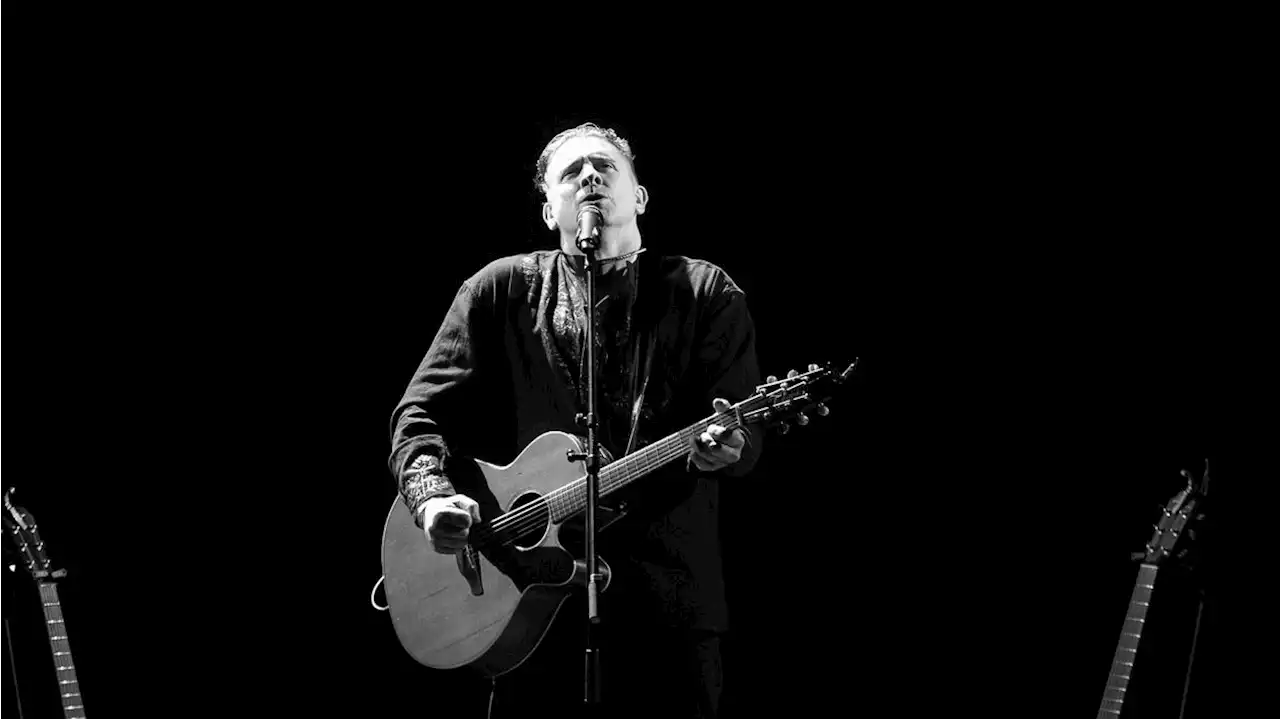
The stage production of Tales From the Holywell, written and performed by Damien Dempsey, is currently running at the Abbey until the 18th – and possibly beyond. Once advertised it was booked out for three weeks (with possible access through cancellations).
It was through cancellations that I and a few others faithfully waiting got in to see the performance on the 7th (it was closed on the bank holiday of the 6th). I really enjoyed it and cried laughing at times.
The whole audience gave him a standing ovation at the end and joined in singing one of his songs during his encore.
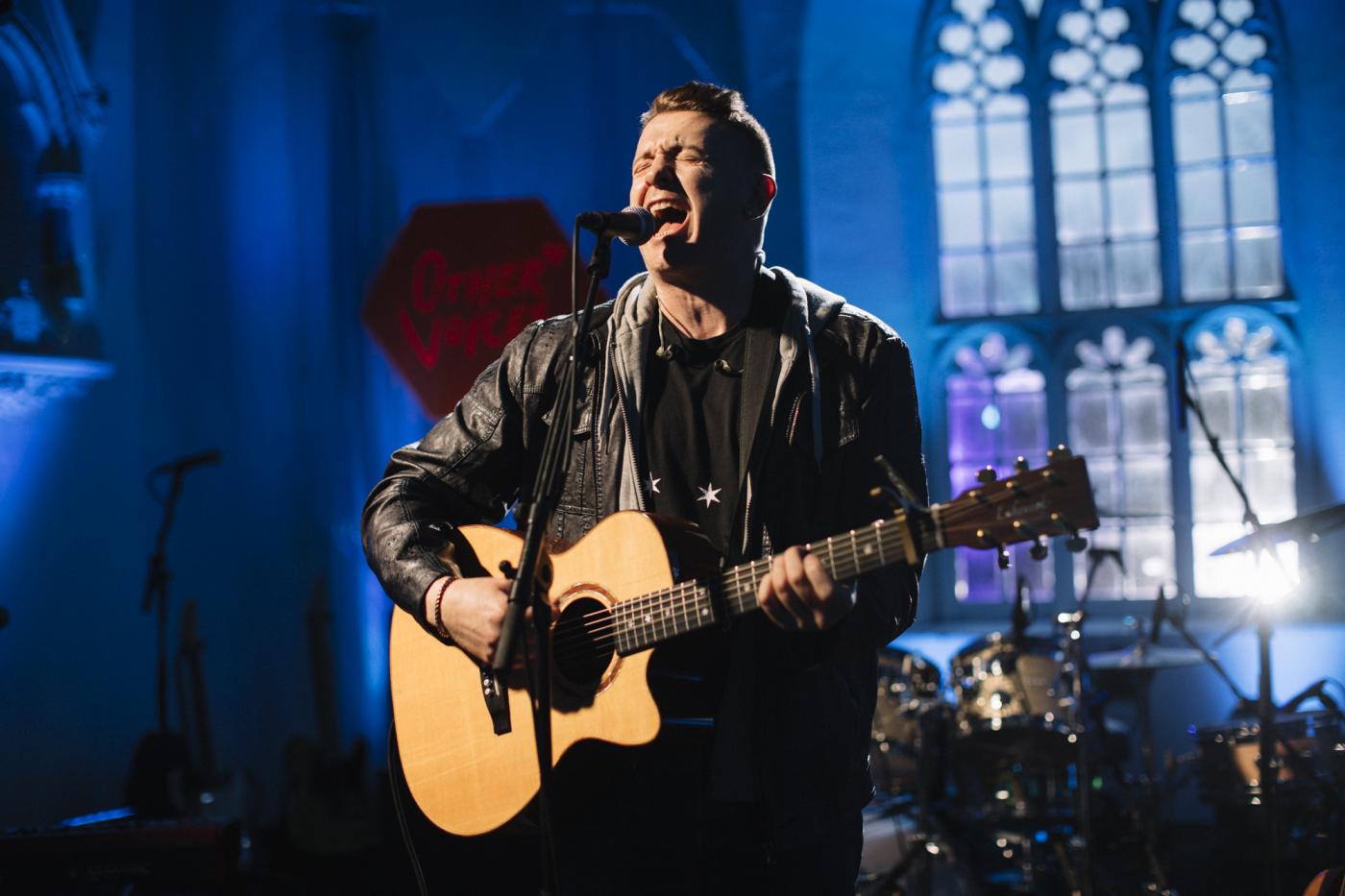
The stage set was bare and without background, with stage lighting showing Dempsey alone at times and at others, revealing players of keyboard, violin, double bass and percussion. Dempsey accompanied himself, alternating between two guitars.
The production consisted of Dempsey talking about his upbringing, his difficulties with his father but with whom he went to live when his mother left home, childhood and adolescent battles, his struggles and desires as an artist – all interjected with humorous cracks and songs.
He comes across as a man committed to his art and with integrity.
Dempsey performing at Abbey Theatre (Photo sourced: Internet; audience photos were prohibited)
Dempsey was raised in Holywell Crescent, a collection of local authority houses constructed on the site of an ancient holy freshwater well. This was one of probably thousands of wells across Ireland, each thought to be inhabited by a pagan spirit and then given a saint’s name by Christianity.
The well after which Dempsey’s street was named was St. Donagh’s Well (probably misnamed, see Links below) near Killbarrack and as the area became anglicised, called only “the Holy well”, then “Holywell” and the pool itself filled in and built over.
Whether he can speak it or not I have no idea but the Irish language made an appearance from time to time in Dempsey’s narrative, always with respect and, one might say, even reverence. And I was amazed to hear him sing a verse from An Cúlfhionn a capella, totally in Irish.
His song Colony – some might say masterpiece – gives a clear indication of what Dempsey feels about the long colonisation of Ireland and its parallels elsewhere in the world. I hoped he might take the opportunity to comment on the growing racist mobilisations in Ireland but was disappointed.
Dempsey performing (Photo sourced: Internet)
Conor McPherson directed the production which was written and performed by Damien Dempsey.
Apart from Dempsey’s, other music was provided by Lucia McPartlin (fiddle, vocals), Aura Stone (double bass) and Courtney Cullen (drums, percussion, vocals). I noted no name given in the theatre program for the keyboard and vocals performer.
I’m a great fan of Damo’s lyrics but less so of his singing; a question of musical and cultural taste, I suppose. But still I rose, wholeheartedly with the rest, to applaud his performance.
Whether its run will be extended I don’t know but currently it’s advertised to end on 18th February. If you haven’t booked, it’s well worth getting there early and hoping for a cancellation.
In late November last year the UK’s Home Secretary1 referred to refugees and migrants entering Britain as “an invasion”, for which a Hollocaust survivor, 83-year-old Joan Salter, challenged her, likening her speech to that of the Nazis.
An NGO working with refugees, Freedom From Torture, posted some of the exchange on Twitter. In turn, the NGO came under pressure from the Home Office to retract the video.
This month, not only did the charity refuse but did so publicly, fully endorsing the content of the video.
Anyone would well understand the difference between invading a country and entering it as a refugee, asylum seeker or even economic migrant. Those come unarmed, fleeing to safety or trying to make a living for themselves and their family.
A minister of a British Government should be extremely well-placed to understand the distinction. After all, there is no continent and very few countries, including its near neighbours, which the British ruling class has not caused to be invaded at some time or other.2
Map of areas of the world ‘owned’ by Britain or the UK at one time (Source: Internet)
From the time the descendants of the Anglo-Saxon invaders of Celtic England merged with the descendants of the later Norman invaders, England has gone from being a major invading and colonising military and naval power to being a major imperialist one.
Imperialist action did not always end in invasion; pressure could be applied in other ways, through bribery — or open threat. The term “gunboat diplomacy” was coined to describe imperialist actions short of actual invasion and Britain was renowned for actions of that type.
The ruling class of Britain has waged war against people to take over trade routes, to colonise land and extract resources, in competition with other colonial powers, to quash resistance and even for the right to sell opium in China.
In the course of those colonial and imperialist activities, Britain has carried out many invasions. In fact, Suella’s parents themselves come from former colonies.
Braverman is a child of migrants
Suella Braverman is the daughter of parents of Indian origin who emigrated to Britain in the 1960s: Uma (née Mootien-Pillay) from Mauritius and Christie Fernandes, from Kenya. Both those countries have indeed been invaded by Britain.
Kenya in particular from 1952-1960 had one of the worst experiences of colonial treatment by the British military, including wide-scale murder, torture and rape. India and Pakistan had their infrastructure and manufacture undermined by Britain leading to regular country-wide famines.
Suella Braverman, MP, currently UK Home Secretary. (Sourced: Internet)
Suella should know about invasions, refugees and migrants but is on record as saying that the British Empire was on the whole a beneficial experience for its conquered. This is a prime example of the “slave mind” that apes the invader and wants to collaborate with it.3
Such “slave-minded” people can be even more vicious and callous in their attitudes than the conquerors themselves and Braverman certainly fills that bill. And it’s not just in occasional choice of words that Braverman nears Nazi appearance.
During Braverman’s unsuccessful campaign for selection as leader of the Conservative Party last July, she said her priorities would have included to “solve the problem of boats crossing the Channel” and “to withdraw the UK from the European Convention of Human Rights.”
In October 2022, Braverman said that she would love to see a front page of The Daily Telegraph sending asylum seekers to Rwanda4 and described it as her “dream” and “obsession.” No doubt she includes human rights and legality concerns as “all of this woke rubbish.5”
A courageous NGO
Holocaust survivor Joan Salter, the woman who accused Braverman of Nazi-like speech, is the daughter of refugees from Nazi persecution who survived but endured imprisonment and hazardous journeys. She has an MBE for her work on Holocaust education.
Joan Salter, Holocaust survivor who challenged the Home Secretary. (Sourced: Internet)
In response to a Home Office accusation that the clip is only partial and therefore misleading, the NGO’s CEO Sonya Sceats pointed out the full exchange is available in video on its website and said the charity will not remove the Twitter clip.
“As an organisation providing therapy to torture survivors who feel targeted by her language and who know first-hand where such dehumanising language can lead, we will not do so. She has used language she should be ashamed of, and we won’t be pressured into helping her hide it.”
Non-Governmental Organisations nearly always rely on government funding, whether directly or indirectly and as a result tend not to rock the boat too much, in case they find their boat getting smaller or their team even being tossed overboard.
Sony Sceats, CEO of Freedom From Torture charity who stood up to the Home Secretary.
As a result, in public the CEOs of those organisations tend to vary from generally totally compliant6 to cautiously critical on certain occasions. In that context, the actions of Salter in the initial video and of the Freedom From Torture NGO in militantly backing her can only be admired.
1This is the UK’s equivalent to Minister for Home Affairs, these days normally restricted to Britain (i.e excluding the colony in Ireland) and in particular England and Wales (i.e often excluding even Scotland).
3The concept of the ‘slave mind’ or ‘colonised mind’ has been addressed by a number of writers on national liberation, notably Patrick Pearse (1879-1916) from Ireland and Franz Fanon (1925-1961) from Martinique.
4That plan has been condemned by many human and civil rights organisations and also denounced as illegal.
5A quote dating from her attempt at Leader of the Conservative Party.















 rebelbreeze