SPANISH CATHOLIC HIERARCHY EXPRESSES FEAR OF REVOLUTION

Diarmuid Breatnach

(Reading time: 10 mins.)

Actually what the hierarchy referenced fearing in a recent 95-page statement was “two Spains”, which most commentators took as being a reference to a repeat of the Anti-Fascist war of 1936-1939, with Republican Spain and Fascist Spain. The statement of the Spanish Episcopal Conference (CEE) spoke of the “stability” which the 1978 Constitution has given the Spanish State. So have they suddenly now become democrats? Of course, one can think of another way of imagining such a dichotomy: Rich Spain and Worker Spain. I think the Bishops fear another kind of civil war – i.e revolution.

The 95-page document entitled ‘Faithful to missionary sending’ was prepared not only by the collegiate bodies of the CEE but also by external collaborators. Less open to different interpretations are the other concerns raised by the Bishop’s Conference, regarding the increasing secularisation of society, the scandals around abuse of those in the care of Church institutions and pastors, along with the other scandal of church appropriation of public property, including even a UNESCO site1. The Bishops feel that some of these processes and issues are not merely accidental or incidental to modern times but rather are deliberately driven by people in hostility to the Church.

CHURCH AND POLITICS

It is customary and has been so throughout history for the dominant religious institution to have a close relationship with the dominant class in society and this has certainly been the case with the Catholic Church in the Spanish Kingdom. The Spanish ruling elite at the turn of the last century, in a country with underdeveloped capitalist industry was an alliance of two different social classes, the aristocracy and the capitalist-financier class. The social atmosphere was deeply conservative and dominated by the Catholic Church hierarchy which, through them and the religious male and female orders, controlled institutions of social and educational provision. Progressive artists were penalised and often enough went into exile.2

The First Spanish Republic, a brief attempt to liberalise and democratise the State after the abdication of King Amadeo in 1873, survived not even two years before being overthrown in a military coup, followed by repression causing the exile of many of republican leaders and supporters.

However, a wave of revolt against the conservatism and lack of democracy of the Spanish Kingdom came around again and in 1931 the Second Republic was created, overthrowing the dictatorship of General Primo Rivera. Initially the composition of the government was right-wing and the revolt of the Asturian miners was cruelly suppressed by the Army and the militarised police force of the Guardia Civil3. The right-wing government fell in 1936 when a democratic left-wing Popular Front government was elected, which set about legislating for greater social freedoms, equality and discussing autonomy for nations4 within the State.

DEMOCRATIC GOVERNMENT AND MILITARY-FASCIST UPRISING

That was the signal for the forces of reaction to strike and most of the military high command, allied with the fascist Falange5, staged a coup. In Barcelona, the coupists were quickly suppressed by a popular upsurge which took on a revolutionary character. In some other parts, particularly in Madrid, the coupists were suppressed too but without a revolution.

General Franco in partnership with another three generals and senior naval commanders led or joined the coup but Franco’s forces were isolated in part of North Africa (then a Spanish colony). While the ‘democratic’ European powers ‘blockaded the conflict’, Nazi Germany and Fascist Italy provided the logistical support6 to get Franco’s forces to the Canary Islands, then to Spain, where they found little organised opposition but nevertheless carried out a reign of terror. The Spanish Catholic Church hierarchy and most of its priests and religious orders supported the military and fascist rebellious forces with enthusiasm.
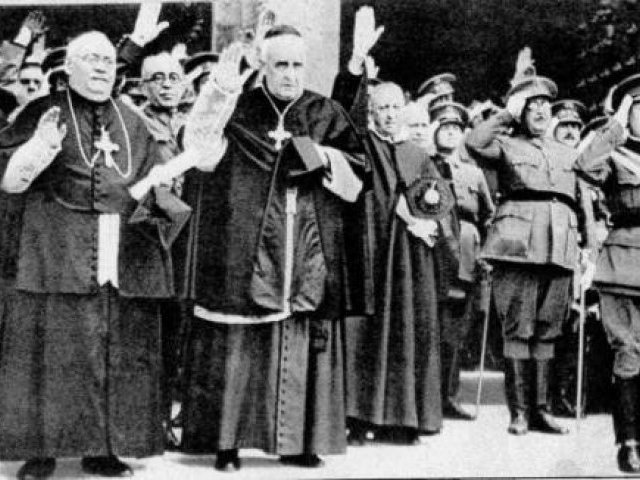
Spanish Catholic hierarchy supporting fascist military (Photo sourced: Internet)

A conflict variously called “the Spanish Civil War” or “the Spanish Antifascist War” followed, ending in 1939 with victory for the military-fascist forces, who lost an estimated 175,000 killed in action, and 110,000 died fighting for the Republic.7

Following the earlier pattern of areas the fascists had conquered, a wave of repression ensued against republicans, communists, socialists, anarchists, democrats, trade unionists, Basque, Catalan and Galician nationalists, gays and lesbians, with summary executions, military tribunals and executions, mass jailing, public humiliation of women …. Estimates of executions behind the fascist-military lines during the War range from fewer than 50,000to 200,0008. Most of the victims were killed without a trial in the first months of the war and their corpses were left on the sides of roads or in clandestine and unmarked mass graves.Spain has the highest number of mass graves anywhere in the world with the exception of Cambodia9, with 740 mass graves containing the remains of some 9,000 people having been found so far. The support of the Catholic Church for the military and fascists did not waver throughout.

THREE DECADES OF FASCIST DICTATORSHIP

After that initial phase, three decades of political and social repression followed under the Franco dictatorship, again fully supported by the Spanish Catholic Church.

However, the dictatorship was always resisted to some degree or another and that resistance began to grow apace during the 1960s. The Partido Comunista de España and the social-democratic Partido Socialista Obrero de España, both banned, were organising underground and becoming increasingly popular. Both had affiliated trade union organisations and the Comisiones Obreras10, linked to the PCE was particularly widespread. The youth of the Basque Nationalist Party (PNV) broke with the conservative and inactive leadership and, joining with a revolutionary socialist movement in the southern Basque Country, formed ETA11, taking up armed struggle at the end of the 1960s.
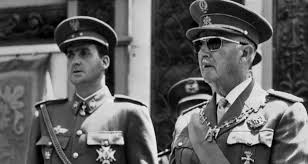
Fascist dictator General Franco (R) with his protege and nominated successor, Juan Carlos (L), later King of Spain. (Photo sourced: Internet)

As the Dictator aged the imperialists began to worry about the potential for a revolution in Spain and contacts in influential circles were sought to persuade the ruling class to replace the Dictatorship with a parliamentary democracy. Some elements in the Spanish Catholic Church opposed those initiatives but one which embraced it was the technocratic Opus Dei, which with some others, steered the country through the Transición.

Amidst a wave of repression including murders of activists by State and other fascist forces, with fear of an indefinite continuation of the Dictatorship, a Referendum on a monarchist and unitary state constitution was held. The PCE and the PSOE were legalised and, with their support, the 1978 Constitution received majority support. It is that Constitution which is regularly quoted when the State declines to permit the Basque and Catalan nations to even hold a referendum on independence.

In summary then, the Spanish State has evolved from a deeply conservative and repressive state, through a fascist-military uprising to a fascist and socially conservative dictatorship, all along with the support of the Spanish Catholic Church. When a revolution was feared, in consultation with imperialist advisers, the technocrat section of the Church, with the support of the social democratic and communist parties, helped prepare a transition to a parliamentary democratic form. Central to the Transition was preserving the mostly fascist ruling class and ensuring it would remain safe from any reparations, not to speak of criminal charges for murder, rape, torture, large-scale thefts …

But now, the Church hierarchy is sounding a warning. If it fears revolution, it has cause to.

VULNERABILITY OF THE SPANISH STATE

The possibility of revolution in Spain may seem far distant to most external and internal observers but two things should be taken into account:

  1. Revolution often grows and matures very quickly from what seemed like unready conditions and
  2. the Spanish State is by far the most vulnerable in the whole of the EU.

INTERNAL FORCES HOSTILE TO THE SPANISH STATE

The Spanish State consists of a number of nations, of which Catalonia, the Basque Country (Euskal Herria) and Galicia (Galiza) are the most obvious. But “Paisos Catalans” includes also Valencia and the Balearic Islands, all areas where Catalan is spoken and Asturias also consider themselves a Celtic nation (as does Galiza).

Map showing regions and nations of the Spanish state (Photo sourced: Internet)

The southern Basque Country has spent decades mobilising for independence in a wide social and political opposition to the Spanish State and though the official leadership of its movement is now pacified, a strong potential remains there. As the momentum of the latter declined, the movement for independence in Catalonia increasingly matured and in 2017 an unsanctioned referendum returned a majority for independence. Spanish police raided polling booths, attacked the voters and later nine social and political leaders were jailed by the State while others were obliged to go into exile. The 2021 elections returned a majority of pro-independence candidates and the total vote for independence exceeded 50% for the first time since pro-independence candidates presented themselves in elections.

The movements for independence respectively in Galiza and Asturies are nowhere near at the same level as those of the Basque Country or of Catalonia but they are growing. This is true also of the Paisos Catalans and the Islas Canarias.

With regard to the wide workers’ organisations, while the Comisiones and UGT at present maintain overall control, the majority of organised workers in the Basque Country and Galiza belong to trade unions supporting independence. Intersindical, a class trade union12 movement, also supporting independence, is growing in Catalonia and the Canaries.

Generally the Spanish State finds itself increasingly isolated at home and abroad. Its repression measures against the Basques and Catalans have not only disaffected people in those nations but also, despite general media and fascist propaganda, sectors of the Spanish intelligentsia. Writers, actors, artists have experienced repression or have spoken out against the repression of members of their sector. Political activist and rapper Pablo Hasel is in jail while Valtonyc, another rapper, is in exile to avoid imprisonment, both because of their lyrics.

Repeated financial corruption scandals have increasingly undermined confidence in the political and business classes.

FORCES SUPPORTING THE SPANISH STATE

The image of the Spanish Monarchy has suffered probably irreparable damage. The previous King, Juan Carlos, who was a visible link between the Dictatorship and the current parliamentary system but credited by liberal commentators as managing the “transition to democracy”, has abdicated. His personal reputation was damaged by a number of public relations disasters and he is now being pursued on allegations of financial and political corruption. His son-in-law is serving a jail sentence for financial and political corruption too. The current King, Juan Carlos’ son Felipe VI, though by no means compromised to any similar degree, has not built up any significant social support either, despite a generally sycophantic Spanish media.

Coronation King Felipe VI of Spain, son of the abdicated King Juan Carlos (Photo sourced: Internet)

The Catholic Church, the great organisation of social control for centuries and throughout the Dictatorship, has lost much of its influence, a fact bewailed by the Bishops in their communique. In the Basque Country and in Catalonia, the Hierarchy had little influence anyway because of its support for Franco. But the scandals of physical and sexual abuse in church institutions and by pastors, common across much of the western world, have impacted on the Church across the Spanish state too. In addition, the increasing secularisation of modern western society has also weakened the Church’s influence, as have its opposition to contraception and abortion, divorce, homosexuality and of course same-sex marriage, all of which are now legal.
(Photo sourced: Internet)

Surveys indicated that only 3% of Spaniards consider religion as one of their three most important values, lower than the 5% European average, though religious festivals remain popular on a mainly cultural level.

According to the Spanish Centre for Sociological Research, as of July 2021, while 58.6% of Spanish citizens self-identify as Catholic, only 18.6% define themselves as practicing, with 40% as not practicing. Another 37% have no religion, identifying variously as atheists (15.1%), agnostics (11.5%) or non-believers (10.4%)13. The total number of parish priests, i.e the level of Church personnel most in direct contact with the population, shrank from 24,300 in 1975 to 18,500 in 2018, with an average age of 65.5 years.14

However, the COPE radio network, owned by the Catholic Spanish Bishops’ Conference, broadcasts material ranging from the conservative to the fascist and always for Spanish unionism. COPE, an acronym for Cadena de Ondas Populares Españolas (“People’s Radiowaves of Spain Network”) formerly called Radio Popular, is the second most played among Spain’s generalist radio. COPE owns music stations Cadena 100, Rock FM and Megastar FM, in addition to the Spanish generalist TV channel Trece. The station is associated with the right-wing Spanish journal Diario ABC.

The privately-owned media in the Spanish state, whether favouring the PSOE (e.g El País) or the Partido Popular (e.g El Mundo and ABC) tends to be supportive of the union and the status quo15, with the state TV networks even more so. The bias against for example Basque or Catalan independence activists is remarkably obvious, with TV cameras accompanying police on raids to arrests of activists and publication of prejudicial statements long before the accused face trial and again during the trial itself.

Both traditional main political parties have their origins in the Spanish Anti-Fascist War. In common with most European parliamentary democracies, the two-party system has lost support in the Spanish state, resulting in recent governments being coalitions of political parties. This increases the potential for political thinking along class rather than party lines while also creating internal difficulties for the coalitions.

The right-wing Partido Popular was formed in 1989 but was a reconfiguration of the Alianza Popular, formed after the State’s change to the parliamentary system to give fascists and deep conservative supporters of Franco a representation in elections. Much reduced now, the PP has given rise to a chain of splits, first to form Ciudadanos, in turn shedding some members to form the more or less openly fascist Vox party. Any return of the PP to governing the Spanish state would require it to form a coalition with one or both of Cs and Vox.

The PSOE, formerly illegal under the Dictatorship, has on the surface many of the features of a western social-democratic party. However, it has been deeply implicated in repression of struggles in the Basque Country, including wide-scale torture of prisoners. Further, under the Felipe Gonzales presidency (prime ministership), the Spanish State ran terrorist squads carrying out kidnapping, torture, murder and bombings against pro-independence Basques. The operation was exposed in a series of articles in El Mundo and, although Gonzales didn’t face even a police interview, the eventual resulting list of convictions included the Minister of the Interior, Director of State Security, Sec-General of the PSOE in the Basque province of Bizkaia, Czar of the “Antiterrorist Struggle”, Bilbao Chief of Police Intelligence Brigade, another Police Chief, regional Governor for the Spanish State in Bizkaia, and a colonel, Chief of the Guardia Civil HQ in Intxaurrondo (Basque Country).

Although successfully unseating the PP Government on a vote of “no confidence” in the Government’s 2018 budget, the PSOE’s leader, Pedro Sanchez, was only able to enter government by forming a coalition with Unidas Podemos16, itself a coalition of left social-democrats, trotskyists and communists. Since the new Government took over the repression of Catalans of its predecessor, only releasing imprisoned Catalan activists on parole recently, it does not have the support of the Catalan independentists, with the exception of one major party which voted to help the Government’s budget scrape through, as did the official leadership of the Basque independence movement17.

Fascism was never defeated in the Spanish state, it merely put on a democratic mask, albeit faded and patched. The current members of the ruling class are mostly descendants of the military-fascist alliance of 1936 and virtually all beneficiaries of the Dictatorship, often sitting on wealth, industry and media expropriated from their opponents defeated in the Antifascist War. There are sections of active and militant fascists across the Spanish state with wide police and military connections, denouncing the independence initiatives in Catalonia, criticising immigration, ridiculing equality measures and parading with fascist symbols and salutes to exalt the memory of General Franco and Primo Rivera. Although some of those activities are illegal, they act with visible impunity. The Vox political party has stated openly that it wants to amend the Constitution to remove the status of regional autonomy, which they believe encourages aspiration for independence and thereby endangers the unity of the Spanish State.

Spanish fascists demonstrating in Madrid in 2018, fascist salutes and symbols illegal but none arrested (Photo sourced: Internet)
Spanish fascist flags and salutes, Catalonia 2019 (Photo sourced: Internet)

Some government antifascist measures of late, along with the rise of independence activism in Catalonia have caused apprehension among this section of fascists, which finds expression in more rallies and demonstrations and increasingly threatening language and displays. The Government measures include the removal — long-promised by the PSOE — of Franco and Rivera’s remains from the mausoleum in the fascist monumental park of the Valle de los Caidos (“Valley of the Fallen”) which was built with political prisoner labour. The State’s TV service covered the event at length and in a manner resembling a homage ceremony.

Currently historical memory legislation is being promoted to assist in the discovery, investigation and honouring of the graves of the victims of Franco, while another piece of legislation seeks to make illegal any promotion of Franco or of fascism generally. The future of these initiatives is uncertain but the fact that even the current anti-fascist legislation is not upheld does not inspire confidence.
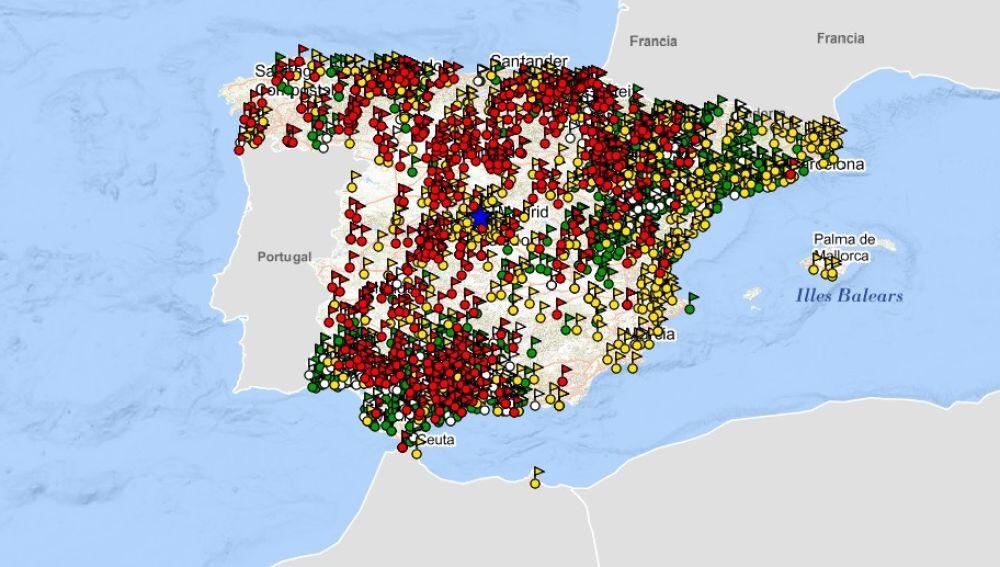
Map of known mass grave locations across the Spanish state (Photo sourced: Internet)

In conclusion,

The Bishops’ concerns about the safety of the 1978 Constitutional State seem to be twofold: on the one hand they see the demands for self-determination of nations within its territory as a threat to the State while on the other hand they fear that the fascists will push matters to an extreme, i.e that “civil war” – and this time, the fascists will lose, in the course of which the State will fall. However a close reading also looks like a threat to the national liberation and democratic forces, a warning to desist from their challenges to the status quo – or else!

As to their concerns for their Church, the Bishops are correct in believing that it is under attack but misunderstand the nature of the opposition, a large part of which is more to do with resenting the privileged position of the Church within the Spanish State than a hatred of the institution and faith as a whole. The Church received €144 million in funding from the State18 in 2019, ultimately from the taxes levied on people, no matter what their religion or state of faith, their opinion of the institutions or of their activities. And the tax-payers have no control over those institutions.

Of course, the Church does have its enemies, people who will never forgive it for the role it has played in the abuse of people and for its role in history, in particular its support for the military-fascist uprising, the horrific repression during that war and again during the subsequent dictatorship.

But the Bishops are right about one thing – the Spanish state is very vulnerable. Which is no doubt also the reason for the general contradictory stance of most other states in the EU, which on the one hand wish the Spanish State would act in a more subtle way than naked repression, while on the other fearing the spillover effect of possible revolution and the territorial breakup of “Spain”.

End.

FOOTNOTES

1This is too big an issue in itself to detail here but in essence it refers to property titles given over to the Catholic Church by Franco early in the Dictatorship and subsequently extended to cover 34,961 by Aznar’s PP government since 1998. One of those is the Cordoba Mosque, a UNESCO Heritage site. More about that controversy may be read about here: https://www.irishtimes.com/news/world/europe/c%C3%B3rdoba-s-mosque-cathedral-dispute-puts-spanish-identity-at-centre-stage-1.4195391 and the general issue in further detail but in Castillian (Spanish) here: https://elpais.com/sociedad/2021-02-16/todas-las-propiedades-inmatriculadas-por-la-iglesia.html?rel=listapoyo

2Cervantes, the most famous Spanish writer and much praised by the State today, never received any support from the Spanish Kingdom. In 1569 he fled a warrant for arrest due to wounding an opponent a duel. Later, his family could not afford his ransom when captured by Corsairs but his freedom was eventually bought by an organisation working to free Christian slaves in the Ottoman Empire. Employed later by the Spanish as a tax collector he was jailed briefly a number of times for “irregularities. He is celebrated as a writer not only in Spanish but his Don Quixote de la Mancha has been widely read in translation.

3The Guardia Civil is a Spanish state-wide police force but militarised — they have military ranks and live in barracks. The gendarme-type force is one common in states needing to control a disparate population with a history of rebellion, eg: the Carabinieri of Italy, Gendarmerie of France, Royal Irish Constabulary of Ireland under British rule (then the RUC in the colony, now the PSNI).

4Catalonia got its autonomy during its popular suppression of the coup attempt and, once the war was underway, three southern Basque provinces got theirs too, while the conservative Carlists in the fourth province, Nafarroa (Navarra) sided with the coup and massacred any supporters of the Government they could find. Galician autonomy was under discussion but after only two weeks of fighting in July 1936, the fascists took control and the project was abandoned. The fascists killed 800,000 people there, mostly civilians and after the hostilities.

5La Falangia Española, a fascist organisation founded by Primo Rivera (son of the General of the same name) in October 1933. It was later remodeled by Franco to unite all the fascist and right-wing nationalist organisations and from then was the only legal political party during the Franco Dictatorship.

6Both fascist powers also provided personnel, weapons, military transport, tanks …. the infamous urban centre bombing of Gernika was carried out by German and Italian planes. The Republican side received some assistance from the Mexican Government and in particular the Soviet Union and volunteers for the International Brigades. The balance of equipment and trained personnel was always however in favour of the fascist-military insurgents.

7See https://en.wikipedia.org/wiki/Spanish_Civil_War

8Historians differ — Hugh Thomas: 75,000; Secundino Serrano: 90,000; Josep Fontana: 150,000; and Julián Casanova: 100,000

9See map

10The Comisiones today is much less under the influence of the PCE and, together with UGT, which remains under the control of the PSOE, form the two main Spanish trade unions, their leaderships institutionalised and generally collaborative with the State and for the union of Spain.

11Euskadi Ta Askatasuna (Basque Country And Freedom) was much more than the depiction of “terrorist” organisation one finds in most descriptions. It was a cultural and social Basque liberation organisation, persecuted by the Spanish State, against which it took up arms after almost a decade of repression and torture. After years of decline but during which the wider movement expanded hugely, ETA disbanded around 2012. Many of its convicted fighters remain dispersed throughout the jails of the Spanish and French states while others are in exile.

12A class union does not recruit members repressive forces (e.g. police, jailers, armed forces), nor of management in work places. Also Intersindical has a very democratic structure with an elected General Secretary permitted to serve for only two years.

13See Sources and References, Religion.

14Ibid.

15An exception is the attitude to the Catholic Church, which is generally critical in El País, in line with its more secular identity.

16Izquierda Unida (United Left), the often disunited coalition of mostly Trotskyist small groups coordinated by the CPE, formed an electoral coalition with Podemos just before the elections. Podemos arose from a small group of Trotskyists that emerged from 13M, the huge popular opposition to the Spanish State, especially in Madrid, in turn engendered by the protest movement commonly known as “Los Indignados”. Podemos rode that wave of indignation to win five seats in their first participation in elections, those to to the European Parliament in May 2014. In the 2015 General Elections on 20 December 2015, Podemos received 21% of the vote and became the third largest party in the Parliament, with 69 out of 350 seats. In subsequent elections, as part of coalitions, Podemos’ number of MPs in the Spanish Parliament has fallen consecutively to 49, 47, 32 and 26, with its 5 MEPs reduced to three. Conversely, the party’s membership is growing, according to reports.

17Esquerra Republicana de Catalunya and Amaiur.

18In addition to €284m through 7% voluntary deductions from people’s tax returns, a benefit which no other organisation is permitted.

SOURCES AND REFERENCES

Statement of Spanish Bishops: https://elpais.com/sociedad/2021-08-02/los-obispos-dibujan-un-panorama-catastrofico-de-la-politica-espanola.html

https://www.thetimes.co.uk/article/spain-sliding-back-to-civil-war-era-bishops-warn-kxlcrww58?fbclid=IwAR0mHPwCJAfQGo8_pY7kzsDKa_v6usf4Pgxz65IlhVskWHTrxFWQEMx8nf4

Executions behind fascist-military lines: https://en.wikipedia.org/wiki/White_Terror_(Spain)

Mass graves etc: https://www.reuters.com/article/us-spain-mass-grave-ring-idUSKBN26626T

Overall number of deaths: https://en.wikipedia.org/wiki/Spanish_Civil_War

Trade unions (site very biased against Intersindical): http://progressivespain.com/labourfile-a-guide-to-spanish-trade-unions/

https://en.wikipedia.org/wiki/List_of_trade_unions_in_Spain

Religion and the Catholic Church: https://en.wikipedia.org/wiki/Religion_in_Spain

https://english.elpais.com/society/2020-02-21/catholic-church-gets-a-record-284m-of-donations-from-spanish-taxpayers.html

Podemos political party: https://en.wikipedia.org/wiki/Podemos_(Spanish_political_party)

DUBLIN PICKET AGAINST ONGOING INTERNMENT MARKS 50th ANNIVERSARY OF BRITISH INTERNMENT IN THE SIX COUNTIES

Clive Sulish

(Reading time: 5 mins.)

As Limerick and Waterford county teams prepared to face one another in the GAA hurling semi-final at Croke Park stadium, anti-internment protesters and campaigners lined up outside Dublin’s General Post Office, in the city centre, to mark the 50th Anniversary on the introduction of internment without trial in the British colony of the Six Counties. Their placards, leaflets and speakers denounced the continuing practice of interning political activists in Ireland today.

Seen at the anti-internment event in Dublin today (Photo crdt: Sean Hogan)

The event was organised by the Anti-Internment Group of Ireland, an independent and non-affiliated campaigning organisation and the supporters included a mixture of socialist Irish Republicans and anarchists. The heavy and persistent rain of the morning held off and Dublin city centre was thronged as GAA hurling supporters added to the usual shoppers. The banners and placards of the picketers drew considerable interest from those passing and here and there people stopped to discuss with them.

Some young Basque girls were curious but also delighted to see their nation’s flag, the ikurrina, being flown at the event and stopped to engage one of the picketers in discussion. Also in evidence was the flag of Amnistia, Basque organisation around solidarity with its political prisoners and against repression, along with the flag of Palestine.

Flag of the Amnistia organisation (solidarity with their political prisoners) in the Basque Country seen on the anti-internment event in Dublin today (Photo crdt: Sean Hogan)

Around 200 leaflets were distributed to passers-by, discussions were held and contacts were made with people interested in supporting the work of the Anti-Internment Group Ireland.

After some time in a picket line and distributing leaflets, a representative of the organisers, speaking in Irish and in English, welcomed the attendance and introduced a speaker from the Anti-Imperialist Action organisation.

One of the leafleters outside the GPO at the anti-internment event in Dublin today (Photo: C.Sulish)

SPEAKERS

Speaking in Irish as some passers-by stopped to listen, the young man said they were there to commemorate the introduction of internment and mindful of the existence of political prisoners all over the world. The were also protesting the extradition to Lithuania of Liam Campbell to face trial in a country in which he had never previously set foot.

The organisers’ representative then spoke in English about the history of repression in the Six Counties colony, how from the moment the nationalist community there stood up to demand equal rights and justice the State had responded with violence. Since the people raised the level of their resistance in response, the State in turn raised the level of its violence higher again, in a rising spiral of violence.

The nationalist community in the Six Counties had marched for civil rights and had been met with the violence of the colonial police and of the Loyalists — the speaker said — but they had continued to resist. Internment without trial was introduced to break that resistance but, knowing that would also lead to increased resistance, the State had prepared the Paratroopers to shoot unarmed civilians dead. They had done that in Ballymurphy on the very day that internment had been introduced1, he reminded his audience and later had shot dead two unarmed Cumann na mBan Volunteers (Republican women’s organisation) who were alerting people to the raiding parties of the British Army. At the start of the following year, the British Army murdered unarmed civilians again, this time in Derry2.

That year 1972, the speaker stated, had the highest death toll of any year during the three decades of the war3 and Loyalists were also bombing streets nearby in Dublin, again in 1973, killing workers. In 1974 Loyalists and British intelligence bombed the Dublin city centre again and Monaghan, killing the highest number of people killed in one day during the war4. That year too, the IRA bombed pubs in England and killed people and the State brought in the repressive Prevention of Terrorism Act against the Irish community. They jailed a score of innocent people on extremely serious charges5 and one of them, Giuseppe Conlon, died in jail6.

The speaker went on to say that although there had been hard repression before, the introduction of internment without trial and the follow-up massacres by the British Army had lit a fuse to a chain-reaction of violence for decades to follow.

Pointing out that internment consists of jailing people without trial, the speaker stated that the practice continues today, by refusing bail to political activists awaiting trial in the non-jury courts on both sides of the British Border. The Anti-Internment Group of Ireland will continue striving to expose this reality and he called on people to support the monthly pickets in the city centre and to follow the End Internment page on Facebook.

ONGOING AGITATING AGAINST INTERNMENT

As the applause died down people began to pack away flags, banners, placards and leaflets and to catch up socially among themselves or to engage with passers-by who had stopped to listen and/ or to ask questions.

Organisers of the event said they hope to hold another picket at some venue in the city centre in a month’s time – when scheduled, the event will be announced on the End Internment FB page.

End.

Leafleter right foreground, person reading leaflet left foreground, picket line of the anti-internment event in Dublin today. ( Photo: C.Sulish)
(Photo: S.Hogan)


(Photo: S.Hogan)
View of the picket with a passer-by expressing solidarity with the picketers (far right of photo). (Photo: C.Sulish)

FOOTNOTES

1Between 9-11 August, British paratroopers caused the deaths of 11 unarmed civilians in Ballymurphy.

213 people were shot dead by British paratroopers on Bloody Sunday in Derry as they protested against internment and a 14th died later of his wounds.

3The period from August 1971 to the end of the year saw a huge jump to 136 violent deaths (including British and colonial armed forces) and the following year, 1972 is counted the most violent year of the conflict overall with 479 people killed (including 130 British soldiers) and 4,876 injured.

434 people were killed that day, all civilians.

5The Birmingham Six, Guildford Four, Maguire Seven, Giuseppe Conlon and Judith Ward. All were eventually cleared after long years of campaigning around them and failed court appeals.

6Giuseppe Conlon, hearing that his son Gerry had been arrested for the Guildford Pub Bombings, came to London to help him in 1974 and was swept up into the police net to become one of the innocent framed victims. Giuseppe Conlon was not a healthy man and died in his 7th year in jail, before the verdicts on the other framed prisoners were finally overturned. His son Gerry, also an innocent man in jail, was not permitted to attend his father’s funeral.

The Wall of us All

Words and photos by Diarmuid Breatnach

This is a section of a limestone wall. You can see that it is composed of limestone blocks.

Small section and detail of a limestone wall

Each block is roughly rectangular but of different sizes, shades and colour.

Section of limestone wall in shade.

All of the blocks in different shades and sizes and types go to make the wall.

A different section of the same wall in strong sunlight.

It takes all of them together to make the wall; if put together well, the wall stands for centuries against all kinds of weather.

End.

LONG LIVE THE VANDALS!

Gearóid Ó Loingsigh

(Reading time: 2 mins.)

In the midst the protests in Colombia the press can be heard denouncing the vandals and various politicians from the left and right have echoed these criticisms in one way or another.  The headlines speak of the destruction of private property and in some cases they try to mark a distinction between what they say is legitimate protest and vandalism.

The word “vandal”, means someone who commits acts pertaining to savage and destructive people and is who destroys a public asset or installation.  Other definitions speak of destroying or damaging what is beautiful.  It should be said that the Transmilenio mass transport system stations are not one bit beautiful.  But should the youths be ashamed or proud of being called vandals?

Resisters in Colombian city of Madrid shelter behind makeshift shields as they are bombarded with water canon in May 2021 (Photo crdt. Juan Pablo Pino, AFP/Getty)

We should look at the origin of the word.  The first vandals were Germanic tribes that in 455 A.D. attacked and sacked Rome carrying away great riches and also destroying buildings, amongst them the Temple of Jupiter, though there is some dispute about the severity of the destruction of the city.  However, they went down in history as the vandals who destroyed that city.  The more modern use of the person who destroys public assets or private property or damages what is beautiful dates from the middle ages and its use is widespread nowadays.

Of course when Vicky Dávila and other right wing journalists speak of vandals they are not talking about Germanic tribes, or at least that is what we believe, though with Vicky even drug traffickers, paramilitaries and corrupt politicians are decent folk, so one is never sure about the meaning of the words that fall from her lips like the Police stun grenades.

“The Police rape and murder” (Photo: G.O.L)

But words and their meanings are not set in stone.  Some words enter a language and in short time fall into disuse, others last for centuries and some come back to life when least we expect like when Kim Jong-un’s translator used the word “Dotard” to describe Trump.  That word hadn’t seen the light of day since the US Civil War in the 19th Century.  Other words simply change their meaning, sometimes slowly and on other occasions they do so more abruptly.

The press has used this word so often to describe and disparage the social protests that we may be witnesses to another change in meaning.  The bourgeois press has emptied the word of any meaning and now in the marches people can be seen with placards that say Vandal’s Honour and in social media there are memes doing the rounds on the subject.  One of them says “The country turned upside down and this one says, what are you and I?  Well, vandals my love.”  They used the word so often to describe any act of rebellion, nonconformity or to and try and shut down and discredit the demonstrators that it has lost its power, its meaning.  Now it is a badge of honour for many.  Vandal no longer means a savage destructive person but rather a person who fights to be heard, for justice.  A vandal is whoever fights against Duque, neoliberalism and poverty.

The word is changing its connotation and once again it is closer to its original meaning, a tribe that defied an Empire, although in this case the Colombian emperor seems more like the Emperor Nero (54-68 A.D.) who played on his Lyre whilst Rome burned than the poor Petronius Maximus who only lasted a few weeks in power.  Duque doesn’t play the Lyre but rather the Guitar, but there he is and Nero’s regime was one of extravagance, waste and tyranny and Nero in the middle of it all playing on his Lyre.

The sacking of Rome in 455 A.D. was the third sacking that the city suffered.  There were a further five sackings after the Vandals.  It should be remembered that the Vandals sacked the capital of a decadent Empire that deserved to be extinguished.

Burnt out bank from 2006 (G.O.L)

So as the meme puts it, ask the question, what are you and I?  And answer:

We are Vandals my love, we damage the hated system of mass transport built with public funds legally stolen to set up a private transport business which to top it all takes 94% of the profits of a business and barely contributes a penny to its own maintenance.

We are Vandals my love, we destroy banks that receive more subsidies from the state than the poor who are denied loans by these banks, which don’t hesitate for a single moment to confiscate the houses of the poor.

We are Vandals my love, who in the face of the lives and censorship of the bourgeois press make our smothered voices reverberate on the walls of the city.  Who needs Twitter when you even the poorest can see the walls?

We are Vandals my love, who in the face of the attacks by the Police throw rocks at them that are found all about the place in the poorly built public infrastructural projects, in a country where the thieves don’t know how to build a pavement and where half the bricks are badly placed.

We are Vandals my love, we fight against a decadent government and system.

We are Vandals my love, and our favourite letter is V:

V for Vengeance on the rich that kill us, rob us and lie to us.

V for Victory against the neoliberal regime.

V for Vandals my love.

Long Live The Vandals!

End.

THOUSANDS IN DUBLIN SHOUT “FREE PALESTINE”!

Diarmuid Breatnach

(Reading time text: 4 mins.)

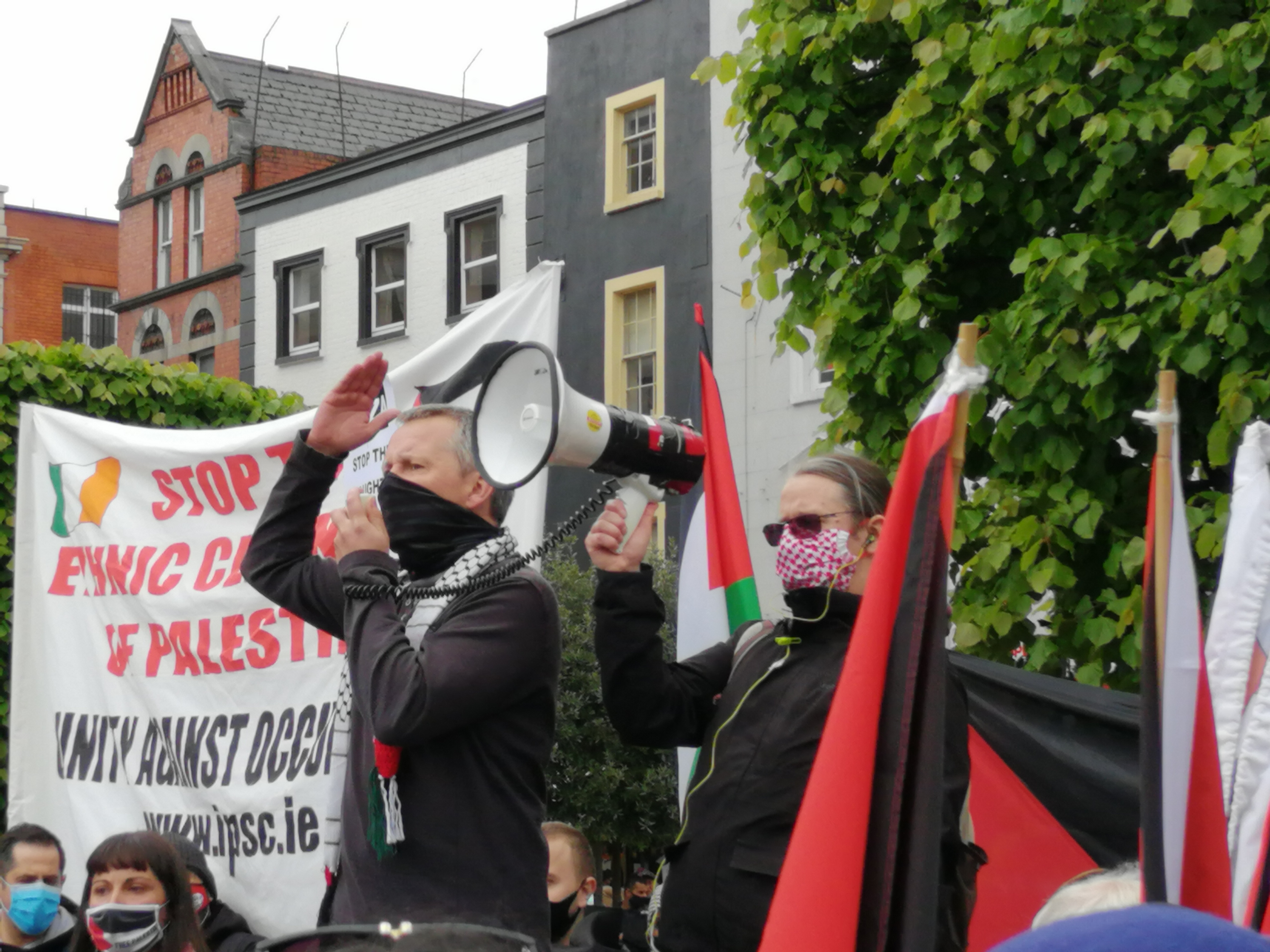
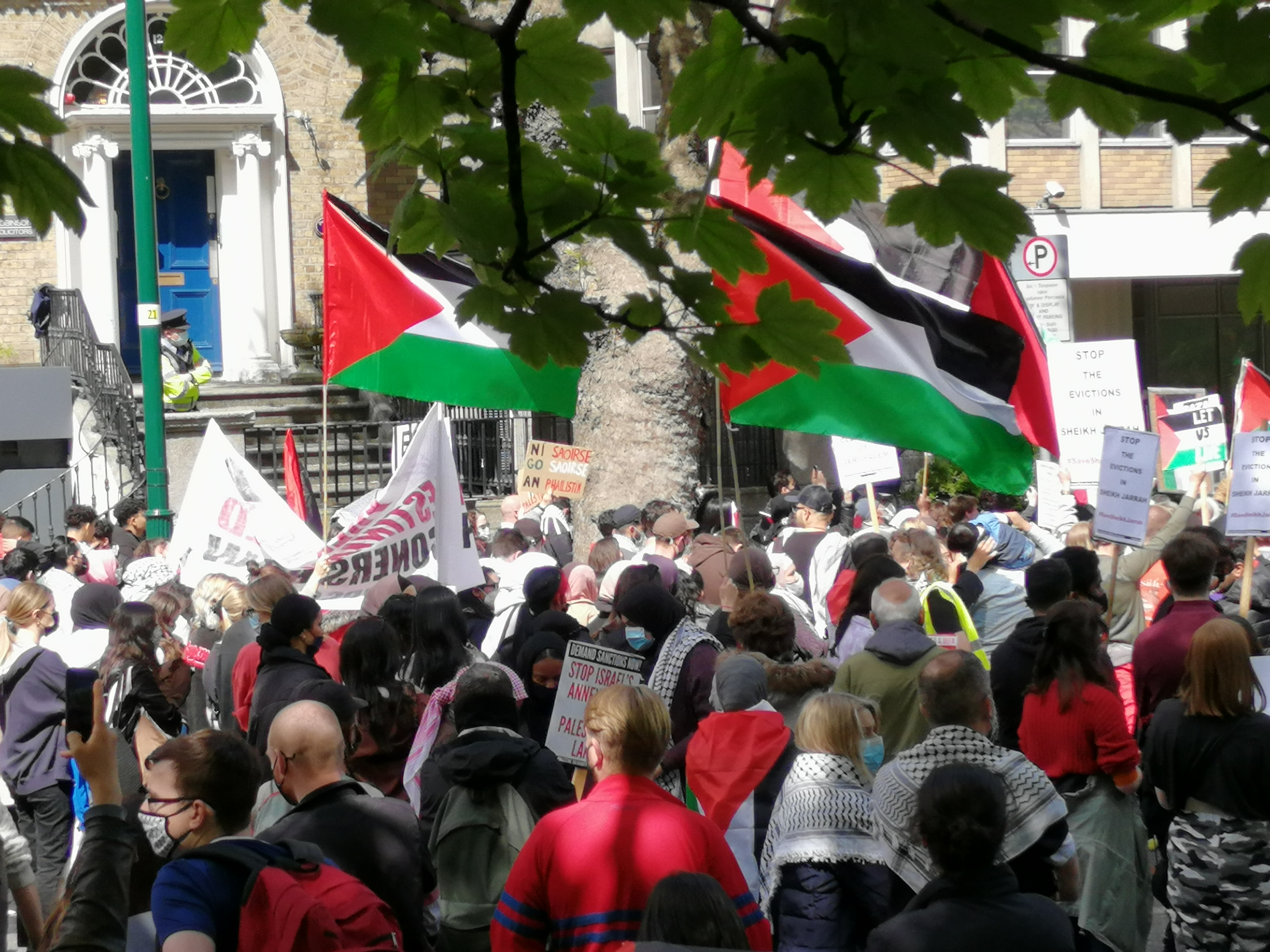
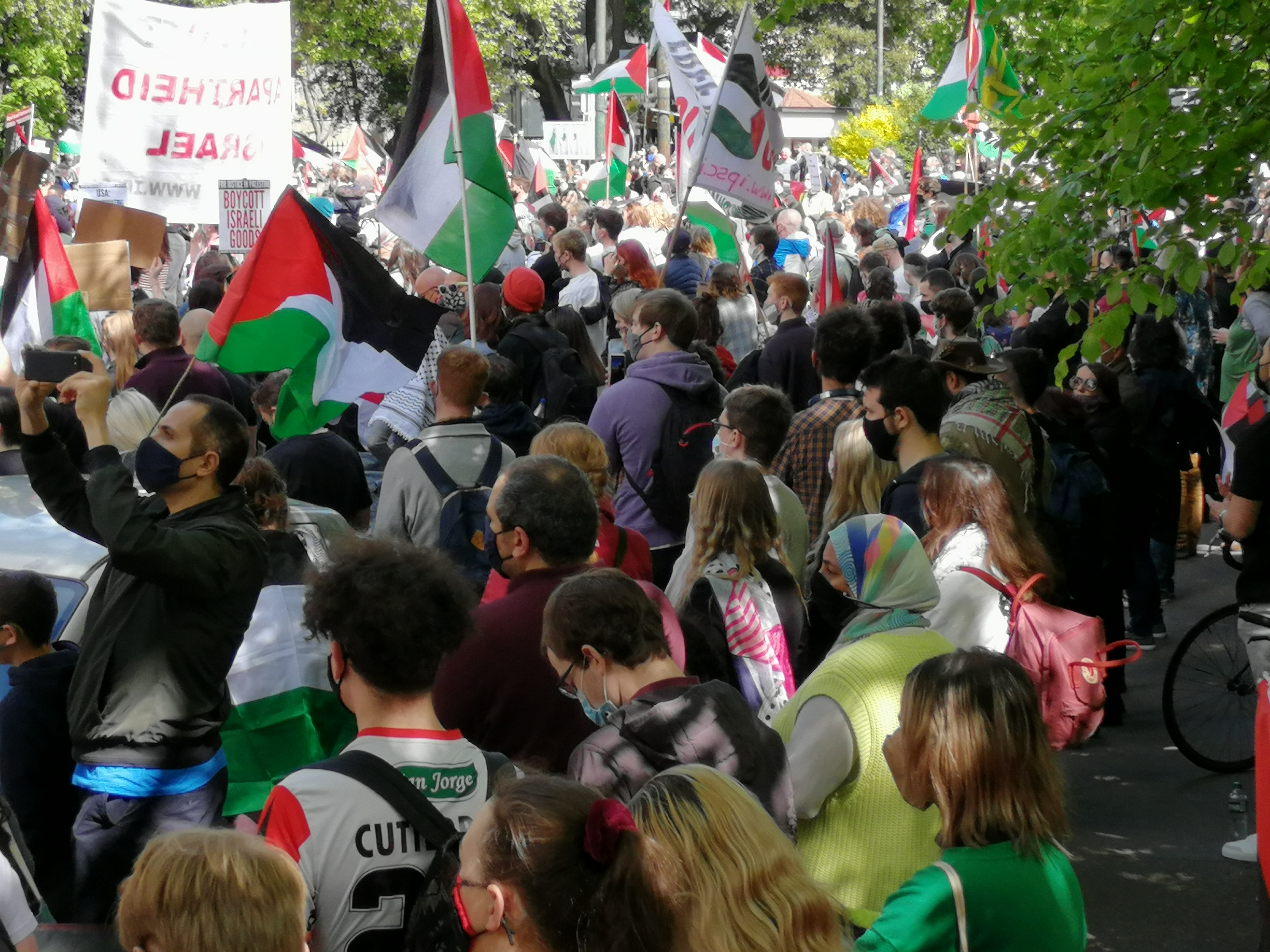
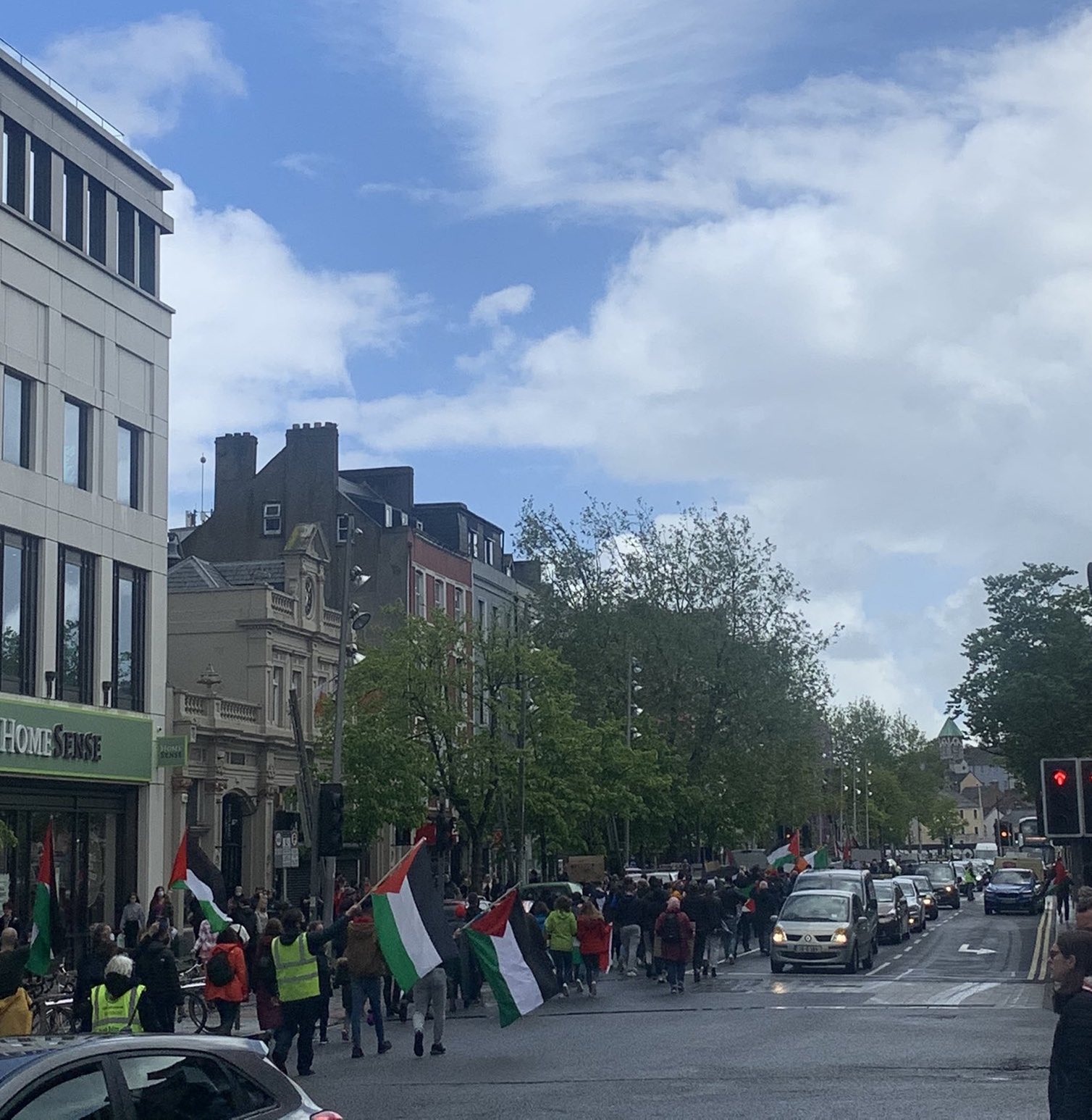
Thousands rallied in the centre of Dublin today, Saturday 22nd May, to express their solidarity with the Palestinian people and their outraged opposition to the murderous attacks on them by the Israeli State. From O’Connell Street they marched across O’Connell Bridge, into Dawson Street and from there straight along Mount Street, across the Grand Canal and on to the Israeli Embassy. Speakers emphasised that the ceasefire, even if it holds, is in essence temporary, since the Israeli occupation has led to war after war and must inevitably lead to another, stating the need therefore to work for an end to the apartheid and similar policies of the Israeli state.

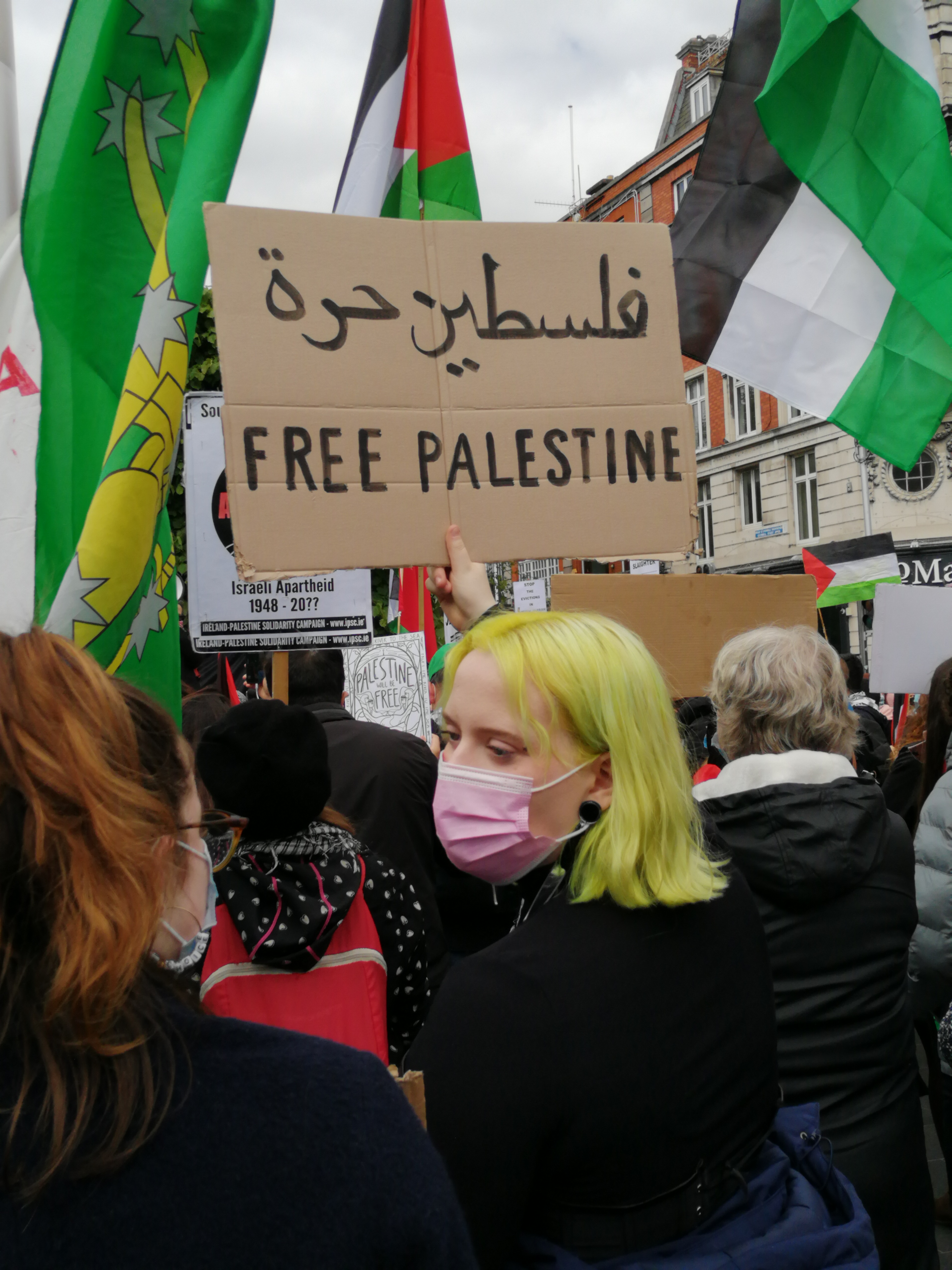
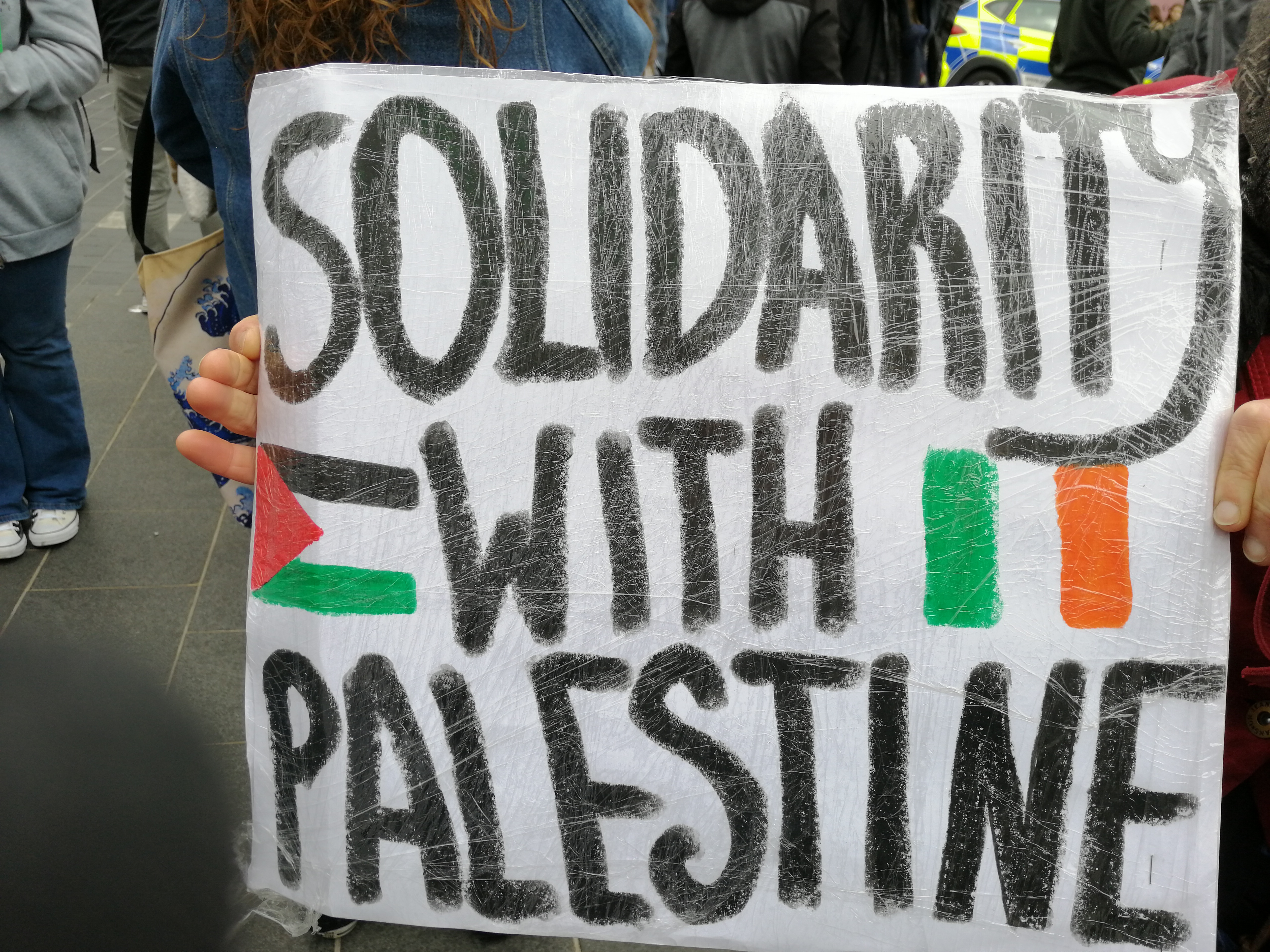
The event was organised by the Ireland Palestine Solidarity Campaign, which had an acapella singing group perform a few songs at the Spire and a number of speakers before they set off on the 3 km march and more speakers outside the Embassy too. Conservative estimates put the number on the march at over 5,000. The slogans shouted for the most part were: “Free, free Palestine!” “One, two, three four – Occupation no more!”; “Five, six, seven, eight – Israel is a terrorist state!” and “Boycott Israel!” “From the river to the sea, Palestine will be free” was another slogan.

(Photo: D.Breatnach)

The ceasefire is now in place since early yesterday (Friday). The current war began with two offensives by the Israeli Zionists on Palestinians in Jerusalem: the first by Israeli settlers harassing and threatening Palestinian residents in the Sheik Jarrah district that they are going to have them evicted because “all of Jerusalem should be Jewish only”; the other nearby in the vicinity of Al Aqsa mosque, where Israeli police harassed Muslims coming to celebrate the religious festival of Eid (this year on May 12th– 13th), culminating in an armed invasion of the temple by Israeli police firing rubber-tipped bullets and stun grenades at the devotees. However the dates fell close also to the anniversary of the Nakba, the Castastrophe of 15 May 1948, the founding of the Zionist state, massacres of Palestinians and expulsion of more than 700,000 refugees whose descendants are in many parts of the world today, forbidden by the Israeli authorities to return.

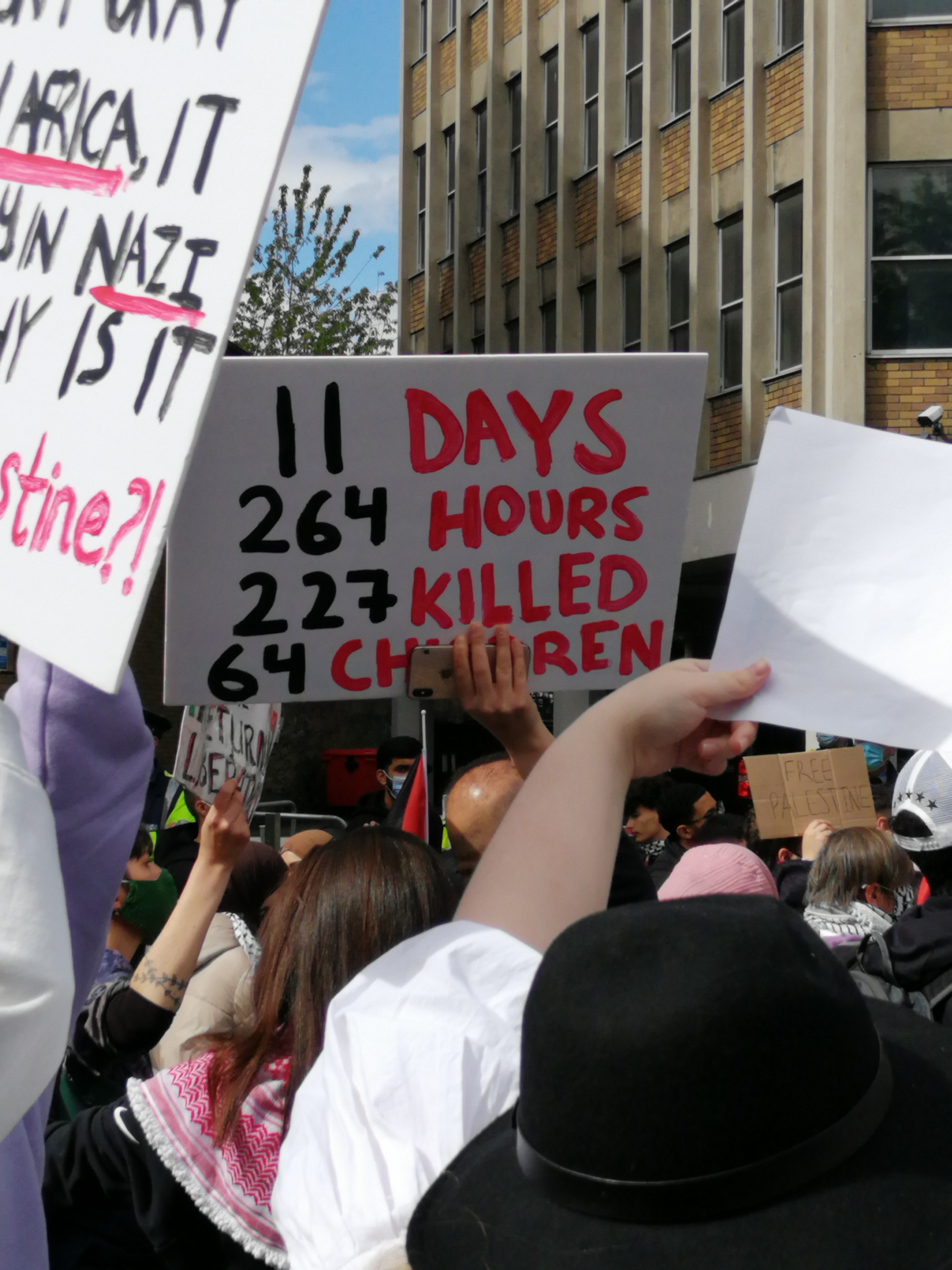
In the 11 days of war just past at least 232 Palestinians, including 65 children, have been killed by the Israeli forces, whilst on the Israeli side, despite hundreds of home-made Palestinian rockets fired at Israel, 12 people, including two children, have been killed. Many buildings in the Palestinian enclave of Gaza have been destroyed or part-destroyed, including hospitals and medical centres and there is major disruption to electrical service and water supply in a city which often experienced power and water flow cuts even in what passed for “normal” times in Gaza. Those killed were mostly in Gaza but Israeli forces killed 11 unarmed civilians in the West Bank also and wounded many, as they came on to the streets in solidarity with those in Gaza and in Jerusalem.

Street events in solidarity with Palestine were also held in cities and towns across Ireland, including Cork, Limerick, Galway, Belfast, Derry and in fact in most counties.

Section immediately in front of the Spire, O’Connell Street during rally and before march (Photo: D.Breatnach)

POLICE

The police on this occasion did not carry out harassment of demonstrators1 but in at least one instance, in Northumberland Road, stopped a section of the march to wave through traffic across it, putting uninvolved pedestrians crossing on a green light in danger. This occurred despite two marchers attempting to block the traffic, the Garda calling one a pejorative name and ordering him to stand aside.

Section of the march near just entering Northumberland Avenue, the front of the march away in the distance (Photo: D.Breatnach)

This was a job for official stewards and in fact, there were far too few of these. I saw perhaps around 20 getting instructions from the Chief Steward before the march at the Spire, some of whom seemed inexperienced but around 50 stewards were needed for a march this size, with a core of around 30 experienced. Stewards could be seen at times enforcing the rule to wear masks, as some young people removed them to shout slogans but once the middle of the march neared the Canal it was rare to see a steward.

A section of the crowd facing back from above photo, approaching along Mount Street towards the Bridge over the Grand Canal (Photo: D.Breatnach)

FAR-RIGHT

A Far-Right group calling themselves “Rise Up Eireann” (sic — who apparently don’t even know the official name of their country) had called for events in various parts of Ireland and had advertised the GPO as being one of the venues.

With apparent lack of awareness they scheduled theirs in Dublin for the same time as the Palestine solidarity rally, 2pm. No far-Right group was seen but one individual, a prominent QAnon activist posted a video of the Palestine solidarity marchers while voicing her disgust that the cops were not batoning or even harassing the demonstrator as they allegedly do to demonstrators demonstrating “for our civil rights.”2.

SPEAKERS

Speaker after speaker at the event pointed out that Israeli massacres and other onslaughts are often followed by ceasefires and back to “normal” oppression and theft of land, until the next war. As long as Israel is an apartheid occupying state, war is inevitable and so is oppression. Some speakers urged those present to encourage people in their social, educational, community and trade union groups to sign up to boycott, divestment and sanctions against Israel. A much more specific direction was given by Richard Boyd Barrett TD, who urged people to write emails to their TDs (parliamentary representatives) in advance of Tuesday’s debate in the Dáil, asking them to vote in favour of the “Occupied Territories” Bill.3

Richard Boyd Barrett TD speaking at the Spire prior to the march (Photo: D.Breatnach)
Aisling Micklethwaite, Vice-Chair of IPSC spoke in place of Fatin Al Tamimi, the Chairperson of the IPSC, who could not be present. (Photo: D.Breatnach)

A young Palestinian speaker from a Jerusalem district spoke with passion and made an interesting point, that a demonstration such as this one would be labelled “terrorist” by the Israelis and people would be liable to be shot with live rounds as well as with less lethal projectiles and gas.


Clara McCormack, Trinity BDS Campaign addresses the crowd outside the Israeli Embassy, Dublin (Photo: D.Breatnach)

It is a terrible statistical fact that in Israeli attacks on Gaza, one quarter have been children. Outside the Israeli Embassy the crowd grew quiet as a child read out the names of the children killed in Gaza, which was followed by a call for a minute’s silence in respect. The crowd was so big that out on one of the fringes, they did not hear the call and were chanting slogans.

Other speakers included a Palestinian young woman Ola at the Spire and Mags O’Brien of SIPTU outside the Embassy, where Martin Quigley, former Chairperson of the IPSC launched into a denunciation of Israel and of the Biden and the USA’s role in Palestine.

YOUTH & STARRY PLOUGH

As with other Palestine solidarity marches recently, a significant part of the whole consisted of Palestinians and other Arabs, among which the youth were particularly noticeable with young women very much to the fore and vociferous. One group of young Arab women shouted slogans non-stop from O’Connell Street to Northumberland Road, where I parted company with them to take up another position and could hear them chanting still as they marched on.

One would hope these youth have opportunities to become organised and gain experience to be leaders of the future.

Starry Plough seen during rally in front of the Israeli Embassy after march (Photo: D.Breatnach)

I brought two flags, a “Starry Plough”4 and one in Palestinian national colours, a friend carrying the ‘Plough most of the time. There was I heard only one other on the march. It is natural and proper that we carry and fly the Palestinian national colours but it seems to me that we should carry indications of Irishness too, to represent Ireland in solidarity with Palestine. This was represented in some placards but flags are more visible and it would be good to see more of them on Palestine solidarity demonstrations.

The Starry Plough flag also aroused interest with many asking what it represented and it was good to be able to tell them that it was the flag of the army of the Irish Citizen Army, the first working class army in the world, one which recruited women and that some of them were officers.

End.

Palestinian from Jerusalem speaking during rally in front of the Israeli Embassy after march (Photo: D.Breatnach)
Section crowd to left of Zionist Embassy (Photo: D.Breatnach, balancing on spiked railings because cops occupied the nearby steps to houses across the street)
Section middle crowd in front of Zionist Embassy (Photo: D.Breatnach)


PLACARDS & BANNERS

(Photo: D.Breatnach)

(Photo: D.Breatnach)
On one side of the placard while ….. (Photo: D.Breatnach)
….. ar an dtaobh eile: (Photo: D.Breatnach)

The essence ….(Photo: D.Breatnach)
(Photo: D.Breatnach)

FOOTNOTES

1Prior to last Saturday (15th) the Irish police threatened the IPSC with intervening to stop the march and huge fines for responsible individuals under Covid19 legislation; luckily the Trinity BDS Campaign took on the risk of repercussions and called the demonstration instead. On Tuesday, for a smaller march, the Gardaí kept the Pembroke Road open despite the danger of rush-hour traffic to the crowd, then continually urged demonstrators in towards the Embassy, forcing them into close contact with others and, when this was pointed out to them, just shrugged.

2In actual fact, Far-Right groups seemed to enjoy complete impunity for months as they held rallies, pickets and marches, without wearing masks or socially distancing, including at the GPO, while nearby, people picketing is solidarity with political prisoners and Debenhams picketers were harassed by Gardaí. Also, at a Yellow Vests rally in August 2020 a mob organised by the fascist National Party attacked unarmed counter-protesters with iron bars and wooden clubs while the Gardaí, instead of arresting them, attacked the victims and drove them off the quay with raised batons and violent shoves (see “There Will Be Another Day” article on the Rebel Breeze blog). A few weeks later, the cops allowed members of the NP to attack a handful of women opponents in Kildare Street and to club one of them, then again drove the victims back. On both occasions the Gardaí told press afterwards that there had been no violence but in the second case had to amend their statement hours later and weeks later charge a fascist individual with the assault.

3Under international law, it is illegal for Israel or Israeli settlers to sell products from the Occupied territories in Palestine, since they are even by UN law illegally occupied. However, the products are exported and sold in many parts of the world including all over Europe. The “Occupied Territories” Bill, if passed into Irish law, would make it an offence to import or re-sell products from those territories and would have an economic as well as a political impact. Although the Bill was framed in 2018 and supported by all political parties except Fine Gael, the Government has dragged its heels about bringing it before the Dáil to be discussed and Tuesday’s will be its Third Reading after which, with enough votes in favour, it will become law.

4“The Starry Plough” is modeled on the shape of the Ursa Mayor constellation. The original version has a green field with a plough in gold following the shape of the constellation, with the seven stars in white or silver. The plough has a sword in the position of the ploughshare. The later version, from the Republican Congress, is on a blue field with the the seven stars only in white (or silver) following the shape of Ursa Mayor and no other feature.

East side O’Connell Street during rally and before march (Photo: D.Breatnach)

REFERENCES & USEFUL LINKS:

Ceasefire: https://www.aljazeera.com/news/2021/5/21/hamas-claims-victory-as-gaza-celebrates-ceasefire

Occupied Territories Bill: https://www.oireachtas.ie/en/bills/bill/2018/6/

Ireland Palestine Solidarity Campaign: https://www.facebook.com/IrelandPSC

TDs contact details (by name or constituency): https://www.oireachtas.ie/en/members/

Middle section of central pedestrian reservation O’Connell Street during rally and before march (Photo: D.Breatnach)
Where the far-right group had planned to set up, west side O’Connell Street and front of GPO during Palestinian solidarity rally and before march (Photo: D.Breatnach)
Section of rally in front of the Israeli Embassy after march (Photo: D.Breatnach)

INTERNATIONALIST SOLIDARITY – THE DIVIDING LINE BETWEEN THE PEOPLE AND OUR RULERS

Diarmuid Breatnach

(Reading time: 12 mins.)

The oppression of the Palestinians led to an outbreak of active resistance recently in Jerusalem, to which the Israeli Army reacted with increased repression, timed to harass Palestinian Muslims during the period of Ramadan.

At the height of devotees attending the Al-Aqsa mosque, this escalated into attacks on worshippers within the temple itself. At the same time, Israeli Zionist settlers threatened dozens of Palestinian families with eviction from their homes in East Jerusalem.

Reacting to these events, one of the Palestinian organisations fired home-made rockets into officially Israeli territory, to which the Israeli armed forces responded in turn with drone missiles and missiles from its air force jets on Gaza.

The Zionist military fired on protesting Palestinians in the West Bank with live ammunition. The death toll has climbed to 200 Palestinians, according to Gaza’s Health Ministry, including 59 children and 35 women, with 1,305 people wounded. Ten Israelis have been killed, two of them children.

The casualty figures once again show the gross disproportion between what the Palestinians and their Zionist masters experience: in civil and human rights, citizenship, in land ownership, electricity and clean water supply, heating, fishing, education facilities, building materials …

… in freedom to travel inside and outside the state, in depth and breadth of surveillance, in arms and defence capability, in states that support them.

And in city structural damage: despite the many home-made rockets launched against the zionists, there has yet been no significant damage in Israeli towns, while their armed forces have effected large-scale structural damage in Gaza and bodies are still being pulled from the rubble.

In only one area perhaps do the Palestinians have the advantage over the Israeli Zionists: in support among the people around the world.


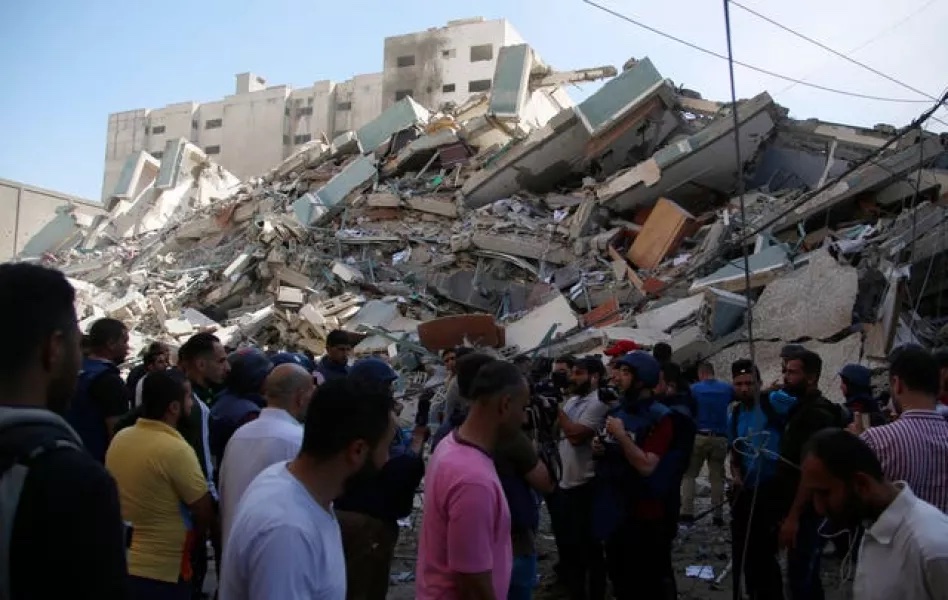
Israeli Zionist missiles strike the tower housing many media services, including Associated Press and Al Jazeera, which drew broad criticism from the mass media for a change. But families also lived here. Everyone was given ten minutes to get out. The Israeli Occupation Force has not yet bothered to explain its rationale for targeting this building. (Photo source: Internet)

PALESTINIAN SOLIDARITY MARCH DEFIES POLICE THREATS

Responding to these attacks on Palestinians, the Ireland Palestine Solidarity Campaign, the main organiser of Palestinian solidarity action in Ireland, called for solidarity demonstrations and in particular advertised a solidarity rally to take place in Dublin’s city centre for 2pm on Saturday 15th May.

The organisation asked those in attendance to comply with measures against Covid19 infection, to wear masks, maintain social distancing and comply with stewards’ instructions.

However the IPSC was contacted by the Irish police force, the Gardaí, who told them not to go ahead with the event, that if they did they would intervene to stop it and also made threats of €5,000 fines and prison against the organisers.

In a later public statement the Gardaí declared that they “have no role in permitting or authorising marches or gatherings. There is no permit/ authorisation required for such events”!

But there is apparently an ability and power to intimidate and threaten progressive organisations to deter them from organising solidarity events.

Or to kettle socialist and socialist republican Mayday marchers and demand all their names, addresses and dates of birth before threatening them with arrest if they did not disperse.

Or to threaten Debenham workers and their supporters, assaulting some of them while escorting KPMG forces in to evaluate stocks during pandemic restrictions.

A Palestinian policeman stands among the rubble of the tower in Gaza recently occupied by families and media agencies. (Photo source: Internet)

The predicament of the IPSC exposed the vulnerability to this kind of intimidation of a broad organisation that seeks to win friends in ruling circles. The leaders and organisers are placed in a position of not only personal but also of organisational vulnerability.

Even should they be prepared to defy the State to fine and/or imprison them, would they also be prepared to damage their organisation or to lose some friends they are cultivating in the circles of political influence?

What was one of the strengths of a broad organisation thus becomes a weakness; a more radical or even revolutionary organisation, with less influence in influential circles can decide on defiance, risk fines and jail with however perhaps less possibility of influencing official opinion and ultimately, action.

Fortunately in this case one such organisation did step forward and took up the baton: the Trinity College BDS group expressed its solidarity with the IPSC on its treatment by the Gardaí and called their own rally for the exact same place and time as the original one called by the IPSC.

https://www.irishtimes.com/news/ireland/irish-news/thousands-attend-rallies-in-irish-cities-in-solidarity-with-palestine-1.4566435

Video of rally at end of demonstration, near Israeli Embassy

Despite concern over Covid19 transmission and Garda threats – and the extremely short notice and much smaller circle of contacts of the TC BDS group — the response was magnificent, both in internationalist solidarity and in maintenance of the right to organise such progressive events.

Before the appointed hour, people began to gather in large numbers at the Spire in O’Connell Street, Dublin’s main street and north city centre.

After being addressed by a number of speakers, they set off in a march towards the Israeli Zionist Embassy near Ballsbridge, beyond the south city centre. As they marched their numbers grew until, approaching the Embassy, they numbered several thousand.

Along the way, bystanders applauded the marchers and passing vehicles blew their horns in solidarity.

A section of the Dublin rally in solidarity with Palestine photographed outside the GPO in the city’s main street before they set off on the 5.5km march to the Israeli Embassy (Photo credit: PA, Breaking News)

Marchers shouted slogans of solidarity with the Palestinians, calling for the freedom of Palestine and the expulsion of the Israeli Ambassador as a mark of the Irish people’s objection to what is being done to the Palestinians.

Near the Embassy, a number of speakers addressed the crowd and after dispersing, a number of demonstrators boarding public transport to return home were congratulated by the drivers.

LESSONS FOR US

The situation regarding calling and holding the demonstration in Dublin outlined some of the weaknesses of a broad organisation when it faces repression from the State and the greater resilience of a smaller organisation in being able to defy the State.

It may be necessary in future to maintain support for both types of organisation, each being appropriate for particular situations.

Also demonstrated was the necessity to openly defy unjust laws and prohibitions at times and particularly around the right to organise, to protest and to show solidarity, which the demonstrators did so well on Saturday.

Such situations also reveal the difficulty for the Gardaí in carrying out repressive actions and they are reduced to threatening individuals.

THE FAR-RIGHT MARCHES TOO – FOR WHAT?

Meanwhile, a couple of hundred of the far-Right also marched in Dublin, allegedly in defence of civil liberty. Not in solidarity with the Palestinians’ civil liberties and not in defence of our civil liberty to organise to show solidarity with people in other struggles.

No, they marched in defence of the right to defy health protection regulations, in proclaiming the Covid19 pandemic to be a) a hoax or b) greatly exaggerated and in claiming that wearing masks damages one’s health and even intelligence(!).

They were insisting that vaccinations are a) dangerous to one’s health or b) means of injecting nano-machines into people’s bloodstream in order to control them.

A clip posted by Ireland Against Fascism showed one of the QAnon Saturday screechers for months outside the GPO, Dolores Webster, aka Dee Wall, lately self-declared “digital journalist” (don’t laugh) posting her reactionary propaganda.

In apparent total ignorance of the actual reality (but when has that mattered?), she broadcasted a claim by video from her studio (her car), accompanied by the strains of Abba from the headphones of her head-bobbing passenger.

She claimed that the “scum in the Dawl” had allowed the Palestinian solidarity march to go ahead to distract from the alleged general removal of freedom and in particular from the far-Right group Irish Yellow Vests to hold their rally on May 1st!

When all the Covid19 precautionary restrictions are removed, what will these elements have to march about? The will need to return to the topics that engaged many of them in the recent past: racism, anti-immigrants, islamophobia, homophobia and anti-socialism, along with their false patriotism.

None of that is welcome of course but at least it will be without this false concern for “civil rights and freedom” and closer to the reality of what the far-Right in general – and fascists in particular — stand for.

SUPERPOWER BACKING AND IMPUNITY

The current atrocities of the Zionist State, which it carries out with impunity, along with its history, starkly reveals the effect of its main backing power, the USA, and the imperialist alliance dominated by that Power.

The USA backs Israel with military aid to the tune of $10 Million daily, which is aside from other direct and indirect aid. Israel is the only state in the Middle East which is not only very friendly to the USA but totally dependent on the support of that superpower.

For the ruling class of the USA, Israel is the only state in the Middle East which is totally safe forever from fundamentalist Muslim revolution or from left-wing anti-imperialist revolution and is therefore an extremely important factor in the USA’s plans to totally dominate the Middle East.

Solidarity marcher in Dublin on Friday with a home-made placard (Photo Credit: PA, Breaking News.ie)

This imperialist alliance finds reflection not only in the action/ inaction of governments in Europe, for example but also in the reporting of the mass media.

One of the latter’s tropes is the constant emphasis on the numbers of Palestinian missiles fired, without revealing their general ineffectiveness in delivering destruction, in total contrast to the Israeli missiles. Another is their constant repetition of a lie, that “Hamas seized power in Gaza”.

The truth is that Hamas swept the board in the 2006 elections for the Palestinian Authority. The “seizing” that was done was by Al Fatah, which usurped the results in the West Bank and installed themselves there; they tried to do the same in Gaza and, in a short fierce struggle, were beaten.

But the Western powers decided that Hamas was illegitimately in power, seized funds due to it and supported its blockading – by both Israel and Egypt.

No explanation is offered in the general mass media as to how a generally politically-secular Palestinian public would turn from its decades of allegiance to Fatah to vote for the fundamentalist Muslim Hamas.

The main reason was Fatah’s surrender of the goals of Palestinian independence and freedom and the return of the refugees, in exchange for running a colonial administration with opportunities for living off bribery and corruption and Fatah’s settling down to that status quo.

CASTING A GIANT DARK SHADOW

It was not only in Dublin and in towns across Ireland that Palestine solidarity demonstrations were held on May 15th but by people across much of the world, generally in opposition to the wishes of their governments and ruling elites.

It is worth thinking about how this has come about, in particular in contradiction to a mass media hostile to the Palestinians.

Palestinians come to view the remains of the tower block that was home to families and that housed a number of media agencies. (Photo source: Internet)

The Zionist state of Israel was declared in 1948, its anniversary actually only three days ago – May 14th, the first states to recognise it being the USA and the USSR. In Ireland at the time, there was general support for the new state which continued to the “June War” of 1967 and somewhat beyond.

The general Irish population were horrified by the history of the Nazi-organised Holocaust and sympathised with the Jewish survivors.

Irish nationalists and even Republicans empathised with the Zionist civil and armed struggle against the British (who, ironically, had begun the process of Zionisisation of Palestine).

The 1966 film Cast a Giant Shadow purporting to show that struggle, starring Kirk Douglas and a cameo appearance by Frank Sinatra, was widely enjoyed and cheered in cinemas across Ireland.

Though some of the film’s characters were based on real-life counterparts, the general narrative was a grotesque distortion, hiding the massacres of Palestinians and the expulsion of thousands as the Zionist state was created.

Many Irish language supporters admired how the new state had brought the Hebrew language, for centuries only spoken in religious contexts, back into everyday usage.

Solidarity marcher in Dublin on Friday with a home-made placard and a thought-provoking message (Photo Credit: Sam Boal, The Journal)

Yet, by a few years ago, general pro-Palestinian sympathy across Ireland had become so strong that Israel’s Ambassador to Ireland declared the country “the most anti-semitic in Europe”. That of course is the Zionists term for anyone who supports the Palestinians or criticises the Israeli state harshly.

Only a few days ago, the current Ambassador accused some politicians of spewing hate towards Israel. He was responding not only to Left and Sinn Féin TDs who criticised the actions of Israel towards the Palestinians, but also to the Tánaiste (Deputy Prime Minister equivalent) Leo Varadkar!

Varadkar had commented that Israel’s actions are “indefensible” and Government Minister for Foreign Affairs Simon Coveney said at an EU conference that the EU had “fallen short” and failed to project its influence in agreeing a position in against illegal activity by the Israelis against Palestinians.

Palestinian solidarity march in Cork on Saturday (Photo source: Internet)

The fact that establishment right-wing/ conservative politicians feel obliged to take a public stand, however ineffectively, against actions of the Israeli Zionists is a strong indication of how much Irish public opinion has changed over decades.

Implicitly such stands reflect against the Zionists’ biggest international backer and world superpower, the USA. Since the Cast a Giant Shadow film, the state’s shadow of which we are aware now is indeed frighteningly giant and very dark.

In response, the natural cultural and historical feelings of the Irish people have stirred in sympathy with the oppressed Palestinians – and in defiance of threatened police repression at home.

end.

SOURCES

Coverage of events in Ireland: https://www.thejournal.ie/peacful-protests-solidarity-with-palestine-5438356-May2021/

https://www.irishtimes.com/news/ireland/irish-news/thousands-attend-rallies-in-irish-cities-in-solidarity-with-palestine-1.4566435

https://www.breakingnews.ie/ireland/protests-held-around-the-country-in-support-of-palestine-1127787.html

Recent reports on the conflict: https://www.nbcphiladelphia.com/news/national-international/weary-gaza-marks-muslim-feast-as-violence-spreads-in-israel/2812715/

https://www.bbc.com/news/world-middle-east-57138996

Israeli Ambasador to Ireland clashing with politicians: https://www.irishtimes.com/news/politics/israeli-ambassador-accuses-some-tds-of-spewing-hate-towards-jewish-state-1.4564184

GOVERNMENT SLAUGHTER IN COLOMBIA

Diarmuid Breatnach

(Reading time main text: 5 mins.)

For months the Duque government in Colombia has been unleashing violent repression on its people, in particular those who organise or participate in protests. The statistics are frightening, which is what they are intended to be: 40 dead, hundreds injured (some with loss of an eye), nearly 170 “disappeared”. Yet the people continue to protest.

What all this has exposed is that Colombia, despite its support by western states, has no democracy and that its vaunted “peace process”, like all others elsewhere before it or since, has had nothing to do with peace but everything to do with pacification. Unlike many in other parts of the world however, its acceptance by the FARC was the prelude to intensified State repression, with assassinations of leaders and activists of popular democratic movements. Also exposed is the lie that Colombia and the USA are truly involved in a “War on Drugs”, a commodity the sale of in which most of the political class of Colombia are involved and the profits in which the financial institutions in Colombia and much of the world are active in laundering.

Meanwhile, the people are subjected to economic squeeze, they protest, they are shot, beaten, tortured, raped, disappear ….

This police victim survived but many did not (Photo source: Gearóid Ó Loingsigh)

In two weeks of protests, statistics from the Defensoria del Pueblo (a kind of Ombudsman), listed 42 dead and 168 reported “disappeared”; of the dead, 41 were civilians and one was a member of the State security forces. A 17-year-old female demonstrator was reportedly sexually abused by four police officers and took her own life afterwards. Protesters burned the station where it happened but the officers themselves remain at large.

Protestors burning the station where police officers sexually violated a 17-year-old demonstrator who took her own life afterwards.

WHO KILLED VILLA?

Lucas Villa Vasquez, an iconic figure in the peaceful demonstrations, dancing and carrying out acrobatic acts, was shot during the General Strike, was declared brain dead in hospital and had his life-support system turned off, his heart stopping finally on 11th of May. Andrés Felipe Castaño, a 17-year-old youth shot on the same day underwent two operations before he could come off the critical list.

Who killed Villa? Not Duque, the President wanted people to believe as he sent a message of condolence to Villa’s family, the first personal condolence he has offered since the demonstrations – and the killing – began, except for the one police officer killed so far. Not the Police, their Director General, Major General Jorge Luis Vargas Valencia insisted, insisting his force is working hard to find the culprits and that a reward for information has risen to 100 million pesos1 for information. But people who know how these things work are only in doubt about one question: was it the police themselves who killed Villa and nearly killed Andrés Felipe, or was it one of the State-sponsored fascist gangs (which have strong links with the police and army)?

Dilan Cruz, murdered by police two years ago, is remembered on demonstrations where people are still being killed. (Photo source: Gearóid Ó Loingsigh)

Villa has joined over 40 martyrs known to have been killed by the forces of the State; since their names are known only to their families or smaller political and social circles, Villa’s name stands for them all. As did Dilan Cruz before him, shot at close range to the head by a “non-lethal” beanbag in October 2019. And what of the nearly 170 disappeared? Are some of them already dumped into pits or rivers? Others in prison cells, awaiting their next session with the torturers? Or in the case of female prisoners, awaiting their next incident of violation?

Man in blue top and white trousers dancing in some clips was Lucas Villa Vasquez

Two Latin American league soccer matches in Colombia were affected on Wednesday: Visitors from Argentina’s River Plate team had their warm-up in Barranquilla abandoned for awhile due to the volume of police tear gas drifting in from outside and loud bangs could be heard also. That was a Copa Libertadores game and another, between Atletico Nacional and Nacional of Uruguay in Pereira was delayed by an hour due to protests there.

The South American Football Confederation (CONMEBOL) moved matches from Colombia to Paraguay and Ecuador last week to ensure the protests did not affect games but the Copa America is due to be held in Colombia and Argentina next month with Colombia hosting 15 games including the final of the world’s oldest international tournament. The title match is due to be held in Barranquilla on July 10.

“SUSTAINABLE SOLIDARITY” WITH WHOM?

Part of the reason for the protests in the first place was the proposed tax reform by another name: Sustainable Solidarity Law. The Duque Government plans by this system to collect 23 billions in Colombian pesos (US$ 6,300 millions) by extending its tax base, to avoid any further increase in the country’s international risk qualification, to institutionalise the basic income level and build a fund to comply with its environmental protection targets.

Well, ok, but who is going to pay this tax-by-another name? According to the Minister of Finance himself, Alberto Carrasquilla, 73% is to be contributed by ordinary citizens and the rest by the companies.

Art in active resistance

In addition, the law proposes to apply the collection of Value Added Tax, which in Colombia is up to 19%, to basic consumer products such as public services (water, electricity and gas), funeral services, electronic items such as computers and other services that have been exempt until now.

Add to that ongoing State repression in the countryside, the number of unemployed nationally rising to 4.1 million as a result of the pandemic and the country was ready to take to the streets. But not ready for the repression of the demonstrators that followed.

Riot Policeman aims weapon at point-blank range at unarmed demonstrators in Colombia. Whether tear-gas canister or stun grenade launcher, at this range it would almost certainly kill but if not, partial or full blindness would be likely along with permanent brain damage. (Photo source: Internet)

President Duque asked the Colombian Parliament to withdraw the new tax reform which they did but the people are on their feet now, as they say there; now they have martyrs too on top of the issues they already had.

WHAT CAN BE DONE?

It is up to the people of Colombia, the workers, civil servants, small business people, indigenous – to free themselves. None else can do it. But we owe them solidarity, just as we in turn have claimed solidarity (and will claim again) from others. It is difficult at the moment to see how our solidarity can express itself in much more than symbolic form, such as pickets, demonstrations, articles and memes on social media. But even those have more than a moral effect, for the Colombian Embassy staff here have as part of their duties to collect information on how the regime in Colombia is viewed in Ireland and to report that to their bosses at home. And since the Colombian ruling class needs to do business around the world ….

Recent small Colombian solidarity picket protest outside the Colombian Embassy in Dublin.

The Colombian masses also need to know that they do not stand alone, that others are watching, applauding them, cursing their enemies, mourning their martyrs.

We can also assist by continuing our efforts against another faraway enemy of democracy, the main instigator and protector of reaction, repression and oppression around the world, and main external supporter of the Colombian regime, trainer of its repressive forces – the ruling class of the United States of America.

Solidaridad con el pueblo Colombiano! Dlúthpháirtíocht le poball na Colóime!

Banner slogan: “The Tax Reform means Hunger and Misery for the people.” (Photo source: Gearóid Ó Loingsigh)

End.

USEFUL SOURCES

Officially-accepted statistics some days ago: https://www.facebook.com/waykaperu/photos/a.586123314805406/4058327907584912/

TV news report on the general strike, general protests against killing by government forces; mothers and grandmothers of murdered protesters demonstrate against “Public Order” forces; Duque tries to present concern and gives a concession to students at a certain level: https://www.youtube.com/watch?v=Xz8ed0hS6OQ

Amnesty International complaint (English version, despite title): https://www.amnesty.org/en/latest/news/2021/05/colombia-preocupan-las-denuncias-de-desapariciones-y-violencia-sexual-contra-manifestantes/

Tear gas drifting on to inter-Latin American soccer game: https://edition.cnn.com/2021/05/13/football/copa-libertadores-players-affected-tear-gas-colombia-spt-intl/index.html

Reasons for the wave of protests: https://www.bbc.com/mundo/noticias-america-latina-56932013

War on Drugs (Plan Colombia) – spraying of glyphosphate: https://www.sciencemag.org/news/2020/06/pandemic-upends-colombia-s-controversial-drug-war-plan-resume-aerial-spraying

Plan Colombia is not working (2016): https://www.bbc.com/news/world-latin-america-35491504

1 €22,185.95

FASCIST REPRESSION IN GALIZA

Argimiro Rodriquez


(Translated by D.Breatnach; la versión en castellano al fondo)


(Reading time: 8 mins.)


To this day, many people, both from the Spanish state and foreigners, believe that Franco’s repression only occurred in areas where the coup failed and war followed. But this is not the case for in areas such as Galicia (1), the Canary Islands, Castilla y Leon, Ceuta, Melilla, where the coup d’état triumphed in just a few days, the repression was equally brutal.

Photo of the executions taken from a distance by a Guardia Civil
Photo montage of original photo of the executions in 1936 and the memorial monument there today.

I am going to expose the events that occurred in my Galician homeland, which is what I know best. There was not a single battle there, so that some historians say that there was no war in Galicia; there are also those who think that the majority of Galicians were Francoists because Franco was born in Galicia. This is another myth, which is refuted by the fact that on June 28, 1936 its Statute of Autonomy was voted and approved by a large majority with almost one million votes in favor of the Statute. One of the main promoters of the Statute was Daniel Castelao, father of the Galician nation, writer, politician, draftsman, painter, etc., who was luckily in Madrid presenting this Statute in the courts, which is how he was able to save his life. The other was Alexandre Bóveda, shot in A Caeira, Pontevedra, on August 15, 1936, which is why every August 15th we Galicians commemorate the day of the GALIZA MARTIR, in memory of all the acts of repression.

“The fascist ‘stroll'” (Daniel Castelao) [The Falange, who carried out many of the non-judicial killings, would round up people and say “We’re going for a stroll.”- DB]
“That will teach them to have ideas” (Daniel Castelao)


The reason why the coup triumphed in Galicia has nothing to do with the Galicians supporting the coup but rather that in Galicia, as in many of the communities where the coup triumphed, it had more to do with the four civil Governors: Francisco Pérez Carballo, Gonzalo Acosta Pan, Ramón Garcia Nuñez and Gonzalo Martín March, who decided not to hand over arms to the people. They thought that the coup was not going to take place, or that in any case it would be easily controlled. They were very mistaken and they paid for it with their lives, because the Francoists, despite this, shot them. I should highlight here also the story of Juana Capdevielle, wife of the civil Governor of A Coruña, who was raped, shot and her breasts torn off. (2)

“All for Country, Religion and Family” (Daniel Castelao)


The repression that I know best about occurred in my city, A Coruña, where in a place near the Tower of Hercules, called Campo De La Rata, about 700 people were shot and thrown into the sea and where veritable mass meetings of fascists were convened to attend the shootings. Here is told the sad story of the brothers known as “La Lejia”, because their father had a bleach factory (3); of these brothers it is told that Bebel de la Lejia was a player of Deportivo de A Coruña (4) and a socialist, like his four brothers — when he went to be shot he lowered his pants and urinated on his murderers. Pepin de la Lejia was the only one of the brothers who managed to escape, he did so on a fishing boat to Asturias where he joined the Republican army and in the subsequent bombardment he lost a leg but managed to escape to France and from there into exile in Argentina. There is a beautiful song that tells his story. (5)

GUERRILLA ORGANISATION IN GALICIA POST-ANTIFASCIST WAR


In Galicia, one of the first guerrilla resistance organisations was also formed, the guerrilla army, part of the Leon-Galicia Guerrilla Federation and formed mostly by refugees who fled to the mountains, people who simply hid in the mountains but that the Communist Party managed to turn into a guerrilla organisation, one of the most numerous in the state, in order to deliver economic blows to the landowners or to carry out sabotage on the Tungsten mines, a mineral that was sold by the Francoists to the Nazis to make cannons for tanks. The guerrilla organisation ended up being abandoned by the Allies who recognized the Franco regime, but even so the last guerrillero was shot in 1968, a Galician they called “O Piloto”. The best known was Benigno Perez Andrade, known as “Foucellas”, an avid fan of the DEPOR, who went every Sunday in disguise to the stadium to see Deportivo A Coruña after which he posted the tickets to the civil Government.


We should also note that of the last five officially shot by the Franco regime (6,) two were Galicians: Xose Humberto Baena and Jose Luis Sanchez Bravo, both members of the FRAP (Frente Revolucionario Antifascista y Patriota) tried in a farce of a trial in which the Defence lawyers were even threatened beforehand by pistols aimed at them and all the evidence presented by the Defence was denied.

PLUNDER BY FRANCO AND FAMILY

And to conclude, I cannot end on the Francoist repression in Galicia, without mentioning something very recent that only occurred a few months ago, when the Department of Justice recognised that the State was the legitimate owner of the Pazo de Meiras (pazo in Galician means “palace”) which was literally usurped, stolen, etc by a series of Francoist characters to give to Franco, supposedly as a gift from the Galician people. The reality was that they created a kind of revolutionary tax (and I know this because my mother is from the same town where the pazo is located), in which whoever did not give money to buy the pazo for the Dictator was called “a Red”, which we all know entailed imprisonment and one could even be shot. After much struggle, there was success in getting the Justice Department to return the pazo to the State, originally without any compensation but the Dictator’s family appealed and once again the Court declared that the State had to pay one million euros, allegedly for a series of repairs they had made. However this has been appealed again by the State and in addition there is another series of processes underway, for other properties confiscated by the Franco family, such as the Casa Cornide, various statues of the Santiago Cathedral, several medieval baptismal fonts of many other churches etc.
End.

“They killed her son” (Daniel Castelao)
“Final lesson from the schoolteacher” (Daniel Castelao). [Non-fascist teachers, as intellectuals, were high on the list for execution by fascists – DB]
“They could not be buried in consecrated ground”. (Daniel Castelao)


FOOTNOTES

  1. Galicia is a nation of Celtic origin with a coast on the north-west of the Spanish state but speaking a Romance language very similar to Portuguese. It is bordered by Asturias (another Celtic nation) and Castilla y León to the east, Portugal to the south and otherwise the Atlantic Ocean. It is recognised as a historic nationality by the Spanish State and is governed as one of the “autonomous communities”.
  2. “According to Carlos Fernández Santander, at least 4,200 people were killed either extrajudicially or after summary trials, among them republicans, communists, Galician nationalists, socialists and anarchists. Victims included the civil governors of all four Galician provinces; Juana Capdevielle, the wife of the governor of A Coruña; mayors such as Ánxel Casal of Santiago de Compostela, of the Partido Galeguista; prominent socialists such as Jaime Quintanilla in Ferrol and Emilio Martínez Garrido in Vigo; Popular Front deputies Antonio Bilbatúa, José Miñones Díaz Villamil, Ignacio Seoane, and former deputy Heraclio Botana); soldiers who had not joined the rebellion, such as Generals Rogelio Caridad Pita and Enrique Salcedo Molinuevoa and Admiral Antonio Azarola; and the founders of the PG,Alexandre Bóveda and Victor Casas as well as other professionals akin to republicans and nationalists, such as the journalist Manuel Lustres Rivas or physician Luis Poza Pastrana (Wikipedia).
  3. “Lejia” is “bleach” in the Castillian (Spanish) language.
  4. Real Club Deportivo de La Coruña (‘Royal Sporting Club of La Coruña’), commonly known as Deportivo La Coruña, Deportivo or simply Dépor, is a professional soccer club based in the city of A Coruña, Galicia, in the Spanish state. They currently play in the third tier of the League in the Spanish state. Founded in 1906 as Club Deportivo Sala Calvet by Juan Parra Rois, the Blue and Whites were a regular in top positions in La Liga for some 20 years, from 1991 to 2010, finishing in the top half of the table in 16 out of 19 seasons, and are 12th in the all time La Liga table. As a result, the club was a regular participant in European competitions, playing in the UEFA Champions League five seasons in a row, reaching the quarterfinals twice and reaching the semi-finals in the 2003-04 season (Wikipedia).
  5. https: //youtu.be/ywhOfjNEuZY
  6. The other FRAP member was Ramón García Sanz; also executed on the same day 27th September 1975 were two ETA members, Ángel Otaegi and Juan Txiki Paredes Manot.

SOURCES, ADDITIONAL MATERIAL


Galician Statute of Autonomy: https://es.m.wikipedia.org/
Wiping out of the Republican authorities in Galiza: https://documentalismomemorialistayrepublicano.wordpress.com/2018/02/23/el-exterminio-de-autoridades-republicanas-en-galicia-por-fascistas/
Murders of the “Lejia” brothers: https://youtu.be/93VlSccyLxE
FRAP & ETA trial and executions: https://youtu.be/ha4SJMgVdvU
Franco plunder ownership challenge: https: //www.lavanguardia.

LA REPRESIÓN FRANQUISTA EN GALIZA

Argimiro Rodriquez

A dia de hoy, mucha gente, tanto del estado español, como extranjeros, creen que la represión franquista sólo se dio en las zonas en donde el golpe de estado fracasó, esto no es asi, zonas como Galicia, Canarias, Castilla y Leon, Ceuta, Melilla, donde el golpe de estado triunfó en apenas unos pocos dias, la represión fue igualmente brutal, yo voy a exponer, los hechos que ocurrieron, en mi patria gallega, que es lo que más conozco, donde no hubo ni una sola batalla , tanto es asi que algunos historiadores dicen que en Galicia no hubo guerra , también hay quienes piensan que la mayoría de gallegos eran franquistas porque Franco nació en Galicia, es otro mito, que no es real.

Para demostrar esto decir que Galicia , el 28 de junio de 1936 voto y aprobó su estatuto de autonomia ( https://es.m.wikipedia.org/ ) por una amplia mayoria con casi un millón de votos a favor del estatuto, cuyos principales impulsores fueron Daniel Castelao, padre de la Patria gallega , escritor, politico, dibujante, pintor etc . , quien por suerte se encontraba en Madrid presentando este estatuto en las cortes, por eso pudo salvar su vida, y Alexandre Bóveda, fusilado en A Caeira , Pontevedra , el 15 de Agosto de 1936, por eso todos los 15 de Agosto los gallegos conmemoramos el dia de GALIZA MARTIR, en homenaje a todos los represaliados . Coleccion de cuadros pintados por Castelao sobre la represión en Galicia https://youtu.be/ljyuasmr9iY  

El motivo por el que el golpe triunfó en Galicia , no tiene nada que ver con que los gallegos apoyaran el golpe, si no que en Galicia, como en muchas de las comunidades donde triunfó el golpe tiene más que ver con que los 4 gobernadores civiles : Francisco Pérez Carballo, Gonzalo Acosta Pan,  Ramón Garcia Nuñez y Gonzalo Martín March , decidieron no entregar armas al pueblo , pensaban ellos que el golpe no se iba a producir, o que en todo caso , seria facilmente controlado, estaban muy equivocados e incluso lo pagaron con sus vidas, porque los franquistas, pese a esto, los fusilaron : https:// , destacar aqui tambien la historia de Juana Capdevielle, mujer del Gobernador civil de A Coruña , a quien violaron, fusilaron y arrancaron los pechos.

La represión que mas conozco ocurrió en mi ciudad, A Coruña, donde en un lugar próximo a la Torre de Hercules , llamado el CAMPO DE LA RATA, se fusilaron y arrojaron al mar a cerca de 700 personas y donde se organizaban autenticas multitudinarias reuniones de fascistas para asistir a los fusilamientos. Aqui contar la triste  historia de los hermanos conocidos como de LA LEJIA , porque su padre tenia una fábrica de lejia, de estos hermanos contar que BEBEL DE LA LEJIA , era jugador del DEPORTIVO DE A CORUÑA y socialista , como sus 4 hermanos , cuando iba a ser fusilado se bajó los pantalones y orinó a sus asesinos : https://youtu.be/93VlSccyLxE Pepin de la Lejia fue el unico de los hermanos que consiguió escapar, lo hizo en un barco pesquero hasta Asturias donde se enroló en el ejercito republicano y en bombardeo perdió una pierna , pero consiguió escapar a Francia y exiliarse en Argentina , esta es una linda canción que cuenta su historia :https://youtu.be/ywhOfjNEuZY

En Galicia también se constituyó una de las primeras formaciónes guerrillera de resistencia, el exercito guerrilleiro, integrado en la Federación de guerrillas Leon-Galicia y formado en su mayoria por huidos al monte, personas que simplemente se escondieron en el monte , pero que el partido Comunista logró convertir en guerrilla, una de las mas numerosas del estado, con el fin de llevar acabo golpes economicos a los terratenientes o de realizar sabotajes a las minas de Wolframio, mineral que era vendido por los franquistas  a los nazis para fabricar cañones para tanques. La guerrilla acabó al verse abandonados por los aliados que reconocieron al regimen de Franco, pero aun asi el ultimo guerrillero fue un gallego al que llamaban O PILOTO, fusilado en 1968. El más conocido fue BENIGNO PEREZ ANDRADE, conocido como FOUCELLAS , reconocido seguidor del DEPOR , que iba todos los Domingos al estadio a ver al DEPORTIVO A CORUÑA , disfrazado y luego enviaba las entradas al gobierno civil por correo

También comentar que de los últimos 5 fusilados por el franquismo, 2  eran gallegos :Xose Humberto Baena y Jose Luis Sanchez Bravo , ambos militantes del FRAP ( Frente Revolucionario Antifascista y Patriota ) juzgados con una farsa de juicio en el que incluso encañonaron en la previa a los abogados defensores con pistolas y fueron denegadas todas las pruebas presentadas por la defensa

Y para acabar, no puedo terminar sobre la represion franquista en Galicia, sin mencionar algo muy reciente que tan sólo hace pocos meses cuando la justicia reconocia que el estado era el legitimo propietario del Pazo de Meiras ( pazo en gallego significa palacio ) que fue literalmente usurpado, robado , etc por una serie de tipos franquistas para regalarselo a Franco, supuestamente como un regalo del pueblo gallego a los Franco , cuando la realidad fue que crearon una especie de impuesto revolucionario, y esto lo sé porque mi madre es del mismo pueblo donde esta el pazo , en el que quien no daba dinero para comprarle el pazo al dictador , se le llamaba rojo, lo que todos sabemos que conllevaba prision y hasta podia ser fusilado. Despues de mucho luchar, se consiguió que la justicia devolviera el pazo al estado, en un principio, sin ninguna indemnizacion, pero la familia del dictador recurrió, y otra vez la justicia declaró que el estado debia de pagar 1 millon de euros , ellos alegan por una serie de reparaciones que hicieron, pero esto ha vuelto a ser recurrido por el estado , al margen de que hay en marcha otra serie de procesos , por otras propiedades confiscadas por los Franco , como la Casa Cornide, diversas estatuas de la catedral de Santiago, varias pilas bautismales medievales de otras tantas iglesias etc: https://www.lavanguardia.

FIN.

Lina Jiménez Numpaque: Victim in the Andino Case Frame-up

Interview of framed ex-prisoner awaiting trial by Gearóid Ó Loingsigh

(Reading time: 8 mins.)

(28/02/2021)

In June 2017 a bomb exploded in the Centro Andino shopping centre in the north of Bogotá, Colombia, cutting down three people. A few days later the police arrested ten youths for their supposed participation in the attack, amongst them Lina Jiménez, an arts student, whose photo went viral. These youths all had something in common and it wasn’t their participation in the attack but rather that they were all friends.

We all met in the university, as we studied together. Some of us studied Law, Politics and others Sociology. I met some of them in optional classes were we coincided. We had a common position on the defence of human rights and the student movement, we met in one or other coffee shops, assemblies that took place in various parts of the university.

Friends to the point that six of them were arrested together a few days after the attack whilst on holidays in the El Espinal area. The precise moment she was arrested was the first time that Lina became aware that the Prosecutor had issued an arrest warrant for her.

I was on holiday in El Espinal and we were going to meet up in a spa resort. In El Espinal there are some festivals for Saint John’s and Saint Peter’s day and that is why we were there and I was in a taxi when various cars surrounded us and stopped us. Then they took me out of the car and officers from the Special Operations Group (GOES) and the Judicial Investigative Police (SIJIN) read out the arrest warrant. They never showed it to me or read me my rights.

It wasn’t just any order. The weaker the State’s case the more need it has to make it appear solid and to show the dangerousness of the detainees.

We were taken to the main police station in El Espinal. There were loads of them, all those that took part in the operation. Later on, one of the police officers who was guarding us said that they had around 1,200 officers involved in our capture in El Espinal. It was basically full of police officers.

Lina Jimenez during interview (Photo credit: Gearóid Ó Loingsigh)

We don’t know whether the figure of 1,200 officers is correct or not, but there is no doubt it was an enormous operation. I asked her jokingly whether such a disproportionate and unnecessary deployment made her feel important. She laughed and said no

That didn’t make me feel important, what made me feel important was the flight, as they brought us in a plane from El Espinal to Bogotá. They took us to the police station, searched us, took our prints and whatnot. They never said it was for terrorism. I was told it was for conspiracy, we were only told it was for terrorism when we got to Bogotá- They took us out of the station well guarded with motorbikes, cars, loads of officers and they took us from Flandes airport to Catam [Military Airport].

As Lina herself acknowledges such an operation was a bad omen for any detainee, even when innocent. When they took her to the airport she knew nothing good could come of it, that the State was going all out against her and would do everything possible to show results in the case and they charged her with terrorism, conspiracy, homicide and attempted homicide with a possible sentence of 60 years.

When we were being taken to the airport in Flandes, I said to myself, this thing is not so that they invalidate our arrest. If they are setting up such an operation to get some people on holidays, they are definitely not going to let us go. Regardless of whether we did it or not, these people are going to convict us. To see how they organised the truth, leaves you feeling powerless.

In fact, later she found out when she could read the press that they had already convicted her, that both state functionaries and the press had declared that the guilty ones had been captured. They published identikit pictures of some of those arrested that matched them so neatly they seemed to be photos, but they did not match the statements from the witnesses. The identikit photos had been prepared days before the attack.

Little did Lina know when she was arrested the legally doubtful manoeuvres the State would resort to, re-arresting her three times in contravention of court orders to free her. The State sought out judges in their pocket to legalise what was illegal and to justify her re-arrest and even open up another slightly different case against her. Amongst the manoeuvres of state was the harassment of the relatives and attempts made to force them to give information or testify against other detainees.

The strategy did not work when it came to the relatives, but one of the detainees, Natalia Trujillo, could not withstand captivity and the pressure on her and handed herself over to the State, reaching an agreement with the Prosecutor which consisted in her not serving any time in exchange for her false testimony against her friends and fellow students. It was a potentially serious blow in the legal case, but it was also a hard knock in personal terms. You could understand bitterness in a case like this, but when Lina speaks of her former cell mate, there is no trace in her voice, but rather of pain and also an understanding of how a person could break like that.

You feel enormous hurt, you just don’t expect that to happen, especially as we went through this process together, together we experienced what was happening, together we felt the same pressure from the State and what happened to her is sort of like that. We all have different ways of dealing psychologically with this type of severe pressure. It is no secret that the State seeks to weave its own truth and as part of doing so it resorts to these type of situations, to push people to their physical and psychological limits that they end up saying things that are not true. It was really hurtful.

Natalia suffered the legal process for more than two years, but in August 2019 she turned up testifying against Lina and other people linked to the case.

As I said, we don’t all have the same capacity and I can’t say that I didn’t feel pain nor exhaustion during all of this process, because it was really severe and there are days you just don’t want to move an inch. I believe in the power of love and I really believe that solidarity also picks you up and saves you from many things. When you are down the other person picks you up and you pick them up, there are series of bonds which are built and that pushes you forward, but we don’t all have the same capacity to say ‘right I can take a little more of this’.

Perhaps, Lina was stronger and she showed that in a photo that went viral. She is seen with her hands tied behind her back leaning in towards a journalist, seething and shouting. I asked her about that photo, as in person she is nothing like that, but an arrest is not a normal situation for anyone.

We were in the station in Puente Aranda and it has to be said that it is a horrible place. It was a complicated situation, we had nowhere to sleep. I hadn’t a clue about the hearing to legalise our arrest, that was explained to me the next day and we were heavily guarded. We left Puente Aranda in an armoured car with police vehicles surrounding it. We got there and the armoured car took a while in getting us out. When I got there I saw relatives and some friends crying, I could see their deep pain in the midst of all the rage and impotence and they were very quiet. I felt the need to say it wasn’t true, that this was about something else.

Of course, they had told me ‘You’re to keep your mouth shut’ and in that moment I felt I couldn’t let this go… You feel a rage for your own life, but also seeing your family subjected to such complex situations, that the police push them around. We were walking and there was a lot of press there and we were guarded by the police and they didn’t want us to talk. So as soon as I got down out of the armoured car I started shouting that this was a judicial false positive that this had got to do with electoral interests at the time, that is was part of the Uribista strategy. I started shouting that and that photo was taken when I was going up the stairs and a journalist from City TV came up to me and I was really upset as whilst I was shouting a policeman tried to push back the journalists and he shouted at me ‘shut up, shut up, don’t say anything!’ Obviously that was like winding me up more. Looking back on it, it would have been very different had we remained silent.

And that is certainly the case. In the entire process none of those arrested bowed their heads, they have even appeared in videos from the jail, some have written articles and others were even spokespersons for prisoners in prison protests. Unjustly detained, but not defeated.

All prisons try to crush the individual, to break them, to take away their dignity, their sense of being alive. Colombia’s prisons are no different in this matter and in fact various problems such as overcrowding and poor health and educational services make the situation worse still. Being a political prisoner can be dangerous, but when the numbers allow for it, being part of a prisoners’ collective has its advantages. Lina was taken to the Good Shepherd Prison (Buen Pastor) in Bogotá and following her processing she was placed in the political prisoners’ wing.

It is very interesting, because when we got there, the last political prisoners of the FARC were beginning to leave, we were eight days in the police station and they put the fear of God into us, that ‘you are just posh kids and in the Good Shepherd prison they are going to rob you and attack you.’

But when we go to Wing Six, the political prisoners really surprised us, they had cleaned our cells, clean sheets, everything was organised, they had hot soup, coffee, toilet paper and other things. There were around 34 prisoners from the FARC and the ELN. After a while the FARC prisoners were released and social prisoners began to arrive and it was very different. As it was a high security wing, people connected to the drugs trade began to be put in it. There was a complete change in the atmosphere as their money could be seen, they paid for whiskey to be brought in, which when the political prisoners where there, that didn’t happen. When the social prisoners came, it was different, a huge change.

Although states usually try to treat political prisoners as common criminals, they are not and it can be seen in how they organise in prison and how they relate to the prison authorities. And to form part of a collective had, as Lina saw when she arrived, certain advantages for own safety and well being.

The prisoners had outside support and they reported things, the guards called Wing Six the wing for the complaints as we were always reporting to the Procurator, the Public Defender’s Office etc. The Director consulted the prisoners about how to do certain things. Meetings were held with the Director. This didn’t happen on other wings; they didn’t take the prisoners’ views into account. The political prisoners won a space, these were not concessions from the prison authorities, but rather they were won through protests and even hunger strikes over the years.

7 killed in Colombia protests against police brutality - Weekly Voice
Colombian riot police attack a demonstrator (Photo sourced: Internet)

But it is not just people like Lina who suffer the effects of judicial frame-ups, but also their families, especially when they are accused of a crime such as the attack on the Centro Andino. The State harasses the relatives and tries to put pressure on them as part of its legal strategy.

There is an enormous pressure put on our families as well as the social stigma. In my case, when I was captured, they were raiding my home at the same time and it was severe as I live on a main avenue and they closed the entire avenue off, there were armoured cars, and at least ten anti-explosives vehicles and a huge number of police officers and everyone was asking, what happened? And since my release, they haven’t stopped following me and taking photos and there is a permanent presence of plainclothes cops.

To her, the case and other processes against other students are state strategies to defeat the social movement and hand down exemplary sentences as a warning to all those who think differently and want to change the country. The legal cases try to break grassroots processes and the detainees themselves. In her case, it didn’t work that well.

To see the misery of this system in the flesh makes you understand and treat this space as another space for political struggle. In the legal process itself and the prison, you see the system so cruelly unmasked because this can only be done by people who have no respect for life, for humanity, for nothing. You feel you have to continue struggling for what you believe in, for life. This system has been in crisis for a long time and I left the prison and we are in a pandemic, we face a very complicated situation which is not far removed from the logic of the system. In this system there are humans who are in the top category and then there are those who are not in any category. And my position and that of my friends in the case, is the type of position that has to be hidden out of view and that is the role of the prison.

You see the State’s aim take shape, to continue suppressing and depleting the movement because, amongst other things that is one of the tools in creating the idea that there has to be an exemplary punishment that has to be handed down and it seeks out the tools to rob people of their humanity.

Although Lina and the others unjustly arrested for the Andino Case are at liberty, the legal case against them continues. It is to be hoped that the judges make a finding in law, as has already happened in the case of Mateo Gutiérrez who was also accused of belonging to the same organisation that supposedly carried out the attack and he managed to demonstrate and prove his innocence. But in Colombia justice limps along and sometimes never gets there.

end.

Photo credit: Gearóid Ó Loingsigh

REPUBLICAN INDEPENDENTIST PARTIES WIN MAJORITY IN CATALAN REGIONAL GOVERNMENT

Diarmuid Breatnach

(Reading time text: 12 mins)

DESPITE LOW TURNOUT DUE TO PANDEMIC FEARS, THE THREE CATALAN INDEPENDENTIST PARTIES TOGETHER HAVE A COMFORTABLE ABSOLUTE MAJORITY

Despite the Covid19 pandemic and bad weather causing a low turnout for the elections to the Government (Govern) of the Catalan Autonomous Region, elected representatives of political parties for Catalan independence won a comfortable absolute majority of their Parlament and, for the first time in recent history, won more than 50% of the total votes cast.

It is worth noting that although most of the Spanish and much of the European media (including shamefully the Irish) is referring to the victors in this election as “separatists” this is not the correct term and implies or at least leaves open to interpretation that there is some basis for their campaign other than a historic nation seeking independence. The Irish over centuries were not “separatists” with regard to England and the United Kingdom, they were independentists. And those Irish parties that wanted to remain with the UK were — and are – unionists, with a parallel too in the elections in Catalonia.

In a Parlament of 135 seats (absolute majority 68 minimum), the results are:

INDEPENDENTISTS

Total seats: 74

ERC (Esquerra Republicana de Catalunya, traditional left-republican party of various trends)

33 seats (up one) 21.4% votes cast

JxCat (Junsts per Catalunya, independentist party consisting of various trends with origins in alliance with right-wing Catalan nationalist party PdeCat but split from them last year)

32 seats (up 12) 20.0% votes cast

CUP (Convergencia Unida Popular, a confederation of left-wing groups mostly active on a community and municipal level)

9 seats (up 5) 6.67% votes cast

UNIONISTS

Total seats: 53

PSC (Catalan branch of the Partido Socialista Obrero de Espana, social-democratic main government party in the Spanish State)

33seats (up 16) 13.9 % of votes cast

PP (Partido Popular, formed by Franco supporters after the Dictator’s death, main government party in the Spanish State after PSOE)

3 seats (down one) 3.8 % of votes cast

Cs (Ciutadans, Spanish unionist party formed by split from the PP)

6 seats (down 30) 5.6 % of votes cast

Vox (Spanish fascist and unionist party formed by split from PP and Ciutadans)

11 seats, 7.7 % of votes cast

OTHER

Total seats: 8 seats (no change) 6.87 % of votes cast

ECP (En Comú Podem [“Communs”], coalition of Podemos, Izquierda Unida etc, left-social democrats and trotskyists, in theory supporting the right to independence but in practice rarely supporting the independentists).

Results of February 2021 elections to the Catalonian Parliament. (Source image: Internet)

CONTEXT

Most of Catalonia is currently part of the Spanish state, with a small part around Pau, in the southern French state. Catalonia has its own political history and national language, Catalan but its autonomy was ended in conquest by the Bourbons of the Spanish Kingdom in 1741 and its language discriminated against. In 1936 the workers of Barcelona, the capital city, rose and defeated the forces of the Spanish military-fascist coup against the elected Popular Front Government of Spain. But after the victory of the military-fascist forces in 1939 in the Spanish Antifascist War, Catalonia, which had sided with the Government on a promise of autonomy, suffered repression, its leaders and supporters executed and language banned.

Map showing Catalonia in the iberian peninsula and part of southern France (without Pau picked out)

Catalonia is also considered by many to be part of the Paisos Catalans (Catalan Countries), which include the regions such of Valencia and the Balearic islands, where dialects of Catalan are spoken.

Although a small part of the Spanish State in terms of land and population, Catalonia is one of the most economically successful regions of the Spanish State. A wish for national independence gained renewed political support during the recent decade, growing apace when the Spanish State greatly reduced Catalan autonomy in a reinterpretation of the Statute of Autonomy in respect of Catalonia. Grassroots movements in favour of independence grew hugely, in particular the ANC and Omnium; they organised a referendum on independence to take place on 1st October 2017. The Spanish State sent its militarised police to seize ballot boxes and attack voters and protesters. Subsequently the Spanish State jailed the leaders of the Independentist party ERC, the grassroots organisations ANC and Omnium, along with politicians. It issued arrest warrants for a number of others, including the President of the Government and leader of JuntsXCat party and a leading activist of CUP, all of whom are currently in exile. 700 Town Mayors are under investigation for their role in the referendum and activists are in jail or on trial for their activities in protests and one-day general strikes (of which there have been three since 2017).

Man and woman celebrating and displaying the Vermelha, the socialist version of the Catalan independentist flag. (Source image: Internet)

ELECTION TIMING AND RESULTS

Quim Torra, Puigdemont’s replacement, who had been stripped of his position as President of the Catalan Parliament by a Spanish Court for displaying a banner in support of the political prisoners on a Government building during Catalan municipal elections, had threatened to call snap regional elections; these were expected around October last year but the Covid19 pandemic prevented that plan going ahead.

However, when the Catalan Govern because of the pandemic decided to postpone their elections until this summer,, it was forced by a Spanish State court (at the behest of unionists) to call them for 14th February. That of course led to a low turnout, which usually favours the Right and Unionists, thus making the results even more remarkable.

Catalans queuing to vote in the rain in the midst of a pandemic; the Spanish State did not permit them to postpone for couple of months. (Source image: Internet)

With the independentist parties achieving more than 50% of the vote for the first time and an overall majority in the Parlament, Catalans favouring independence regard the election results as positive overall. But their pleasure is tempered by the unwelcome gains of the Spanish social democrats of the PSC and the ten seats won for the first time in Catalonia by the fascist Vox party.

The PSC is the Catalan branch of the PSOE, the Spanish social-democratic party currently in government in coalition with Podemos-Izquierda Unida, the latter a kind of trotskyist coalition (of which the Catalan version is “En Comú Podems”) and both parties are essentially Spanish unionist, the PSOE bluntly so and the junior partner in practice.

Although the PSC were no doubt aided by having as a candidate Salvador Illa, the former Minister for Health of the current Government of the Spanish State, it seems that some of the votes to elect the PSC came from pro-Spanish unionist Catalans on the Right, deserting their more natural allegiances in order to achieve a strong unionist and Spanish government presence in the Catalan Parlament. The Catalan traditional unionist Right wing took a hammering, losing 31 seats as the PP went down from four to three seats and their upcoming replacement Ciutadants from 36 to just six. But newcomers and more clearly fascist Vox gained eleven seats. In terms of seats alone, as a crude measure, the PSC and Vox gained seats totalled 44, while PP and Cs together lost 31. Looked at that way, it seems clear that the increase of seats for the social-democratic PSC and the fascist Vox came from right-wing unionists, with a gain of another 13 seats unexplained.

The PSC and Vox successes have been of concern to many Catalan independentists. However those parties reflect existing realities in Catalonia with which the independentist republicans will need to grapple. The vote for Vox illustrates quite starkly that much of the base of the allegedly democratic right-wing conservative Ciutadans was in fact fascist, as suspected by more than a few and it is as well to be aware of it and to have that exposed.

The support for the PSC is a wider problem and, while some of it will remain irreconcilably Spanish Unionist for the foreseeable future, there are probably elements among its voters that are capable of being won over to the independentist position.

GOING FORWARD

As noted earlier, the three republican independentist parties have won a comfortable overall majority, in that they have 74 seats between them, six more than the 68 needed for an absolute majority in the 135-seat Parlament. Even if all the Spanish unionist parties vote together, social democrats voting with Right and Far-Right, they can only outvote the Catalan independentists, in the normal course of events, should one of the latter parties join their vote or abstain, which is hard to imagine occurring.

In the last Parlament, the CUP became a left-opposition to the coalition Govern of ERC and JxCat but never joined the unionist parties in voting against the Govern.

Immediately following the announcement of the results, the Communs leader in effect admitted she would try and split the independentist alliance by asking ERC to join with them and with PSC to form “a left-wing government” which is a shameful use of words since the independentist alliance has put forward more proposals of a socialist nature for Catalonia than have been presented by the PSOE in the state, most of them blocked by the Spanish Constitutional Court and the PSOE is in fact now about to renege on the rent controls it had agreed with its coalition partner. However neither its supporters nor the electorate would be likely to forgive ERC’s leadership should they take such a step and whether tempted or not, they will not go there.

Of course, the Spanish State could reduce the Independentist majority by finding some pretext to jail some of their elected members and such a scenario is far from inconceivable, given the nature of the Spanish State and its recent history in Catalunya. But that would be a very high-risk avenue, even for the Spanish State.

The very likely development is for ERC and JxCat to join in a coalition government, with or without CUP (who might choose to remain in opposition but in “confidence and supply” with the Govern, meaning that they would vote for them if necessary to defeat a vote of the unionist opposition). ERC and JxCat are quite deeply divided on how to proceed in relation to the Spanish State. Although ERC has a longer history of Republican opposition and even some armed struggle through the Terra Lliure resistance, and thinks of itself as “Left”, it is JxCat that has been most resolute in its attitude to the Spanish State. ERC wanted to sit down for talks with Sanchez, Prime Minister and leader of the PSOE, even though Sanchez has stated categorically that independence is not up for negotiation; JvCat ridiculed the very idea. When Sanchez needed other party votes to get his Government’s budget through the Cortes (the Spanish Parliament), ERC gave their votes along with the PNV, the Basque Nationalist Party. And now ERC has asked the Spanish Government to authorise a referendum on Catalan independence which, on past performance, can only be denied. In the absence of getting something substantial in return, JxCat refused to give their votes to support the Spanish Government’s budget (as did the Basque independentist members).

Going into the mid-term future, not only will Catalan independence be forbidden by the Spanish ruling class through its State but many of the measures the Catalan Government has agreed to take around social justice, for equality, against bullfighting and so on, will be frustrated by the Spanish State through its upper courts, as before.

There seems no way forward for the Catalan independentists other than at the very least a sustained campaign of civil disobedience to make Catalonia ungovernable by the Spanish State. In such a situation, it is difficult to imagine the Spanish State not sending its military to occupy the nation and repress the resistance. With whatever response that would arouse among Catalans.

End.

POSTSCRIPT:

Clerk in court, Pablo Hasél trial: “Do you swear to tell the whole truth?” Hasél: “I am here because of telling the whole truth.”

The jailing by the Spanish State of Catalan revolutionary socialist poet-rapper Pablo Hasél on 16th February has led to demonstrations and rioting in Barcelona in which both the Guardia Civil of the Spanish State and the Catalunya police, the Mossos d’Escuadra, have been engaged. The Spanish police have fired rubber bullets which are banned in Catalunya while the Mossos have baton-charged ferociously and, firing foam projectiles, took the eye of a 19-year-old woman. The protests are ongoing.

Over 400 visual artists, also of words and music, have signed a demand for the release of Hasél whose jailing has also been condemned by Amnesty International. Pickets in his support have been organised across the southern Basque Country and Navarran regional police, the Forales, fired rubber bullets at a march in Hasél’s support in Iruna (Pamplona). Other places including Madrid have also seen demonstrations protesting the jailing of the rapper.

Riot police and people protesting jailing of Pablo Hasél. (Source image: Internet)