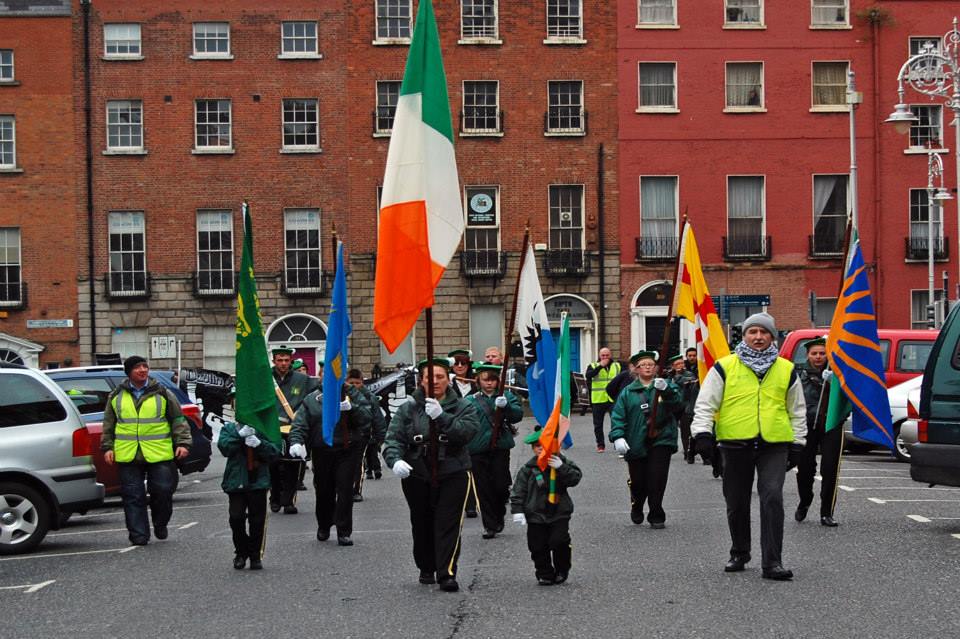
Broad Cospito Solidarity Picket at Dublin Italian Embassy

Ireland Anti-Internment Campaign

(Reading time: 3 mins.)

A picket outside the Italian Embassy in Dublin on Thursday (23rd) was part of a day of action across Europe in solidarity with an Anarchist prisoner on hunger strike since October in a struggle for more humane prison conditions.

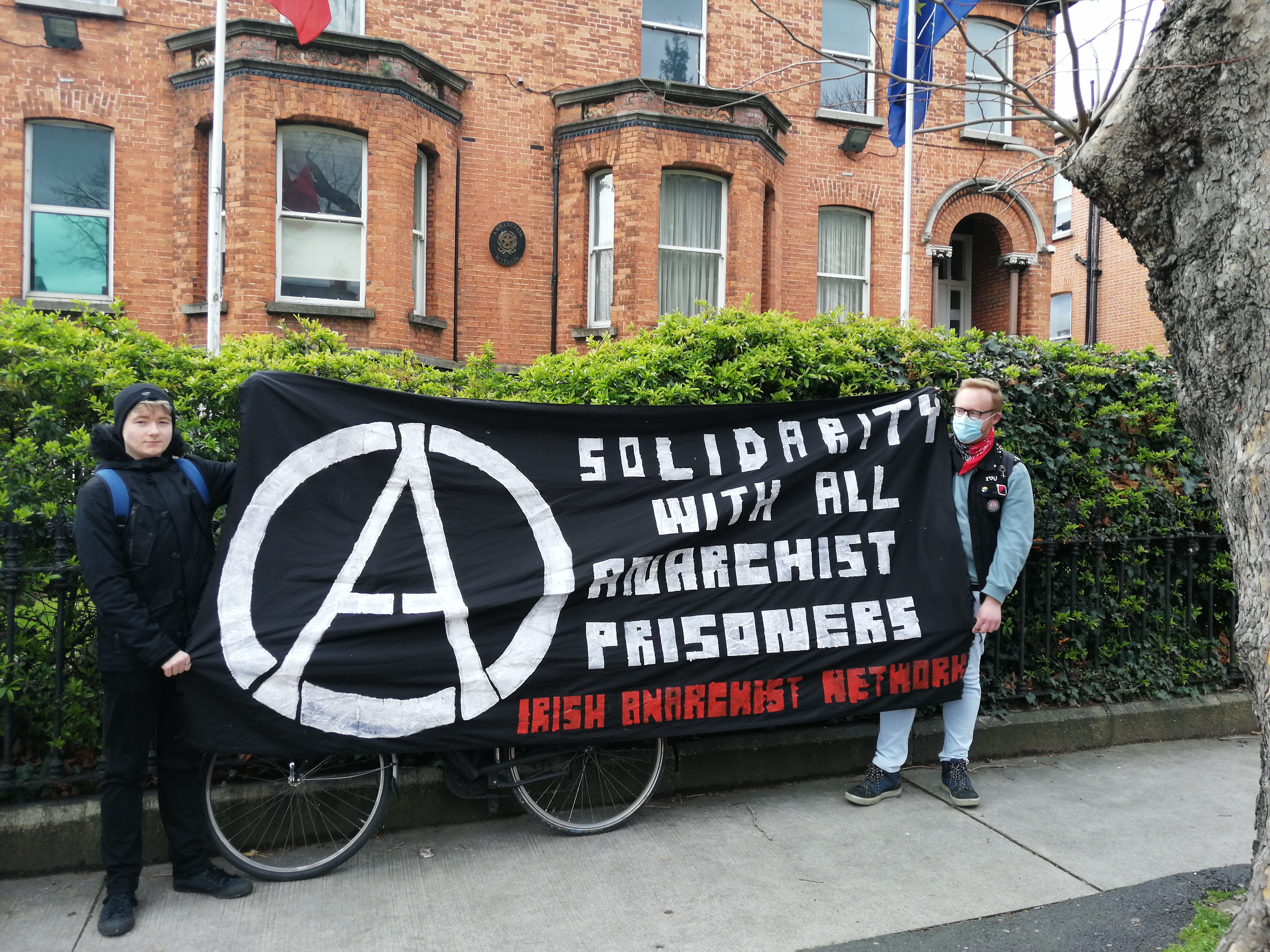
The picket, organised at short notice, included Irish Republicans, Anarchists and revolutionary Socialists. Banners and placards indicated the presence of Saoradh, Irish Anarchist Network and Ireland Anti-Internment Campaign.

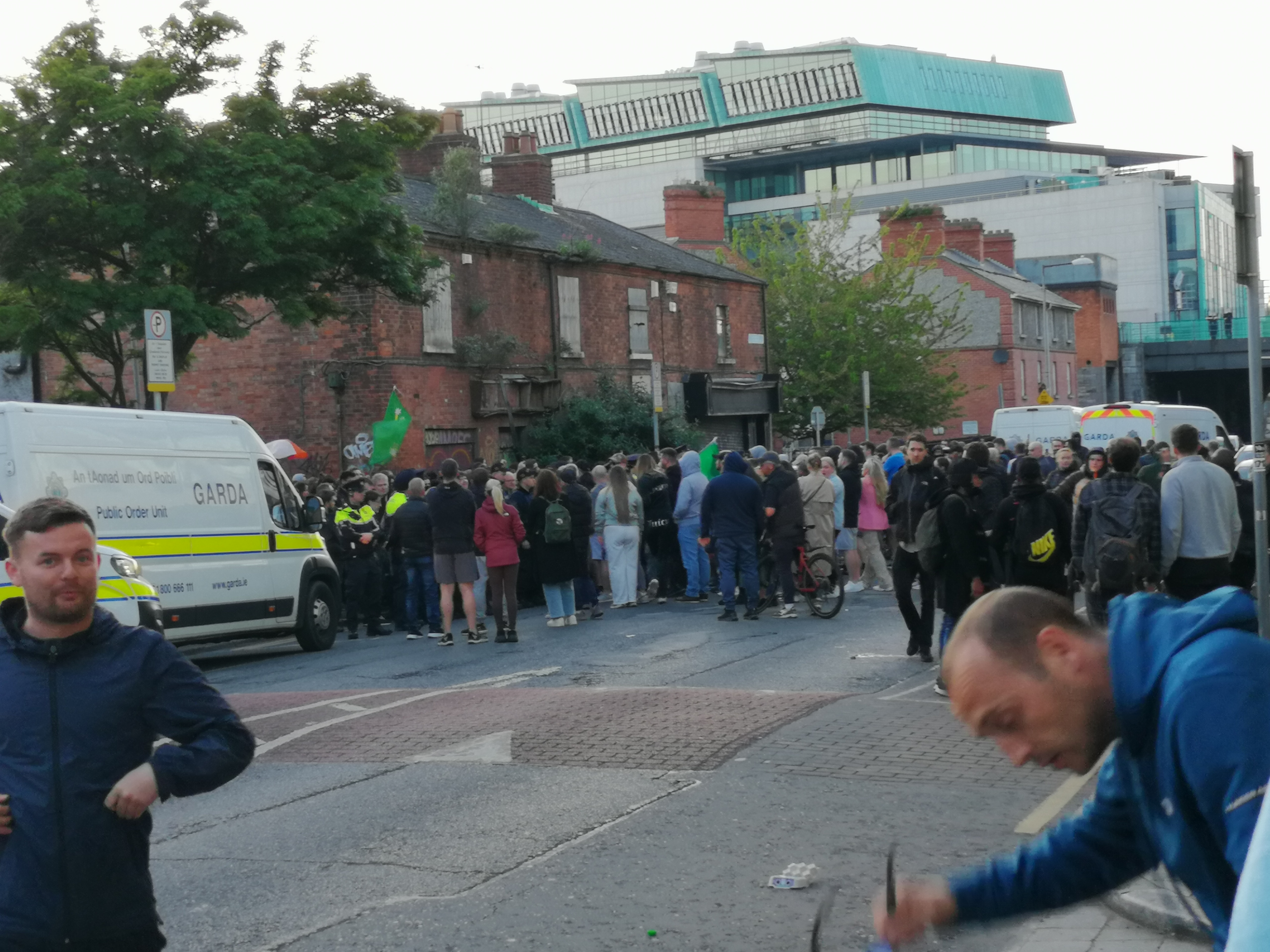
At one point five uniformed Gardaí stood near the Embassy’s gate while three plain-clothes Special Branch (i.e. political police) watched from a car across the road. The police numbers may have been due to a request from the Embassy in the midst of attacks on some Italian Embassies in Europe.

Despite the presence of Gardaí, Embassy staff appeared nervous, meeting one visitor at the gate to check her reason for attendance after speaking to her on her mobile phone, rather than first allowing her to enter the garden and approach the main entrance.

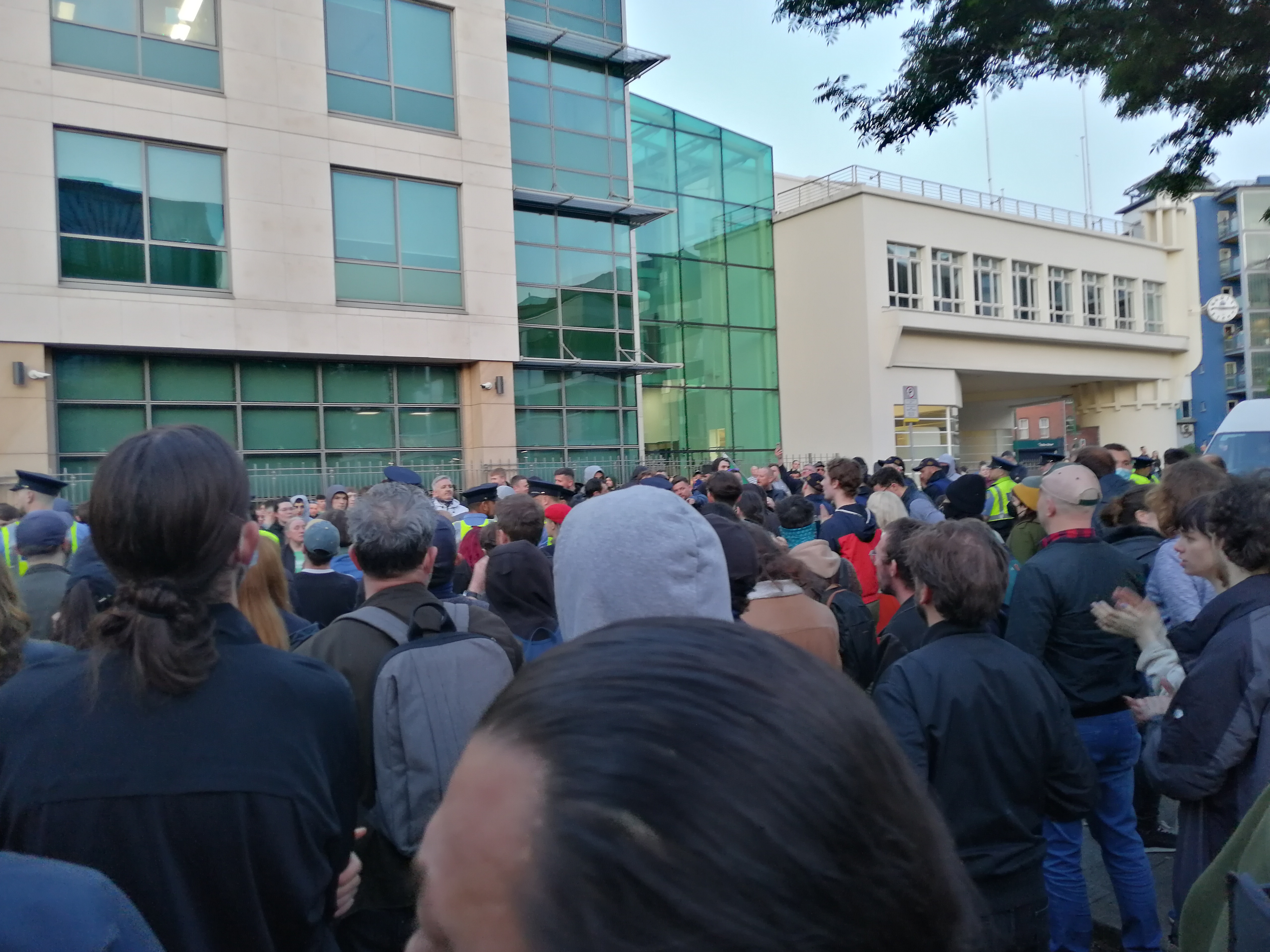
Some of the uniformed Gardaí attending the solidarity picket and some of the protesters. (Photo: IAIC)
Three Special Branch Gardaí (political police) parked across from the picketers, surveilling them (Photo: IAIC)

THE HARSHEST ITALIAN PRISON CONDITIONS

Alfredo Cospito is an Italian political prisoner kept under the harshest Italian prison conditions, “41-bis”, which include solitary confinement for most of the day, family visit once a month through glass, no reading matter sent from outside and no phone calls in either direction or lawyer privacy.

According to information on the Internet, these inhumane conditions were developed for Mafiosa leaders, in order to prevent them running their organisations from inside jail and also to pressure them into breaking ranks and informing on their colleagues.

Whatever we may say about that, what can be the intention of subjecting a political prisoner to those conditions, except to break him or to destabilise him mentally? EU recommended rules on prisoner management don’t recommend more than three weeks in solitary confinement.

Lawyers for political prisoner Nadia Lioce, who has been living under the 41-bis regime for two decades, have said due to limited hours permitted contact, she has effectively only interacted with people for a total of 15 hours in the space of a year.

Italian media reported Lioce’s lawyers as saying she is now so “psychologically isolated” that, when her mother and sister visit, she is unable to speak to them for more than a few minutes.

Some of the picketers, the Italian Embassy in the background (Photo: IAIC)

Amnesty International and the European Court of Human Rights have both criticised several aspects of the 41-bis, and in 2007 a US court refused to extradite a convicted Mafia drug trafficker on the grounds that the 41-bis regime he would face in Italy would have “constituted torture”.

The Anti-Imperialist Front gave a call for an international solidarity day of action which found an active response in many countries.

Alfredo Cospito’s case is up for review by the Italian prison system this month and pickets and other actions have been organised around Europe to exert pressure on the Italian penal authorities to release Cospito into house arrest in his sister’s home.

The picket displayed not only internationalist solidarity but exemplary broad unity of disparate political forces in solidarity with an Anarchist political prisoner. Hopefully this unity will continue to be built upon as time goes on, for the unfolding struggles of class and nation demand it.

Hopefully the international actions will cause the Italian authorities to relax the inhumane conditions of Alfredo Cospito’s incarceration but now Italian authorities are claiming that Cospito is somehow coordinating violent actions from within his extreme isolation.

Another two of the picketers (Photo: IAIC)

A side trip into history

The Italian Embassy is in Northumberland Road, on the south side of the Grand Canal (near the Israeli and US Embassies).

As they were leaving, some of the picketers took time to look at a plaque and monument to the Mount Street Bridge Battle between Irish Volunteers and British soldiers in 1916. Four Volunteers were killed and between 26 and 30 Sherwood Foresters, with 134 more wounded.

Mount Street Battle Monument, on the Bridge over the Grand Canal itself. The English explanation is on the reverse. (Photo: IAIC)

A number of Volunteers were captured but a number got away also. Two of the buildings from which the Volunteers fought remain, bearing the marks of bullet strikes. The third, Clanwilliam House was set on fire by the British and was replaced by a 1960s-type office building later.

End.
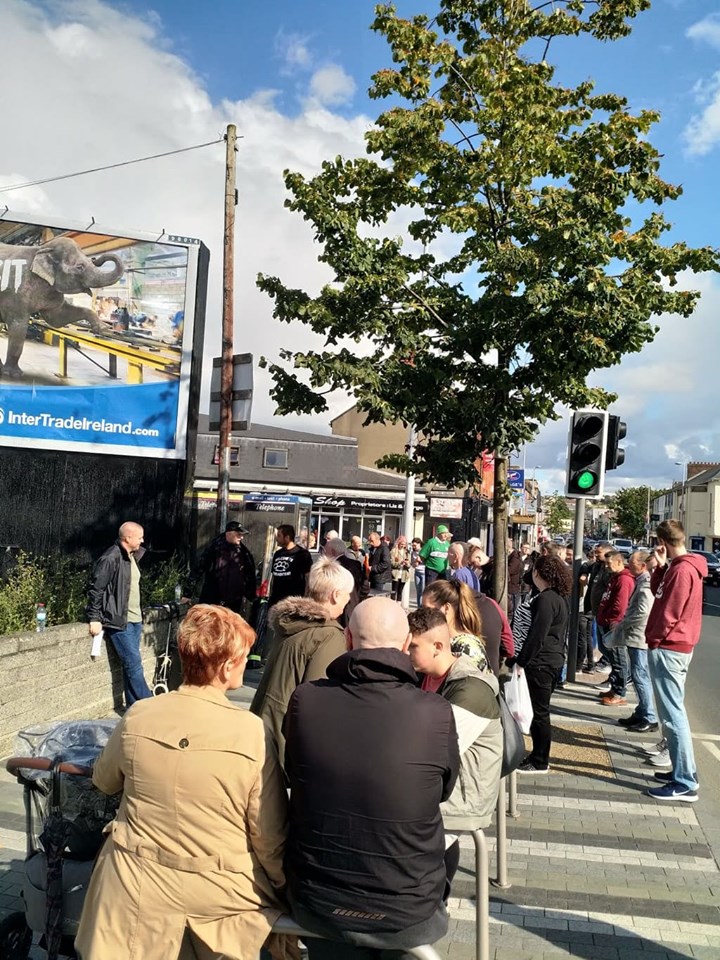
(Photo: IAIC)

Sources

Alfredo Cospito: Hunger-striking Italian anarchist moved amid protests – BBC News

FS_Prisoners_health_ENG (coe.int)

THOUSANDS MARCH IN BILBAO AGAINST NATO, WAR AND FASCISM

Manifesto of the organisers: Askapena1, NATOren eta EBren Aurkako, Herri Ekimena and Bardenas Ya
(Translated from Castilian version by D.Breatnach)

(Reading time total: 6 mins. including Comment)

We began the previous manifesto talking about emergencies. We said that it was essential to reclaim an anti-imperialist and internationalist Euskal Herria2.

And that urgency, that need, is what has brought together comrades from all corners of Euskal Herria here today. Well done all of us!

Capitalism is going through a systemic crisis. They speak to us of a “extraordinary period” but the truth is rather that we find ourselves in a permanent crisis. As we have supposedly departed one, they have already placed us in another.

As of 2020, moreover, we have entered a phase of exceptionality in which States take advantage to impose economic, social and disciplinary policies that point towards a war scenario. Therefore, we cannot separate the capitalist decomposition from the increase in repression and censorship.

Banner reading “Condemning us to war and misery” and section of the anti-NATO march in Bilbao 11 March. (Photo sourced: organisers)

The rise of fascism that is taking place throughout Europe is a direct consequence of the bourgeoisie’s fear of losing the control it exercises over an increasingly exploited and angry population.

In the field of international relations, we are also witnessing the increasing loss of hegemony of the Empire that has controlled the world practically without opposition for the last 30 years.

The bloc led by the United States and NATO, far from accepting the end of its historical cycle, seems determined to increase armed conflicts. In addition to giving a boost to the arms industry, they intend to hinder the growth of emerging powers such as China or Russia.

For this phase of confrontation, they have finally achieved the support of the lobby led by Ursula Von der Layen, the “gardener” Borrell3 and company.

NATO and the EU, together with the Zionist entity that redoubles its attacks on the Palestinian people, are today the main props of this dark period in history.

As far as NATO is concerned, we have to understand that its role goes beyond being a mere military organization. It is true that it is mainly the army of the bourgeoisie (and it is demonstrating this in Donbass, as it has also demonstrated in Yugoslavia, Libya or Syria).

But it has the superior function of being the military arm against anyone who opposes the policies of capital. Today these translate into the over-exploitation and precarity of the working class (especially women and people of colour).

And changes in labour rights to deprive us of material concessions wrested through class struggle, change of laws to increase the repression of those struggles, etc.

A clear example of this is the latest General Budget of the Spanish State, supported by all the social democratic parties4.

The budget supports the deterioration of the material conditions of working peoples to benefit NATO, giving it more control capacity and recognizing their right to appropriate civil infrastructures to defend the interests of the bourgeoisie.

The support for these militaristic policies, at the dawn of a world war, is a real shame and demonstrates the total lack of commitment of the leadership of these parties to the future of the Working Peoples of the world.

In Euskal Herria we are well aware of what NATO represents:

in addition to the military training industrial estate in Las Bardenas or the military exercises carried out at the Araka base (Gasteiz), we have recently witnessed blatant support from the Government of Gasteiz for war industries such as SENER or SAPA.

Nor can we forget the historical support of NATO, through the Gladio network, to the Spanish and French States in their legal and illegal repression5 against the struggle in Euskal Herria.

If we add to this the economic and social exception measures imposed on us by Brussels (private pension funds, increase in the retirement age, dismantling of public health) …

It becomes increasingly clear to us that neither as a nation nor as working class do we have a future within NATO or the EU. The need to destroy these instruments of domination by the bourgeoisie, as well as the Spanish and French States, is more than evident if we aspire to build a future in freedom.

These are not good times, of course not. The situation is becoming more and more complicated throughout the world. And that is why we here today are calling for the activation in each town and each neighborhood of the anti-imperialist Euskal Herria.

Thirty-seven years ago we said “NO to NATO!”6

Today, we not only reaffirm this rejection, but we once again make an urgent call to join forces with the rest of the working peoples and oppressed nations of the world to stop the imperialist offensive promoted by this criminal organization along with its allies in the European Union.

From Chile to Donbass, passing through Laos, Mali or Vietnam…

LONG LIVE THE STRUGGLE OF THE WORKING PEOPLE!

AN ANTI-IMPERIALIST BASQUE COUNTRY!

Front of march heading towards the Bridge across the Nervión river and the old city (Photo sourced: organisers)

COMMENT: A GIANT STEP FORWARD

Diarmuid Breatnach

(Reading time: One min.)

The estimated 2,000 turnout in support of this demonstration must have exceeded the expectations of the organisers and greatly encouraged them. Two thousand is not a huge number in the highly-politicised Basque Country, even with a total population of less than three million, north and south.

But this is a nation which has for decades been under a political leadership, the surviving members of which have now taken the road of pacificaction, of accommodation to capitalism and the Spanish and French states, of social-democratic ‘opposition’.

This movement had a united national political leadership, an armed guerrilla movement, a daily newspaper, a trade union and smaller affiliated groups; it had café/bars/social centres throughout the southern provinces.

Though in decline and fragmented with the leadership’s embracing of the pacification process (through which, unlike the Provos, they did not even gain the release of their hundreds of imprisoned comrades), it still exercises a heavy influence on politics in the Basque Country.

That is today the ambit of Otegi, EH Bildu and Geroa Bai and neither did their parties participate in Saturday’s demonstration nor as an individual any of senior responsibility in their structures, though certainly individuals in their social and cultural sectors were seen in the march.

In that context and after 25 years of pacification, 2,000 in open attendance is a giant step forward for the Basque resistance. ‘Tús maith, leath na hoibre‘, it is said in Irish: ‘A good beginning is half the work’ and indeed, a beginning is how the organisers view the event.

“Dissident” groups such as Amnistia ta Askatasuna, Amnistia Garrasia, Tinko and Jardun have arisen in the last decade and youth have been very prominent in these and others disparate groupings, which is important for any revolutionary movement.

The photos and videos of Saturday’s demonstration show older and mature faces too, veterans of the struggle and also those active during the pacification period and this too is important, for it brings a certain continuity to the movement and the awareness of mistakes made in the past.

More than 50 organisations in the Basque Country supported the call for this demonstration.

The road ahead will not be easy (when has it ever been for the Basque nation or the working class in general?) but a giant step forward has been taken.

End.
FOOTNOTES

1Askapena is the internationalist arm of the Basque movement for independence and was responsible for a number of years for maintaining a network of Basque solidarity organisations (which in some cases it founded) in Mexico and across a number of European cities, including Belfast, Dublin and Cork. In 2011 five of its leading activists were arrested on charges of supporting the guerrilla organisation ETA, through Askapena’s solidarity with political prisoners. The five defended their right to work with prisoner and internationalist solidarity and were finally acquitted in 2016 earning much admiration for their stance (in stark contrast to the 47 activists in a number of prisoner support organisations who apologised for their activity in a Spanish court in September 2019 in exchange for non-custodial sentences for the majority).

2The current Basque name for their nation, “the Basque-speaking country”, replacing the former “Euskadi”, now used to refer only to the three-province ‘autonomous’ region of Bizkaia, Araba and Gipuzkoa.

3Josep Borrell, Foreign Minister of the EU Parliament who has described the EU as “a garden”. A Catalan member of the PSOE, hostile to Catalan independence who after five minutes stormed out of an English-language interview by Tim Sebastian on the German TV program Conflict Zone regarding the struggle in Catalonia.

4This is a reference not only to the social-democratic coalition government of the PSOE and Podemos but also of the Basque EH Bildu and Catalan ERC, the votes of which MPs supported the Budget.

5A reference not only to banning of parties, organisations and demonstrations but also to routine torture and the kidnapping and assassinations of the State-sponsored GAL of the 1980s.

6In the 1986 Referendum on whether the Spanish state should join NATO, the southern Basque Country gave a majority vote against, the only region to do so (though the vote against was high in some regions), the total vote being 52.54% in favour.

SOURCES

2022: Busy Year for the Ireland Anti-Internment Campaign

Ireland Anti-Internment Campaign

(Reading time main text: 5 mins.)

2022 was a busy year for the anti-internment campaign organisation, involving, along with its public awareness-rising events, a reorganisation with a new constitution, a new name and expansion of membership.

Origins

The formation of an anti-internment campaign was sparked by the revoking of the licence of ex-political prisoner Marian Price in May 2011 for the “crime” of steadying the written speech of an IRA speaker during a windy Easter Rising commemoration in Milltown Cemetery, Belfast.

In addition to revocation of the licence under which Republican prisoners were released under the Good Friday Agreement, other activists were also being charged under “anti-terrorist” legislation and routinely being refused bail, if not granted it under severe restrictions.

The wait for a trial is often two years and regardless of the eventual outcome, the individuals had already spent two years in jail or at home, barred from travel or political activity and harassed by police visits to their homes.

Early banner-placard protesting the internment of Marian Price (Image sourced: Libcom.org)
Front section of Anti-Internment March, coming into top part of Parnell Square, Dublin 2013. (Image sourced: IAIC archives)

These conditions were considered to be in effect the same as internment without trial and the campaign against internment was founded as an independent one, a status it maintained despite a number of attempts to take it over or to intimidate with threats and State harassment.

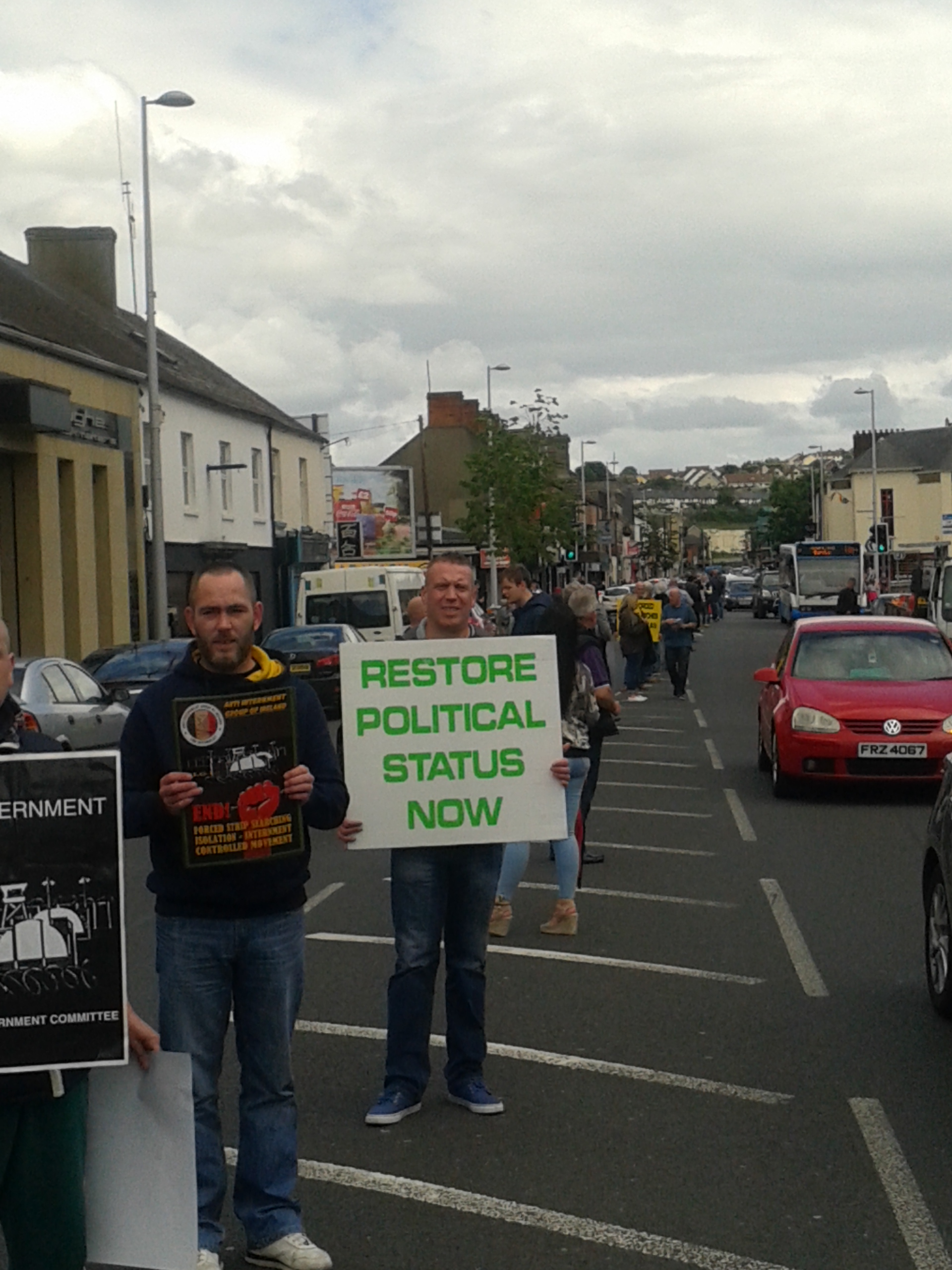
Throughout its history the Anti-Internment Campaign has organised the annual Newry event (not since 2021 unfortunately), many pickets (including in protest against Amnesty Ireland) and a march in Dublin, spoken at or participated in public events in Belfast, Cork, Derry, Glasgow and Wexford.

It has also organised and hosted conferences and public meetings, for example with speakers from the campaigns for the Craigavon Two, Munir Farooqi and Tony Taylor and about the Right to Protest with a speaker from the Irish Council for Civil Liberties.

Section of the annual Anti-Internment white-line picket Newry, August 2016 (Image sourced: IAIC archives)
Annual Anti-Internment, Newry, rallying after white-line picket, August 2019 (Image sourced: IAIC archives)

A busy year

As stated in the introduction above, 2022 was a busy year for the anti-internment campaign group, involving, along with its public awareness-rising events a reorganisation with a new constitution and a new name. The campaign organised nine public events and participated in more.

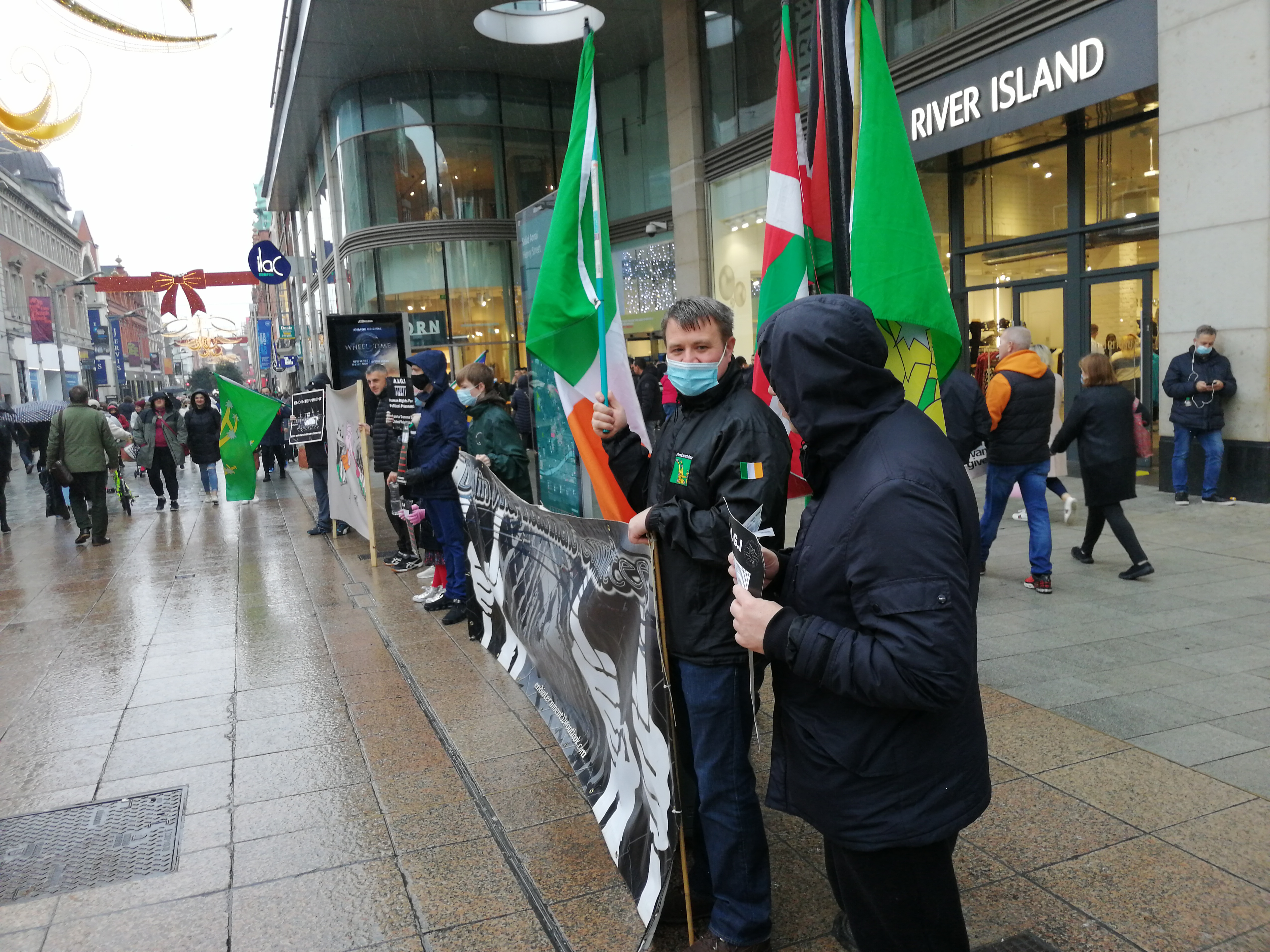
Most of those public events were awareness-raising pickets with placards, banners, flags and leaflet distribution. Usually the pickets alternated between the Henry Street/ Liffey Street junction and at Crown Alley by the square in the Temple Bar area, both areas busy with shoppers and tourists.

Anti-Internment picket in Henry Street, November, Dublin 2022 (Photo: IAIC)

The campaign carried out pickets in Henry Street on 9th April, 6th August and 19th November and in Temple Bar on 5th March, 21st May, 2nd July and 27th August. On 22nd October, with a special focus on Palestinian prisoners, we were on the iconic Ha’penny Bridge.

It has always been of particular interest to the campaign group to reach working people and large numbers of that class of all ages pass through those areas. Of interest also are people from other lands and the Basque and Palestinian flags alongside the Irish ones often stimulate discussion.

In September the campaign attended the Peter Daly commemoration in Wexford and provided a speaker at the Dublin meeting to re-launch the End State Repression campaign which our group had supported in the past but which had waned over the Covid epidemic period since.

Our campaign group also took part in the planning of and participation in the joint prisoner’s solidarity picket in Dublin on 17th December 2022.

Reorganisation

It had been clear for some time that the organisation was in need of reorganisation to facilitate expansion but the process had been difficult.

Eventually in July the decision was taken to close down the Anti-Internment Group of Ireland and to reform under another name. This was done and, after democratic consultation process a new constitution was agreed, with the Ireland Anti-Internment Campaign as the new name.

According to agreed decisions, a new banner with the organisation’s new name was commissioned (though it would take some time to come to fruition). A new Facebook identity for the group was constructed with a statement explaining the development.

The new constitution, more explicitly democratically-based than had been previously the case, was published.

Anti-Internment picket in Temple Bar, Dublin, March 2022 (Photo: IAIC)

Year planning

In the reorganisation process, the IAIG lost one member but gained three new activists and the return of two lapsed members. With renewed energy, members began planning for the rest of the year, to conclude with participation in the annual Bloody Sunday March for Justice in Derry.

Issuing a statement to explain the reorganisation, commissioning a new banner, scheduling a number of pickets in Dublin and organising the annual Prisoners’ Solidarity Picket in Dublin December were part of the planning and most of the target actions were completed.

In December and in good time, the campaign’s members organised to purchase, sign and mail Christmas cards to all Irish Republican prisoners, also a number of non-complying Basque political prisoners and the Catalan jailed revolutionary Catalonian rapper Pablo Hasel.

The proposal to organise the annual Prisoners’ Solidarity picket in December jointly with the Irish Republican Prisoners’ Welfare Association and with Ireland Anti-Imperialist Action was agreed and the joint event went ahead on 17th December with around 40 participating.

Section of the joint AICI, AIA and IRPWA Republican Prisoners’ solidarity picket 17 December 2022, O’Connell Street, Dublin 2022 (Photo: IAIC)

The picket with placards and banners, including the illuminated words of the IAIC’s “SAOIRSE” (“Freedom”) attracted attention and passers-by, both Irish and from abroad engaged leafleters and other participants in discussion. A speaker from each group gave a short statement.

The year’s programming ended with the specific scheduling of participation with a new banner in the annual Bloody Sunday March for Justice in Derry.

New Banner Aired at Bloody Sunday March for Justice in Derry

The new banner got its first public airing at the annual march in Derry, commemorating the massacre of unarmed civilians by the British Army in Derry in January 1972 and was carried as part of the march from the Creggan, through a large part of Derry and down to Free Derry Corner.

The marchers in different political parties, campaign organisations and independent individuals marched trough cold rain and strong wind-gusts through the nearly 5-kilometre walk. The members of four Republican Flute Bands played bravely throughout.

The new banner of the Ireland Anti-Internment Committee carried in the Bloody Sunday March for Justice in Derry in January 2023. (Photo: IAIC archives)

The IAIC will shortly begin its year-planning for the rest of the year, its calendar again probably ending at 2024’s Bloody Sunday March for Justice and meanwhile organising events to publicise the on-going undemocratic jailing of activists without trial both sides of the British Border.

The IAIC considers that the jailing of people without trial by both administrations is, in addition to political repression, a significant assault on civil rights and a threat to all opposition groups and that it is in the interests of all to unite in opposing the practice.

The Campaign welcomes the active support of all democratically-minded individuals at its public events.

End.

USEFUL LINK

Ireland Anti-Internment Campaign:https://www.facebook.com/profile.php?id=100063166633467

MENSAJE SOLIDARIO CON LOS PRESOS DES DE CONCENTRACIÓN EN DUBLIN

Clive Sulish

(Tiempo en leer: un minuto)

Los compradores navideños del sábado 17 en la calle O’Connell de Dublín, el bulevar principal de la ciudad, estaban interesados en ver una larga línea de piquetes que exhibía pancartas, banderas y pancartas.

El evento fue un recordatorio público organizado conjuntamente de la existencia continua de presos políticos en Irlanda y también un gesto de solidaridad con los presos.

Los organizadores conjuntos fueron la Campaña Antiinternamiento de Irlanda, la Asociación de Bienestar de lxs Presxs Republicanxs Irlandesxs y la organización Acción Antiimperialista. La asistencia fue en su mayoría republicanxs irlandesxs, pero también hubo algunos de las tradiciones socialistas/anarquistas presentes.

Larga fila mirando hacia el sur del evento conjunto de solidaridad con lxs presxs republicanxs (Foto: Rebel Breeze)

Actualmente hay 40 presos republicanos irlandeses en cárceles en Irlanda, entre ambos lados de la frontera británica. Como señaló un orador al final, todos habían sido condenadxs – o se les había denegado la libertad bajo fianza – por tribunales especiales sin jurado de los estados irlandés y británico.

Por supuesto, se exhibieron el Tricolor Irlandés y el Arado Estrellado, pero también una bandera palestina y dos vascas; este último llamó la atención de varios jóvenes del estado español que se mostraron complacidos y se acercaron a los piqueteros para conversar.

Sección del evento conjunto de solidaridad con los presxs republicanos que muestra la caricatura de Latuff en una pancarta (Foto: Rebel Breeze)
Sección del acto solidario conjunto de presxs republicanos que muestra un par de banderas vascas y una palestina a media distancia (Foto: Rebel Breeze)

Dos pancartas pedían el fin de la extradición de lxs republicanxs irlandesxs y una ilustraba la ilustración de solidaridad entre lxs presoxs políticxs irlandesxs y palestinxs del caricaturista Carlos Latuff.

Se repartieron folletos de la IRPWA y de la IAIC a los transeúntes.

Sección del evento conjunto de solidaridad con los presos republicanos (Foto: Rebel Breeze)

Cuando el evento llegó a su fin, un representante de cada grupo organizador leyó una breve declaración; tanto la IAIC como la AIA enfatizaron la necesidad de unidad para resistir la represión y cada una junto con la IRPWA pidieron apoyo para los presos republicanos irlandeses.

Final.

“SAOIRSE” (“Libertad”) en luzes (Foto: Rebel Breeze)
mde

SEASONAL SOLIDARITY GREETINGS SENT TO IRISH POLITICAL PRISONERS FROM DUBLIN PICKET LINE

Clive Sulish

(Reading time: one minute)

Christmas shoppers on Saturday 17th in Dublin’s O’Connell Street, the city’s main boulevard, were interested to see a long picket line displaying banners, flags and placards.

The event was a jointly-organised public reminder of the continuing existence of political prisoners in Ireland and as a gesture of solidarity to the prisoners too.

The joint organisers were the Ireland Anti-Internment Campaign, the Irish Republican Prisoners Welfare Association and the Anti-Imperialism Action organisation. The attendance were mostly Irish Republicans but there were also some from the socialist/ anarchist traditions present.

Long line looking southward of joint Republican prisoners’ solidarity event (Photo: Rebel Breeze)

There are currently 40 Irish Republican prisoners in jails in Ireland, on both sides of the British Border. As a speaker noted at the end, all had been sentenced or refused bail by no-jury special courts of the Irish and British states.

The Irish Tricolour and the Starry Plough were displayed of course but also a Palestinian flag and two Basque ones; the latter attracted the attention of a number of young people from the Spanish state who were pleased and approached the picketers for discussion.

Section of the joint Republican prisoners’ solidarity event showing the Latuff cartoon on a banner (Photo: Rebel Breeze)
Section of the joint Republican prisoners’ solidarity event showing couple of Basque flags and Palestinian one in the middle distance (Photo: Rebel Breeze)

Two banners called for and end to the extradition of Irish Republicans and one figured cartoonist Carlos Latuff’s illustration of solidarity between Irish and Palestinian political prisoners.

Leaflets of the IRPWA and of the IAIC were distributed to passers-by.

Section of the joint Republican prisoners’ solidarity event (Photo: Rebel Breeze)

As the event came to an end a representative of each organising group read out a short statement; both the IAIC and the AIA emphasised the need for unity in resisting repression and each along with the IRPWA called for support for Irish Republican prisoners.

End.

Section of the joint Republican prisoners’ solidarity event (Photo: Rebel Breeze)

NOT “LA QUINTA” — THE INTERNATIONAL BRIGADE WAS THE FIFTEENTH

Diarmuid Breatnach

(Reading time main text: 2 mins.)

We see and often hear “viva la Quinta Brigada” but this is usually a mistake – the reference is not to the Fifth but to the 15th International Brigade. The word for fifteen in Spanish is “quince”1 whereas “quinta” means “fifth”. The brigade being referred to, the Fifteenth International Brigade, was one formed at the instigation of the Communist International (Comintern) in 1936 from volunteers from more than 55 countries2.

The estimates of numbers of participants in the International Brigades range from 40,000 to 59,000 with a death toll of around 10,0003 and of course many more injured.
Not all the Irish-born and Irish diaspora antifascists who fought4 in what is called the Spanish Antifascist (or Civil) War fought in the 15th Brigade5 but most of them did, whether in the British, Commonwealth or US Battalions (“Abraham Lincoln” and “Washington”, later combined), chiefly because these were the English-speaking battalions of the 15th International Brigade, which also included specific battalions for French, German, Italian, Spanish (from Mexico, Caribbean and Latin America) Czechoslovak, Hungarian and Polish languages6.

International Brigaders crossing the Ebro for the battle. The one in the bows of the boat appears to be Irish communist Michael O’Riordan, carrying the Senyera, the recognised Catalan flag of its time (red and yellow stripes without a star). O’Riordan survived the Civil War and returned to Ireland to lead the Communist Party of Ireland. (Image sourced: Internet)

The familiar songs in English were always about the 15th International Brigade, no other. So why and how has this mistake arisen of referring to the 5th?

The chief transmission of this error in recent time has been through that song with the wonderful lyrics and air created by the Irish balladeer and most famous folk performer, Christy Moore.

And he called his song “Viva La Quinta Brigada”. Recorded and performed under that title, with numerous videos repeating the error, even though he has himself corrected the reference in later performances.7 And in fact there are a number of Quinta Brigada versions of the Ay Carmela song on Youtube. So we can hardly blame all those people who are now singing the incorrect version, can we?

But before we arraign Comrade Christy Moore before a People’s Tribunal, it’s worth looking at the longer process of the error’s transmission. In fact, the incorrect wording was around long before Christy composed his song and it almost certainly informed his lyrics.

TRACING THE ERROR: THE AY CARMELA SONG AND SPIN-OFF

I remember thinking one time, when I became aware of the error in the title and refrain, that Christy should have consulted some Spanish-speaking people in Ireland. But I and my siblings are all Spanish-speaking and I recall even some of us singing a different song with a repeated line: Viva la Quinta Brigada, rumba la rumba la rumba la.

We were Spanish-speaking, yes and very sympathetic to the Republican side in that war — but at that time clearly not clued enough historically to detect the error,

That Rumba la rumba etc was a song in Spanish from the Republican side in the Civil/ Antifascist War, itself a spin-off or readaptation of a Spanish folk song about the crossing of the Ebro against Napoleonic troops in the 1800s. In this case the adaptation was fashioned to record the Republican forces’ crossing of the same river in attack on the advancing military-fascist forces in 1938.

The Battle of the Ebro was the largest ever fought on Spanish soil and lasted from 25th July to 16th November. The International Brigade song to the same air is generally known as Ay Manuela! and clearly refers to the International Brigade, not only by the lyrics in the final verse but by its alternative title, Viva La Quince Brigada!

Somewhere along the line someone made the error of replacing the Quince with Quinta. And so when Christy came to write his wonderful tribute to the Irish who went to the Spanish territory to fight against the fascist-military coup, the mistaken name had already been current for decades.

Re-enactment with partipants playing the parts of soldiers of the Spanish Republic advancing in the Battle of the Ebro. (Image sourced: Internet)

CORRECTING IT NOW

So no-one to blame for repeating the error and whoever caused it originally is long in the past. But we are here now and we know – so we have a responsibility not to perpetuate the error. We can do this quite simply in three ways:

  • Call the song “Viva la Quince8 Brigada” on all occasions
  • If we sing it, replace Quinta with Quince in the lyrics
  • Inform others about the correct version

End.

FOOTNOTES

1Fifteenth is “decimoquinta” in Castillian (Spanish) but, that being five syllables and therefore three too long for the song, “quince” (fifteen) must be sung instead.

2One of the many sources gives the figure of “55 Countries” but that probably means “55 states” and a number of states such as the UK, France, Belgium and Russia in Europe contain other nations, as do China, states in the Middle East, etc. In addition, many Jews also fought, one estimate putting them at one-quarter of the total of the “Brigadistas”.

3The very high casualty rate had a number of contributory factors but chief among them was the superiority of war-machines on the fascist-military side, in particular of aircraft, most of which were supplied, with pilots, by fascist Italy and Nazi Germany, while Britain and France blockaded Spain.

4Some served as paramedics also.

5Some fought as part of the POUM, largely Trotskyist antifascist organisation or may have fought in anarchist militia and one that we know of fought alongside the Basques (and gave his life there).

6There were other language groups but their numbers did not usually rate a whole battalion and they were integrated into battalions primarily of some other language.

7And even later still, amended the historically incorrect “the bishops blessed the Blueshirts in Dun Laoghaire

8Pronunciation guide for Quince: keen-the or keen-se.

9I’ve translated Ay! as Oh! but it’s more like Alas!, only hard to see that in the song’s context perhaps.

10I’ve translated Ay as Oh but it’s more like Alas, only hard to see that in the song’s context perhaps.

11The “Moors” were native North African troops raised by Spain’s Foreign Legion. Franco had been sent there by the Republican Government probably to get him out of the way after his ferocious suppression of the Asturias miners’ revolt. From there Franco’s troops were airlifted to the Canary Islands and from there to Andalucia in southern Spain, carving their way in the blood of mostly unarmed civilians.

SOURCES

The original Ay Carmela/ Viva la Quince Brigada song: ¡Ay Carmela! (song) – Wikipedia

Lyrics of the original Viva La Quince Brigada as sung by Pete Seeger: Pete Seeger – Viva la Quince Brigada Lyrics | Lyrics.com

The 15th International Brigades: International Brigades – Wikipedia

Battle of the Ebro – Wikipedia

APPENDIX – THE SONGS

Ay Carmela – Spanish Republican version

Ay Carmela

El Ejército del Ebro,
Rumba la rumba la rumba la.
El Ejército del Ebro,
Rumba la rumba la rumba la
Una noche el río pasó,
¡Ay Carmela! ¡Ay Carmela!
Una noche el río pasó,
¡Ay Carmela! ¡Ay Carmela!

The Army of the Ebro, rumba la rumba la, rumba la etc
One night crossed the river, Oh9 Carmela, Oh Carmela!

Y a las tropas invasoras,
Rumba la rumba la rumba la.
Y a las tropas invasoras,
Rumba la rumba la rumba la
Buena paliza les dio,
¡Ay Carmela! ¡Ay Carmela!
Buena paliza les dio,
¡Ay Carmela! ¡Ay Carmela!

And to the invading troops rumba la rumba la, rumba la etc
Gave a good beating, Oh Carmela, Oh Carmela!

El furor de los traidores,
Rumba la rumba la rumba la.
El furor de los traidores,
Rumba la rumba la rumba la
Lo descarga su aviaciónes,
¡Ay Carmela! ¡Ay Carmela!
Lo descarga su aviaciónes,
¡Ay Carmela! ¡Ay Carmela!

The fury of the traitors, rumba la rumba la, rumba la etc
Is dropped from their ‘planes, Oh Carmela, Oh Carmela!

Pero nada pueden bombas,
Rumba la rumba la rumba la.
Pero nada pueden bombas,
Rumba la rumba la rumba la
Donde sobra corazón,
¡Ay Carmela! ¡Ay Carmela!
Donde sobra corazón,
¡Ay Carmela! ¡Ay Carmela!

But bombs have no power, rumba la rumba la, rumba la etc
Where exists excess of heart, Oh Carmela, Oh Carmela!

Contraataques muy rabiosos,
Rumba la rumba la rumba la.
Contraataques muy rabiosos,
Rumba la rumba la rumba la
Deberemos resistir,
¡Ay Carmela! ¡Ay Carmela!
Deberemos resistir,
¡Ay Carmela! ¡Ay Carmela!

Ferocious counterattacks, rumba la rumba la, rumba la etc
We must resist, Oh Carmela, Oh Carmela!

Pero igual que combatimos,
Rumba la rumba la rumba la.
Pero igual que combatimos,
Rumba la rumba la rumba la
Prometemos resistir,
¡Ay Carmela! ¡Ay Carmela!
Prometemos resistir,
¡Ay Carmela! ¡Ay Carmela!

But as we fight, rumba la rumba la, rumba la etc
We promise to resist, Oh10 Carmela, Oh Carmela!

Ay Manuela!/ Viva La Quince BrigadaInternational Brigades version in Spanish

Viva la quince brigada,
-Rumba, la rumba, la rumba, la-,
Viva la quince brigada,
-Rumba, la rumba, la rumba, la-,
Que sea cubierta de gloria
Ay Manuela, ay Manuela!
Que sea cubierta de gloria
Ay Manuela, ay Manuela!

Long live the fifteen(th) Brigade
-Rumba, la rumba, la rumba, la etc
May it be covered in glory,
-Rumba, la rumba, la rumba, la etc.

Luchamos contra los moros
-Rumba, la rumba, la rumba, la-,
Luchamos contra los moros
-Rumba, la rumba, la rumba, la-,
Mercenarios y fascistas
Ay Manuela, ay Manuela
Mercenarios y fascistas
Ay Manuela, ay Manuela

We fight against the Moors11
-Rumba, la rumba, la rumba, la etc
Mercenaries and fascists.
-Rumba, la rumba, la rumba, la etc,

En el frente de Jarama
-Rumba, la rumba, la rumba, la-,
En el frente de Jarama
-Rumba, la rumba, la rumba, la-,
No tenemos ni aviones
Ni tanques ni camiones
Ay Manuela!
No tenemos ni aviones
Ni tanques ni camiones
Ay Manuela!

On the Jarama front
-Rumba, la rumba, la rumba, la etc
We have neither planes, tanks or lorries,
-Rumba, la rumba, la rumba, la etc

Ya salimos de España
-Rumba, la rumba, la rumba, la-,
Ya salimos de España
-Rumba, la rumba, la rumba, la-,
Pa luchar en otros frentes
Ay Manuela ay manuela
Pa luchar en otros frentes
Ay Manuela ay manuela.

Now we are leaving Spain
-Rumba, la rumba, la rumba, la etc
To fight on other fronts
-Rumba, la rumba, la rumba, la etc

Viva la quince brigada,
-Rumba, la rumba, la rumba, la-,
Viva la quince brigada,
-Rumba, la rumba, la rumba, la-,
Que sea cubierta de gloria
Ay Manuela, ay Manuela
Que sea cubierta de gloria
Ay Manuela, ay Manuela.

Long live the fifteen(th) Brigade
-Rumba, la rumba, la rumba, la etc
May it be covered in glory,
Oh Manuela, Oh Manuela! etc

Viva La Quince Brigada!
Lyrics and musical arrangement by Christy Moore.

Ten years before I saw the light of morning
A comradeship of heroes was laid:
From every corner of the world came sailing
The Fifteenth International Brigade.

They came to stand beside the Spanish people
To try and stem the rising fascist tide;
Franco’s allies were the powerful and wealthy –
Frank Ryan’s men came from the other side.

Even the olives were bleeding
As the battle for Madrid it thundered on,
Truth and love against the force of evil
Brotherhood against the fascist clan.

(Chorus)
Viva la Quince Brigada!
No Pasarán“, the pledge that made them fight
Adelante!” is the cry around the hillside
Let us all remember them tonight.

Bob Hilliard was a Church of Ireland pastor,
From Killarney across the Pyrenees he came;
From Derry came a brave young Christian Brother,
Side by side they fought and died in Spain.
Tommy Woods, age seventeen died in Cordoba,
With Na Fianna he learned to hold his gun,
From Dublin to the Villa del Rio,
Where he fought and died beneath the blazing sun.

(Chorus)
Viva la Quince Brigada!
No Pasarán“, the pledge that made them fight
Adelante!” is the cry around the hillside
Let us all remember them tonight.

Many Irishmen heard the call of Franco,
Joined Hitler and Mussolini too;
Propaganda from the pulpit and newspapers
Helped O’Duffy to enlist his crew.
The word came from Maynooth, “support the Nazis” –
The men of cloth failed again,
When the Bishops blessed the Blueshirts down in Galway
As they sailed beneath the swastika to Spain.

(Chorus)
Viva la Quince Brigada!
No Pasarán“, the pledge that made them fight
Adelante!” is the cry around the hillside
Let us all remember them tonight.

This song is a tribute to Frank Ryan
Kit Conway and Dinny Coady too
Peter Daly, Charlie Regan and Hugh Bonar,
Though many died I can but name a few:
Danny Boyle, Blaser-Brown and Charlie Donnelly,
Liam Tumilson and Jim Straney from the Falls,
Jack Nalty, Tommy Patton and Frank Conroy,
Jim Foley, Tony Fox and Dick O’Neill.

(Chorus)
Viva la Quince Brigada!
No Pasarán“, the pledge that made them fight
Adelante!” is the cry around the hillside
Let us all remember them tonight.

Anglo-US company supporting Israeli occupation picketed in Dublin

Diarmuid Breatnach

(Reading time: 1 minute)

Hatch street in Dublin is an unusual venue to hear the sounds of a political protest but that was where a protest took place Friday, outside the headquarters of Jones Lang LaSalle, an Anglo-US real estate and investment multinational.

Section of the protesters. (Photo: D.Breatnach)

The lunchtime protest was organised by the Anti-Imperialist Action organisation in protest at JLL’s complicity in what they called “the occupation and genocide in Palestine.”

In a leaflet handed out to construction workers, office workers and passers-by, AIA stated that JLL “work with Elbit Systems, the largest private arms supplier for the occupation” and that last year “their CEO boasted about ‘a significant increase in (its) activity in Israel’ “.

The Garda van as part of the State’s protection for the JLL building (Photo: D.Breatnach)

The leaflet also pointed out that “Palestine Action, a group in England and Scotland, have successfully shut down two of Elbit’s sites through … direct action” against the companies.

Also pointed out in the leaflet was the result of property management companies in stoking the housing crisis and also commented on the colonial history of Ireland and its solidarity with the Palestinian people.

The protest photographer, JLL building and some Garda protection in the background.

The picketers displayed placards along with flags: the Starry Plough, Palestinian national flag and another of the PFLP, one of the Palestinian liberation organisations. They regularly shouted slogans against the Israeli occupation, in solidarity with Palestine and against the JLL organisation.

Gardaí (Irish police) arrived to protect the JLL building but there were no incidents. The reaction of those who accepted a leaflet varied from non-committal, through curious to supportive.

end.

(Photo: D.Breatnach)

FURTHER INFORMATION:

isrmedia@protonmail.com

REPUBLICAN FIGHTER, EX-PRISONER, PROMOTER OF HISTORICAL MEMORY

Diarmuid Breatnach

(Reading time main text: 5 mins.)

The celebration of the memory of Eddie O’Neill, organised by Friends of the International Brigades Ireland was held in the Dublin Club building of the Irish National Teachers’ Union on 5th August, attended by many of his friends, relatives and comrades.

Eddie died 27th July 2021 but the commemoration had to be postponed until Covid precautions permitted a gathering of many of those who wished to attend, although messages were also received from those who inevitably could not attend this event.

Maureen Shiels opening the event (Photo: D.Breatnach)

Opening the event, speaking in Irish and in English, Maureen Shiels said that although Eddie was sorely missed, the proceedings were intended to celebrate the life of FIBI’s honorary President, with talks, reminiscences and music.

Eddie O’Neill had been a member of the Provisional IRA active in England, had been captured and jailed, had then become a part of the resistance within the prison system, not only with other IRA prisoners but also others within the jails.

After his release Eddie had worked to bring former Republican prisoners together for mutual support, going on to work on having the story of those in English prisons told and also working to strengthen the historical memory of the Irish who fought against Franco.

FILM

Joe Mooney showed a short fictional film but celebrating Tyrone socialist Republican and poet, Charley Donnelly, who was killed on 23rd September 1937 at the Battle of Jarama. Mooney is a history activist in his East Wall community and has organised walking history tours, talks and other events.

These have involved the social and political history of his area around the Fenians, 1913 Lockout, 1916 Rising, War of Independence and Civil War. But also connections to other actions in other areas, such as the Spanish Anti-Fascist War, in which local anti-fascist Jack Nalty1 was killed.

Shiels called on Ruan O’Donnell to give the main oration, historian and author, including of Vols. 1 & 2 of Special Category – the IRA inEnglish prisons, in which Eddie had organised the interviews, she had written them out in longhand and Maureen Maguire2 had then typed them up.

MAIN ORATION – RUAN O’DONNELL

Giving the main oration of the event, historian O’Donnell took the audience on a tour through the record of Eddie’s activism in England, actions of sabotage carefully calculated to cause disruption, publicise the on-going war yet without causing any civilian casualties.

O’Neill had been the impulse and some of the driving force behind O’Donnell’s two works (so far) on Irish political prisoners in jails in England during the the last decades of the former century and had been not only one of the prisoners but an organiser of escapes and other acts of resistance.

Eddie watched the paratroopers and colonial police attack the demonstrators’ protest march at Magilligan internee concentration camp from the roof on to which he had climbed; during the English prison protest at Gartree was again a rooftop protester and drew up the list of demands.

Ruan O’Donnell went on to speak of Eddie’s personal qualities of not only courage but also determination and his privacy, how he kept his family life separate from his military activities and also talked little about the illness that was going to end his life.

Seán Óg performing at the event (Photo: D.Breatnach)

MUSIC

A recording of The Mountains of Pomeroy3 was played, along with a video clip of Andy Irvine performing at a FIBI gala concert in the Workman’s Club in November 2018, played by Joe Mooney. Irvine worked Woody Guthrie’s You Fascists Bound to Lose into his own instrumentals.

At various times Sean Óg was called to sing and, accompanying himself on guitar, performed The Prisoners’ Anthem4 (celebrating the resistance of Irish Republican prisoners), Christy Moore’s Viva La Quince Brigada and The Peat Bog Soldiers5 (song of revolutionary prisoners of the Nazis).

At a request from Sheils that “we should remember our own Civil War”, he sang Soldiers of ‘226. I sang the Hans Beimler song to celebrate the German trade unionist and communist who had escaped Dachau, gone to fight in Spain and was killed in the Battle for Madrid in November 19367.

Right: Diarmuid Breatnach singing Hans Beimler. Left, Brenda O’Riordan (Photo: FIBI)

Brenda O’Riordan sang a rendition of Si Me Quieres Escribir (“If You Want to Write to Me” [I’ll be on the Gandesa frontline]) and related some reminiscences of her brother Manus, a foremost activist in FIBI (1949-September 26, 2021) and of their father, International Brigader Michael O’Riordan.

PERSONAL REMINISCENCES

A number of people gave personal reminiscences of Eddie O’Neill from their own experience, including one member of his family who talked about Eddie’s sense of humour and also his observance of security with regard to his Volunteer activities.

(Photo: D.Breatnach)

Harry Owens, Spanish Civil War historian and author, said that Eddie had contributed so much to remembering the war in Spain. At a commemoration there once, they had been asked why they drag up the past; Harry had replied “So we don’t let it happen again.”

FOCAL SCOIR

There is something else about Eddie O’Neill’s political standpoint of that I do not hear said about him, which is that he was not a supporter of the pacification strategy called “the Irish Peace Process”, nor indeed of the South African or Palestinian parallel processes.

It is understandable why in a “broad church” such as the Friends of the International Brigades Ireland, there would be a reluctance to mention this. Understandable but mistaken, in my opinion. It was an important facet of Eddie that he could reflect on the struggle and his and others’ sacrifices.

Section of attendance early, centre left of room. (Photo: D.Breatnach)

But he could assess mistakes also and where the leadership had taken the movement. Specifically with regard to the South African situation, we agreed that Ramaphosa and Zuma had betrayed the struggle and that Mandela had, with his personal status and silence, facilitated that8.

Nevertheless, Eddie surprised me by calling ANC fighter Robert McBride “one of the worst gangsters”, as I was recalling how I had once campaigned to save him from execution9. It seems a weakness in us if we can’t assess our errors even when one of our fighters points them out.

Eddie was all the good things that people said about him and the event was a fitting tribute to his memory and his contribution to the struggle but also a reminder to us that we are not supposed to just honour a fallen flag but to pick it up and carry it forward as far as we can. As Eddie did.

End.

Eddie O’Neill and Andy Irvine (Photo: FIBI)

FOOTNOTES

1Jack Nalty (1902-23 September 1938), Irish Republican Volunteer, socialist, trade unionist and athlete, was the last Irish Brigader to be killed in action in that war, on the Ebro the day before the Republican forces surrendered to the military coupist and fascists under General Franco. “He died heroically, after returning into danger to rescue a machine gun crew that had been left behind. As they withdrew they were hit by a burst of fascist machine gun fire and, though Jack died instantly, thankfully both British volunteers survived”(East Wall History Group). Jack Nalty is mentioned in Christy Moore’s “Viva La Quince Brigada” and on a number of plaques in public places.

2I have personal reason to know that Maureeen Maguire also did some of the interviews.

3The mountains are in Eddie O’Neill’s County of Tyrone. The song is of resistance, lyrics penned by George Sigerson (1836-1925).

4Composed by Gerry O’Glacain of The Irish Brigade group.

5As the communists and socialists were forbidden to sing their own songs, they created this one but in some cases were threatened with death to stop singing this one too, although it is has been recorded that the guards in some cases enjoyed the singing as they marched the prisoners out to work. The lyrics have been translated into many languages.

6Lyrics by Brian “na Banban” Ó hUigínn/ O’Higgins (1882 – 10 March 1963), to the air of The Foggy Dew, a popular song about the 1916 Rising.

7Lyrics in German by Ernst Busch (22 January 1900 – 8 June 1980) to air by Friedrich Silcher (1789-1860).

8Those were leaders of the African National Congress and the National Union of Miners respectively, though Ramaphosa is currently head of the ANC and President of South Africa and Zuma is in a long process of being tried for corruption. Ramaphosa is widely believed to have organised the Marikana massacre of striking mineworkers in 2012, which Zuma colluded with and which Mandela, then at liberty, kept silent about.

9 it has been suggested that McBride was an unrecognised grandson of John McBride, Mayor in the Irish Transvaal Brigade fighting the English in the Boer War and 1916 insurgent shot by British firings squad. Robert McBride was held up by IRA/Sinn Féin leader Martin McGuinness as an example of a former combatant who moved up into a l eadership role following the political changes in South Africa. The Wikipedia entry on his career after Apartheid will shock some people.

FURTHER READING etc

FIBI Ireland: https://www.facebook.com/fibi.ireland

Dedication by Nancy Wallach, descendant of a Lincoln Brigader: https://albavolunteer.org/2021/08/eddie-oneill-1951-2021/

FIBI dedication reprinted by ex-prisoner Anthony McIntyre, editor of The Pensive Quill blog: https://www.thepensivequill.com/2021/07/eddie-o-neill-1950-2021-irish.html

APPENDIX

Dedication of Friends of the International Brigades Ireland:

Eddie O’Neill 1951 – 2021

Irish Republican, Anti-Fascist, Internationalist

Éamon ‘Eddie’ Ó Néill, a true legend of the left republican and anti-fascist movement passed away peacefully in the company of his family in Connolly Hospital, Blanchardstown, Dublin, on July 27. Eddie was a proud loughshore native of Doire Treasc i gContae Thír Eoghain.

We send our condolences to his family in Dublin and Tyrone and to his many comrades and friends across Ireland, Spain, the Basque Country, Catalunya, the US, Britain, Canada, Cúba and elsewhere.

Eddie O’Neill represented the very essence of Irish republican resistance and its symbiotic relationship with international anti-fascist solidarity and activism. A warm, engaging, charismatic and intriguing individual, he represented all that is best in humanity, with his understated selflessness often masking a fearless determination.

Interned as a young man while serving his engineering apprenticeship at Shorts, he was incarcerated in Crumlin Road Jail, Belfast, and Magilligan prison Camp, Co Derry, where he witnessed the infamous precursor to Bloody Sunday, when soldiers fired plastic bullets and CS gas at anti-internment protesters on Magilligan Strand.

After his release, Eddie became a full-time republican activist, operating in Ireland, the US and England. He was arrested in London in 1974 on conspiracy charges and while on remand he was broken-hearted by the death of his close friend and Co Tyrone comrade, Hugh Coney, who was shot dead by British soldiers after an escape from Long Kesh prison camp that October.

Convicted as a member of the so-called ‘Uxbridge 8’ the following year, he received a 20 years’ sentence in maximum-security English prisons. Over the next 14 years until his eventual release in 1988, he would spend much of his time in solitary confinement in various jails, enduring unimaginable brutality.

Eddie held little regard for material things, but he did treasure a copy of Peadar O’Donnell’s The Gates Flew Open – although he never read it. It belonged to his comrade Frank Stagg who left it open on his locker before he died on hunger strike in 1976. Eddie had shared the adjoining cell in Wakefield Prison. In all the years he had it, he never turned that page.

He was classed as a Category E prisoner – one considered likely to escape. He made good on this classification in 1977 with an escape attempt from Wormwood Scrubs and the following year he took part in a rooftop protest in Gartree in pursuit of demands for repatriation and political status.

As a result of the relentless attempts to break his spirit, in May 1979 he was rushed to the prison hospital at Parkhurst on the Isle of Wight suffering from blinding headaches, insomnia, partial blindness and partial paralysis.

For the previous two years he had suffered an inhumane regime of sleep torture, consisting of his cell light being left on 24 hours a day and frequent night searches, even though he was forced to strip before going to bed and to leave his clothes outside his cell.

He had no sooner finished his treatment than he was transferred to Winson Green prison and put back into solitary. He subsequently received a severe beating from prison officers. When he complained about his injuries, he lost his remission. Ever the fighter, he appealed this capricious decision, and the lost remission was restored.

He took everything that the empire could throw at him.

Following his eventual release, he continued his republican activism but widened it to encompass internationalism and anti-fascism. This path inspired him, along with International Brigades veteran Bob Doyle, Harry Owens and a small number of others, to establish the Friends of Charlie Donnelly, in memory of a fellow republican socialist, Co Tyrone native and International Brigader who had fallen at the Battle of Jarama in defence of the Spanish Republic in February 1937.

The group’s motivation has never been purely historical in nature: Eddie and the other members believe that the best way to honour the International Brigades is to draw inspiration from them to encourage future generations to take up the fight against fascism and imperialism.

Thanks in no small part to Eddie’s single-minded dedication to getting things done and his ability to attract people to work with him, in 2010 the group evolved into Friends of the International Brigades Ireland (FIBI).

Eddie proved that neither borders nor languages were insurmountable barriers to activism. He forged strong and enduring links across Ireland, Britain, Spain, The Basque Country, Catalunya, and the US in particular. These relationships will be the backbone of FIBI’s work into the future.

In Ireland, Eddie and other FIBI members had been erecting and repairing monuments to International Brigaders for several years. His work extended to every corner of Ireland and in 2010, he fulfilled a long-term ambition to complete a cairn overlooking where Charlie Donnelly fell at Jarama.

Of course, he had already planned this many years before it happened, laying the groundwork for this initiative of such symbolic importance through close co-operation with the Ayuntamiento de Rivas Vaciamadrid local authority and activists in the Asociación de Amigos de las Brigadas Internacionales (AABI).

The cairn, comprising stones from the 32 counties of Ireland, has been maintained and restored by the local authority after frequent attacks by Franco’s heirs and successors – a backhanded compliment to its significance. This monument has become a rallying point for internationalists, socialists, republicans, communists, anarchists, and democrats who gather every year to pay homage to those who defended democracy and freedom in the 1930s.

Eddie was committed to erecting memorials to every single Irish Brigader who served the anti-fascist cause in Spain. He researched primary and secondary sources in several countries and unearthed information on previously ‘lost’ volunteers, spending countless hours researching the labyrinthine Moscow Archives.

This research forged a path for commemorations in areas where local communities had no idea of the heroism of their forebears. Many of these ‘Volunteers of Liberty’ remain buried in unknown graves on Spanish soil, but Eddie was determined that their memories would endure.

Eddie’s determination to confront fascism became emblematic of his activism and internationalist outlook. In him, it was easy to recognise the living spirit of the International Brigaders.

His name was rightfully synonymous with the anti-fascist cause in Ireland and beyond. He planned and organised commemorative events across Spain, the Basque Country and Catalunya, where he was a regular and popular visitor in his famous green Hiace van (which served simultaneously as transport, accommodation and centre of logistics). Eddie’s name is lauded in many villages, towns, and cities across the Iberian Peninsula where he rested, laughed, talked politics, cajoled, and took part in acts of international solidarity.

Eddie stayed particularly close to his many friends and comrades in the Republican Movement and he had a deep and enduring bond with his fellow ex-prisoners, many of whom joined him as he led solidarity trips to Spain and the Basque Country from 2007 onwards.

Although a committed internationalist, he remained very proud of his Co Tyrone roots. He was the force behind the recent revival of the Charlie Donnelly Winter School in Dungannon and the annual commemorations at Killybrackey and Moybridge. He was also passionate about his beloved Fir an Chnoic (Derrytresk Gaelic Football Club) in his native parish and was extremely proud to see the team reach the All-Ireland Final in Croke Park in 2012.

Eddie leaves a powerful, inspiring legacy that will endure for those of us who follow. His energy seemed boundless and, even as his final illness took a heavy toll, he continued to carry his pain with stoicism, dignity, and humour.

His loss is devastating, not only to his family and friends, but to FIBI, of which he was the founder and Honorary President. His final message to the group urged us to carry on his work in commemorating the International Brigades and continuing the anti-fascist cause, which he considered more relevant now than ever, in the face of the increasing threat from resurgent monopoly capitalism, neoliberalism and the growing confidence of the fascist foot soldiers of hate and intolerance.

In his final days, he implored us to keep following in his footsteps. We are comforted in the belief that he knew we would continue his struggle. And what an inspiration we now have! What a legacy he has left us.

La lucha continúa!

No pasarán!

The Flowering Bars

(Charlie Donnelly 1914-37)

After sharp words from the fine mind,

protest in court,

the intimate high head constrained,

strait lines of prison, empty walls,

a subtle beauty in a simple place.

There to strain thought through the tightened brain,

there weave

the slender cords of thought, in calm,

until routine in prospect bound

joy into security,

and among strictness sweetness grew,

mystery of flowering bars.

1Jack Nalty (1902-23 September 1938), Irish Republican Volunteer, socialist, trade unionist and athlete, was the last Irish Brigader to be killed in action in that war, the day before the Republican forces surrendered to the military coupist and fascists under General Franco. “He died heroically, after returning into danger to rescue a machine gun crew that had been left behind. As they withdrew they were hit by a burst of fascist machine gun fire and, though Jack died instantly, thankfully both British volunteers survived”(East Wall History Group). Jack Nalty is mentioned in Christy Moore’s “Viva La Quince Brigada” and on a number of plaques in public places.

2I have personal reason to know that Maureeen Maguire also did some of the interviews.

3The mountains are in Eddie O’Neill’s County of Tyrone. The song is of resistance, lyrics penned by George Sigerson (1836-1925).

4Composed by Gerry O’Glacain of The Irish Brigade group.

5As the communists and socialists were forbidden to sing their own songs, they created this one but in some cases were threatened with death to stop singing this one too, although it is has been recorded that the guards in some cases enjoyed the singing as they marched the prisoners out to work. The lyrics have been translated into many languages.

6Lyrics by Brian “na Banban” Ó hUigínn/ O’Higgins (1882 – 10 March 1963), to the air of The Foggy Dew, a popular song about the 1916 Rising.

7Lyrics in German by Ernst Busch (22 January 1900 – 8 June 1980) to air by Friedrich Silcher (1789-1860).

8Those were leaders of the African National Congress and the National Union of Miners respectively, though Ramaphosa is currently head of the ANC and President of South Africa and Zuma is in a long process of being tried for corruption. Ramaphosa is widely believed to have organised the Marikana massacre of striking mineworkers in 2012, which Zuma colluded with and which Mandela, then at liberty, kept silent about.

9 it has been suggested that McBride was an unrecognised grandson of John McBride, Mayor in the Irish Transvaal Brigade fighting the English in the Boer War and 1916 insurgent shot by British firings squad. Robert McBride was held up by IRA/Sinn Féin leader Martin McGuinness as an example of a former combatant who moved up into a l eadership role following the political changes in South Africa. The Wikipedia entry on his career after Apartheid will shock some people.

“WOLFE TONE IS COMING BACK!” — BODENSTOWN 2022

Clive Sulish

(Reading time: mins.)

The “father of Irish Republicanism”, Theobald Wolfe Tone was honoured on Sunday afternoon at the Irish patriot’s final resting place, in Bodenstown churchyard in Co. Kildare, a place of annual pilgrimage for Irish Republicans. Irish Socialist Republicans and Anti-Imperialist Action Ireland convened the event including speakers, musicians, singers and colour party, in which the speeches drew on the past to comment on the present and on the future.

Colour Party flags against those permanently maintained there at the monument by the NGA. (Photo: Rebel Breeze)

WOLFE TONE AND THE RISINGS OF 1798

Theobald Wolfe Tone and others sought the extension of political participation from the Anglicans in Ireland to the Dissenters, i.e non-Anglican Protestants in addition to the Catholics. When efforts in this direction failed1 towards the end of the 18th Century he and others formed the United Irishmen. This was a secret revolutionary organisation, with a democratic, non-sectarian ideology, seeking assistance from republican France to rise against English control of Ireland.

One of the banners carried on the march and at the rally (Photo: Rebel Breeze)

The English authorities occupying Ireland harried the Republican communities (including hanging some individuals), pushing them into uprising in 1798 when they were in some disarray, particularly after the arrest of most of the Leinster Directorate of the United Irishmen in Bridge Street, Dublin. The French ship in which Tone was being brought back to Ireland was captured by an English naval vessel and though Tone was in French Army uniform he was recognised, tried and sentenced to public hanging but apparently cheated the hangman by cutting his own throat, though he died slowly and painfully.

The initial engagements in Wexford and Antrim were successful for the insurgents but Wexford was soon left as the only area in which they had control of most of the county. A small French invasion force arrived too late in Mayo and though again initially successful, the combined French-Irish force was soon surrounded and defeated.

Tone’s body was brought to the small churchyard in Bodenstown and buried there; Young Irelanders leader Thomas Davis later wrote about his own pilgrimage there and composed the “In Bodenstown Churyard” song; since then the annual pilgrimage there has become an important point on the Irish Republican calendar and, at the high point of support for the Republican movement in the latter half of the last century, attended by thousands.

THE BODENSTOWN EVENT

Colour party leads off on the march to the Churchyard (Photo: Rebel Breeze)
One of the banners at the event (Photo: Rebel Breeze)

SPEAKERS

The rally was preceded by a small march led by a colour party to approach the cemetery, where it was joined by others to march into the cemetery. Opening the event, the MC welcomed everyone in Irish before continuing to speak in English, putting the event in its context of history since the late 18th Century onwards up to the present, referencing recent activity of supporters of the ISR, AIAI and the Revolutionary Housing League before going on to introduce the next speaker.

(Photo: Rebel Breeze)
Peter Rogers speaking seen from a distance (Photo: Rebel Breeze)

Irish historian Peter Rogers recounted briskly a list of prominent Republican speakers who had taken part in Wolfe Tone commemorations down through the decades (some later martyred). Rogers spoke about the importance of the tradition and its relevance today as in the past and also spoke of his own participation as a young man at such commemorations in the past. Among those who had spoken at the monument, Rogers mentioned James Connolly, Patrick Pearse and Liam Mellows.

Seán Doyle, member of the Irish Socialist Republicans/ AIAI and a housing activist spoke about what the capitalist system is doing to the people in Ireland, particularly in the housing crisis, with deaths on the streets while houses lie empty, along with long-time harm being suffered by the victims in physical and mental health, including suicides.

Sean Doyle speaking at the event (Photo: Rebel Breeze)

Doyle stated that any system of law or property that justifies that kind of situation must be done away with, that the health of society over-trumps the property rights of the few and encouraged those who agreed with that to join the Revolutionary Housing League.

The MC noted the importance of internationalism in Irish Republican history including that of the United Irishmen2 and noted the presence of Basque and Palestinian flags before calling forward a recent supporter of the ISR/ AIAI activities from Turkey.

The man was not easy to understand but the gist seemed to be the different ways in which resistance expressed itself apart from armed resistance. The Turkish speaker listed among those the celebration of historical memory, the retention of language, the combatting of fear.

The final speaker was a housing activist and urban geographer who has been doing some research into past housing struggles in Ireland, particularly alluding to past actions in Dublin which CATU (Community Action Tenants’ Union) is researching currently. Republicans had taken part in these and initiated many of them but he felt they did not get the credit they deserved. The speaker mentioned also the 1970s tenant rent strike movement in against Dublin City Council, which is hardly ever mentioned, in effect a mass movement. The speaker maintained that we need to understand the different categories of empty houses so that we can understand the causes and address them but ultimately the cause is the capitalist system. The speaker called for resistance and support for CATU and for such initiatives as James Connolly House.3

Urban geographer speaking on housing within the Irish capitalist system (Photo: Rebel Breeze)

CULTURAL PART OF THE PROGRAM

Music and lyrics are an important part of the Irish Republican tradition, the MC commented, before calling up singers to perform at intervals between speakers. Seán Óg accompanied himself on guitar singing the Irish Republican ballads Tone Is Coming Back Again and Soldiers of ‘22. The latter song was one of a number of references by speakers to the counterrevolution of 1922-1924, more usually referred to as the Civil War. The MC commented that the Tone Is Coming Back4 song is rarely heard these days and Soldiers of ‘225 not often enough.

Diarmuid Breatnach preceded his singing of The Plane Crash at Los Gatos (sometimes known as Deportees) by saying that the victims of imperialism are often civilian refugees fleeing repression, or migrants fleeing famine or simple poverty (as we Irish had done), these most vulnerable sections of society then being targeted by racists and fascists. Mexican seasonal labourers hired to bring in the fruit harvests are often hunted if they remain in the USA. In 1948 a USA plane delivering deported labourers to Mexico crashed with everyone on board killed. However the radio news only gave the names of the USA citizen crew and Woody Guthrie composed the song about the incident. Breatnach also mentioned the deaths of trafficked Latin American migrants more recently in the USA and those killed in Morocco while trying to get into the nearby Spanish colony, numbers similar to some recent deaths in the war in Ukraine which become front page news while the migrant deaths may not reach anywhere near there.

Coiste na mBan of the AIAI banner at the event (Photo: Rebel Breeze)

The MC, drawing the event to a close, commented that more people had attended the event this year than last but more were still needed to mobilise. He gave his thanks to the colour party, also larger this year and including people who were new to the role, commenting that five counties were represented there. Some of them are women and the MC mentioned as a progressive development the formation of Coiste na mBan (Women’s Committee) within the Anti-Imperialist Action Ireland organisation.

The event concluded with thanks to all present from the MC, also to the National Graves Association6 and the singing of Amhrán bhFiann.

Section of the rally in Bodenstown Churchyard seen from behind (Photo: Rebel Breeze)

End.

FOOTNOTES

1The English Crown was opposed and rallied opposition to the move among the MPs but self-interest also played a part, in that some landowners feared that power given to the pre-settler indigenous might result in their lands being repossessed.

2The United Irishman had strong links with Republicans in France and in the USA but also with the United Englishmen and United Scotsmen in which the Irish diaspora was active. Irish Republicans had also had links with the movement for liberation from Spanish rule in Latin America in the mid-19th Century and with the Basques and Catalans in the early 20th.

3James Connolly House was the revolutionary re-naming title of a building leased by the Salvation Army on Eden Quay, Dublin, left empty for nearly two years in the midst of a homelessness crisis. Earlier this year it was occupied by activists of the ISR-related Revolutionary Workers’ Union for some weeks before a court-authorised eviction of over 80 gardaí to remove two activists a couple of weeks earlier.

4A song which was part of the ’98 Cantata written in celebration of the hundredth anniversary of the Rising. The cycle contained ten songs and was revived again in 1948 on the 150th anniversary. Thomas Francis Mullan was born near Ardmore, Co. Derry in 1860. He taught in Derry and later became headmaster of Faughanvale PES. He collaborated with a Derry music teacher, Edward Conaghan, in the writing of a ’98 Cantata devised to commemorate the centenary of the Rising. He died in 1937.

5Some online sources claim the author is unknown while others give Brian Ó hUigínn as the author, which seems likely.

6The NGA is a voluntary organisation independent of any political party and of the State, from which it seeks no funding; it is the major organisation caring for graves and memorials of the struggle for Irish freedom and has the responsibility of caring for the Tone memorial, which it has renovated in the past to facilitate commemoration events.

USEFUL LINKS

Revolutionary Housing League: https://www.facebook.com/groups/1062927280980792

Rent strike Dublin Council tenants: https://dublininquirer.com/2022/06/22/fifty-years-on-a-tenants-union-is-putting-together-a-history-of-the-1972-rent-strike

PICKET PROTESTS ONGOING INTERNMENT WITHOUT TRIAL AND EXTRADITION OF IRISH REPUBLICANS

The Dublin Committee of the Anti-Internment Group of Ireland held a picket yesterday to highlight the ongoing internment without trial of Irish Republicans and to protest the recent extradition of Liam Campbell to Lithuania, a country to which he has never been. The picket was held in Temple Bar, a tourist quarter of the Dublin’s south city centre.

(Photo source: Anti-Internment Group of Ireland)

Afterwards, the AIGI issued the following report (reposted with kind permission): “Tourists, Irish shoppers and young people socialising in Dublin city centre were interested to see the banners and placards against internment in Ireland, along with a banner against extradition of Irish Republicans. They also noted the various placards of the Anti-Internment Group of Ireland and the flags of Palestine and the Basque Country, in addition to the Starry Plough flag of the Irish Citizen Army, representing three of the many nations holding political prisoners.

(Photo source: Anti-Internment Group of Ireland)

Supporters distributed up to 200 leaflets and had a number of engagements with people wanting to know more. People were surprised and angry to learn that internment under another name continues in Ireland on both sides of the British Border.

A portable PA machine played resistance music and an AIGI speech from a previous public event which attracted some interest.

(Photo source: Anti-Internment Group of Ireland)

The AIGI’s Facebook page lists approximately 60 political prisoners held in Ireland, mostly in Portlaoise Prison in the Irish state and Maghaberry Jail in the British colony in the north-east of the country. All of those were convicted in special no-jury courts created for the purpose of sentencing political prisoners — i.e nearly always exclusively Irish Republicans. Frequently some charged and facing trial in those special courts are denied bail and are held in custody until their trial comes up, two or three years later and if then chance to be found ‘not guilty’, they will still have spent that time in jail. When granted bail on the other hand it is always under restrictive conditions that prevent them continuing their political activity: e.g night curfew, wearing an electronic tag, banned from attending political activities, etc.

Liam Campbell, an Irish Republican from Dundalk, Co. Louth, was extradited to Lithuania last week to face charges relating to trying to obtain arms in that country. Campbell says that he has never been in that country, which Lithuania and the Irish State both seem to accept yet, after a legal battle of almost 12 years up to the Irish Supreme Court, the Irish Republican was extradited. According to unconfirmed reports Campbell has been granted bail in Lithuania but under what conditions is currently unknown.

The group campaigning against what it sees as ongoing “internment by different names” developed from the campaign to free Marian Price around six years ago and, apart from monthly pickets, has also organised conferences and concerts and representatives have travelled to Belfast, Cork, Derry, Newry and Glasgow. The group has sent messages of solidarity to a Basque liberation group which was read out at the latter’s public event and also to the Mumia Al Jamal and Leonard Peltier campaigns in the USA, Munir Farooghi campaign in England (for which AIGI spoke at public meetings in Ireland), to prisoners in Turkey, Palestine and Latin America. Its street pickets, though legal, have frequently been subject to police harassment on both sides of the British Border — in the Irish state nearly exclusively by the plain-clothes political police, the Special Branch.

The picket yesterday in Temple Bar, view southward towards the Liffey River. (Photo source: Anti-Internment Group of Ireland)

The AIGI report concluded: The Anti-Internment Group of Ireland is a democratic group independent of any political party or organisation that holds monthly awareness-raising pickets, as well as a few special public events every year. It is organised by a democratic committee composed of people who attend our pickets and who would like to become involved in running the group.

NÍ NEART GO CUR LE CHÉILE. AN INJURY TO ONE IS AN INJURY TO ALL.

End.

Contact link for the Anti-Internment Group of Ireland: https://www.facebook.com/Anti-Internment-Group-Of-Ireland-581232915354743/