LA INFLUENCIA DE LA CLASE TRABAJADORA EN EL LEVANTAMIENTO DE 1916

Diarmuid Breatnach

(Tiempo leyendo: 11 minutos)

El Levantamiento de 1916 suele considerarse un levantamiento nacionalista de los republicanos irlandeses, quizás con alguna participación socialista.

Incluso Connolly suele ser retratado únicamente como un patriota (véase la canción James Connolly the Irish Rebel) con ideas socialistas.

De las seis organizaciones que participaron activamente en el Alzamiento de 1916 (1) sólo una de ellas pertenecía específicamente a la clase obrera irlandesa. Quizá por eso se suele pasar por alto la gran influencia de la clase obrera en el Alzamiento.

Como es bien sabido, James Connolly es uno de los Siete Firmantes (2) de ese maravilloso y progresista documento, la Proclamación de Independencia de 1916.

Sin embargo, Connolly sólo entró a formar parte del comité de planificación del Alzamiento muy poco antes de la fecha prevista (3) Siendo esto así, deberíamos preguntarnos por qué lo incluyeron.

Los Voluntarios Irlandeses tenían una organización a escala nacional con el movimiento -también nacional- Cumann na mBan como auxiliar, mientras que Connolly quizá podía movilizar quizás tres cientos de combatientes.

Monumento a James Connolly en Chicago, EEUU.

Se dice que lo incluyeron porque el IRB (“Irish Republican Brotherhood”, es decir, “Hermandad Republicana Irlandesa”) creía que su constante demanda de un Alzamiento durante la Primera Guerra Mundial y los ejercicios militares del Ejército Ciudadano Irlandés (ECI) indicaban que Connolly probablemente llevaría al ECI a levantarse por su cuenta y les arruinaría el calendario.

¿Qué probabilidades había de que lo hiciera? Es cierto que, como socialista, Connolly estaba horrorizado por la masacre de la guerra, en la que los trabajadores de un Estado son enviados a matar y ser asesinados por los trabajadores (4) de otro, y la lectura de sus escritos muestra que pensaba que era desesperadamente necesario un levantamiento para sabotear la guerra.

¿Habría seguido adelante sólo con los aproximadamente 300 hombres y mujeres del Ejército Ciudadano Irlandés, esperando quizás inspirar un levantamiento popular y animar a los Voluntarios Irlandeses a unirse a él, a pesar incluso de sus líderes (5)?

Es difícil creerlo pero, por supuesto, es posible.

Sin embargo, desde el momento en que los planificadores republicanos del Alzamiento aceptaron a Connolly, podemos ver un cambio organizativo significativo hacia la clase obrera en Dublín y especialmente alrededor del Liberty Hall, donde se izó la primera bandera para un levantamiento y se imprimió la Proclamación.

Liberty Hall era, por supuesto, la sede del sindicato Irish Transport & General Workers’ Union, del que James Connolly era líder en aquella época y también editor de su periódico, The Irish Worker.

Es asombroso que Connolly recibiera el rango de Comandante General siendo una persona incorporada tan recientemente a la organización.

Una responsabilidad que se tomó en serio, enviando mensajeros por todo el país e intentando dirigir los preparativos de defensa en torno a las distintas guarniciones de Dublín.

La Primera Bandera de Combate del Alzamiento

Una semana antes del Alzamiento, Connolly y el Ejército Ciudadano Irlandés habían izado una bandera republicana irlandesa sobre Liberty Hall como bandera de guerra y la elegida para izarla fue una chica de 16 años, Molly O’Reilly (6).

Merece la pena recordar las circunstancias asociadas, aunque sólo sea para ilustrar la diferencia entre el Liberty Hall de entonces y el de hoy.

Los adultos asistían allí a clases de lengua irlandesa y a actividades culturales, mientras sus hijos y los de los activistas sindicales esperaban a sus padres, asistían a clases de baile o jugaban.

Jugando, Molly O’Reilly rompió accidentalmente una ventana y, aterrorizada y avergonzada, corrió a casa.

Cuando Connolly le envió un mensaje a casa diciéndole que quería verla, ella fue al Liberty Hall esperando una severa reprimenda.

En lugar de eso, le dijo que no se preocupara, y le explicó lo que él esperaba de ella. Estaba orgullosa de hacerlo, pero era tan pequeña que tuvo que subirse a una silla para tirar de la cuerda que izaba la bandera.

Resto de la bandera izada en Liberty Hall (Imagen procedente de: Museo Nacional)
Ceremonia de conmemoración “Mujeres de 1916” con familiares de Molly O’Reilly en lugar de honor (tenga en cuenta que los uniformes son de voluntarios irlandeses en lugar de ejército ciudadano irlandés). (Foto: D.Breatnach)

Por supuesto, sabemos que esa bandera no era la de los trabajadores revolucionarios, sino la del arpa sobre verde, que era la de los primeros fenianos y se parecía mucho a la de los United Irishmen, la primera organización republicana revolucionaria irlandesa (7).

Aquellos primeros fenianos estaban compuestos en su mayoría por miembros de la clase obrera y su proclama de 1867 al mundo tenía en gran medida una perspectiva proletaria.

En Gran Bretaña, los fenianos formaron parte de la Primera Asociación Internacional de Trabajadores, dirigida por Marx y Engels.

Su bandera ondeó al menos en una de las guarniciones del Alzamiento de 1916, creo recordar que en la destilería Jameson de Marrowbone Lane.
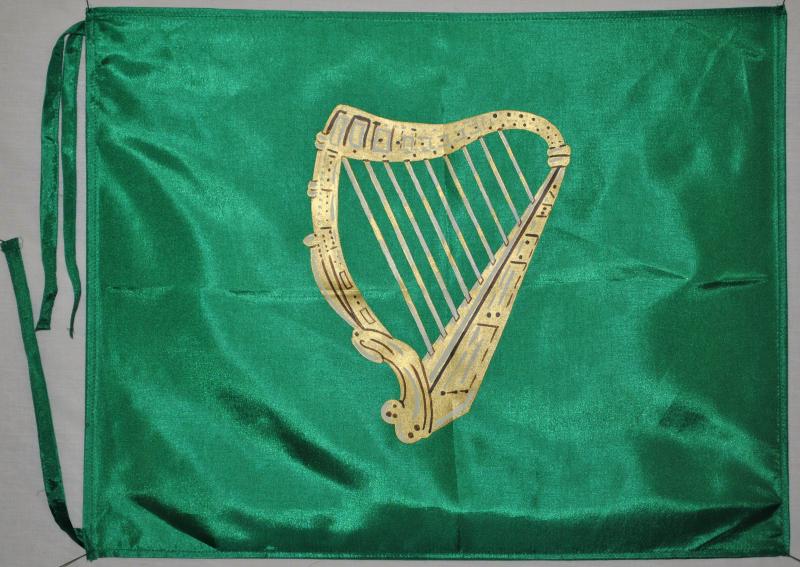
Bandera similar a la izada sobre Liberty Hall (Foto obtenida: Internet)

Las otras banderas del Alzamiento incluían la Tricolor, regalada a los republicanos de los “Jóvenes Irlandeses” por las mujeres del París revolucionario de 1848, que era una de las dos que ondeaban en el tejado del GPO (General Post Office, es decir, el edificio de Correos), cuartel general del Alzamiento.

Compartiendo el tejado de la GPO con la Tricolor estaba la bandera confeccionada pocos días antes del Alzamiento con material doméstico y pintada con las palabras “República Irlandesa” en casa de Constance Markievicz, oficial del Ejército Ciudadano Irlandés.

La bandera del Ejército Ciudadano Irlandés, el Starry Plough, ondeaba sobre el edificio de Clery’s, frente a la GPO.

Desgraciadamente, hoy en día la mayoría de los irlandeses no conocen esa bandera, aunque la conciencia sobre ella y sus antecedentes están aumentando entre los irlandeses autóctonos y la comunidad inmigrante.

El diseño del Starry Plough (El Arado de Estrellas), bandera del ICI tal como era en 1916 (Imagen obtenida: Internet)

El primer ejército obrero del mundo (8)

El Ejército Ciudadano Irlandés (ECI) se formó como milicia obrera durante el gran cierre patronal y la huelga de 1913-1914, para defenderse de los ataques de la policía, la primera línea física represiva de la clase capitalista; la bandera de la ECI se colocó sobre el Hotel Imperial de Murphy en Clery’s (9).

El Ejército Ciudadano Irlandés en ejercicios en sus terrenos cerca de lo que hoy es Fairview (Foto obtenida: Internet)

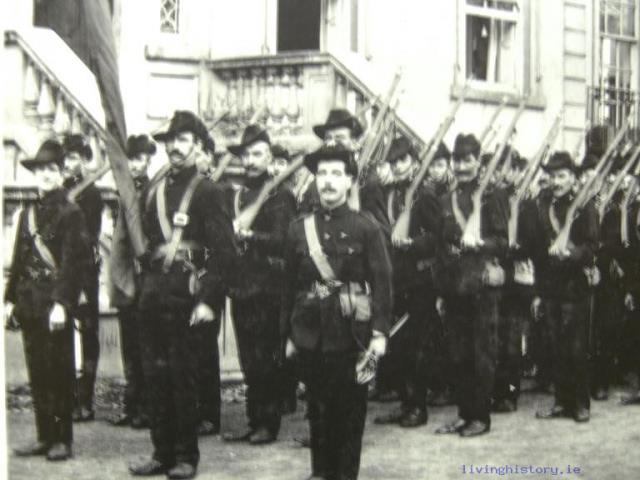
Aunque su constitución era más nacionalista que socialista, el ECI fue, por su composición y su finalidad, el primer ejército obrero del mundo y, cuando se reorganizó unos años más tarde, representó también el feminismo de la clase obrera, reclutando a mujeres, algunas de las cuales eran oficiales al mando de hombres.

Una vez que los preparativos para el Levantamiento se fueron a pique por la orden de anulación de MacNeil, ¿dónde se reunieron los organizadores para discutir qué hacer?

En Liberty Hall, el edificio del Sindicato Irlandés de Trabajadores Generales y del Transporte; fue allí donde se tomó la decisión de levantarse el lunes.

No es exagerado remarcar la importancia del hecho de que la decisión de seguir adelante con la insurrección se tomara en el edificio que se había convertido de facto en el cuartel general de la clase obrera revolucionaria de Dublín, con una bandera ilegal de rebelión ondeando y donde se iba a imprimir la Proclamación.

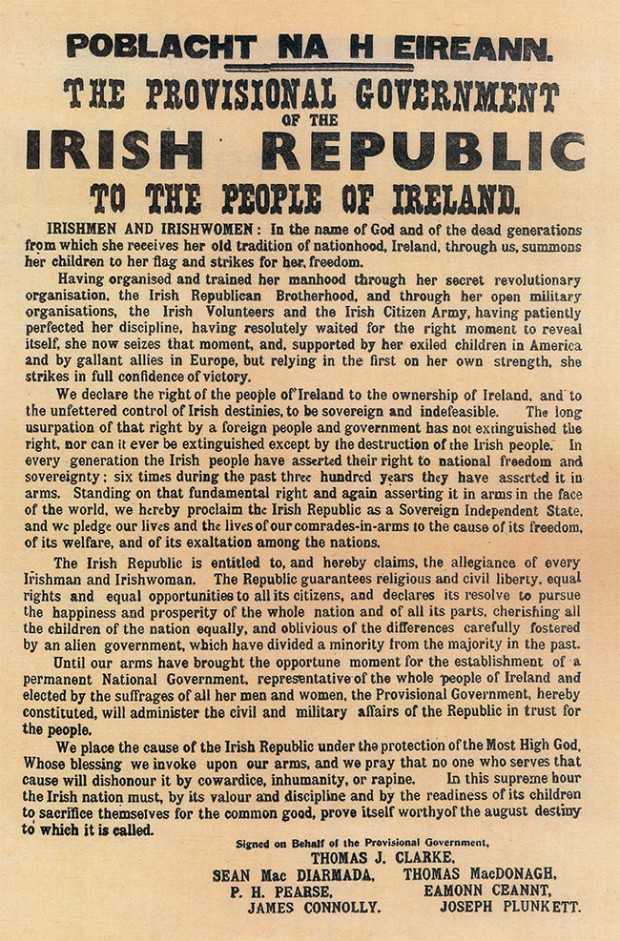
Redacción y texto de la Proclamación

Se cree que la redacción de la Proclamación fue hecha en gran parte por Pearse, pero influenciada por Connolly, incluyendo su destino a “los hombres y mujeres irlandeses” y quizás también “Declaramos el derecho del pueblo irlandés a la propiedad de Irlanda, y al control sin restricciones de los destinos irlandeses”.

Otro fragmento que podría llevar la huella de Connolly reza así: “La República garantiza la libertad religiosa y civil, la igualdad de derechos y la igualdad de oportunidades a todos sus ciudadanos, y declara su resolución de perseguir la felicidad y la prosperidad de toda la nación y de todas sus partes, apreciando por igual a todos los hijos de la nación.

Copia de la Proclamación de Independencia de 1916 (Imagen procedente de Internet)

Pero, quienquiera que compusiera o influyera en el texto de la Proclamación, ésta fue impresa en Liberty Hall. Un miembro del Ejército Ciudadano Irlandés fue a Stafford Street (hoy Wolfe Tone St.) a pedir a un impresor de allí las letras de imprenta para llevarlas a Liberty Hall, que estaba bajo guardia armada las 24 horas del día.

Habiendo impreso la Proclamación en Liberty Hall bajo guardia armada y habiendo decidido allí sublevarse el Lunes de Pascua, ¿dónde se reunieron los grupos de asalto a Stephens Green, Castillo y la GPO (General Post Office, es decir, edificio de Correos)?

Incluido el Batallón del Cuartel General, la mañana del Alzamiento? …. De nuevo, en Liberty Hall.

Una de las primeras víctimas no combatientes del Alzamiento fue Ernest Kavanagh (10) que dibujaba caricaturas para el periódico del ITGWU, The Irish Worker.

Por alguna razón acudió el martes al Liberty Hall y fue asesinado a tiros en la escalinata del edificio del sindicato, presumiblemente por un francotirador del ejército británico.

La resistencia armada de la clase obrera:

Una vez puesto en marcha el Alzamiento, el Ejército Ciudadano Irlandés era el principal responsable de dos zonas, la guarnición de Stephens Green/Colegio de Cirujanos y la guarnición del Castillo de Dublín/Ayuntamiento, pero también luchó en otras zonas, por ejemplo en Annesley Bridge y en la zona de GPO/Moore Street.

Todos los que lucharon junto a ellos comentaron su valor y disciplina. Tras la rendición, muchos de ellos, junto con los Voluntarios Irlandeses, fueron condenados a muerte, la mayoría conmutada por cadena perpetua.

Pero dos líderes del Ejército Ciudadano Irlandés fueron fusilados.

Una de las zonas desde las que las fuerzas británicas fueron tiroteadas durante días después del Alzamiento fue la de los muelles del Liffey, entonces rodeada predominantemente por zonas residenciales de clase trabajadora.

Una pregunta que deberíamos hacernos es por qué las fuerzas procedentes de Gran Bretaña para reprimir el Alzamiento desembarcaron en Dún Laoghaire, desde donde tuvieron que marchar casi 12 km hasta el centro de Dublín, en lugar de hacerlo en los excelentes muelles dublineses del Liffey.

Hugo McGuinness, especializado en la historia de la zona del Muro Norte, cree que los británicos esperaban que Dublín estuviera en manos de la resistencia obrera y que, sencillamente, era demasiado peligroso desembarcar allí tropas británicas, aunque las cañoneras podían disparar desde el Liffey.

Ciertamente, los británicos creían que Liberty Hall y los edificios a lo largo de Eden Quay estaban ocupados como puestos de combate por el Ejército Ciudadano Irlandés y dispararon artillería contra el edificio del sindicato desde la calle Tara, como atestiguan las fotos de agujeros de proyectiles en ese edificio y en el siguiente.
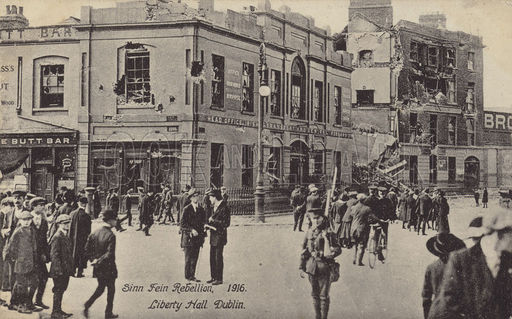
Foto del Liberty Hall dañado por los proyectiles (primer edificio con la esquina hacia la cámara, visto hacia el norte desde Butt Bridge) como parte de un conjunto de postales conmemorativas. (Foto obtenida: Internet)
Otra postal con un primer plano de los daños causados por los bombardeos al Liberty Hall y al edificio contiguo. Curiosamente, en este, Liberty Hall está etiquetado como “el Cuartel General Rebelde”. (Foto obtenida: Internet)

En algunos relatos históricos se habla mucho de la oposición al Alzamiento por parte de algunos sectores de la población de Dublín, durante e inmediatamente después del Alzamiento.

La ciudad era la capital de una colonia británica, y poco más de un siglo antes se hablaba de ella como “la segunda ciudad del Imperio Británico”.

Una parte sustancial de las clases media y acomodada era lealista, incluidos algunos católicos; incluso los sectores “nacionalistas” estaban comprometidos a apoyar al Reino Unido en la Primera Guerra Mundial y John Redmond, líder del partido político “nacionalista”, había reclutado abiertamente para el ejército británico.

Además, entre la clase obrera y el lumpenproletariado, muchos dependían de las “indemnizaciones por separación”, por los varones que servían en el ejército británico.

Es cierto que en algunos lugares los insurgentes tuvieron que amenazar, apalear o incluso disparar a algunos civiles que intentaron obstruir el Alzamiento (11).

Estos incidentes durante el Alzamiento no fueron muchos, pero posteriormente hubo insultos y se lanzaron objetos a los prisioneros que marchaban a la cárcel (o al pelotón de fusilamiento).

La ciudad estaba bajo la ley marcial, pero aun así un periodista canadiense informó de que los insurgentes eran vitoreados en los barrios obreros.

También hubo otros relatos de testigos individuales, como el de un hombre en un tranvía que saludó a los prisioneros en Parnell Street hasta que fue amenazado por los soldados de escolta, y el de un bombero en la GPO que hizo lo mismo.

Un año después, la mayor parte de la hostilidad anterior se había transformado en admiración y orgullo por los combatientes.

El liderazgo de la clase obrera:

James Connolly escribió y dijo muchas cosas de importancia, pero seguramente, con respecto a la lucha por la independencia nacional irlandesa, la más importante fue: “Sólo la clase obrera irlandesa permanece como heredera incorruptible de la lucha por la libertad en Irlanda”.

Con ello quería decir -y estoy de acuerdo- que todas las demás clases sociales pueden ganar algo vendiendo los intereses y recursos de la nación irlandesa, pero que la clase trabajadora no puede ganar nada con ello.

La clase obrera irlandesa se jugó la lucha por la independencia de Irlanda en 1916, pero no tuvo éxito en dirigirla y, por eso, esa lucha está aún por ganar.

Hoy en día, recordando esa larga lucha y a la clase cuyo liderazgo los socialistas revolucionarios pretenden representar y defender, declaramos la necesidad de ese liderazgo sobre un amplio frente de todos los que desean luchar para avanzar.

Al hacerlo, declaramos que lejos de que la clase obrera tenga que esperar al socialismo, en el curso de la lucha nacional también debe dar forma a sus propias reivindicaciones en torno a la economía, los recursos naturales, las infraestructuras, los servicios sociales, las cuestiones sociales, la cultura y, sobre todo, a los frutos de su trabajo.

FIN.

NOTAS A PIE DE PÁGINA:

  1. Hermandad Republicana Irlandesa, Voluntarios Irlandeses, Ejército Ciudadano Irlandés, Cumann na mBan, Na Fianna Éireann, Hibernian Rifles.
  2. Todos ellos fueron ejecutados por un pelotón de fusilamiento británico, junto con otros siete en Dublín y uno más en Cork. La decimosexta ejecución fue en la horca en Londres.
  3. (Véase Fuentes: Cooption of James Connolly etc) Connolly fue un socialista de toda la vida y un revolucionario durante toda su vida adulta, autor, historiador, periodista, compositor de canciones, activista sindical; activo políticamente en Escocia, Irlanda, Nueva York y de vuelta en Irlanda.
  4. El movimiento socialista internacional vio con horror la inclinación de los imperialistas hacia la guerra y en conferencias internacionales prometió oponerse a ella con todas sus fuerzas, incluso convirtiendo la resistencia a la guerra en revolución (“Guerra contra la guerra”). Sin embargo, una vez declarada la guerra imperialista, esa determinación se derrumbó en la mayoría de los Estados, siendo Rusia, Alemania e Irlanda notables excepciones, y en cada una de ellas se produjo un levantamiento contra la guerra, siendo el de Irlanda el primero.
  5. Joseph E.A. O’Connell (Jnr.) sugiere una posible intención de azuzar al Estado para que le ataque a él y al ECI, lo que podría desencadenar el levantamiento general.
  6. (Ver fuentes)
  7. El arpa de la bandera de los Irlandeses Unidos estaba más adornada y llevaba inscritas las palabras “Está recién encordada y se oirá”
  8. http:// www.connollybooks.org/product/irishcitizenarmy
  9. Tenía una buena ubicación, céntrica, pero más que eso: el hotel era uno de los negocios de William Martin Murphy, principal organizador del bloque patronal para romper el sindicato Irish Transport & General Workers’ Union.
  10. Kavanagh era partidario de los trabajadores, del voto femenino y contrario a la participación en la guerra imperialista, contribuyendo también con caricaturas a las publicaciones Irish Citizen, Fianna e Irish Freedom, y acompañando poemas de su hermana, Maeve Cavanagh McDowell.
  11. No incluyo en esto a los tres miembros de la Policía Metropolitana de Dublín, que eran una fuerza al servicio de la ocupación británica y también de los capitalistas dublineses. El Ejército Ciudadano Irlandés, en particular, tenía buenas razones para ajustar cuentas con ellos por los ataques que les habían infligido, entre ellos las heridas mortales causadas con porras a dos trabajadores durante una carga contra una reunión sindical el 30 de septiembre de 1913 en Eden Quay y las palizas y destrozos de mobiliario en domicilios en Corporation Street un poco más tarde.

FUENTES:

Cooptación de James Connolly al Consejo Militar que planeaba el Alzamiento:

Izado de la bandera en Liberty Hall:

https://microsites.museum.ie/1916objectstories/ObjectDetail/remains-of-irish-flag

Incidente de Molly O’Reilly rompiendo una ventana:

https://www.independent.ie/irish-news/ladies-day-for-1916-heroines/26528456.html

Impresión de la Proclamación de Independencia:

https://libguides.ucc.ie/1916Proclamation

https://www.dublincity.ie/library/blog/printing-1916-proclamation-transcript

Decisión de continuar con el Alzamiento el Lunes de Pascua:

https://www.irishtimes.com/culture/heritage/easter-rising-uneasy-calm-before-the-storm-1.2575638

https://www.nli.ie/1916/exhibition/en/content/risingsites/libertyhall

“Sólo la clase obrera irlandesa sigue siendo la heredera incorruptible…” (fin de la penúltima frase):

https://www.marxists.org/archive/connolly/1910/lih/foreword.htm

NEUTRALIDAD IRLANDESA: ¿A QUIÉN LE IMPORTA?

28 de junio, Clive Sulish

(Tiempo en leer parte principal: 8 minutos)

Una multitudinaria reunión pública en el centro de la ciudad de Dublín el sábado escuchó y aplaudió a personas destacadas que hablaron en contra de que el Estado irlandés se convierta en parte de alianzas militares, ya sea PESCO1 (“OTAN a escondidas”2) o la propia OTAN.

El panel de oradores de alto perfil presidido por la eurodiputada irlandesa Clare Daly contó con la participación de su colega eurodiputado Mick Wallace, Sevim Dagdalen (MP Die Linke), Medea Benjamin (fundadora de Code Pink) y Anne Wright (ex comandante del ejército de EEUU pero opositora a la Guerra en Irak).

El célebre rapero antiimperialista Lowkey también participó como orador, al igual que Yanis Varoufakis (ex-Syrza)3, quien se dirigió a la reunión mediante un video grabado desde el extranjero y aplaudió a los irlandeses por su larga resistencia al colonialismo y los instó a estar orgullosos de la neutralidad de su estado.

El video del discurso grabado de Yanis Varoufakis se proyectó en la reunión de Neutrality Who Cares el sábado (Foto: Rebel Breeze)

FONDO

Existe un impedimento constitucional para que el estado irlandés participe en una asociación de guerra con otro estado y durante la Segunda Guerra Mundial la posición oficial del estado fue la neutralidad.

Sin embargo, siempre fue una neutralidad pro-aliada con los aviadores británicos derribados que podían cruzar al territorio del Reino Unido y los militares estadounidenses a menudo cruzaban la frontera del Reino Unido para visitar el “sur”, mientras que los aviadores alemanes derribados eran internados durante la guerra.

El impedimento no es absoluto y generalmente se lo conoce como el “Triple bloqueo”, que enumera las tres condiciones que permitirían al gobierno enviar más de 12 tropas al extranjero:

  • un mandato de las Naciones Unidas
  • una decisión del gobierno
  • y un voto del Dáil 4

En los últimos años, algunos políticos y comentaristas públicos han planteado la idea de que el estado irlandés podría reincorporarse a la Commonwealth británica y, desde la guerra en Ucrania, ha surgido un discurso de que el estado debe unirse a una alianza militar externa para protegerse de la Rusia.

Sevim Dagdalen, diputado del partido Die Linke, hablando en la reunión de Neutrality Who Cares el sábado (Foto: Rebel Breeze)

La encuesta Irish Times/Ipsos de abril, en medio de críticas por no seguir las mejores prácticas en su diseño e incluso acusaciones de tratar de incitar a los encuestados a favor de unirse a alguna alianza militar externa, arrojó dos tercios claramente en contra de que el Estado irlandés haga tal cosa.

La propaganda rusofóbica ha especulado sobre las actividades de los arrastreros rusos en el Mar de Irlanda. Esto es completamente una alarma y una discusión agitadas sin el más mínimo fundamento, ya que Rusia nunca ha presentado la más mínima amenaza, militar o políticamente, para el pueblo irlandés.

Por otro lado, Gran Bretaña ha invadido y ocupado Irlanda durante más de 800 años y todavía está en posesión de una quinta parte de su territorio y tiene importantes intereses económicos y financieros en el país como, más recientemente, los Estados Unidos y la Unión Europea.

La Royal Navy del Reino Unido entra con frecuencia en aguas nacionales irlandesas y el Estado ha permitido regularmente que sus barcos, junto con los buques de guerra de otros países de la OTAN, atraquen en puertos irlandeses. Y también la Royal Air Force, ha surgido recientemente, para patrullar el espacio aéreo territorial irlandés.

Medea Benjamin, fundadora de Code Pink, hablando en la reunión de Neutrality Who Cares el sábado (Foto: Rebel Breeze)

Como parte de esta falsa alarma y discurso, el Gobierno irlandés5 fundó recientemente el Foro Consultivo sobre Política de Seguridad Internacional que tenía previsto reunirse la semana pasada en Cork y Galway, y luego durante dos días en el Castillo de Dublín.

El presidente del Estado, Michael D. Higgins, en una intervención inusual durante una entrevista con el Examiner expresó su preocupación por lo que percibía como la “deriva hacia la OTAN” y criticó la composición de los oradores y presidente de esta organización por ser pro- OTAN.

Michael D comentó sobre “los almirantes, los generales, la fuerza aérea, el resto” y describió a su presidenta, Louise Richardson, como una persona “con un DBE muy grande – Dama del Imperio Británico”.

El presidente Higgins se disculpó más tarde por lo que calificó como “un comentario trivial” sobre Richardson, pero no retiró sus comentarios sobre la composición general del Foro, que de hecho ha sido criticado por otros, incluidos Richard Boyd Barrett TD6 y la senadora Frances Black.

LA REUNIÓN EN DUBLÍN

Varoufakis se refirió a Irlanda como si la nación hubiera ganado su independencia, como sucedió con todos los oradores que siguieron (con la excepción de Lowkey).

Se escuchó a un miembro de la audiencia comentar irónicamente a otro que estaba agradecido de haber asistido ya que hasta ahora no había estado al tanto de la “independencia” de Irlanda.

Lowkey, Rapero antiimperialista de bajo perfil de Londres, hablando en la reunión en Dublín. (Foto: Rebel Breeze)

Lowkey, el rapero radicado en Gran Bretaña, hizo trizas la ilusión de la neutralidad del estado irlandés al relatar el uso de los aeropuertos irlandeses no solo para los vuelos del Ejército de los EE.UU en el territorio estatal.

El rapero expuso la ‘neutralidad’ del gobierno irlandés en el entrenamiento de soldados que iban a luchar en Ucrania y también en su continuo apoyo al Estado de Israel y fue aclamado cuando declaró que, como iraquí, estaba orgulloso de que su país hubiera “pateado el culo de los británicos”.

En un ejercicio magistral de crítica respaldada por la investigación, Lowkey pasó a despojar de la pretensión de independencia e imparcialidad del “Foro Consultivo” fundado por el gobierno, exponiendo los antecedentes imperialistas e incluso de la OTAN de los principales miembros del panel y su presidente.

Todos los miembros del panel de Neutrality — Who Cares fueron oradores efectivos e hicieron puntos útiles, aunque fue curioso escuchar a uno de ellos denunciar a los “fascistas rusos” sin comentar sobre las unidades fascistas en el ejército nacional del régimen ucraniano.

Fue Lowkey quien clavó los clavos más largos y afilados en la crucifixión verbal de la campaña del gobierno irlandés hacia la OTAN y quien provocó los vítores más fuertes de su audiencia, en su mayoría irlandesa.

Incluso el célebre orador Daly no estuvo muy cerca, aunque ella también expuso la propaganda del Gobierno y las porristas pro-OTAN. El eurodiputado desmintió la excusa de proteger los cables de comunicación subterráneos, señalando que el 25% de ellos están fuera de servicio regularmente.

La eurodiputada Clare Daly hablando en la reunión de Neutrality Who Cares el sábado (Foto: Rebel Breeze)

El eurodiputado irlandés también satirizó la idea de que cualquier cable submarino esté protegido por la OTAN, ¡teniendo en cuenta dónde reside la responsabilidad de la voladura del gasoducto Nord Stream!7

Finalmente, advirtió a la audiencia que esté atenta a un intento de eliminar el Triple Lock bajo algún tipo de excusa como un primer paso para permitir que el Gobierno ingrese a una alianza militar.

UNA PARTE DE IRLANDA YA EN LA OTAN

Se dejó a un joven miembro de la audiencia en la sección de preguntas y respuestas, leyendo una declaración en nombre de la organización Acción Antiimperialista, señalar que una parte de Irlanda ya está en la OTAN, a saber, los Seis Condados, ocupados por Gran Bretaña y una parte del Reino Unido.

El joven llamó a un frente amplio para unirse en torno a la oposición a formar parte de una alianza militar externa y el imperialismo (ver declaración completa en el apéndice). Antes se habían distribuido pequeños volantes que abogaban por el mismo curso de acción dentro de la reunión.

El partido People Before Profit también distribuyó folletos en contra de unirse a la OTAN a las personas que asistieron a la reunión.

De hecho, es difícil ver por qué la presencia de la OTAN en una parte de Irlanda debería estar tan ausente de los discursos del panel. Dado que no puede haber sido accidental, debemos reflexionar sobre cuál podría haber sido la razón de su omisión.

¿Están de acuerdo los del panel con la ocupación colonial de una parte de Irlanda? Eso parece difícil de creer, al menos para algunos de ellos. O tal vez creen que su discusión sería una distracción del tema de la neutralidad y, de ser así, ¿cómo puede ser eso?

¿O es que buscan el apoyo de sectores de la sociedad irlandesa que se sienten cómodos con la continua ocupación y partición de Irlanda? Si es así, están tratando de construir el movimiento contra el ingreso irlandés en la OTAN en términos que consideren aceptables para los tímidos sectores de la clase media.

Cuando se hace necesaria una acción resuelta o cuando la reacción comienza a hacer mella, esas secciones se desvanecerán del movimiento anti-OTAN. Por razones tanto prácticas como ideológicas, la campaña debe atraer a la clase obrera sobre una base descaradamente anticolonial y antiimperialista.

Pancarta de protesta en la reunión del Foro Gubernamental para la Seguridad Internacional en Cork mientras Tánaiste (Viceprimer Ministro, en el extremo izquierdo de la foto) hablaba (Foto obtenida: Internet)

Dondequiera que ha ido el Foro del Gobierno, ha encontrado oposición pública. Hubo piquetes en sus sedes de Cork y Galway, mientras que dentro de la primera se desplegó una pancarta contra la OTAN y muchos en la audiencia denunciaron la dirección del Gobierno.

Incluso después de que sacaron a los manifestantes, otro se puso de pie para denunciar el discurso del presidente antes de que él también fuera maltratado.

En el Castillo de Dublín, sede del Foro el lunes y martes con una larga historia como centro administrativo de la ocupación británica, personas contrarias a la OTAN, la guerra o el militarismo ya favor de la independencia irlandesa desplegaron pancartas y pancartas de protesta y enarbolaron banderas nacionales.

Manifestantes dentro de un patio del Castillo de Dublín contra el Foro Gubernamental sobre Seguridad Internacional celebrado dentro del complejo esta semana. (Foto fuente: Acción Antiimperialista)
Tweet del AIA en el que aparece la cadena de televisión nacional RTÉ citando los comentarios ridículos de los líderes del gobierno irlandés sobre la exhibición de banderas republicanas irlandesas por parte de los manifestantes frente a la entrada peatonal principal al Castillo de Dublín en el centro de la ciudad.

EN CONCLUSIÓN

El silencio general de los medios de comunicación sobre la reunión de Neutrality Who Cares en Dublín y la minimización de las protestas contra el Foro en todos sus lugares es parte de la campaña de la clase irlandesa Gombeen para unirse a la OTAN, a pesar de la conocida oposición de la amplia población irlandesa.

No se olvida que cuando decenas de miles atestaron las calles de Dublín marchando contra la triple imposición de impuestos del servicio de agua y la privatización, cómo los medios de comunicación informaron de la participación simplemente de “varios miles” o incluso “cientos”.

Sin embargo, los comentarios del Presidente del Estado y las declaraciones de algunos periodistas en los medios de comunicación revelan que incluso en sus propias secciones, los Gombeen no se salen con la suya. En la población general, sin embargo, el estado de ánimo es claramente de no militarización de Irlanda.

Si el movimiento anti-OTAN permanece activo y militante y adopta una postura antiimperialista generalmente amplia, yendo a la mayoría de los sectores de la sociedad pero especialmente a la clase trabajadora, el impulso de los Gombeen hacia la participación en PESCO y la OTAN será derrotado de manera decisiva.

Fin.

NOTAS AL PIE

1 Cooperación Permanente Estructurada es el extraño nombre de esta alianza militar propuesta para toda la Unión Europea.

2 Como lo describe Clare Daly.

3 Syriza es un partido de coalición socialdemócrata de izquierda que fue elegido para el gobierno de Grecia en 2015 con la promesa de implementar las reformas sociales y económicas necesarias frente a la UE y otras resistencias imperialistas. Sin embargo, una vez que la UE y el BCE comenzaron a apretar las tuercas, la resistencia de la dirección del partido se desintegró. Varoufakis había sido nombrado ministro de Finanzas y, para darle lo que le corresponde, trató de reunir a sus colegas del gabinete en torno a un programa de incumplimiento de los dictados de la UE, pero no tuvo éxito. Aunque sigue siendo la principal oposición socialdemócrata en Grecia, el partido ha seguido perdiendo popularidad en las elecciones desde entonces.

4. Las fuerzas irlandesas de mantenimiento de la paz de la ONU que superaban los 12 efectivos han sido enviadas al extranjero con esas tres condiciones satisfechas a muchos conflictos por todo el mundo, sobre todo al Líbano, donde han sufrido algunas bajas y al Congo, donde han sufrido muchas.

5. El Gobierno irlandés es una coalición de los dos principales partidos de oposición tradicionales, Fianna Fáil y Fine Gael, con el Partido Verde. El Partido Laborista no tiene una posición notablemente diferente sobre la alianza militar externa y el Sinn Féin recientemente abandonó su oposición de décadas a la membresía irlandesa en la OTAN y la UE.

6. Barrett es Teachta Dála (miembro del parlamento irlandés) y miembro del partido político de izquierda People Before Profit. Frances Black, con una exitosa carrera como cantante, es una senadora independiente en el mismo parlamento que ha patrocinado un proyecto de ley para prohibir los productos de los asentamientos ilegales israelíes. El Proyecto de Ley de Control de la Actividad Económica (Territorios Ocupados) de 2018 fue aprobado en su totalidad por el Senado en 2018 y pasó su primera votación en el Dáil Éireann a principios de 2019. Luego se envió para un escrutinio detallado en el Comité Selecto de Asuntos Exteriores y Comercio del Oireachtas. Esta revisión se llevó a cabo durante varios meses, escuchando el testimonio y los aportes de expertos, y en diciembre de 2019 el Comité también votó a favor del proyecto de ley. Desde entonces el Gobierno está tardando en sacarlo adelante.

7. Aunque aún no se dispone de pruebas directas, la evidencia circunstancial apunta hacia la responsabilidad de las fuerzas armadas estadounidenses y el periodista Seymour Hersh (ganador del premio Pullitzer por exponer la masacre militar estadounidense en Mai Lai, Vietnam y su posterior intento de encubrimiento) ha confirmado la responsabilidad de las fuerzas armadas estadounidenses sobre la base del conocimiento de sus contactos internos.

APPÉNDICE

Traducción del texto de la declaración leída durante el período de preguntas y respuestas de la reunión pública Neutralidad – a Quien Le Importa? en Dublín el 24 de junio de 2023:

Acción Antiimperialista Irlanda mantiene la posición revolucionaria de que Gran Bretaña, la OTAN y cualquier otro poder imperialista no son bienvenidos en Irlanda. La Acción Antiimperialista se ha mostrado activa en la oposición a todas las formas del imperialismo en Irlanda y ha estado en primer plano en la oposición a la OTAN.

La OTAN es una gran amenaza para Irlanda y el pueblo irlandés, y al darnos cuenta de ello, instamos y llamamos a todos aquí a oponerse abiertamente a la presencia de la OTAN en Irlanda, ya sea uno activista contra la guerra, un republicano socialista, un anti- Fascista, sindicalista o simplemente en contra de la presencia de una potencia extranjera en Irlanda, apoye esta posición y asegúrese de que sus hijos e hijas no sean enviados a ser masacrados en guerras ilegales de conquista.

Si bien todo el enfoque se ha centrado en el impulso hacia la OTAN para los 26 condados, no podemos olvidar que los Seis Condados ya están ocupados por la OTAN en virtud de la ocupación ilegal de Gran Bretaña. Solo un amplio frente militante de fuerzas progresistas en los 32 condados puede oponerse firmemente a la presencia de la OTAN en Irlanda. Todos tienen un papel que desempeñar en tan amplio frente que Acción Antiimperialista y otras se esfuerzan por establecer.

Rechazar la OTAN. ¡Gran Bretaña y la OTAN fuera de Irlanda ahora!

FUENTES Y MÁS INFORMACIÓN

https://www.breakingnews.ie/ireland/irish-people-overwhelmingly-support-military-neutrality-in-latest-poll-1290604.html

Anti-Imperialist Action statement on line: https://anti-imperialist-action-ireland.com/blog/2023/06/21/the-free-states-imperialist-circus/?fbclid=IwAR27Y7HSZOJKgLe_oivFx828jHfUMFa4mNXADUY1jhFh1KaDsoxGmsxhN1Q

https://www.france24.com/en/live-news/20230622-ireland-s-debate-on-neutrality-derailed-by-anti-nato-protest

https://www.irishtimes.com/ireland/2023/06/22/ireland-should-not-be-squeamish-over-security-issues-micheal-martin-tells-ucc-forum/

https://www.gov.ie/en/campaigns/e2a6b-consultative-forum-on-international-security-policy/

Anti-Fascist Event in Gernika Pays Homage to a Basque-Nicaraguan Revolutionary

Clive Sulish

(Reading time: 9 mins.)

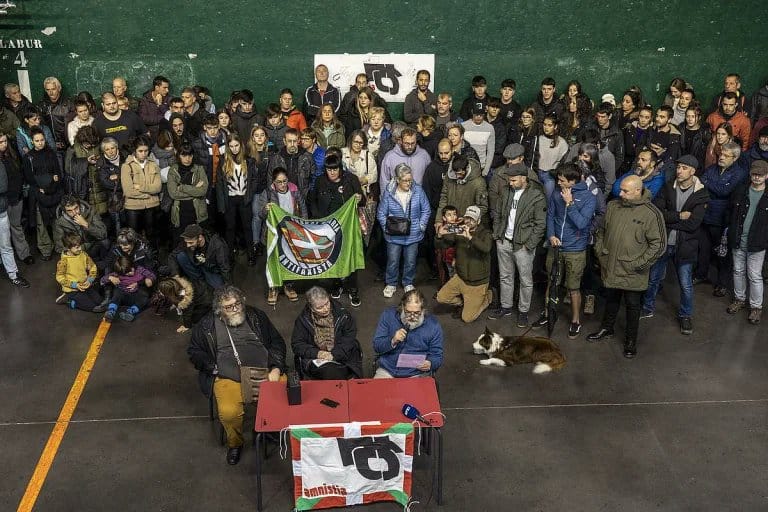
Kontxi Arana, code name “Rita”, was a fighter of the Basque armed organisation ETA and also of the Sandinista movement. A ceremony of homage to her memory on 22nd April was also the occasion of an antifascist conference with representatives from a number of European countries.

The event took place in Gernika, the SW Basque town infamously bombed by German and Italian Nazi and Fascist squadrons during the Spanish Civil/ Ant-Fascist War, the act which inspired the Catalan painter Picasso´s famous piece on the event (which he called by its Spanish name, “Guernica” (sic)). The venue was the disused Astra factory, formerly manufacturer of handguns.

The Origins and Nature of Fascism

The day-long anti-fascist conference began with a talk on the origins and basic nature of fascism by Iñaki Gil de San Vincente, Marxist theoretician and veteran of the Basque Left Patriotic Movement from which leadership of however he has broken for a number of years.

Speaking in Castillian, he declared the essential nature of fascism to be authoritarianism, deriving from the development of the bourgeois family. The central authority figure in that family, later reproduced in other social classes including the working class is the Father, represented in capitalist society by the employer and the Church.

It is an authority to which all are required to submit: patriarchical, homophobic and intolerant of criticism or deviation.

De San Vincente spoke at length about this development and about early descriptions of fascism, for example by Clara Zetkin and Lukacs and described it as a production of capitalism and imperialism and therefore represented today most clearly in the actions of US Imperialism and the NATO over which it exercises hegemony.

The speaker also highlighted the development of NATO and its recruitment of Nazis as well as the development of its Vatican route for Nazis to leave Europe and enter Latin American countries where they would form fascist centres.

This talk was followed by a representative of Ezkerraldea Antifaxistako (Antifascist Left) who, speaking mostly in Castilian, outlined the history of the development of fascism in the Spanish state following the military-fascist uprising and the four decades of dictatorship, and how the organisation he represented responded to that.

The final speaker of the morning session was from Mugimendu Socialistako (the Socialist Movement – organisation with a large membership, according to a participant) who spoke entirely in Euskera (Basque language). Although simultaneous translation was provided into Castilian (Spanish), the volume of such was too low to be understood by many.

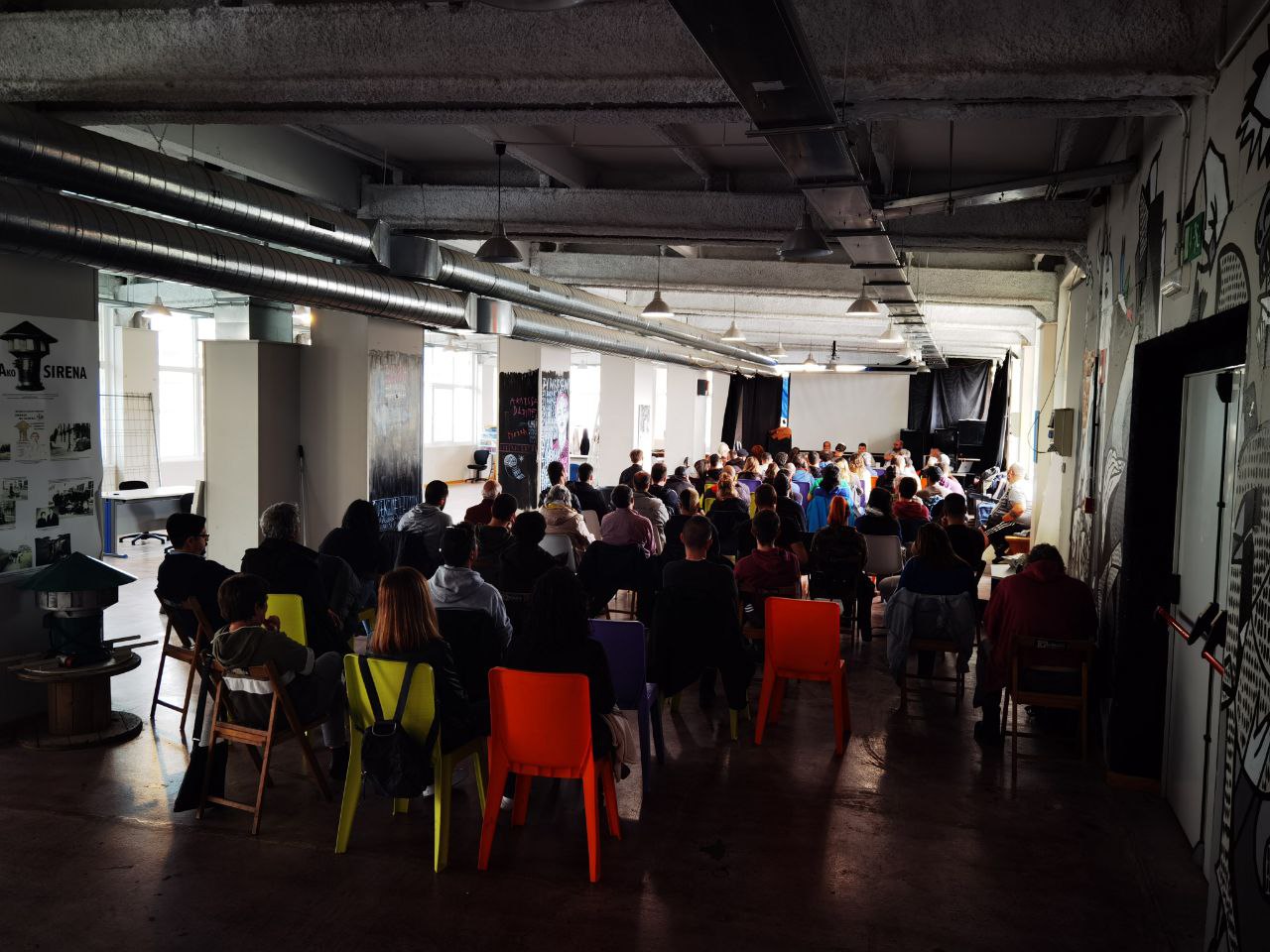
Morning session of the anti-fascist conference in Gernika (Photo: DRAF)

According to a participant, the content of that speaker´s contribution was similar to that of the previous speaker, although he mentioned the existence of Frente Obrero (Workers´Front), a Basque organisation which, despite its name, is a fascist organisation. The existence of that latter group appeared to be news to many present.

These talks were followed by a break and, upon resumption, there were some contributions from the floor and some responses from the panel, after which all repaired to the green outside the Astra building to where the ceremony of respect to the memory of Kontxi “Rita” Arana was to take place.

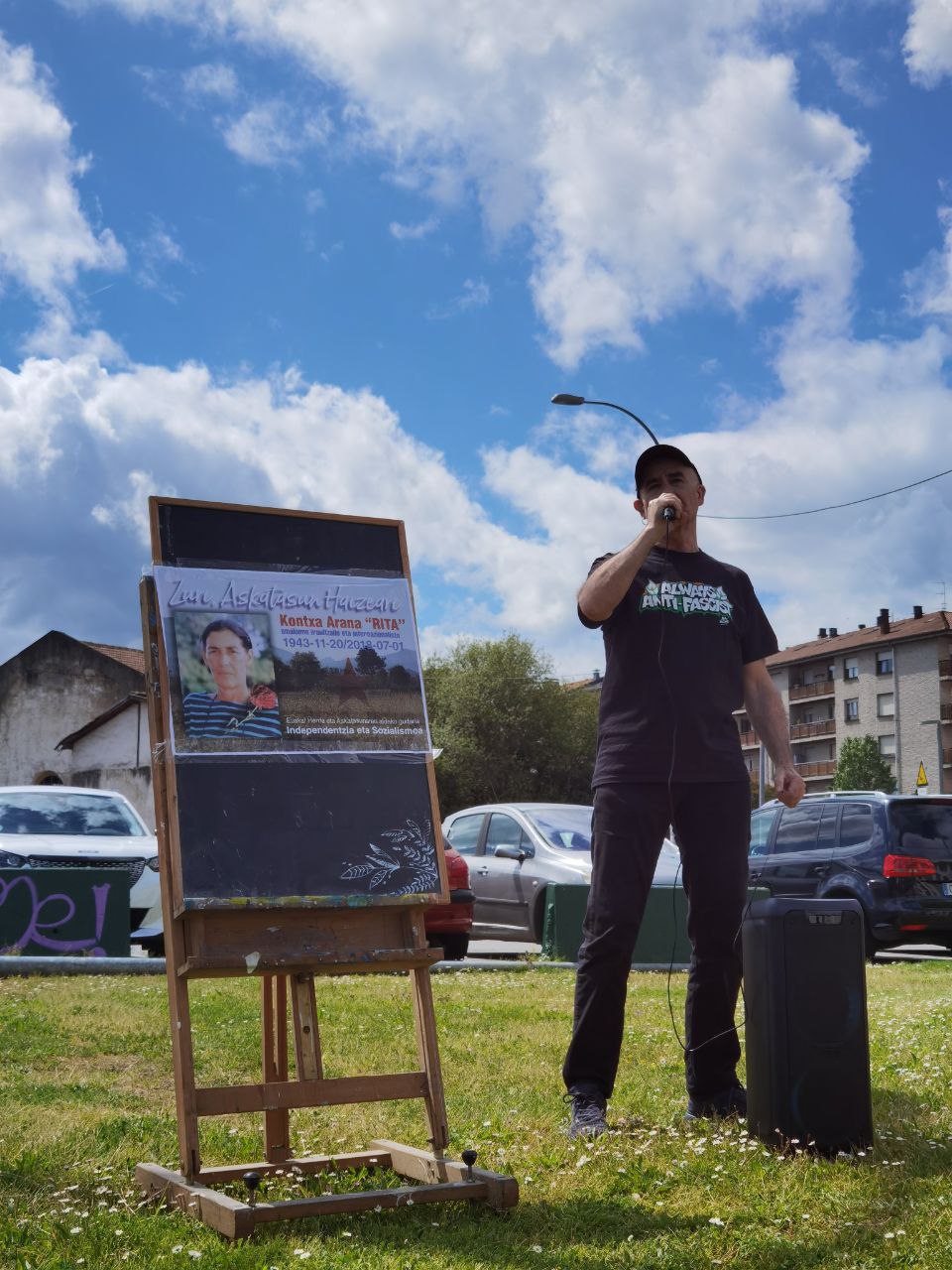
Kontxi Arana: A leading Basque liberation fighter who also joined the Sandinistas in the liberation struggle of Nicaragua

A Basque woman of the independent Patriotic Left movement blew the traditional cow or bull horn to summon attention, while the speaker in the Basque language introduced the program and speakers along with a short history of this internationalist anti-imperialist and anti-fascist fighter.

Kontxi Arana was an active member of the Basque armed liberation organisation ETA who avoided capture while on operations in the Spanish State but was arrested in the French state and exiled to an island, from which she and others escaped. Sometime later she surfaced in Nicaragua, where she had joined the Sandinista armed liberation movement.

Around the end of the 1990s, the leadership of the Basque Patriotic Left asked some exiles to return to the Basque Country to help push the pacification process and release of prisoners but the Spanish State refused to play, though they did not arrest Kontxi (however according to reports arrangements were not well organised to support her).

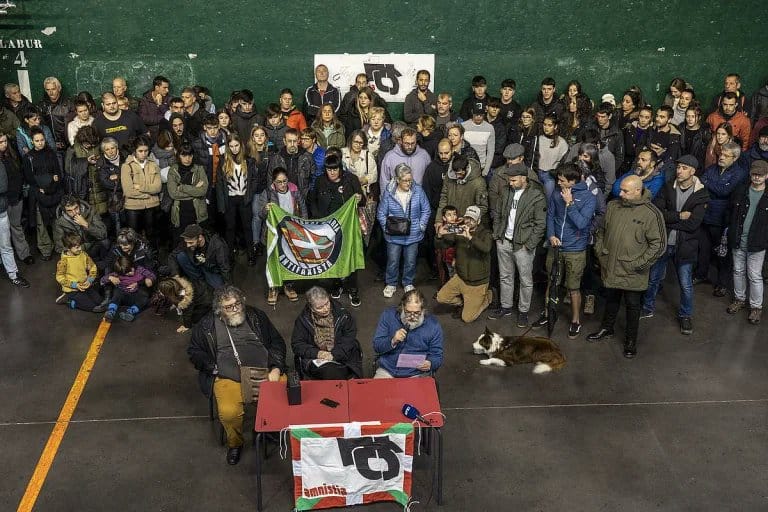
Most of the crowd present at the Gernika commemoration and homage to Kontxi “Rita” Arana, with the Astra building in the background and the railway line fence just visible in the left background.

The homage to her memory

A man formerly of the official patriotic Left movement spoke in Spanish about the need for internationalist solidarity, through which however mistakes can be made (e.g. in supporting corrupt leadership) which however does not alter the importance of such solidarity, without which the revolution cannot advance.

This was followed by a man from Dublin Republicans Against Fascism who briefy explained in Castilian (Spanish) the history behind Christy Moore´s “Viva La Quince Brigada“, which the Dubliner then sang in its original English.

Dublin Republicans Against Fascism representative singing Christy Moore’s Viva La Quinze Brigada.

The homage event concluded with red carnations being laid by members of the audience in front of a portrait of Kontxi “Rita” Arana. Two ex-political prisoners played the ´txistu´ (Basque three-hole flute), one of them also beating a rhythm on a small drum (´tamborina´). A young woman stepped forward and danced the ´aurresku´, a traditional honour dance.

Crowd queuing to lay red carnations in front of a portrait of Kontxi Arana

This dance was traditionally danced by a male, then by male dancers, then by male and female dancers until today, when it may be performed by any of those combinations or by a lone female, as in this case, and often enough in ordinary clothing as was the case on this occasion, though she did wear dancing shoes laced to the ankles.

The young woman performing the honour Aurresku dance in one of the high kicks of the dance with, to the far right, the ex-political prisoner txistulari (players of the Basque flute). In the immediate background, participants and organisers. (Photo: DRAF)

The musicians then played the air of The Internationale, which most could be heard singing in Euskera, followed by Eusko Gudariak (“Basque Soldiers”), the Basque national resistance song, similar to the Soldiers’ Song/ Amhrán na bhFiann of Ireland in content. Many had raised clenched fists as the songs were sung.

Suddenly, a wild high-pitched yodelling cry rang out from a female throat, the Irrintzi, traditional Basque battle-cry which probably echoed around the mountains in olden days.

All the audience then repaired to the Astra building where a hot meal was served to all on long tables with a bottle of wine to share among each group of several people (those present had purchased tickets to the event either in advance or upon attendance).

Afternoon session: Presentations from Turkish, Irish and Catalan antifascists.

The afternoon session started a little late as people straggled in. The chairperson, speaking in Euskera, introduced the theme of the session which was for antifascists from Turkey, Ireland and Catalonia to describe the situation with regard to fascism in their countries and how it was being confronted.

Turkey

Two people from the Turkish-based revolutionary organisation Anti-Imperialist Front presented their contribution while using a video of images, some subtitled in Castilian but where not, spoken by the woman in English while her comrade translated simultaneously into Castilian.

Overall, the presentation was about the development of state fascism in Turkey and the failed military coup of 2016. The DHKP/C organisation had resisted this on the streets but a major struggle with the Erdogan government took place in trials and in the jails.

Through hunger strikes and physical resistance in the jails, hundreds of martyrs had lost their lives, said the speaker but had remained undefeated. Also martyred had been members of the Group Yorum music group which has played revolutionary songs heard by millions.

Another struggle was carried out through public hunger strikes by elderly relatives seeking the uncovering of mass graves in the bodies of fighters, their sons, had been thrown by the Turkish military.

As a result two mass graves had been eventually disinterred, permitting the remains of fighters of the DHKP/C and of the PKK (Kurdish patriotic socialist organisation) to be returned to their families for respectful re-burial.

The Turkish speakers concluded by stating the necessity for anti-fascism to be anti-imperialist and calling for internationalist solidarity and victory to peoples’ struggles.

Section of audience at afternoon session of the anti-fascist conference in Gernika, Basque Country.

Ireland

The next speaker was from Dublin Republicans Against Fascism, explaining that eight centuries of occupation of his country by England has ensured that the dominant struggle had been one of national liberation and that all armed struggles since 1798 had been led by Republicans of various kinds: 1801, 1848, 1867, 1882 and 1916.

The Irish State that came into being after the War of Independence in 1921 had been a client of the UK, conceding over one-fifth of its national territory as a direct colony. The armed forces of the State had formally executed over 80 of the IRA and instituted a wave of repression including kidnappings, torture, murders including of prisoners.

In keeping with the rise of fascism across 1930s Europe, Ireland saw the Blueshirt movement, led by former police chief Eoin O’Duffy. The Republican movement and socialists fought these on the streets, the speaker said.

The Dubliner recounted briefly the history of Irish Republicans and socialists going to fight Franco in the Spanish state and the Irish diaspora fighting the British fascists, the Blackshirts, in British cities and in defence of Eastern European Jews in famous Battle of Capel Street in the East End of London against over 7,000 police.

He went on to recount some more recent successful physical attacks by joint Republican groups against fascist organisations, the Pegida group in 2016 and even more recently the National Party. Recently too, Republican ex-prisoners had released a video stating the opposition of Republicanism to fascism with a growing list of signatures.

In conclusion, the speaker said that Ireland’s history made it difficult for fascism to advance in Ireland (except in the Loyalist areas) but as long as capitalism exists so too does the danger of fascism, particularly if the progressive forces do not fight effectively against the attacks of Capital on working people.

Catalonia

The representative of the Anti-Repression Platform of Catalonia, speaking in Castilian (Spanish), explained their organisation had come into existence after the repression of the Independence Referendum in 2017 and the subsequent frame-ups and allegations of terrorism against the Committees for the Defence of the Republic.

The speaker alluded to the jailing of the revolutionary socialist rapper Pablo Hasel and comrades who were charged with terrorism merely for expressing and organising solidarity for those being repressed.

“Don’t try to frighten us with threats of a fascist party getting into government”, he said in a reference to the growth of the Spanish fascist party Vox, because we have had a fascist government in the Spanish state since 1939!” (The year that the military-fascist forces defeated the Second Republic and founded four decades of dictatorship).

The Catalan went on to denounce the social-democratic party PSOE (currently in coalition government with Podemos Unitas), pointing out that it has had more political prisoners in jail and fatal victims than any other party in Spanish government (he was probably including the sponsoring the GAL terrorists of the 1980s).

“There has not been a year in which there were no political prisoners in the Spanish state”, he went on to say but also denounced the current Catalan Government, led by the allegedly pro-independence and leftist ERC party and its repression of socialists and independence activists.

He pointed out that fascists would make no distinction between communists and anarchists and asked “so then why should we?” He declared that all who resist repression now, regardless of before, are welcome to take part in their organisation.

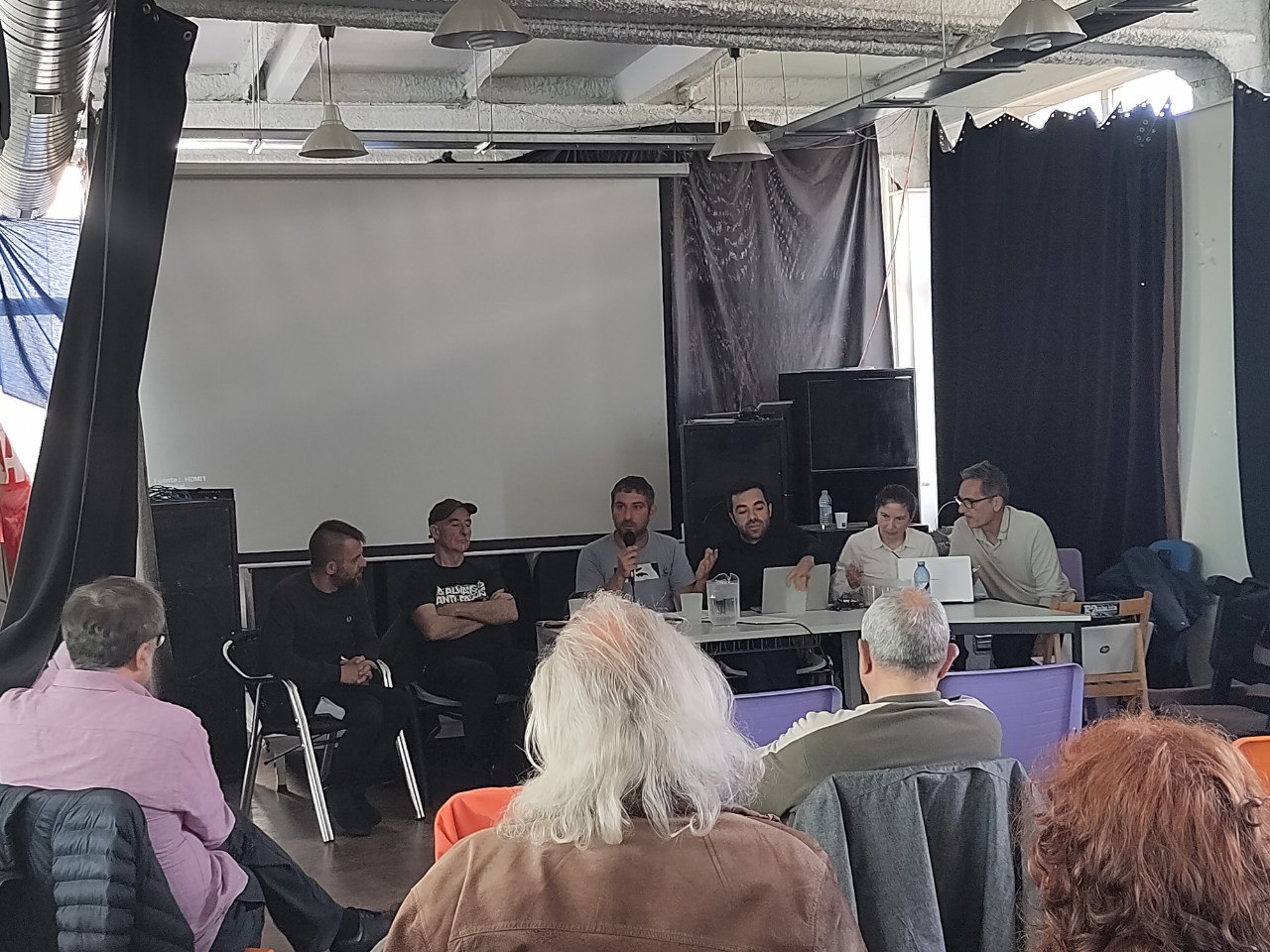
The panel at the afternoon session: from left to right: speakers from Catalonia and Ireland, Basque chairperson, Turkish speakers and translator.

Prisoners on hunger-strike

The chairperson of the panel thanked the speakers and drew together elements from each of their presentations.

He went on to announce the declared intention of a small group of Basque political prisoners to embark on a hunger strike and to outline solidarity events being organised. The prisoners concerned are in the non-compliance minority of Basque political prisoners with a regime that forbids them referring to themselves as political prisoners.

The prison authorities intended to make the prisoners share a cell with other political prisoners who are however in compliance, intending to undermine the resistance of the small group and also posing the danger of conflicts within the cell. (A few days later news came that the hunger-striking prisoners had won their demands).

Amnistia organisation solidarity poster announcing forthcoming hunger-strike of political prisoners, now over because they won their demand.

Summary

The conference in its organisation and content of contributions drew anti-fascism together with imperialism and internationalist solidarity, all from an anti-capitalist perspective. It also drew connections between solidarity with political prisoners and resistance to repression.

All of the Basque organisations represented are in opposition to the trajectory of the leadership of what had been the Basque Left Patriotic movement, now represented by the EH Bildu party led by Otegi (with daily newspaper GARA, its trade union organisation LAB) and many of the older people were ex-supporters of that leadership.

That included some prominent ones such as Inaki Gil de San Vincente and the speakers and organisers of the conference and of the homage to the memory of Kontxi “Rita” Arana. The younger participants might have included ex-members or had come into political consciousness in opposition to that leadership.

Taken together, they are what many call ‘dissidents’ though some reject that term, saying that they are in fact sticking to the original line of independence and socialism and that it is the official leadership and their followers who have deviated. Their numbers are comparatively small at the moment but they are growing.

end.

USEFUL LINKS

Speaking at the Conference:

Boltxe: https://www.boltxe.eus/

Inaki Gil de San Vincente:

Socialist Movement (Socialist Councils) of the Basque Country: LANGILE KAZETA (gedar.eus)

Antifascist Left: Ezkerraldea Antifaxistasta
https://www.facebook.com/profile.php?id=100069359823294

???

Anti-Imperialist Front (Turkey): https://anti-imperialistfront.org/

Dublin Republicans Against Fascism: https://www.facebook.com/profile.php?id=100067893558778

Anti-Repression Platform of Barcelona: https://twitter.com/antirepreBCN
Plataforma Antirepressiva de Barcelona | Barcelona | Facebook

More to come later

Others in Ireland:

Dublin Basque Solidarity Committee: https://www.facebook.com/dublinbasque

Anti-Fascist Action: https://www.facebook.com/afaireland/

Republicans Against Fascism: https://www.facebook.com/profile.php?id=100090617432158

There are also other local antifascist groups and organisations that include antifascist activity in their programs

THOUSANDS MARCH IN BILBAO AGAINST NATO, WAR AND FASCISM

Manifesto of the organisers: Askapena1, NATOren eta EBren Aurkako, Herri Ekimena and Bardenas Ya
(Translated from Castilian version by D.Breatnach)

(Reading time total: 6 mins. including Comment)

We began the previous manifesto talking about emergencies. We said that it was essential to reclaim an anti-imperialist and internationalist Euskal Herria2.

And that urgency, that need, is what has brought together comrades from all corners of Euskal Herria here today. Well done all of us!

Capitalism is going through a systemic crisis. They speak to us of a “extraordinary period” but the truth is rather that we find ourselves in a permanent crisis. As we have supposedly departed one, they have already placed us in another.

As of 2020, moreover, we have entered a phase of exceptionality in which States take advantage to impose economic, social and disciplinary policies that point towards a war scenario. Therefore, we cannot separate the capitalist decomposition from the increase in repression and censorship.

Banner reading “Condemning us to war and misery” and section of the anti-NATO march in Bilbao 11 March. (Photo sourced: organisers)

The rise of fascism that is taking place throughout Europe is a direct consequence of the bourgeoisie’s fear of losing the control it exercises over an increasingly exploited and angry population.

In the field of international relations, we are also witnessing the increasing loss of hegemony of the Empire that has controlled the world practically without opposition for the last 30 years.

The bloc led by the United States and NATO, far from accepting the end of its historical cycle, seems determined to increase armed conflicts. In addition to giving a boost to the arms industry, they intend to hinder the growth of emerging powers such as China or Russia.

For this phase of confrontation, they have finally achieved the support of the lobby led by Ursula Von der Layen, the “gardener” Borrell3 and company.

NATO and the EU, together with the Zionist entity that redoubles its attacks on the Palestinian people, are today the main props of this dark period in history.

As far as NATO is concerned, we have to understand that its role goes beyond being a mere military organization. It is true that it is mainly the army of the bourgeoisie (and it is demonstrating this in Donbass, as it has also demonstrated in Yugoslavia, Libya or Syria).

But it has the superior function of being the military arm against anyone who opposes the policies of capital. Today these translate into the over-exploitation and precarity of the working class (especially women and people of colour).

And changes in labour rights to deprive us of material concessions wrested through class struggle, change of laws to increase the repression of those struggles, etc.

A clear example of this is the latest General Budget of the Spanish State, supported by all the social democratic parties4.

The budget supports the deterioration of the material conditions of working peoples to benefit NATO, giving it more control capacity and recognizing their right to appropriate civil infrastructures to defend the interests of the bourgeoisie.

The support for these militaristic policies, at the dawn of a world war, is a real shame and demonstrates the total lack of commitment of the leadership of these parties to the future of the Working Peoples of the world.

In Euskal Herria we are well aware of what NATO represents:

in addition to the military training industrial estate in Las Bardenas or the military exercises carried out at the Araka base (Gasteiz), we have recently witnessed blatant support from the Government of Gasteiz for war industries such as SENER or SAPA.

Nor can we forget the historical support of NATO, through the Gladio network, to the Spanish and French States in their legal and illegal repression5 against the struggle in Euskal Herria.

If we add to this the economic and social exception measures imposed on us by Brussels (private pension funds, increase in the retirement age, dismantling of public health) …

It becomes increasingly clear to us that neither as a nation nor as working class do we have a future within NATO or the EU. The need to destroy these instruments of domination by the bourgeoisie, as well as the Spanish and French States, is more than evident if we aspire to build a future in freedom.

These are not good times, of course not. The situation is becoming more and more complicated throughout the world. And that is why we here today are calling for the activation in each town and each neighborhood of the anti-imperialist Euskal Herria.

Thirty-seven years ago we said “NO to NATO!”6

Today, we not only reaffirm this rejection, but we once again make an urgent call to join forces with the rest of the working peoples and oppressed nations of the world to stop the imperialist offensive promoted by this criminal organization along with its allies in the European Union.

From Chile to Donbass, passing through Laos, Mali or Vietnam…

LONG LIVE THE STRUGGLE OF THE WORKING PEOPLE!

AN ANTI-IMPERIALIST BASQUE COUNTRY!

Front of march heading towards the Bridge across the Nervión river and the old city (Photo sourced: organisers)

COMMENT: A GIANT STEP FORWARD

Diarmuid Breatnach

(Reading time: One min.)

The estimated 2,000 turnout in support of this demonstration must have exceeded the expectations of the organisers and greatly encouraged them. Two thousand is not a huge number in the highly-politicised Basque Country, even with a total population of less than three million, north and south.

But this is a nation which has for decades been under a political leadership, the surviving members of which have now taken the road of pacificaction, of accommodation to capitalism and the Spanish and French states, of social-democratic ‘opposition’.

This movement had a united national political leadership, an armed guerrilla movement, a daily newspaper, a trade union and smaller affiliated groups; it had café/bars/social centres throughout the southern provinces.

Though in decline and fragmented with the leadership’s embracing of the pacification process (through which, unlike the Provos, they did not even gain the release of their hundreds of imprisoned comrades), it still exercises a heavy influence on politics in the Basque Country.

That is today the ambit of Otegi, EH Bildu and Geroa Bai and neither did their parties participate in Saturday’s demonstration nor as an individual any of senior responsibility in their structures, though certainly individuals in their social and cultural sectors were seen in the march.

In that context and after 25 years of pacification, 2,000 in open attendance is a giant step forward for the Basque resistance. ‘Tús maith, leath na hoibre‘, it is said in Irish: ‘A good beginning is half the work’ and indeed, a beginning is how the organisers view the event.

“Dissident” groups such as Amnistia ta Askatasuna, Amnistia Garrasia, Tinko and Jardun have arisen in the last decade and youth have been very prominent in these and others disparate groupings, which is important for any revolutionary movement.

The photos and videos of Saturday’s demonstration show older and mature faces too, veterans of the struggle and also those active during the pacification period and this too is important, for it brings a certain continuity to the movement and the awareness of mistakes made in the past.

More than 50 organisations in the Basque Country supported the call for this demonstration.

The road ahead will not be easy (when has it ever been for the Basque nation or the working class in general?) but a giant step forward has been taken.

End.

FOOTNOTES

1Askapena is the internationalist arm of the Basque movement for independence and was responsible for a number of years for maintaining a network of Basque solidarity organisations (which in some cases it founded) in Mexico and across a number of European cities, including Belfast, Dublin and Cork. In 2011 five of its leading activists were arrested on charges of supporting the guerrilla organisation ETA, through Askapena’s solidarity with political prisoners. The five defended their right to work with prisoner and internationalist solidarity and were finally acquitted in 2016 earning much admiration for their stance (in stark contrast to the 47 activists in a number of prisoner support organisations who apologised for their activity in a Spanish court in September 2019 in exchange for non-custodial sentences for the majority).

2The current Basque name for their nation, “the Basque-speaking country”, replacing the former “Euskadi”, now used to refer only to the three-province ‘autonomous’ region of Bizkaia, Araba and Gipuzkoa.

3Josep Borrell, Foreign Minister of the EU Parliament who has described the EU as “a garden”. A Catalan member of the PSOE, hostile to Catalan independence who after five minutes stormed out of an English-language interview by Tim Sebastian on the German TV program Conflict Zone regarding the struggle in Catalonia.

4This is a reference not only to the social-democratic coalition government of the PSOE and Podemos but also of the Basque EH Bildu and Catalan ERC, the votes of which MPs supported the Budget.

5A reference not only to banning of parties, organisations and demonstrations but also to routine torture and the kidnapping and assassinations of the State-sponsored GAL of the 1980s.

6In the 1986 Referendum on whether the Spanish state should join NATO, the southern Basque Country gave a majority vote against, the only region to do so (though the vote against was high in some regions), the total vote being 52.54% in favour.

SOURCES

BASQUE ANTI-REPRESSION ORGANISATION TINKO – WHO WE ARE

(Translation and footnotes by D. Breatnach)

(Reading time: 4 mins.)

TINKO is an independent organization created to work for COMPLETE AMNESTY. As an amnesty organization, it intends to create the necessary means to fight against repression with its scope of work being the Basque Country.

As its name indicates2, it intends to reflect the attitude of determination and commitment of some political prisoners3 in these difficult times. Along with the dignity and toughness that is being maintained, there must be constant struggle in the streets.

It is our responsibility to keep the flame of the struggle burning; for this reason, we see it more necessary than ever to organise ourselves.

Drop-banners against repression in different locations in the southern Basque Country/ Spanish state (Photo: Tinko)

TINKO’s understanding of repression goes beyond reporting each case in isolation, since each of these cases responds to a general repressive situation.

The states are the ones that speak of the individualised treatment of prisoners, denying their political nature and hindering solidarity. Therefore, our duty in this regard is to promote unity and solidarity.

It is the slogan of COMPLETE AMNESTY that offers this overview of the aforementioned repression, as well as the political solution that opposes this repression.

Full amnesty includes freedom from all political repression without exclusion, as well as overcoming the underlying causes of repression, such as national and social oppression.

Therefore, TINKO is an organization made up of ideologically-conscious activists, who want to make their contribution in the field of anti-repression towards a Basque Socialist State.

If the intensity of the struggle is met with repression, it will be our task to counter that repression, to try to facilitate the conditions for the struggle.

It is necessary to take a broader reading of repression, paying attention to reality with the intention of joining our forces.

We aim to create a broad movement against the repression that upholds the interests of the political victims of the struggle cycles of yesterday, today and tomorrow, that will always be in accord with the declaration of complete amnesty and not establish differences according to the struggles carried out.

It is necessary to underline the enormous generosity of the militants who suffered the repression of the previous phase. They have been our compass even in the bleakest times and they continue to be so today.

Total amnesty is our strategic objective and we do not define it in a purely legal way but instead in a political way.

Amnesty includes the unconditional release and freedom of prisoners, fugitives, refugees and political deportees and also the resolution of the reasons that motivated these people to fight for their fundamental rights, in the case of the Basque Country, against national and social oppression by the Spanish and French states.

Only ending the denial of our rights can ensure that prisons do not fill up anew after they have been emptied. These are the other measures that a full amnesty should include, along with the aforementioned freedom from political repression:

  • The right to self-determination
  • Abolition of repressive laws against the working class. Repeal the labour reform laws, the muzzle law, the party law and the anti-terrorism law4.
  • Dismantle and expel the repressive and occupying forces from the Basque Country.
Press conference in November in solidarity with 18 people from Berango accused of “glorification of terrorism” (sic) for organising an “ongi etorri” (welcome) event for a released political prisoner. (Photo: Tinko)

ANTI-REPRESSION NETWORK

As we said at the beginning, TINKO intends to create the necessary means to combat repression.

We consider it necessary to create useful tools to organise in cases of repression, which allow the creation of effective solidarity networks for the protection of those who suffer repression for being active in different fields.

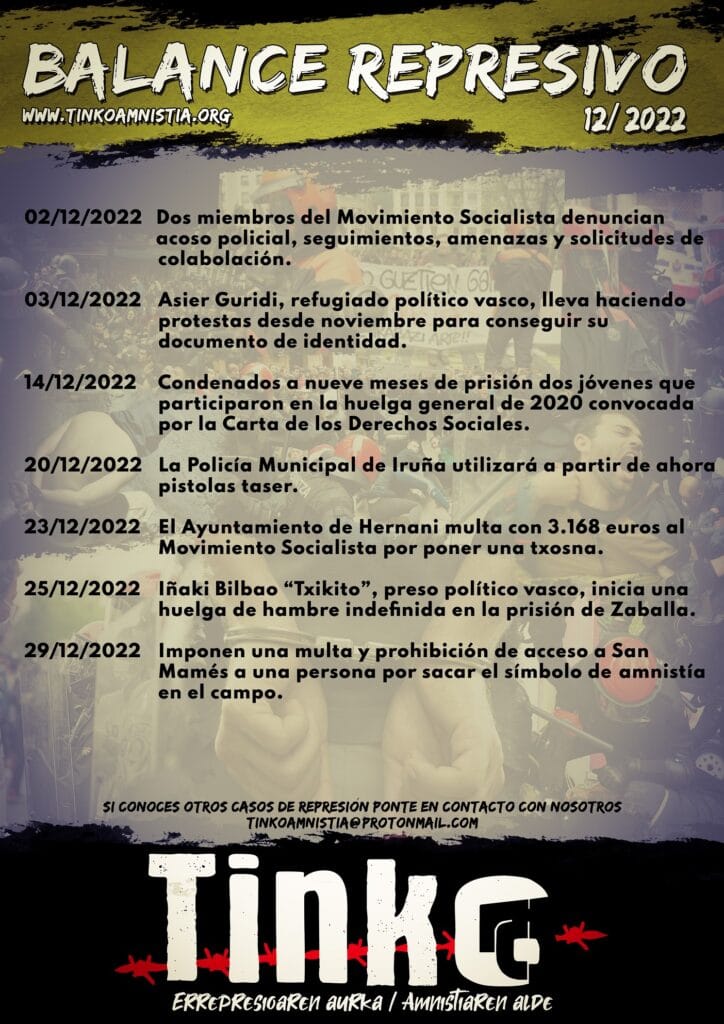
Monthly summary of repression (Castilian language version) December 2022, including: 9 months jail for two youth participants in the 2020 General Strike; municipal police in Irunea/ Pamplona are to get taser pistols; the municipal council in Hernani fine Socialist Movement 3,168 euro for running a street stall; Basque political prisoner initiates indefinite hunger strike in the Zabala prison. (Source: Tingo)

In addition to organising instruments for protection in the courts, insisting on repression as being general and calling for total amnesty. While the net would be politically wide, victims of repression would receive protection according to the following minimum essentials:

Joining the call for total amnesty.

Feeding the network itself, that is, strengthening the network against other cases of repression.

Putting the collective before the individual.

Not denying access to basic political rights in a possible trial: the right to political organization, the right to demonstrate, the right to assembly and the right to freedom of expression.5

End.

FOOTNOTES

1Tinko was founded some months after an internal dispute inside the Amnistia organisation in the autumn of 2020 about whether to support a demonstration in Madrid or not. Amnistia itself, as with Tinko, grew out of the perceived necessity to resist repression in order to move forward in struggle, while the official leadership of the left-nationalist movement was adapting itself to the requirements of the Spanish State.

2“Tinko” means ‘firmness’ in the sense of ‘resolved/ standing firm’.

3Note the qualification “some”: the leadership of the Basque prisoners’ organisation and of the relatives’ support group, Etxerat, followed the abandonment of the revolutionary path by the leadership of the Basque Izquierda Abertzale mass movement. Most of the prisoners followed the leaders’ line, which entailed prisoners not calling themselves “political” prisoners, not joining any protests and seeking parole as individuals, including apologising for their previous actions. The leadership dropped the call for Amnesty and confined their demands to an end to the dispersal of prisoners away from their home areas.

4In brief, laws restricting the right to strike and to record and disseminate police violence, along with laws permitting repression of political activists.

5There is a practical reason for the inclusion of this requirement: The Spanish State demands the political activists it arrests apologise for their resistance and undertake not to repeat it. Shamefully and to the shock of many, in September 2019, 47 activists in three organisations engaged in prisoner solidarity work, including officials of the Basque Left Movement, in exchange for non-custodial sentences on all but two (who received relatively light sentences) pleaded “guilty” to ‘anti-terrorism’ charges. Doing so endorsed the criminalisation by the Spanish State of prisoner solidarity work and was a great shock to many Basques, including the 50,000 who had demonstrated in Bilbao in solidarity with the accused only days before the trial and had been kept in ignorance of the deal. (See Euskal Herria. Iñaki Gil de San Vicente: “Es inadmisible engañar a 50.000 personas, pactando a sus espaldas” – Resumen Latinoamericano)

REFERENCES

https://www.facebook.com/profile.php?id=100069611901196

Euskal Herria. Iñaki Gil de San Vicente: “Es inadmisible engañar a 50.000 personas, pactando a sus espaldas” – Resumen Latinoamericano

RESUMEN DE LAS ACTIVIDADES POLÍTICAS RECIENTES EN IRLANDA

Diarmuid Breatnach

(Tiempo de lectura del texto principal: 10 minutos)

Un resumen seleccionado de eventos políticos y sindicales en Irlanda en los últimos meses (edición final 17 de agosto de 2022).

EN LOS 26 CONDADOS

La Coalición Gubernante de partidos neoliberales Fianna Fáil y Fianna Gael, con orígenes en bandos opuestosde la Guerra Civil Irlandesa (1922-1924), y el Partido Verde sobrevivió a moción de falta de confianza a principios de julio en el gobierno con una cómoda mayoría de 26 votos.

La moción fue propuesta por el partido Sinn Féin con motivo de la pérdida de la mayoría absoluta de la Coalición (de 85 a 84) cuando uno de los miembros de la Coalición renunció a su partido.

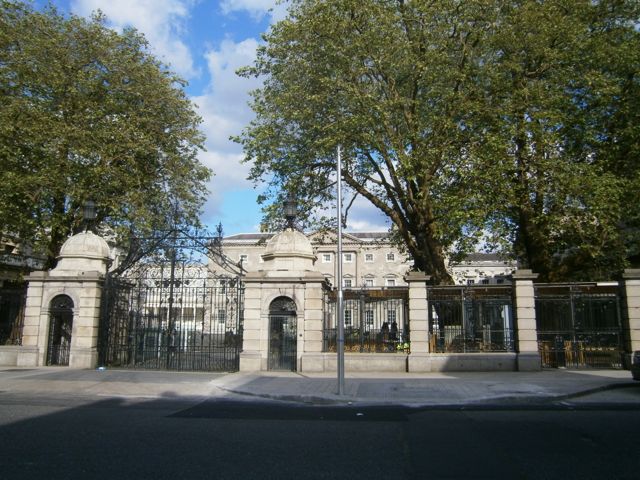
Leinster House, Dublín, ubicación del Dáil, parlamento del estado de Irlanda (imagen descargado del internet)

El Estado recibió más refugiados de guerra de Ucrania de los que pudo manejar cómodamente, con arreglos para su alojamiento que incluyeron campamentos del Ejército, discusiones sobre islas, y retrasos en la investigación de antecedentes de personas que ofrecen alojamiento a cambio de pagos del gobierno.

El Gobierno se mantiene en línea con la tendencia dominante entre los estados de la UE y de los EE.UU./OTAN. Todos los partidos de la Oposición y la mayoría de los diputados Independientes también siguen esa línea, con una pequeña colección en la Izquierda condenando simultáneamente la guerra de la OTAN.

El movimiento republicano (“disidentes”) contiene una variedad de opiniones sobre ese tema incluso dentro de las organizaciones, por lo que ningún partido se siente capaz de expresar una posición concreta sobre la cuestión.

En todo el estado, la influencia de los medios de comunicación se puede ver mucho en el apoyo público al régimen ucraniano y la oposición a Rusia, pero también mucho de eso se debe al odio tradicional a la invasión, junto con la falta general de acceso a fuentes alternativas.

Cualquiera que se aparte de la línea aprobada, por ejemplo, dos eurodiputados irlandeses (Clare Daly y Mick Wallace), es probable que sea atacado ferozmente por los medios de comunicación (y lo que aquí pasa por “la izquierda”), incluso la esposa del presidente, Sabina, que simplemente dijo en público que la lucha debe terminar en negociaciones.

El peligro de que el Estado se una a la OTAN se ha visto muy disminuido por la oposición pública y también se ha desvanecido de unirse a cualquier alianza militar de la UE. Sin embargo, el debate público en torno a él arrojó algunas señales peligrosas de interés por parte de al menos una sección de la élite gobernante.

Además, el Taoiseach (equivalente a Primer Ministro) declaró en el Dáil que el Gobierno podría tomar tal decisión sin la necesidad de un debate y votación sobre la cuestión en el Dáil.

Siguiendo con el Gobierno, recientemente decidió un plan para reducir las emisiones de CO2 en un 25%, muy por debajo de lo que se ha declarado públicamente como necesario para evitar un desastre ambiental.

La decisión fue atacada desde la izquierda y por el partido Demócratas Progresistas pero el Sinn Féin intentó evitar comprometerse ya que quiere el apoyo de los grandes ganaderos y de la industria cárnica.

El intento del fascista Irish Freedom Party de realizar una manifestación en Limerick en marzo fue interrumpido por un gran grupo de antifascistas, ahogando los discursos en gritos y abucheos, muchos ondeando banderas del arcoíris y cantando “¡Escoria fascista fuera de nuestras calles!”

Sección de la oposición a una decena de fascistas del Irish Freedom Party realizando un mitin en la ciudad Limerick en marzo. (Imagen descargado del Irish Socialist Party).

En el servicio de salud (una mezcla de provisión pública y privada), con fondos y personal insuficientes, ya tambaleándose por las tensiones de lidiar con Covid, se citó a un abogado que representa al personal, el efecto de que muchos miembros del personal médico agredidos y amenazados demandarán al Gobierno.

Esto se llevará a cabo bajo las disposiciones de la legislación de Salud y Seguridad en el Trabajo que obliga a los empleadores a tomar medidas para eliminar o, cuando no sea del todo posible, reducir los riesgos para sus empleados. Estos últimos ya no están dispuestos a aceptar los malos tratos como parte ineludible del trabajo.

El sindicato IMPACT, que representa a muchos trabajadores de Dunne’s Stores, ha reclamado un aumento salarial del 7,7 %, días de vacaciones adicionales, mejores descuentos y más contratos a tiempo completo. El costo de vida actual ha aumentado a un promedio del 9%, pero la dirección sindical dice que los beneficios para sus miembros se nivelan por encima de esa cifra.

La última vez que IMPACT se enfrentó a la dirección del supermercado, el sindicato fue derrotado y se quejó de que no recibía suficiente apoyo de sus miembros.

Veinte años de “participación social” de las direcciones sindicales desde la década de 1980 con representantes del gobierno y de los empleadores han dejado a los sindicatos débiles y bajos en afiliación (del 60% al 27%); muchos trabajadores jóvenes nunca han estado en un sindicato ni los consideran útiles.

Las huelgas actuales de trenes en Gran Bretaña por parte del sindicato Ferroviario, Marítimo y de Transporte han despertado cierto interés en Irlanda, ya que el secretario general del sindicato, Mick Lynch, es de ascendencia irlandesa y ha declarado que su héroe es James Connolly, el socialista revolucionario irlandés-escocés ejecutado por Gran Bretaña en 1916.

Este año, siendo el centenario del inicio de la Guerra Civil Irlandesa (1922-1924), muchas conmemoraciones y charlas históricas están siendo organizadas por grupos que no representan al Estado. Este último, después de todo, es descendiente directo de los vencedores de esa Guerra Civil.

Pancarta de la campana para rescatar al mercado callejero y campo de batalla de 1916, participando en el desfile en Junio 2022 de conmemorar el comienzo de la Guerra Civil de Irlanda en 1921. El parque al otro lado de la pared a la izquierda es la ubicacíon de fosa común de insurgentes del 1798; en el fondo lejano se ve parte de los antiguos cuarteles británicos, más tarde rebautizados como Collins Barracks pero ahora un Museo Nacional. (imagen: D.Breatnach)

El movimiento nacionalista-republicano se dividió en 1921 sobre si aceptar el Tratado anglo-irlandés. A pesar de las instrucciones, los delegados a las conversaciones en Londres, bajo la dirección de Michael Collins, ya habían firmado el contenido. Una pequeña mayoría votó a favor en el Dáil.

Sin embargo, una gran mayoría del ala militar que había luchado en la Guerra de la Independencia (1919-1921) (el IRA, Cumann na mBan, Fianna Éireann y el Ejército de Ciudadanos Irlandeses) se oponía a la aceptación de algo que no fuera una República Irlandesa. Algunos de ellos ocuparon los Four Courts en 1922.

Bajo la presión de los británicos, en particular de Churchill y, sin duda, internamente también, el nuevo gobierno irlandés de Michael Collins, con artillería suministrada por los británicos, abrió fuego contra Four Courts (la segunda vez desde el levantamiento de 1916), mató a dos miembros del IRA e hirió a y arrestó a otros.

Ejército del Estado nuevo con artillería prestado por los británicos, bombardeando fuerzas republicanas (IRA) en Los Cuatro Juzgados, iniciando la Guerra Civil en Junio 1921 (imagen descargado del internet)

Cathal Brugha, un héroe de 1916 y uno de los que habían tratado de conciliar entre ambos lados, tomó medidas con otros para tratar de desviar algunas de las fuerzas atacantes de los Cuatro Patios. Ocuparon edificios en la calle O’Connell en el centro de la ciudad, donde Brugha resultó herida de muerte.

La Guerra Civil se extendió al país, durante la cual otro destacado republicano irlandés, Harry Boland, antiguo amigo cercano de Michael Collins, fue asesinado a tiros por soldados enviados por Collins para arrestarlo; aunque se afirmó que había sido un accidente, se necesitaron diez horas para llevarlo al hospital.

El 26 de junio, la Asociación de Tumbas Nacionales organizó una marcha desde el exterior del Museo de Historia Nacional de Collins Barracks hasta los Four Courts para conmemorar el ataque por el “Estado Libre”. Allí se pronunciaron discursos militantes con llamamientos al establecimiento de la República por la que se había luchado.

El punto de partida fue simbólico, ya que el antiguo cuartel del ejército británico lleva el nombre del hombre que ordenó el ataque a los Four Courts y también está justo al lado de Croppies’ Acre, un parque de ocio en el sitio de una fosa común de los insurgentes de los irlandeses unidos en 1798 y sospechados seguidores.

Harry Boland fue conmemorado en una discusión histórica, eventos deportivos y ceremonias junto a la tumba durante los tres días del fin de semana pasado, que incluyó el centenario de su muerte.

Boland había sido director del IRB en Irlanda hasta 1921 (que dejó a Collins para acompañar a De Valera en una gira de recaudación de fondos por los EE. UU.), un hábil organizador, miembro de la Liga Gaelica, un prometedor jugador (en “hurling”) y administrador de su club en la Asociación Gaélica de Atletismo.

Parte de la asistencia en el cementerio de Glasnevin a la conmemoración de Harry Boland, matado por el Estado Irlandés en la Guerra Civíl (imagen: D.Breatnach)

El 7 de julio, Cathal Brugha fue conmemorado con un discurso y una canción en el lugar donde le dispararon, organizado por Republicanos Independientes de Dublín, que también han erigido paneles en varios lugares para recordar a luchadores del IRA asesinados allí por las fuerzas del “Estado Libre” durante la Guerra Civil.

También hay planes para conmemorar el 81 (u 83, los números están en disputa) ejecutados formalmente por el nuevo Estado durante la Guerra Civil, más de lo que los británicos habían ejecutado entre 1916 y 1921.

La calle Moore de Dublín lleva uno de los paneles que conmemoran a un voluntario del IRA asesinado por las fuerzas del Estado irlandés el 9 de junio de 1922, pero el sitio también fue un campo de batalla en 1916. La guarnición del cuartel general del Alzamiento evacuó el GPO en llamas y tuneló por los 16 edificios de la terraza central.

Tanto insurgentes como civiles murieron en las calles aledañas. 300 hombres y mujeres tomaron posiciones allí, incluidos cinco de los Siete Signatarios de la Proclamación de 1916, y fue allí donde se tomó la decisión de rendirse a las fuerzas británicas que los rodeaban.

La calle es también un mercado callejero centenario de alimentos frescos y otros artículos. Sin embargo, los especuladores inmobiliarios lo están desmantelando deliberadamente, y planean un hotel y una zona comercial de cadenas de tiendas, con el apoyo de algunos altos funcionarios municipales de Dublín y ministros del gobierno.

La campaña para conservar la memoria histórica y el mercadillo comenzó hace 20 años y en 2016 los edificios fueron ocupados durante seis días y bloqueados durante seis semanas para evitar su demolición.

Un grupo ha mantenido un puesto de campaña en la calle durante dos horas todos los sábados desde septiembre de 2014 y ha recolectado más de 380.000 firmas para peticiones. Sin embargo, los funcionarios de planificación municipal han dado luz verde a los especuladores y ahora están sujetos a Apelaciones de Planificación.

La vivienda sigue en crisis dentro del estado con la peor situación en Dublín: alquileres más alto que nunca, precios de compra elevados al nivel del auge de los 1990s, familias en albergues, gente durmiendo (y muriendo) en las calles y problemas estructurales con las viviendas construidas de forma privada durante el boom inmobiliario.

Ante la falta de iniciativa de vivienda pública y la dependencia total del gobierno en el sector privado, un pequeño grupo llamado Revolutionary Housing League ha estado ocupando propiedades vacías y llamando a otros a hacer lo mismo, lo cual ha hecho llamar la atención del público (y de la policía y los tribunales).

El Comité Anti internamiento de Irlanda, de diez años de antigüedad, se relanzó a finales de julio como la Campaña Anti internamiento de Irlanda con una constitución actualizada. El grupo sigue siendo independiente de cualquier partido político y realiza piquetes de sensibilización pública con regularidad en Dublín.

EN LOS 6 CONDADOS

El unionismo, esa estructura política antidemocrática y antiirlandesa de apoyo colonialista británico, continúa quejándose de los efectos del Brexit que apoyaron y en protesta, flexionando la amenaza lealista y negándose a formar el gobierno que gestiona la colonia para Gran Bretaña.

La ideología reaccionaria, racista y homofóbica del Lealismo, sembrada por el colonialismo británico con efectos asesinos, enciende cada mes de julio enormes hogueras para celebrar su ideología atrasada, en las que queman banderas irlandesas y palestinas y retratos de algunos políticos.

También continúan despotricando y delirando sobre las “leyes extranjeras” (!) bajo el Brexit (es decir, la salida del Reino Unido de la UE, por la que votaron una mayoría de unionistas), según las cuales se impondrán controles aduaneros a las importaciones de Gran Bretaña a la colonia que aún pueden recibir importaciones del Estado irlandés (que permanece en la UE).

Este año, el lealismo celebró como héroe al miembro de la UDA, John Steele, que murió al cayer de la construcción de una monstruosa hoguera. Dos de la gendarmería colonial, el PSNI, fueron fotografiados saludando su féretro. Otro asesino leal murió al caer en los escalones de su hogar en su exilio en Escocia.

La Ley de Operaciones en el Extranjero (personal de servicio y veteranos) aumentará la impunidad del Estado británico, que evitará el enjuiciamiento de miembros de las fuerzas armadas del Reino Unido acusados de delitos, incluida la tortura, cometidos en el extranjero hace más de cinco años.

El gobierno del Reino Unido también tiene la intención de evitar que se inicien casos penales con respecto al conflicto de 30 años en su colonia y está considerando lo mismo con respecto a los casos civiles, pero todas las partes de la colonia británica se oponen a las propuestas.

El 16 de julio se llevaron a cabo protestas públicas por toda Irlanda por el encarcelamiento continuo de los incriminados Craigavon Two, John Paul Wooton y Brendan McConville, con panfletos y pancartas en el puente Ha’penny de Dublín y muchos otros en las cuatro provincias.

Protesta en solidaridad con los Craigavon Two el 16 de Junio en Dublín (imagen: D.Breatnach)

El internamiento sin juicio continúa en Irlanda por otros medios. El caso más reciente es el del ex preso político republicano irlandés Jason Ceulmans, liberado bajo licencia pero luego revocado por el Secretario de Estado y ahora de regreso en la cárcel sin cargos ni juicio.

Los republicanos y socialistas irlandeses (de varios grupos y activistas independientes) impidieron al fascista Irish Freedom Party llevar a cabo su propaganda racista y homofóbica en Belfast en julio de 2020. Tres republicanos de diferentes grupos fueron acusados por la policía en 2021.

El caso contra los tres fue desestimado en julio de 2022 luego de que la policía no presentara pruebas en su contra. En el Estado irlandés, varios republicanos todavía enfrentan cargos por la prevención masiva en 2016 del intento del grupo fascista islamófobo Pegida de lanzarse en Dublín).

Los activistas buscan la publicación de información policial y una investigación adecuada sobre el niño mestizo de 14 años Noah Donohoe de un área nacionalista, encontrado desnudo y muerto en un desagüe pluvial en distrito leal de Belfast en Junio 2020 con la sospecha generalizada de un encubrimiento policial.

Noah Donohoe, muerto de manera misteriosa (imagen descargado del internet)

Varios miles protestaron en Belfast el 13 de agosto contra la policía colonial pidiendo que emitiera un certificado de “inmunidad de interés público” que permitiera retener algunas pruebas en la investigación sobre la muerte de Noah, que el forense puede conceder o rechazar.

Fin.

Protesta en Belfast 13 agosto en solidaridad con la madre de Noah Donohoe y contra ocultación de información por la policía colonial británica el PSNI. (imagen descargado del internet)


ENLACES ÚTILES y más información (todo en inglés):

Objetivos de emisiones de CO2 bajos: https://www.thejournal.ie/emissions-targets-problematic-5828736-Jul2022/

Sindicato MANDATE: https://mandate.ie/

Agresiones a trabajadores de la salud: https://www.irishexaminer.com/news/arid-40853276.html
https://www.independent.ie/opinion/comment/when-nurses-are-being-threatened-and-punched-its-time-for-tougher-laws-to-protect-them-from-aggressors-41676939.html

Conmemoraciones Históricas:
National Graves Association: nga.ie and https://www.facebook.com/NationalGravesAssociation/
Independent Republicans Dublin: (no link as yet)

Campaña de Moore Street: https://www.facebook.com/save.moore.st.from.demolition
and smsfd.ie

Lucha por la vivienda:
Revolutionary Housing League: https://www.facebook.com/JamesConnollyHouse/
https://catuireland.org/about/

Anti-Internamiento: https://www.facebook.com/people/Ireland-Anti-Internment-Campaign/

Lealismo británico: https://www.irishnews.com/news/northernirelandnews/2022/07/14/news/hundreds_of_mourners_attend_funeral_for_bonfire_fall_victim-2772661/
https://www.ft.com/content/effe6649-f3d9-44bc-8577-f5a89653133f

Impunidad británica:
https://www.hrw.org/news/2020/03/20/uk-bill-license-military-crimes
https://theconversation.com/troubles-amnesty-uk-government-plan-would-subvert-peace-and-reconciliation-in-northern-ireland-164658
https://www.euronews.com/2021/07/14/northern-ireland-uk-plans-to-end-prosecutions-for-historical-troubles-crimes

Craigavon Two: https://www.facebook.com/mrsmcconville
https://www.thecanary.co/uk/analysis/2019/03/09/despite-unreliable-evidence-the-craigavon-two-have-spent-the-last-10-years-in-prison/

Anti-Fascismo: https://www.facebook.com/people/Dublin-Republicans-Against-Fascism/
https://www.facebook.com/limerickagainstfascism/
https://saoradh.irish/saoradh-nuacht/f/crown-force-case-against-anti-fascist-saoradh-member-thrown-out

Noah Donohoe: https://www.vice.com/en/article/v7dkgy/he-was-seen-cycling-naked-through-a-housing-estate-and-then-he-vanished
https://www.bbc.com/news/uk-northern-ireland-62533892

Basque Solidarity for Corsican Patriot Murdered in French Jail

Clive Sulish

(Reading time: 2 mins.)

SPEECH DELIVERED AT THE RALLIES ORGANISED BY JARDUN IN RESPONSE TO THE MURDER OF CORSICAN POLITICAL PRISONER YVAN COLONNA (Se encuentra la versión anterior en castellano/español al fondo)

Yvan Colonna was from a young age a member of the Corsican liberation movement. After being forced to remain in hiding for four years, he was arrested in 2003, accused of participating in an action carried out by an anonymous group. The accusation was based on statements of several of the movement’s members detained at the police station, who later rejected the statements but Yvan was sentenced to life imprisonment.

Posters demanding justice for Yvan Colonna after his arrest (Photo sourced: Internet)

Colonna was left in a very serious coma after the beating by a jihadist prisoner in Arles prison. On Monday of this week, Yvan passed away after three weeks in hospital. During that time there were riots denouncing the role of the French state in Yvan’s murder.

Yvan was murdereded by the penitentiary policy of dispersal and the conditions of the prison. We in the JARDUN Coordination charge that the beating and death received by Yvan was a direct consequence of the penitentiary policy of the French State. Likewise, we want to underline the need to create an organisation in support of the freedom of political prisoners and the fight against oppression and exploitation.

It should not be forgotten that in Corsica, the struggle for independence has been ongoing for decades with the aim of overcoming the political-economic system imposed by the French State and fighting for a popular and democratic government that would act in favour of the Corsican people. The struggle of the Corsicans is the struggle against French imperialism, against the oppression of the local working people and against the exploitation they suffer.

In Euskal Herria (the Basque Country – Trans.) we are well aware of the repression and oppression by oppressive states and we are witnesses to the massacres committed so many times by the French State. Because we cannot forget the imperialist attitude of the French State in Algiers and other colonies, becoming, together with the United States, the main promoters of contemporary torture.

Solidarity picket in Gastheiz/ Vitoria, southern Basque Country, on Friday 25th (Photo: Jardun Koordinadora)

All of this shows us nothing less than the need for the organisation of the working class. It is evident that both the imperialist power and the oppressive States exercise a monopoly on violence to defend their economic interests and, in every nation, those who pay are always the working class.

It is time to denounce the fraud of social peace, it is time to denounce the warlike attitude of NATO, in Donbass, the Sahara, Palestine, today they are waging endless wars in defence of the interests of imperialism and its servants — and in view of this, it is time to awaken internationalist solidarity!

For this reason, we in JARDUN proclaim that it is time to turn to revolutionary organisation for all working people! Because only the organised people can offer real help and, as far as we are concerned, only the Basque working people can obstruct the participation of the Spanish and French States, organizing themselves in Euskal Herria to face the enemy, working for a political system in favour of the Basque working people.

We are clear that struggle is the only way and we will loudly proclaim that we have to confront the enemy, exploitation and class oppression. That is why we encourage you to join the organisation, because it is time to fight, it is essential to resist!

AGUR ETA OHORE YVAN! (Farewell with Honour Yvan!)

GORA KORSIKAKO HERRI LANGILEAREN BORROKA! (Long live the struggle of the Corsican working people!)

GORA EUSKAL HERRIA ASKATUTA! (Long live a free Basque Country!).

end.

Solidarity picket in Donosti/San Sebastian, southern Basque Country, on 26th March (Photo: Jardun Koordinadora)

Lectura lanzada en las concentraciones organizadas por JARDUN ante el asesinato de Yvan Colonna

Yvan Colonna era miembro del movimiento de liberación corso, en el que militó desde joven. Tras ser obligada a permanecer 4 años en la clandestinidad, fue detenida en 2003 acusada de participar en una acción llevada a cabo por un grupo anónimo. La acusación se fundamenta en la declaración de varios de los miembros detenidos en la comisaría, que posteriormente rechazaron la declaración, pero Yvan fue condenado a cadena perpetua.

Colonna quedó en coma muy grave tras la paliza de un preso yihadista en la cárcel de Arlés. El lunes de esta semana, Yvan falleció cuando llevaba 3 semanas hospitalizado. Con el objetivo de denunciar el papel del Estado francés en el asesinato de Yvan desde que ingresó en hospital, durante ese tiempo  ha habido disturbios.

Yvan fue asesinado por la política penitenciaria por la dispersión vivida y las condiciones de la prisión. Desde la  coordinadora JARDUN  denunciamos que la paliza y la muerte recibida por Yvan ha sido consecuencia directa de la política penitenciaria del estado francés. Asimismo, queremos subrayar la necesidad de articular una organización a favor de la libertad de los presos políticos y de la lucha contra la opresión y la explotación.

No hay que olvidar que en Córcega, la lucha por la independencia se ha dado durante décadas con el objetivo de superar el sistema político económico impuesto por el Estado francés y luchar por un gobierno popular y democrático que actuara en favor del pueblo corso. La lucha de los corsos es la lucha contra el imperialismo francés, la opresión del pueblo obrero local y la lucha contra la explotación que sufren.

En Euskal Herria conocemos bien la represión y la opresión de los estados opresores y somos testigos de las masacres cometidas tantas veces por el Estado francés. Porque no podemos olvidar la actitud imperialista del Estado francés en Argel y otras colonias, llegando a ser, junto con los Estados Unidos, los principales impulsores de la tortura contemporánea.

Todo ello no nos demuestra más que la necesidad de la organización de la clase trabajadora.. Es evidente que tanto la potencia imperialista como los Estados opresores ejercen el monopolio de la violencia para defender sus intereses económicos, y en todo pueblo, su pagador, es siempre la clase obrera.

Es hora de denunciar el fraude de la paz social, es tiempo de denunciar la actitud guerrera de la OTAN, Donbass, el Sáhara, Palestina, hoy en día están dando un sinfín de guerras en defensa de los intereses del imperialismo y de sus siervos, ¡y ante eso es tiempo de despertar la solidaridad internacionalista!

Para ello, desde JARDUN proclamamos que es hora de volcarse en la organización revolucionaria para todo pueblo obrero!! ¡Porque sólo el pueblo organizado puede ofrecer una verdadera ayuda, y en lo que a nosotros se refiere, sólo el pueblo trabajador vasco puede interrumpir la participación de los Estados Español y Francés, organizándose en Euskal Herria para hacer frente al enemigo, trabajando por un sistema político a favor del pueblo trabajador vasco.

Nosotros tenemos claro que la lucha es el único camino y proclamaremos en voz alta que tenemos que enfrentar al enemigo, a la explotación y la opresión de clase. Por eso os animamos a uniros a la organización, porque es tiempo de lucha, ¡es imprescindible resistir!

AGUR ETA OHORE YVAN!

GORA KORSIKAKO HERRI LANGILEAREN BORROKA!

GORA EUSKA HERRIA ASKATUTA!

LAS AUTORIDADES BUSCAN PRISIONEROS IMPORTANTES FUGADOS

25 Diciembre

“Ayer se escapó de la custodia a importantes prisioneros y ahora se está llevando a cabo una intensa persecución. Se advierte a la gente que no los ayude so pena de un proceso penal y de sanciones severas si es condenado.

“Según fuentes confidenciales, pero no confirmadas por las autoridades, se cree que los prisioneros son Aodh Rua Ó Domhnail y Art y Henry O’Neill, del los clanes importantes de la provincia de Ulster, cuales escaparon de su confinamiento en el castillo de Dublín. Se cree que se sospecha de asistencia interna.

“Los prisioneros pueden dirigirse en una de varias direcciones o pueden haberse separado. Es probable que el frío y la nieve retrasen su avance, pero también impiden la búsqueda”.

Tal, en el lenguaje moderno, podría haber sido la respuesta de los medios de comunicación de los ocupantes ingleses a la fuga el día de Navidad de 1591 de los rehenes políticos Aodh “Rua” (“Pelirojo”) Ó Domhnail, Art & Henry O’Neill del Castillo de Dublín. Un asistente se reunió con ellos y les dio ropa ligera para que se cambiaran de las que se habían ensuciado por su escape a través del conducto del baño del castillo.

El Record Tower, Castillo de Dublín, tomado en recién anos. (Foto: D.Breatnach)

Los fugitivos estaban mal provistos y vestidos o se habían separado de las provisiones y la ropa preparadas y estaban a pie. Además, al salir de la ciudad de Dublín, uno de los hermanos Ó Néill (‘Henry’), se separó y se hizo su proprio camino.

Cuando llegaron a cierto lugar en las montañas de Wicklow, Art Ó Néill ya no pudo viajar y el asistente fue a buscar ayuda. Cuando regresó con un grupo de rescate enviado por Fiach Mac Aodh Ó Broin, su hermano Art había muerto y aunque Aodh Ó Domhnaill todavía estaba vivo, iba a perder el dedo gordo de cada pie por congelación.

Una impresión gráfica de los hombres de Fiach Mac Aodh que encuentran a Art O’Néill muerto y Aodh Rua Ó Domhnaill en una situación desesperada. (Imagen encontrado: Internet)

UN ENEMIGO FORMIDABLE

Aodh Rua Ó Domhnaill se convertiría en un enemigo formidable de los ingleses en los años venideros, primero ganando el liderazgo de su clan, luego estallando en una rebelión abierta y en una conspiración secreta con Ó Néill, quien más tarde se unió a él abiertamente en la Guerra de los Nueve Años.

En el 15 Agosto 1599, Aodh Rua Ó Domhnaill preparó emboscada a una columna de 1,700 en el Puerto (montaña) de Corrsliabh (Curlew Pass en inglés) en lo que hoy es el Condado de Ros Comáin (Roscommon). La columna invasora fue encabezado por el Señor Conyers Clifford y su cabeza fue presentado a Ó Domhnaill al fin de la batalla, cual fue una derrota para los militares ingleses en que fallecieron 1,230 de sus soldados.

“Art’s Cross” (la Cruz de Art) en las montañas de Wicklow, donde los rescatistas los encontraron. (Photo encontrada: Internet)

Aodh Ó Néill, en alianza con Aodh Rua Ó Domhnail, resistió todos los intentos de los ingleses de castigar a los clanes del Ulster, les infligió fuertes derrotas y comenzó a atraer a otros clanes a sus estandartes. La rebelión se desvaneció en la batalla de Kinsale (Cath Cinn tSáile) en 1602 en lo que hoy es el condado de Cork, lejos del territorio de ambos caciques, donde una fuerza invasora de aliados españoles había sido sitiada por los ingleses.

Tras la derrota de Kinsale, los dos líderes y muchos otros se huyeron al Reino de España de Felipe II con intención de volver a Irlanda con ayuda militar del Reino pero nunca sucedió.

La partida de Ó Néill y Ó Domhnaill provocó una evacuación a gran escala de los líderes de los clanes que se resistían y sus familias, lo que ha sido llamado “La Huida de los Condes” y abrió el camino para una profundización de la conquista inglesa.

La resistencia a gran escala volvió a estallar ostensiblemente por una cuestión de religión, aprovechando el conflicto interno inglés en 1649 y en 1688, en ambas ocasiones en las que los irlandeses apoyaron al bando inglés perdedor. Los vencedores completaron no solo su conquista, sino también la apropiación a gran escala de la tierra para la plantación de colonos que debían ser protestantes, de habla inglesa y tener prohibido emplear católicos, una guarnición colono para los ingleses en Irlanda.

Algunos creen que Aodh Rua fue envenenado por el espía anglo-irlandés, James “Spanish” Blake. Sea así o no, Aodh Rua murió el 10 de septiembre de 1602 en el Castillo de Simancas, Valladolid, España. Fue enterrado en el capítulo del monasterio franciscano de Valladolid. Aunque el edificio fue demolido en 1837, la ubicación exacta de la tumba puede haber sido descubierta después de una excavación arqueológica española en mayo de 2020. Si sus restos se identifican con éxito, serán devueltos para su entierro en el condado de Donegal.

El mensaje en palabras es sin sustancia de realidad pero el arte del mural es magnífico. En Ard Eoin, Béal Feirste (Ardoyne, Belfast). (Foto encontrado: Internet)

MOROCCO OCCUPATION USING DRONES AGAINST SAHARAWI RESISTANCE

POLISARIO FIGHTER WOUNDED IN DRONE-GUIDED ATTACK

JAIRO VARGAS MARTÍN@JAIROEXTRE

(Reading time: 3 mins.)

SPECIAL REPORT FROM THE SAHARAWI REFUGEE CAMPS IN TINDUF (ALGERIA)

(Report in https://www.publico.es/internacional/drones-marroquies-combatiente-saharaui-herido-guerras-marruecos-me-ataco-dron-gran-diferencia.html translated by D.Breatnach)

Mohamed Fadel states that he was seriously injured last April by a Moroccan drone, during the same action in which the head of the Saharawi National Guard was killed. Morocco is silent on the use of these unmanned devices that have become the obsession of the Polisario Front troops.

Mohamed Fadel, ‘Mundi’, in a tent in the Saharawi refugee camp of Bojador, in Tindouf, Algeria, on October 15.

Mohamed Fadel can say that he has firsthand experience of the changes between the two wars against Morocco in which he was wounded. The first was in 1985, when a shell fragment hit him in the arm. But he recovered and returned to the front in no time. The second time was the recent April one and “it was more serious,” he says, showing the marks on his body under his military jacket.

Polisario female fighters (Photo cred: Dominique Faget/ Getty)

Burns to his face, hands and arms, two scars the size of a coin on his right side and an incision of more than a foot long across the middle of his belly. “They had to open me up to remove the three pieces of shrapnel that I had inside. It took me three months to fully recover,” he explains in perfect Spanish. “It was a drone attack. That is now the big difference,” insists this seasoned 64-year-old Saharawi fighter.

But Mundi, as everyone knows him in the refugee camps in Tindouf, Algeria, does not like to talk about two different wars. This, he says, the one that the Polisario Front declared on November 13 after 30 years of ceasefire, “is just a continuation of the previous one”, the one that began in 1975, after the military occupation of the former Spanish Sahara by part of Morocco. “The enemy is the same and the objective is the same: the referendum that has not been held and the independence of the Sahara. The only things that have changed are the means, the technology,” explains the Saharawi fighter, in the shade of a tent in the Bojador refugee camp.

“They are neither seen nor heard, but they are there and attack at any moment”

Moroccan drones are the worst nightmare in this new stage of hostilities, according to all the Sahrawi fighters interviewed by Público during the Polisario-organized trip to the camps last week.

“They are neither seen nor heard, but they are there and attack at any moment,” insists Mundi, although at the moment they have not shown any documentary evidence certifying the presence of armed or surveillance drones. The two parties accuse each other of using them, although both deny it, according to the latest report on this conflict by the UN Secretary General, Antonio Guterres.

Saharawi women living in Gastheiz (San Sebastian) in the south-west Basque Country demonstrate in solidarity with their people’s struggle and the Polisario Front (“askatu” = “free”) in May 2020. (Photo source: Internet)

An almost paranoid obsession

After each Sahrawi attack against the defensive Wall built by Morocco, all eyes are on the sky. Drones feel close almost always, even if they are not there, like an almost paranoid obsession. One of the main military directives of the Polisario is to stay away from cars when they halt, because they are their main target. When they believe that a drone is following behind, the old Sahrawi vehicles separate, stop and the unit that was on board runs away.

Morocco has embraced the purchase of Turkish-made armed drones, according to ‘Reuters’

These unmanned devices make up much of modern warfare and have been instrumental in recent conflicts. One of the most recent, for example, was the capture by Azerbaijani troops of Nagorno Karabakh last year. They defeated the Armenians thanks to Turkish-made drones, deploying practically no soldiers to the front, recalls the arms trade expert Tica Font, from the Delàs Center for Peace Studies.

Font emphasizes that Turkey, Azerbaijan’s main ally in the conflict, is one of the few countries that manufacture and sell drones capable of loading and firing missiles, along with the United States, Rabat’s main military supplier, followed by France and Spain.

Indeed, as Reuters recently revealed, Turkey has expanded the sale of armed drones to Morocco. Specifically, several sources cited by the British agency speak of purchase requests from Rabat of the Bayraktar TB2 model, of which they would have already received a first batch ordered in May.

The Moroccan Army attack on the protest camp at Guergat on 13 Nov. 2020 which sparked the long-delayed renewal of Polisario armed struggle (Photo source: Internet)

As we moved away, a drone followed us

Although that was two months after the attack Mundi is talking about. According to him, the bombing that wounded him was on April 11. “In broad daylight, at four in the afternoon. We were near the Wall, we had just carried out an operation against a Moroccan base and they responded. First with artillery and, later, when we were moving away, a drone followed us,” he described.

His vehicle stopped and his three companions followed the rules of dispersing, but Mundi had no time to get to safety. “The missile landed very close to the car and I was level with the front wheel,” he recalls. He claims that that afternoon he was able to see one of the aircraft in the air, although he did not see it fire. He believes there had to be more than one, “because eight or nine missiles were launched, and that cannot be carried by a single drone,” he maintained.

Mohamed Fadel ‘Mundi’, wounded Saharawi Fighter photographed in Saharawi refugee camp, Tinduf, Algeria 15 Oct 2021 (Photo cred: Jairo Vargas)

In that Moroccan bombardment, Mundi explained, the esteemed head of the Saharawi National Guard, Adah el Bendir, 61, a noted military strategist expert in engineering and combat, died. The Polisario announced the important loss. Morocco, for its part, opted for its most effective tactic since the resumption of hostilities: silence and indifference. Only the Alawite news portal Le Desk reported that an Israeli-made Harfang model drone had participated in the attack on El Bendir. Morocco did not even want to claim a goal in a war that does not exist for Rabat.

However, the Delàs Center expert warned that most of the marketed drones are for surveillance and monitoring, and that they do not need to carry weapons to attack a target. “Many have all kinds of built-in radar and sensors that send information to a central computer. With that data, you can open fire with precision from any platform, be it a ship, an aircraft or a ground unit. Tens of kilometers from the target” says Font.

Saharawi struggle supporters in Bordeaux, France on 11 December 2020 (AFP). France is a Permanent Member of the UN Security Council and is the main European state supporting Morocco.

That’s Le Desk‘s version of the attack in which Mundi was wounded and El Bendir killed. According to this Moroccan portal, the drone laser marked the target and an F-16 fighter launched the projectiles.

“They do not scare us, because with fear nothing is done in war. But there is a lot of uncertainty, a lot of anxiety and tension,” he affirms after 46 years as a soldier in the Saharawi people’s army.

Mundi is confident that sooner or later they will find the formula to detect and demolish the Moroccan aircraft. “We learned to fight them when they raised the wall, we learned to shoot down their planes and we learned to capture their armour,” he says. “We are still starting. At the moment we are using a tactic of attrition. We attacked bases and retreated. In the 80s we also started that way when they built the wall. Until 1984 we did not carry out large-scale attacks. War has its times,” he says. This one has already lasted more than 40 years.

End.

USEFUL LINKS

SOLIDARITY

Western Sahara Action Ireland: https://www.facebook.com/groups/256377861125569/?

Algargarat Media

OTHER MEDIA ARTICLES

Youth yearning for independence fuel Western Sahara clashes: https://apnews.com/article/middle-east-africa-united-nations-algeria-morocco-507429fe13915902668f589179ce0c67?

https://www.mondaq.com/human-rights/1021716/war-resumes-in-occupied-western-sahara-an-interview-with-polisario-representative-kamal-fadel

https://www.euronews.com/2020/11/17/sahrawi-arab-democratic-republic-declares-war-on-morocco-over-western-sahara-region

https://www.middleeasteye.net/news/morocco-western-sahara-european-court-annuls-eu-deals

Drugs, War and the ELN

It’s not the guerrillas that are running the drug cartels …..

by Gearóid Ó Loingsigh

(Versión en castellano: https://rebelion.org/wp-content/uploads/2020/12/colombia_drogas_eln.pdf)

(Published elsewhere earlier in December, including Red Line; published here with author’s permission and section headings, photo choices (except one) and intro line are by Rebel Breeze editing)

The issue of drugs is one that is never far from public discourse on the Colombian conflict. Biased or just simply lazy journalists use the issue to ascribe motives for an endless list of events, massacre and murders. It is true that drug trafficking has permeated all of Colombian society and there is no sector that has not been impacted by it. But not everyone in Colombia is a drug trafficker. However, once again the King of Clubs is played to describe the conflict in terms of a drug problem.

Several Colombian newspapers have recently published articles on the supposed relationship of the guerrillas of the National Liberation Army (ELN) with drug trafficking and there are already eleven commanders who are under investigation for such crimes and are sought in extradition.[1]  They talk as if the ELN dominated the drugs trade, and talk of settling of accounts over drug money, as if they were a crime gang, instead of saying that the ELN takes drastic measures against its members who get involved in drug trafficking and that those internal executions are due to the indiscipline and betrayal of principles of some people and are not an internal dispute over money.[2]  Of course, the ELN in an open letter widely distributed on social networks and alternative press, denied any links to the drug trade.[3]  But, how true is this new tale?  Before looking at the accusations levelled against the ELN it is worth going over the history of drug trafficking in Colombia and the reality of the business in international terms.

POLITICIANS, GUERRILLAS AND BANKS

Let’s start with the obvious.  When the FARC and the ELN were founded in 1964 drug trafficking was not a problem in the country and there were no large plantations, i.e. the existence of the guerrillas predates the drugs trade.  Later in the 1970s the country went through the marijuana bonanza on the Caribbean coast, but it is the emergence of the large drugs cartels in 1980s around the production of cocaine that would define forever the shape drug trafficking in the country would take.  Up till the 1990s the country was not self sufficient in coca leaf, even though it was the main manufacturer of the final product: cocaine.  Escobar was dead by the time Colombia achieved self sufficiency and it is in that context that the discourse of blaming the FARC for the drugs trade gained ground, completely ignoring that the main narcos were the founders of the paramilitary groups.  One of the most notorious paramilitary groups in the 1980s was the MAS (Death to Kidnappers) founded by the Cali Cartel and other drug traffickers in response to the kidnapping by M-19 of Marta Nieves Ochoa a relative of the Ochoa drug barons.

That discourse, however, was useful in justifying Plan Colombia and there was an element of truth to it, but not that much back then.  The FARC’s relationship with the drugs trade has not been static and has evolved over time.  Almost everyone accepts that they began by imposing a tax on the production of coca leaf, coca base or cocaine in the territories they controlled.  The initial relationship changed and the FARC went from just collecting a revolutionary tax to promoting the crop, protecting laboratories and even having laboratories of their own and in some cases, such as the deceased commander Negro Acacio, got directly involved in the drug trade.  There is no doubt on the issue.  But neither were they the big drug barons that they tried to have us believe, those barons are in the ranks not just of the Democratic Centre but also the Liberal and Conservative parties.  It is forgotten that Samper’s (1994-1998) excuse regarding drug money entering his campaign’s coffers was and still is that it was done behind his back, but no one denies that drug trafficking has to some degree financed every electoral campaign in the country.  Although companies like Odebrecht play a role at a national level, at a local and regional level drug trafficking decides who becomes mayor, governor, representative in the house and even senators.  Even the brother of the current Vice-President Marta Lucía Ramírez was a drug trafficker and there are loads of photos of many politicians with Ñeñe Hernández and Uribe appears in photos with the son of the paramilitary drug trafficker Cuco Vanoy.  It is a matter of public knowledge that several high ranking police officers close to Uribe such as his former head of security Mauricio Santoyo were extradited to the USA for drug related crimes and Uribe’s excuse was the same as Samper’s: it was all done behind his back.

Alvaro Uribe, ex-President of Colombia and patron of current President Duque is under house arrest and investigation for close links with drug cartels and murder paramilitary organisations. (Photo source: Internet)
Late drug mafia boss”Nene” Jose Guillermo Hernandez (r) with President Ivan Duque ((Photo source: La Nueva Prensa)

NOT THE ELN

But when we look at the extent of illicit crops in Colombia, we can clearly see the reason why they are linked to the FARC for so long and not to the ELN.  The reason is simple, the majority of the large plantations of coca and opium poppy were to be found in areas under the influence of the FARC.  If we look at the crop monitoring carried out by the United Nations Office on Drugs and Crime (UNODC) we can see that in 2001 the main departments (administrative regions: Colombia has 32 — RB editing) where there were crops were almost exclusively FARC fiefdoms.

In 2001, coca was to be found in 22 departments of the country, compared to just 12 in 1999.  However, despite the expansion, just two areas accounted for the majority of the crops:  Putumayo-Caquetá had 45% of the total amount of coca (about 65,000 hectares) and Meta-Guaviare-Vaupés with 34% of the area (about 49,000 hectares) i.e. 79% of the total area under coca.[4]  They were areas that were completely dominated by the FARC, not a single eleno was to be found in those territories and if they did venture in, it was undercover at the risk of execution by the FARC were they discovered as the FARC did not tolerate political competition in their fiefdoms. When one looks at the map of crops back then, one can see not only the concentration in those areas but also almost all the other departments were dominated by the FARC and those where there were significant amounts of coca and also an ELN presence, one finds Cauca with 3,139 hectares, Nariño with 7,494 hectares and the Norte de Santander with 9,145 hectares.  But in those areas there was a certain territorial balance between the different guerrillas and one of the few departments where the ELN was clearly the dominant force was Arauca with 2,749 hectares.[5]  But when we look at the counties we can see that it is not as clear cut, as in the Norte de Santander 83% of the coca crops were to be found in just one county: Tibú, FARC fiefdom for many years before the paramilitary takeover in 1999.[6]  In Arauca the county of Araquita accounted for 60% of the crops in the department and it was also a FARC fiefdom within an area dominated by the ELN.  Thus it is obvious as to why they spoke almost exclusively about the role of the FARC in drug trafficking and not the ELN at that time.

Years later the situation had not changed much, the main producing departments were the FARC fiefdoms.  The UNODC study on coca crops in the country in 2013 continues to show a concentration in FARC fiefdoms, with a displacement from Putumayo to Nariño due to aerial spraying and the persecution of the FARC by the State.  In 2013, there were just 48,000 hectares of coca in the entire country, with significant reductions in some parts. Nariño, Putumayo, Guaviare and Caquetá accounted for 62% of the land under coca, with Norte de Santander representing 13% and Cauca with just 9%.[7]  There was a reduction and a displacement of the crops towards new areas with Nariño accounting for the most dramatic increase of all departments.

In 2019, there was 154,000 hectares of coca, a little over three times the amount grown in 2013, though it was slightly down on 2018 when there was 169,000 hectares.[8]  Coca production recovered after 2014 in the middle of the peace process with the FARC.  It stands out that in 2019, Arauca, a department dominated by the ELN the UNODC did not report any coca crops.[9]  Once again Norte de Santander is a department with widespread coca leaf production almost quadrupling the amount reported in 2001.  It had 41,749 hectares of coca but the county of Tibú alone had 20,000 hectares and the same UNODC report indicated that these are not new areas and show that the crop has deep roots in the area.[10]

THE BANKS, THE BANKS!

However, despite the role of the FARC in the drugs trade, they weren’t the big drug barons we were led to believe.  How can we be sure?  Their demobilisation did not alter the flow of cocaine towards the USA and Europe.  The big drugs capos in the companies, the Congress of the Republic, the international banks did not stop for a second.  Neither did people such as Ñeñe Hernández and other associates of right wing political parties in Colombia stop for a single instant.

Neither the production nor consumption of cocaine halted.  The UNODC’s World Drug Report says as much about both phenomena.  According to the UNODC consumption of cocaine fell from 2.5% in 2002 to 1.5% in 2011 in the USA, but from that year it increased again reaching 2.0% in 2018 and also there are indications of an increase in the sale of cocaine of high purity at lower prices between 2013 and 2017.  The price of a gram fell by 29% and the purity increased by 32%.[11]  The report also indicates that in Europe there was a significant increase in various places such as the Netherlands, Norway, Denmark, Estonia and Germany.  Nevertheless, some of those countries had seen decreases in consumption in the first years of the century.[12]  All of this suggests that there is a greater supply of the drug.  This can be seen not only in the previously mentioned figures of an increase in the production of coca leaf in Colombia (or in other countries such as Peru and Bolivia), but can also be seen in drug seizures.  An increase in seizures may indicate greater efficiency by the police forces, but combined with stability or an increase in consumption and a reduction in price, rather indicate an increase in production and availability.

According to the UNODC cocaine seizures have increased dramatically since the commencement of Plan Colombia, indicating, although they do not acknowledge it, the failure of their anti-drugs strategy and the tactic of aerial spraying with glyphosate.  In 1998 400 tonnes were seized globally and that figure remained relatively stable till 2003, reaching 750 tonnes in 2005 and surpassing the threshold of 900 tonnes in 2015 to finish off at 1,300 tonnes in 2018,[13] i.e. there was no reduction in consumption or the production of cocaine.  Throughout the years with or without the FARC there has been coca production and of course the main drug barons never demobilised, the heads of the banks remain in their posts.

The real drug traffickers wear a tie, own large estates, meet with President Duque, it is not the ELN that moves hundreds of tonnes of cocaine around the world.  In 2012, the Swiss bank HSBC reached an agreement with the US authorities to pay a kind of fine of $1,920 million dollars for having laundered $881 million dollars from the Sinaloa Cartel and the Cartel of Northern Valle, Colombia.  The bank had, despite everything, classified Mexico as a low risk country, thus excluding $670 billion dollars in transactions from monitoring systems and the bank was notified by the authorities but ignored them.[14]  Nobody went to jail, in fact no one was prosecuted.  As Senator Warren in a session of the Senate Banking Commission pointed out, no one was going to go to jail for this massive crime.  Moreover, the Sub Secretary for Terrorism and Financial Intelligence, David S. Cohen refused to recommend a criminal investigation against the bank.  There is no need to state that no ELN commander is on the board of this or other banks.  The ELN is usually accused of infiltrating universities, but to date no one has accused them of having infiltrated the boards of banks.

In 2012, the Swiss bank HSBC paid US authorities a penalty of $1,920 million for having laundered $881 million dollars from the Sinaloa Cartel and the Cartel of Northern Valle, Colombia. The bank had classified Mexico as a low risk country (!), thus excluding $670 billion dollars in transactions from monitoring systems. (Photo sourced: Internet)
HSBC bank has bought building of former Central Bank Ireland on Central Plaza, Dame Street, Dublin (Photo sourced: Internet).

It is not the only bank implicated in money laundering, in 2015 London was described as one of the main centres for money laundering the proceeds of drug trafficking.[15]  A report by the UK National Crime Agency states, on the basis of a UN calculation that between 2% and 5% of global GDP are laundered funds “that there is a realistic possibility [defined as between 40-50%] that it is in the hundreds of billions of pounds annually”[16] and the majority of it comes from crimes committed outside of the UK.  There is no need to say that no ELN commander is a director of those companies, nor is there any need to state that these companies continue to operate and their directors are walking about free and according to the report they could only recover £132 million.[17]  The NCA cites favourably the reports of Transparency International.  According to this organisation, 1,201 companies operating in the British Overseas Territories inflicted £250 billion in damage through corruption in recent decades.  They analysed 237 cases of corruption in the last 30 years.  The majority of the companies are registered in the British Virgin Islands (92%) and the majority (90%) of the cases happened there[18] in the favourite headquarters of many companies that operate in Colombia, without mentioning those who finance election campaigns.  Once again, the ELN does not operate in those territories, although many mining companies in Colombia are registered there.  The report points out that due to legislative changes there are fewer reasons to buy property in the UK through those companies registered in the Overseas Territories, yet the number of properties has remained relatively stable at some 28,000.[19]  Of course not all them are the result of illicit funds, however… As far as we know the ELN’s Central Command is not the owner of any of these properties.

Transparency International continued with its investigations and its last report highlighted the number of British companies involved in money laundering or dubious transactions.  It states that there are 86 banks and financial institutions, 81 legal firms and 62 accounting companies (including the big four that dominate the market).  According to this NGO

Whether unwittingly or otherwise, these businesses helped acquire the following assets and entities used to obtain, move and defend corrupt or suspicious wealth: 2,225 Companies  incorporated in the UK, its Overseas Territories and Crown Dependencies directly involved in making payments; 17,000 more companies incorporated in the UK that we have reasonable grounds to suspect have facilitated similar activity; 421 Properties in the UK worth more than £5 billion; 7 Luxury Jets 3 Luxury Yachts  worth around £237 million worth around £170 million. [20]

Of course not all the laundered funds are drug related but they are all illicit in origin.  However, the USA has not sought in extradition any of the banking capos, legal firms and less still the four big accountancy companies in the world.  It would simply collapse the financial system were they to do so.

The extradition of criminals from Colombia has always been problematic in legal and political terms.  Nowadays, the majority of those extradited are extradited for drug trafficking.  The USA receives 73% of all those extradited from Colombia and 60% of them face charges of drug trafficking or money laundering.[21]  Though not all those extradited are guilty and there are various cases of people being returned to Colombia, after their extradition, or others more fortunate who managed to demonstrate their innocence before being extradited, such is the case of Ariel Josué, a carpenter from San Vicente del Caguán who didn’t even know how to use a computer and yet for

… the United States and then the Colombian justice system, Ariel Josué was the head of an electronic money laundering network, and had to pay for his crime in a north American prison.

In the absence of an independent investigation nor the verification of his identity, the Supreme Court issued a court order in favour of his extradition and even President Juan Manuel Santos signed the order for him to be taken.[22]

OPEN LETTER FROM THE ELN

Despite those extradited, when not innocent, being poor people or those who have some relationship with right wing political parties or the economic elites of the country, the media and the Colombian and US governments’ focus on the problem is always the same: the guerrillas and not the banks or business leaders.  In fact, one of the most famous people extradited is Simón Trinidad, a FARC commander and part of the negotiating team in the Caguán.  Trinidad was extradited for drug trafficking and despite being a FARC commander they didn’t manage to prove any link to the drugs trade and thus resorted to the detention and captivity of three north American mercenaries hired by the Dyncorp company, a company denounced for crimes such as trafficking in minors, prostitution, sexual abuse amongst others.[23]  So we should be very careful when it comes to accepting these new allegations against the ELN.

Private company mercenaries in Yemen conflict, paid by United Arab Emirates. Dyncorp have replaced Blackwater/ Academi there, who were faring badly against President-loyal troops and guerrillas’ resistance. Vulture capitalists Cerberus now own Dyncorp which has ex-Vice President USA Dan Quayle and Israeli billionaire Steve Feinberg as directors. (Photo source: voltairenet.org)

The ELN in its open letter acknowledges that they collect taxes from the buyers of coca base and cocaine who come into their areas of influence, as they do with other economic activities.  So if the ELN is not involved in drug trafficking, how can we explain the presence of illicit crops[24] in their areas?  The ELN commanders explain the presence of these crops in the same manner and the same dynamic they describe could be seen in all the regions where they had to deal with the FARC.  There was a dispute between the two organisations as to what to do regarding the crops and drug trafficking itself.  Initially the ELN opposed the planting of coca and opium poppy in the regions, but the FARC said yes and they authorised the peasants to grow it and moreover in some parts they were willing to buy base or cocaine itself, depending on the region.  Faced with this reality the ELN felt that it had no choice but to allow the growing of the crop, as otherwise they would have to militarily face the FARC and the communities.  That is why the ELN is to be found in areas with a coca tradition and as they acknowledge in their open letter they tax the buyers as they do with other economic activities.  However, it is worth pointing out that the FARC also initially only charged taxes, but given the long ELN tradition on drugs it is unlikely, though not impossible that they do the same.

ELN guerrilla patrol in Colombia (Photo source: GL)

Its open letter not only refutes the allegations against it, but they also put forward proposals as to what to do regarding the problem of crops and drug consumption.  It extends an invitation to various organisms to carry out in situ visits and inspections to see the reality of their relationship to the drugs trade, but they go further than clearing up the question of their links or otherwise to the drugs trade and they put forward proposals on the drugs problem as such.

PROPOSALSSOLUTIONS?

To pick up the proposals made on various occasions by the ELN with the aim of reaching an Agreement that overcomes the phenomenon of drug trafficking that includes the participation of the international community, the communities in the regions that suffer this scourge and various sectors of Colombian society.[25]

The issue of drug trafficking is not one that Colombia can solve on its own, it is an international issue in nature, not just in terms of the distribution and consumption of the final products, such as cocaine and heroine or ecstasy and other drugs generally produced in northern countries, but also because Colombia’s obligations on the issue are covered by various international UN treaties.  The ELN makes various points.

  • Only the legalisation of psychotropic substances will put end to the extraordinary profits of drug trafficking and its raison d’être.

This position has been discussed thousands of times in various fora and international settings. It is partially true.  No doubt the legalisation demanded by various social organisations, including health organisations, would put an end to the mafia’s profits, but not the profits as such.  The medicinal uses of coca and opium have never been banned, rather the International Narcotics Control Board (INCB) regulates and controls its production and end use.  The UNODC calculates that in 2018 there just under 12 billion daily doses of opiates available in the legal market, double the amount available in 1998.[26]  Cocaine and medicinal opiates, including heroin, have always been used in a medical context and the use and regulation of cannabis is a growing market.  The legalisation of recreational consumption is another matter, the state of Colorado in the USA and Uruguay are two places where they legalised the recreational consumption, with various benefits in terms of crime, health and taxes.  The profits are lower in these legal markets but they are large, nonetheless, as are they for other legal drugs such as alcohol and tobacco, products that are controlled in terms of quality and their impact on the health of the consumer.  The legal marijuana market in Colorado amounted to $1,750 millions in 2019 with 69,960,024 transactions with an average price per transaction of $51.89, but the price to the consumer continues to fall and quality is guaranteed.[27]  However, both Colorado and Uruguay have experienced legal problems with the banking system as their legalisation has no international recognition.  The ELN’s proposal could only happen in the context of an international debate and a paradigm shift in the states and regulatory bodies at an international level such as the UNODC and the INCB, amongst others and the recent decision by the WHO on the medicinal use of cannabis is a good start.[28]

  • A pact on shared responsibility between drug producer and consumer countries is required

This pact already exists.  There are various UN pacts on the issue starting with the Single Convention of 1961, the Convention on Psychotropic Substances of 1981 and United Nations Convention Against Illicit Traffic in Narcotic Drugs and Psychotropic Substances.  This last treaty deals with aspects related to organised crime, precursor chemicals etc.  What is lacking is political will, not another pact. The factories where the acids used to make cocaine are not bombarded but they do attack and bombard the producer communities, neither do they bombard the factories of illegal drugs such as ecstasy in the Netherlands.  It is not the case that there is a lack of pacts but rather as they say the law is for the ragged and in geopolitical terms, Colombia is very ragged

  • The drug addicts are sick and should be treated by the states and should not be pursued as criminals.

This is one point that is always overlooked in the discussions on illicit crops and despite the belligerent tone of the USA, both the north American health system and that of the majority of countries in Europe deal with it as such, some countries do not even pursue consumption as such, acknowledging its character as a health problem and only go after related crimes.  The UN accepts the need for treatment for drug addicts and calculates in its World Drug Report that 35.6 million people in the world abuse drugs and just 12.5% of those who need treatment get it, i.e. about 4.45 million people.[29]

  • The peasants who work with illicit use crops, should have alternative plans for food production or industrial raw materials, financed by the states in order to solve their sustenance without seeking recourse in illicit use crops.

Although this point is well intentioned it makes the same mistake as the FARC, the NGOs, international aid etc. Whilst it is true that the peasants should have alternative plans and receive economic support from the states, the problem is a core issue and cannot be solved through projects or credits: the economic aperture ruined the agricultural production of the country and the peasants can’t compete with the imports subsidised by the US and European governments.  The underlying problem is not agricultural, nor economic but political and requires national and international changes.  The free trade agreements, the monopoly in the agricultural and food sector exercised by multinationals such as Cargill, Nestlé, Barry Callebaut amongst others are not resolved by subsidies or projects.[30]

  • As well as pursuing the Cartels in the narcotic producing countries they should also pursue the distribution Cartels in the industrialised consuming countries; as well as the Cartels for the precursor chemicals and money laundering of narco funds in the international financial system and the tax havens.

This is a key point.  As long as drugs are illegal, they should go after the points in the production chain there, both the banks and the companies that engage in money laundering and the companies whose chemicals are used in the manufacture of cocaine.  They don’t do this, one little bit or not much at least.  Whilst the USA seek in extradition just about anyone in Colombia, they have never sought nor will they seek the directors of banks such as HSBC.

There are reasons to accept the ELN’s word on the issue of drugs, and there are more than sufficient reasons to accept the debate on drugs and what to do about them.  It is a debate that never occurred in the context of the negotiations with the FARC.  The FARC opted to negotiate benefits for themselves, their social base and they never touched the structure of the agricultural economy in the country nor the international law in force on drugs.[31]

The allegations against the ELN lack any basis in fact, but the media does not ask us to treat it as truth, rather it serves as an excuse to delegitimise this organisation in the eyes of Colombian people and in the international area they are useful as excuse to continue to militarily support the Colombian state and in a given moment can be used as a pretext for more direct interventions against the ELN and perhaps Venezuela.

End.

“Freedom for political prisoners; Jail for those who oppress the people.” Cartoon poster from Chile but which applies to Colombia with thousands of political prisoners (Image sourced: Internet)

FOOTNOTES

[1] El Tiempo (05/10/2020) Los 11 elenos que EE.UU. pide en extradición por narcotráfico https://www.eltiempo.com/unidad-investigativa/los-11-miembros-del-eln-que-estados-unidos-pide-en-extradicion-por-narcotrafico-541475

[2] El Tiempo (16/10/2020) Confirman vendetta por coca en las entrañas del Elnhttps://www.eltiempo.com/unidad-investigativa/eln-alias-pablito-ordena-ejecutar-a-3-lideres-por-temas-de-narcotrafico-543671

[3] ELN (12/10/2020) Carta abierta al Departamento de Estado, a la Fiscalía Federal de los Estados Unidos y al gobierno colombiano https://eln-voces.net/carta-abierta-al-departamento-de-estado-a-la-fiscalia-federal-de-los-estados-unidos-y-al-gobierno-colombiano/

[4] UNODC (2002) Annual Coca Cultivation Survey 2001, SIMCI Project AD/COL/99/E67 p.4

[5] Ibíd., p.6

[6] Calculations made on the basis of the Coca Census November 1st 2001, SIMCI Project.

[7] UNODC (2014) Colombia: Monitoreo de Cultivos de Coca 2013.  Colombia.  UNODC p. 17

[8] UNODC (2020) Colombia: Monitoreo de Cultivos de Coca 2019.  Colombia.  UNODC p.15

[9] Ibíd., p.22

[10] Ibíd., p.81

[11] UNODC (2020) World Drug Report Vol. 2 Drug Use and Health Consequences. UNODC. Vienna, p. 26

[12] Ibíd., p.29

[13] UNODC (2020) World Drug Report Vol. 3 Drug Supply. UNODC. Vienna. p.28

[14] Reuters (11/12/2020) HSBC to pay $1.9 billion U.S. fine in money laundering case https://www.reuters.com/article/us-hsbc-probe-idUSBRE8BA05M20121211

[15] The Independent (25/12/2015) London is now the global money-laundering centre for the drug trade, says crime expert.https://www.independent.co.uk/news/uk/crime/london-

[16] NCA (2020) National Strategic Assessment of Serious and Organised Crime. NCA. London p.54 https://www.nationalcrimeagency.gov.uk/who-we-are/publications/437-national-strategic-assessment-of-serious-and-organised-crime-2020/file

[17] Ibíd., p.55

[18] Transparency International UK (2018) The Cost of Secrecy: The role played by companies registered in the UK’s Overseas Territories in money launderin and corruption. TIUK. London. p.2https://www.transparency.org.uk/sites/default/files/pdf/publications/TIUK-CostofSecrecy-WEB-v2.pdf

[19] Ibíd., p.4

[20] Transparency International (2019) At Your Service: Investigating how UK businesses and institutions help corrupt individuals and regimes launder their money and reputations p.13https://www.transparency.org.uk/sites/default/files/pdf/publications/TIUK_AtYourService_WEB.pdf

[21] Rojas Castañeda, D. (16/07/2020) Estados Unidos recibió 73% de extraditados desde Colombia en los últimos tres añoshttps://www.asuntoslegales.com.co/consumidor/estados-unido-recibio-73-de-extraditados-desde-colombia-en-los-ultimos-tres-anos-3032110

[22] This and other stories can be consulted at https://www.kienyke.com/krimen-y-korrupcion/indignantes-historias-de-inocentes-que-fueron-prision-por-errores-judiciales

[23] The description of Dyncorp as a mercenary company may seem controversial, but their own webpage leaves in no doubt on the issue.  It has 15,000 employees and contractors in 36 countries in the world and they offer their services to all branches of the US military forces, federal agencies and other international “clients”.  See  https://www.dyn-intl.com/  .  Furthermore, the company has been publicly denounced for various activities, amongst them the ill-treatment of its employees and child trafficking and prostitution in Bosnia and Afghanistan.  See https://www.mintpressnews.com/lawsuit-military-contractor-enslaved-american-employees-sewage-flooded-barracks-tent-cities/250994/ The website https://trello.com/b/KdjpFSGS/dyncorp-crimes-by-country  gives a list of the companies crimes by country.

[24] Some NGOs prefer the expression illicit use crops, but it is misnomer.  The international treaties on the matter leave us in no doubt on the issue, the crop itself is illicit.  The Single Convention of 1961, the convention in force on the issue, in Article 22 No.1 demands the total eradication, the coca leaf and its derivatives are banned.  The treaty demands that even the plants belonging to indigenous people be destroyed.

[25] ELN (12/10/2020) Op. Cit.

[26] UNODC (2020) World Drug Report Vol 6. Other Drug Policy Issues. Vienna. UNODC p.9

[27] MPG (2020) 2019 Regulated Marijuana Market Update.https://www.colorado.gov/pacific/sites/default/files/2019 Regulated Marijuana Market Update Report Final.pdf

[28] For more information on the WHO decision see Jelsma, M. (2020) Potential fall-out from the vote on the WHO cannabis recommendationshttps://www.tni.org/en/article/potential-fall-out-from-the-vote-on-the-who-cannabis-recommendations

[29] UNODC (2020) World Drug Report Vol 5. Socioeconomic Characteristics and Drug Use Disorders.  Vienna. UNODC.

[30] For a critique of the Colombian agricultural model in the sub region of Southern Bolivar, North East of Antioquia and Bajo Cauca see Ó Loingsigh, G. (27/07/2014) El Modelo Agro-Exportador y las Comunidades Campesinashttps://www.academia.edu/44677017/El_Modelo_Agro_Exportador_y_las_Comunidades_Campesinas  and Ó Loingsigh, G. (2019) Extractivismo y muerte en el nororiente. Bogotá. Equipo Jurídico Pueblos https://www.equipopueblos.com/project/extractivismo-y-muerte-en-el-nororiente/

[31] Ó Loingsigh, G. (2016) Las Drogas y la Paz.  El Salmón. No.27  Ibagué pp. 42 – 46 https://www.academia.edu/30669926/La_Paz_y_las_Drogas