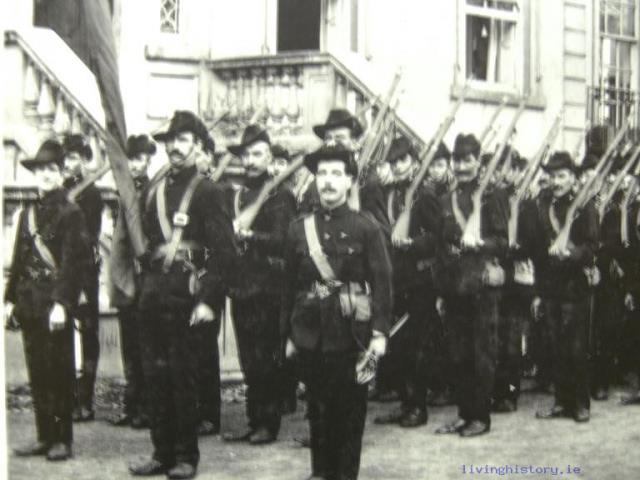
LA INFLUENCIA DE LA CLASE TRABAJADORA EN EL LEVANTAMIENTO DE 1916

Diarmuid Breatnach

(Tiempo leyendo: 11 minutos)

El Levantamiento de 1916 suele considerarse un levantamiento nacionalista de los republicanos irlandeses, quizás con alguna participación socialista.

Incluso Connolly suele ser retratado únicamente como un patriota (véase la canción James Connolly the Irish Rebel) con ideas socialistas.

De las seis organizaciones que participaron activamente en el Alzamiento de 1916 (1) sólo una de ellas pertenecía específicamente a la clase obrera irlandesa. Quizá por eso se suele pasar por alto la gran influencia de la clase obrera en el Alzamiento.

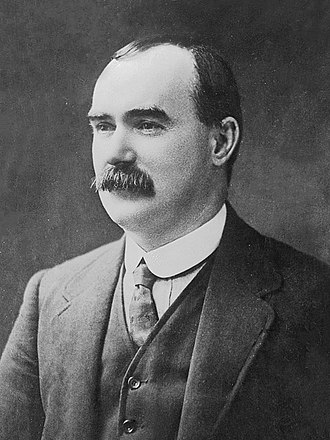
Como es bien sabido, James Connolly es uno de los Siete Firmantes (2) de ese maravilloso y progresista documento, la Proclamación de Independencia de 1916.

Sin embargo, Connolly sólo entró a formar parte del comité de planificación del Alzamiento muy poco antes de la fecha prevista (3) Siendo esto así, deberíamos preguntarnos por qué lo incluyeron.

Los Voluntarios Irlandeses tenían una organización a escala nacional con el movimiento -también nacional- Cumann na mBan como auxiliar, mientras que Connolly quizá podía movilizar quizás tres cientos de combatientes.

Monumento a James Connolly en Chicago, EEUU.

Se dice que lo incluyeron porque el IRB (“Irish Republican Brotherhood”, es decir, “Hermandad Republicana Irlandesa”) creía que su constante demanda de un Alzamiento durante la Primera Guerra Mundial y los ejercicios militares del Ejército Ciudadano Irlandés (ECI) indicaban que Connolly probablemente llevaría al ECI a levantarse por su cuenta y les arruinaría el calendario.

¿Qué probabilidades había de que lo hiciera? Es cierto que, como socialista, Connolly estaba horrorizado por la masacre de la guerra, en la que los trabajadores de un Estado son enviados a matar y ser asesinados por los trabajadores (4) de otro, y la lectura de sus escritos muestra que pensaba que era desesperadamente necesario un levantamiento para sabotear la guerra.

¿Habría seguido adelante sólo con los aproximadamente 300 hombres y mujeres del Ejército Ciudadano Irlandés, esperando quizás inspirar un levantamiento popular y animar a los Voluntarios Irlandeses a unirse a él, a pesar incluso de sus líderes (5)?

Es difícil creerlo pero, por supuesto, es posible.

Sin embargo, desde el momento en que los planificadores republicanos del Alzamiento aceptaron a Connolly, podemos ver un cambio organizativo significativo hacia la clase obrera en Dublín y especialmente alrededor del Liberty Hall, donde se izó la primera bandera para un levantamiento y se imprimió la Proclamación.

Liberty Hall era, por supuesto, la sede del sindicato Irish Transport & General Workers’ Union, del que James Connolly era líder en aquella época y también editor de su periódico, The Irish Worker.

Es asombroso que Connolly recibiera el rango de Comandante General siendo una persona incorporada tan recientemente a la organización.

Una responsabilidad que se tomó en serio, enviando mensajeros por todo el país e intentando dirigir los preparativos de defensa en torno a las distintas guarniciones de Dublín.

La Primera Bandera de Combate del Alzamiento

Una semana antes del Alzamiento, Connolly y el Ejército Ciudadano Irlandés habían izado una bandera republicana irlandesa sobre Liberty Hall como bandera de guerra y la elegida para izarla fue una chica de 16 años, Molly O’Reilly (6).

Merece la pena recordar las circunstancias asociadas, aunque sólo sea para ilustrar la diferencia entre el Liberty Hall de entonces y el de hoy.

Los adultos asistían allí a clases de lengua irlandesa y a actividades culturales, mientras sus hijos y los de los activistas sindicales esperaban a sus padres, asistían a clases de baile o jugaban.

Jugando, Molly O’Reilly rompió accidentalmente una ventana y, aterrorizada y avergonzada, corrió a casa.

Cuando Connolly le envió un mensaje a casa diciéndole que quería verla, ella fue al Liberty Hall esperando una severa reprimenda.

En lugar de eso, le dijo que no se preocupara, y le explicó lo que él esperaba de ella. Estaba orgullosa de hacerlo, pero era tan pequeña que tuvo que subirse a una silla para tirar de la cuerda que izaba la bandera.

Resto de la bandera izada en Liberty Hall (Imagen procedente de: Museo Nacional)
Ceremonia de conmemoración “Mujeres de 1916” con familiares de Molly O’Reilly en lugar de honor (tenga en cuenta que los uniformes son de voluntarios irlandeses en lugar de ejército ciudadano irlandés). (Foto: D.Breatnach)

Por supuesto, sabemos que esa bandera no era la de los trabajadores revolucionarios, sino la del arpa sobre verde, que era la de los primeros fenianos y se parecía mucho a la de los United Irishmen, la primera organización republicana revolucionaria irlandesa (7).

Aquellos primeros fenianos estaban compuestos en su mayoría por miembros de la clase obrera y su proclama de 1867 al mundo tenía en gran medida una perspectiva proletaria.

En Gran Bretaña, los fenianos formaron parte de la Primera Asociación Internacional de Trabajadores, dirigida por Marx y Engels.

Su bandera ondeó al menos en una de las guarniciones del Alzamiento de 1916, creo recordar que en la destilería Jameson de Marrowbone Lane.
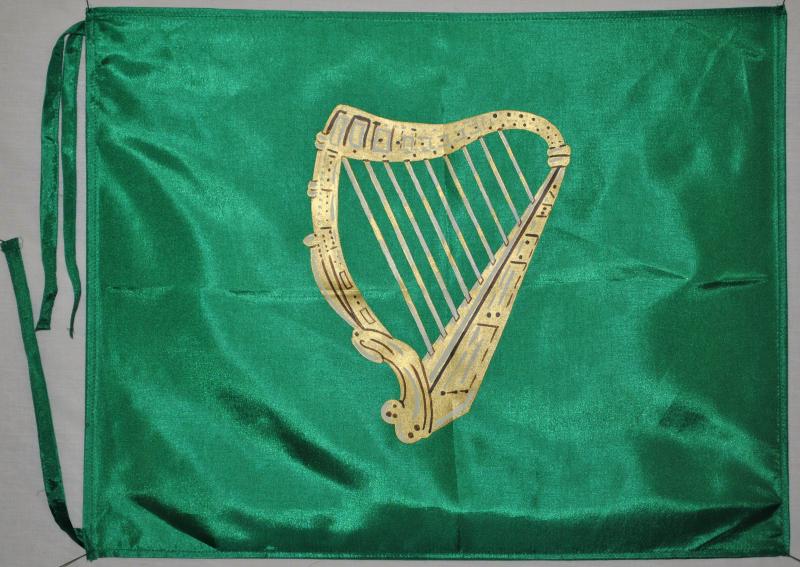
Bandera similar a la izada sobre Liberty Hall (Foto obtenida: Internet)

Las otras banderas del Alzamiento incluían la Tricolor, regalada a los republicanos de los “Jóvenes Irlandeses” por las mujeres del París revolucionario de 1848, que era una de las dos que ondeaban en el tejado del GPO (General Post Office, es decir, el edificio de Correos), cuartel general del Alzamiento.

Compartiendo el tejado de la GPO con la Tricolor estaba la bandera confeccionada pocos días antes del Alzamiento con material doméstico y pintada con las palabras “República Irlandesa” en casa de Constance Markievicz, oficial del Ejército Ciudadano Irlandés.

La bandera del Ejército Ciudadano Irlandés, el Starry Plough, ondeaba sobre el edificio de Clery’s, frente a la GPO.

Desgraciadamente, hoy en día la mayoría de los irlandeses no conocen esa bandera, aunque la conciencia sobre ella y sus antecedentes están aumentando entre los irlandeses autóctonos y la comunidad inmigrante.

El diseño del Starry Plough (El Arado de Estrellas), bandera del ICI tal como era en 1916 (Imagen obtenida: Internet)

El primer ejército obrero del mundo (8)

El Ejército Ciudadano Irlandés (ECI) se formó como milicia obrera durante el gran cierre patronal y la huelga de 1913-1914, para defenderse de los ataques de la policía, la primera línea física represiva de la clase capitalista; la bandera de la ECI se colocó sobre el Hotel Imperial de Murphy en Clery’s (9).

El Ejército Ciudadano Irlandés en ejercicios en sus terrenos cerca de lo que hoy es Fairview (Foto obtenida: Internet)

Aunque su constitución era más nacionalista que socialista, el ECI fue, por su composición y su finalidad, el primer ejército obrero del mundo y, cuando se reorganizó unos años más tarde, representó también el feminismo de la clase obrera, reclutando a mujeres, algunas de las cuales eran oficiales al mando de hombres.

Una vez que los preparativos para el Levantamiento se fueron a pique por la orden de anulación de MacNeil, ¿dónde se reunieron los organizadores para discutir qué hacer?

En Liberty Hall, el edificio del Sindicato Irlandés de Trabajadores Generales y del Transporte; fue allí donde se tomó la decisión de levantarse el lunes.

No es exagerado remarcar la importancia del hecho de que la decisión de seguir adelante con la insurrección se tomara en el edificio que se había convertido de facto en el cuartel general de la clase obrera revolucionaria de Dublín, con una bandera ilegal de rebelión ondeando y donde se iba a imprimir la Proclamación.

Redacción y texto de la Proclamación

Se cree que la redacción de la Proclamación fue hecha en gran parte por Pearse, pero influenciada por Connolly, incluyendo su destino a “los hombres y mujeres irlandeses” y quizás también “Declaramos el derecho del pueblo irlandés a la propiedad de Irlanda, y al control sin restricciones de los destinos irlandeses”.

Otro fragmento que podría llevar la huella de Connolly reza así: “La República garantiza la libertad religiosa y civil, la igualdad de derechos y la igualdad de oportunidades a todos sus ciudadanos, y declara su resolución de perseguir la felicidad y la prosperidad de toda la nación y de todas sus partes, apreciando por igual a todos los hijos de la nación.

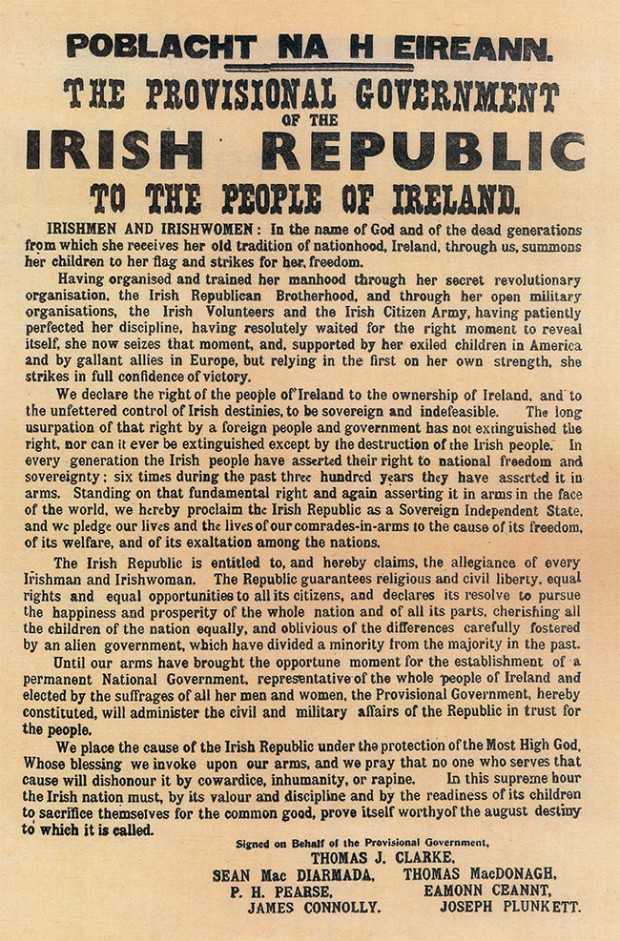
Copia de la Proclamación de Independencia de 1916 (Imagen procedente de Internet)

Pero, quienquiera que compusiera o influyera en el texto de la Proclamación, ésta fue impresa en Liberty Hall. Un miembro del Ejército Ciudadano Irlandés fue a Stafford Street (hoy Wolfe Tone St.) a pedir a un impresor de allí las letras de imprenta para llevarlas a Liberty Hall, que estaba bajo guardia armada las 24 horas del día.

Habiendo impreso la Proclamación en Liberty Hall bajo guardia armada y habiendo decidido allí sublevarse el Lunes de Pascua, ¿dónde se reunieron los grupos de asalto a Stephens Green, Castillo y la GPO (General Post Office, es decir, edificio de Correos)?

Incluido el Batallón del Cuartel General, la mañana del Alzamiento? …. De nuevo, en Liberty Hall.

Una de las primeras víctimas no combatientes del Alzamiento fue Ernest Kavanagh (10) que dibujaba caricaturas para el periódico del ITGWU, The Irish Worker.

Por alguna razón acudió el martes al Liberty Hall y fue asesinado a tiros en la escalinata del edificio del sindicato, presumiblemente por un francotirador del ejército británico.

La resistencia armada de la clase obrera:

Una vez puesto en marcha el Alzamiento, el Ejército Ciudadano Irlandés era el principal responsable de dos zonas, la guarnición de Stephens Green/Colegio de Cirujanos y la guarnición del Castillo de Dublín/Ayuntamiento, pero también luchó en otras zonas, por ejemplo en Annesley Bridge y en la zona de GPO/Moore Street.

Todos los que lucharon junto a ellos comentaron su valor y disciplina. Tras la rendición, muchos de ellos, junto con los Voluntarios Irlandeses, fueron condenados a muerte, la mayoría conmutada por cadena perpetua.

Pero dos líderes del Ejército Ciudadano Irlandés fueron fusilados.

Una de las zonas desde las que las fuerzas británicas fueron tiroteadas durante días después del Alzamiento fue la de los muelles del Liffey, entonces rodeada predominantemente por zonas residenciales de clase trabajadora.

Una pregunta que deberíamos hacernos es por qué las fuerzas procedentes de Gran Bretaña para reprimir el Alzamiento desembarcaron en Dún Laoghaire, desde donde tuvieron que marchar casi 12 km hasta el centro de Dublín, en lugar de hacerlo en los excelentes muelles dublineses del Liffey.

Hugo McGuinness, especializado en la historia de la zona del Muro Norte, cree que los británicos esperaban que Dublín estuviera en manos de la resistencia obrera y que, sencillamente, era demasiado peligroso desembarcar allí tropas británicas, aunque las cañoneras podían disparar desde el Liffey.

Ciertamente, los británicos creían que Liberty Hall y los edificios a lo largo de Eden Quay estaban ocupados como puestos de combate por el Ejército Ciudadano Irlandés y dispararon artillería contra el edificio del sindicato desde la calle Tara, como atestiguan las fotos de agujeros de proyectiles en ese edificio y en el siguiente.
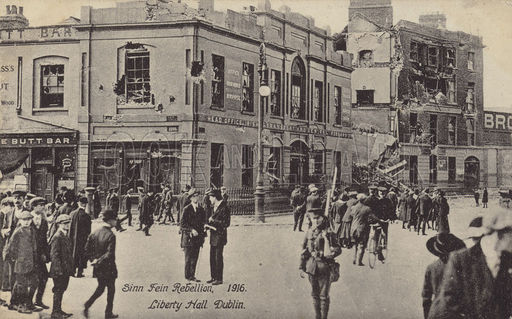
Foto del Liberty Hall dañado por los proyectiles (primer edificio con la esquina hacia la cámara, visto hacia el norte desde Butt Bridge) como parte de un conjunto de postales conmemorativas. (Foto obtenida: Internet)
Otra postal con un primer plano de los daños causados por los bombardeos al Liberty Hall y al edificio contiguo. Curiosamente, en este, Liberty Hall está etiquetado como “el Cuartel General Rebelde”. (Foto obtenida: Internet)

En algunos relatos históricos se habla mucho de la oposición al Alzamiento por parte de algunos sectores de la población de Dublín, durante e inmediatamente después del Alzamiento.

La ciudad era la capital de una colonia británica, y poco más de un siglo antes se hablaba de ella como “la segunda ciudad del Imperio Británico”.

Una parte sustancial de las clases media y acomodada era lealista, incluidos algunos católicos; incluso los sectores “nacionalistas” estaban comprometidos a apoyar al Reino Unido en la Primera Guerra Mundial y John Redmond, líder del partido político “nacionalista”, había reclutado abiertamente para el ejército británico.

Además, entre la clase obrera y el lumpenproletariado, muchos dependían de las “indemnizaciones por separación”, por los varones que servían en el ejército británico.

Es cierto que en algunos lugares los insurgentes tuvieron que amenazar, apalear o incluso disparar a algunos civiles que intentaron obstruir el Alzamiento (11).

Estos incidentes durante el Alzamiento no fueron muchos, pero posteriormente hubo insultos y se lanzaron objetos a los prisioneros que marchaban a la cárcel (o al pelotón de fusilamiento).

La ciudad estaba bajo la ley marcial, pero aun así un periodista canadiense informó de que los insurgentes eran vitoreados en los barrios obreros.

También hubo otros relatos de testigos individuales, como el de un hombre en un tranvía que saludó a los prisioneros en Parnell Street hasta que fue amenazado por los soldados de escolta, y el de un bombero en la GPO que hizo lo mismo.

Un año después, la mayor parte de la hostilidad anterior se había transformado en admiración y orgullo por los combatientes.

El liderazgo de la clase obrera:

James Connolly escribió y dijo muchas cosas de importancia, pero seguramente, con respecto a la lucha por la independencia nacional irlandesa, la más importante fue: “Sólo la clase obrera irlandesa permanece como heredera incorruptible de la lucha por la libertad en Irlanda”.

Con ello quería decir -y estoy de acuerdo- que todas las demás clases sociales pueden ganar algo vendiendo los intereses y recursos de la nación irlandesa, pero que la clase trabajadora no puede ganar nada con ello.

La clase obrera irlandesa se jugó la lucha por la independencia de Irlanda en 1916, pero no tuvo éxito en dirigirla y, por eso, esa lucha está aún por ganar.

Hoy en día, recordando esa larga lucha y a la clase cuyo liderazgo los socialistas revolucionarios pretenden representar y defender, declaramos la necesidad de ese liderazgo sobre un amplio frente de todos los que desean luchar para avanzar.

Al hacerlo, declaramos que lejos de que la clase obrera tenga que esperar al socialismo, en el curso de la lucha nacional también debe dar forma a sus propias reivindicaciones en torno a la economía, los recursos naturales, las infraestructuras, los servicios sociales, las cuestiones sociales, la cultura y, sobre todo, a los frutos de su trabajo.

FIN.

NOTAS A PIE DE PÁGINA:

  1. Hermandad Republicana Irlandesa, Voluntarios Irlandeses, Ejército Ciudadano Irlandés, Cumann na mBan, Na Fianna Éireann, Hibernian Rifles.
  2. Todos ellos fueron ejecutados por un pelotón de fusilamiento británico, junto con otros siete en Dublín y uno más en Cork. La decimosexta ejecución fue en la horca en Londres.
  3. (Véase Fuentes: Cooption of James Connolly etc) Connolly fue un socialista de toda la vida y un revolucionario durante toda su vida adulta, autor, historiador, periodista, compositor de canciones, activista sindical; activo políticamente en Escocia, Irlanda, Nueva York y de vuelta en Irlanda.
  4. El movimiento socialista internacional vio con horror la inclinación de los imperialistas hacia la guerra y en conferencias internacionales prometió oponerse a ella con todas sus fuerzas, incluso convirtiendo la resistencia a la guerra en revolución (“Guerra contra la guerra”). Sin embargo, una vez declarada la guerra imperialista, esa determinación se derrumbó en la mayoría de los Estados, siendo Rusia, Alemania e Irlanda notables excepciones, y en cada una de ellas se produjo un levantamiento contra la guerra, siendo el de Irlanda el primero.
  5. Joseph E.A. O’Connell (Jnr.) sugiere una posible intención de azuzar al Estado para que le ataque a él y al ECI, lo que podría desencadenar el levantamiento general.
  6. (Ver fuentes)
  7. El arpa de la bandera de los Irlandeses Unidos estaba más adornada y llevaba inscritas las palabras “Está recién encordada y se oirá”
  8. http:// www.connollybooks.org/product/irishcitizenarmy
  9. Tenía una buena ubicación, céntrica, pero más que eso: el hotel era uno de los negocios de William Martin Murphy, principal organizador del bloque patronal para romper el sindicato Irish Transport & General Workers’ Union.
  10. Kavanagh era partidario de los trabajadores, del voto femenino y contrario a la participación en la guerra imperialista, contribuyendo también con caricaturas a las publicaciones Irish Citizen, Fianna e Irish Freedom, y acompañando poemas de su hermana, Maeve Cavanagh McDowell.
  11. No incluyo en esto a los tres miembros de la Policía Metropolitana de Dublín, que eran una fuerza al servicio de la ocupación británica y también de los capitalistas dublineses. El Ejército Ciudadano Irlandés, en particular, tenía buenas razones para ajustar cuentas con ellos por los ataques que les habían infligido, entre ellos las heridas mortales causadas con porras a dos trabajadores durante una carga contra una reunión sindical el 30 de septiembre de 1913 en Eden Quay y las palizas y destrozos de mobiliario en domicilios en Corporation Street un poco más tarde.

FUENTES:

Cooptación de James Connolly al Consejo Militar que planeaba el Alzamiento:

Izado de la bandera en Liberty Hall:

https://microsites.museum.ie/1916objectstories/ObjectDetail/remains-of-irish-flag

Incidente de Molly O’Reilly rompiendo una ventana:

https://www.independent.ie/irish-news/ladies-day-for-1916-heroines/26528456.html

Impresión de la Proclamación de Independencia:

https://libguides.ucc.ie/1916Proclamation

https://www.dublincity.ie/library/blog/printing-1916-proclamation-transcript

Decisión de continuar con el Alzamiento el Lunes de Pascua:

https://www.irishtimes.com/culture/heritage/easter-rising-uneasy-calm-before-the-storm-1.2575638

https://www.nli.ie/1916/exhibition/en/content/risingsites/libertyhall

“Sólo la clase obrera irlandesa sigue siendo la heredera incorruptible…” (fin de la penúltima frase):

https://www.marxists.org/archive/connolly/1910/lih/foreword.htm

Anti-Fascist Event in Gernika Pays Homage to a Basque-Nicaraguan Revolutionary

Clive Sulish

(Reading time: 9 mins.)

Kontxi Arana, code name “Rita”, was a fighter of the Basque armed organisation ETA and also of the Sandinista movement. A ceremony of homage to her memory on 22nd April was also the occasion of an antifascist conference with representatives from a number of European countries.
The event took place in Gernika, the SW Basque town infamously bombed by German and Italian Nazi and Fascist squadrons during the Spanish Civil/ Ant-Fascist War, the act which inspired the Catalan painter Picasso´s famous piece on the event (which he called by its Spanish name, “Guernica” (sic)). The venue was the disused Astra factory, formerly manufacturer of handguns.

The Origins and Nature of Fascism

The day-long anti-fascist conference began with a talk on the origins and basic nature of fascism by Iñaki Gil de San Vincente, Marxist theoretician and veteran of the Basque Left Patriotic Movement from which leadership of however he has broken for a number of years.

Speaking in Castillian, he declared the essential nature of fascism to be authoritarianism, deriving from the development of the bourgeois family. The central authority figure in that family, later reproduced in other social classes including the working class is the Father, represented in capitalist society by the employer and the Church.

It is an authority to which all are required to submit: patriarchical, homophobic and intolerant of criticism or deviation.

De San Vincente spoke at length about this development and about early descriptions of fascism, for example by Clara Zetkin and Lukacs and described it as a production of capitalism and imperialism and therefore represented today most clearly in the actions of US Imperialism and the NATO over which it exercises hegemony.

The speaker also highlighted the development of NATO and its recruitment of Nazis as well as the development of its Vatican route for Nazis to leave Europe and enter Latin American countries where they would form fascist centres.

This talk was followed by a representative of Ezkerraldea Antifaxistako (Antifascist Left) who, speaking mostly in Castilian, outlined the history of the development of fascism in the Spanish state following the military-fascist uprising and the four decades of dictatorship, and how the organisation he represented responded to that.

The final speaker of the morning session was from Mugimendu Socialistako (the Socialist Movement – organisation with a large membership, according to a participant) who spoke entirely in Euskera (Basque language). Although simultaneous translation was provided into Castilian (Spanish), the volume of such was too low to be understood by many.

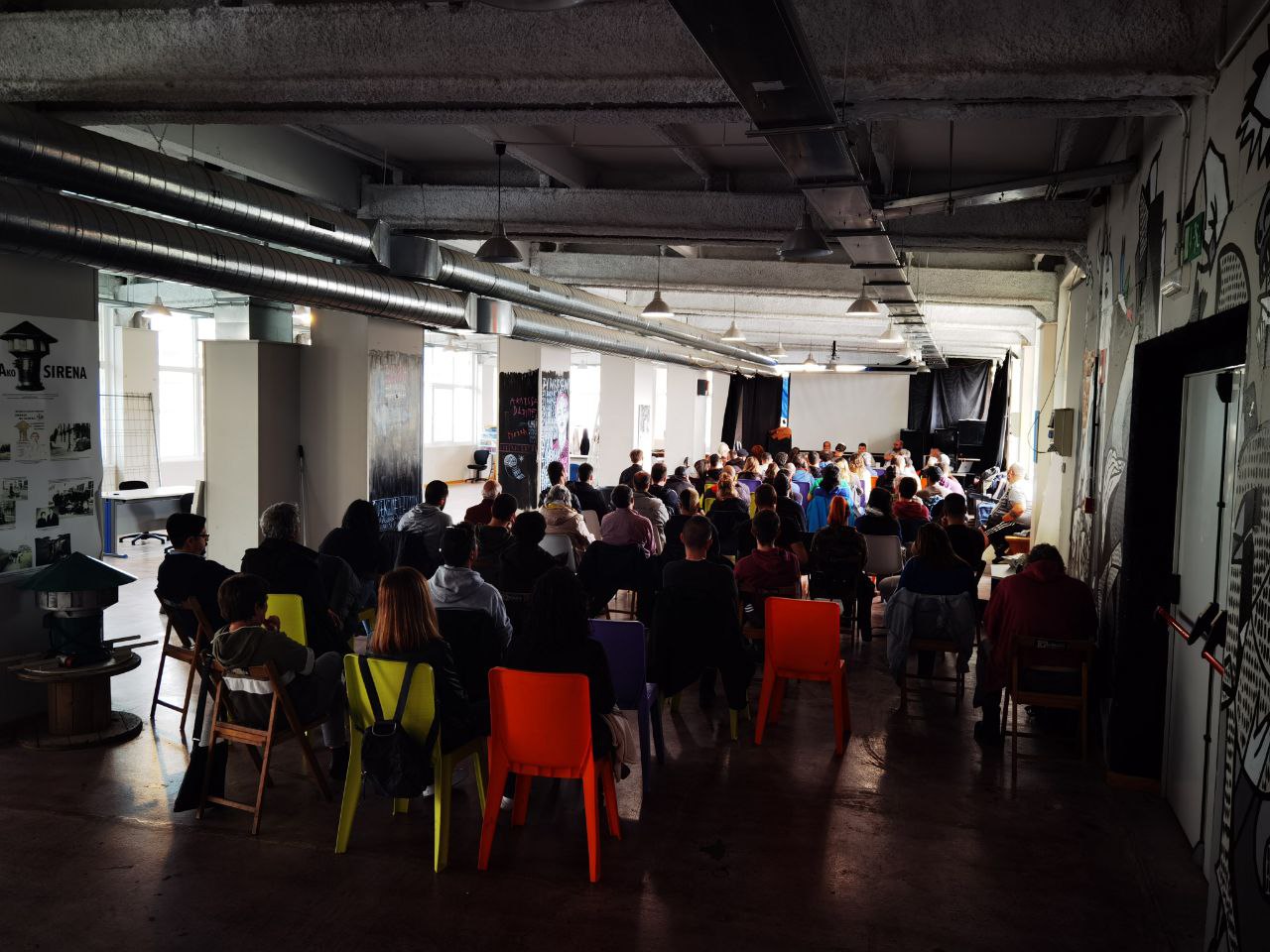
Morning session of the anti-fascist conference in Gernika (Photo: DRAF)

According to a participant, the content of that speaker´s contribution was similar to that of the previous speaker, although he mentioned the existence of Frente Obrero (Workers´Front), a Basque organisation which, despite its name, is a fascist organisation. The existence of that latter group appeared to be news to many present.

These talks were followed by a break and, upon resumption, there were some contributions from the floor and some responses from the panel, after which all repaired to the green outside the Astra building to where the ceremony of respect to the memory of Kontxi “Rita” Arana was to take place.

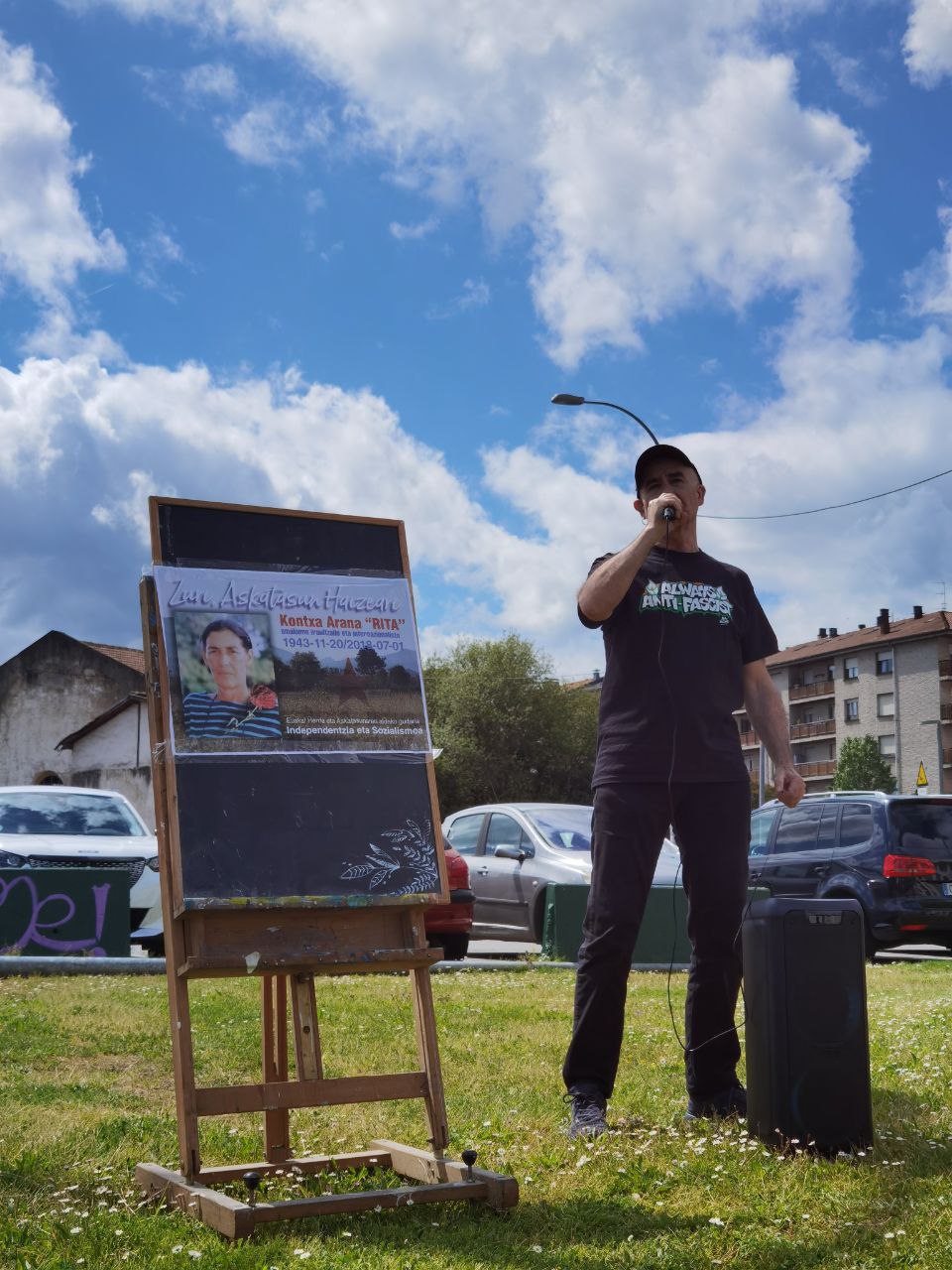
Kontxi Arana: A leading Basque liberation fighter who also joined the Sandinistas in the liberation struggle of Nicaragua

A Basque woman of the independent Patriotic Left movement blew the traditional cow or bull horn to summon attention, while the speaker in the Basque language introduced the program and speakers along with a short history of this internationalist anti-imperialist and anti-fascist fighter.

Kontxi Arana was an active member of the Basque armed liberation organisation ETA who avoided capture while on operations in the Spanish State but was arrested in the French state and exiled to an island, from which she and others escaped. Sometime later she surfaced in Nicaragua, where she had joined the Sandinista armed liberation movement.

Around the end of the 1990s, the leadership of the Basque Patriotic Left asked some exiles to return to the Basque Country to help push the pacification process and release of prisoners but the Spanish State refused to play, though they did not arrest Kontxi (however according to reports arrangements were not well organised to support her).

Most of the crowd present at the Gernika commemoration and homage to Kontxi “Rita” Arana, with the Astra building in the background and the railway line fence just visible in the left background.

The homage to her memory

A man formerly of the official patriotic Left movement spoke in Spanish about the need for internationalist solidarity, through which however mistakes can be made (e.g. in supporting corrupt leadership) which however does not alter the importance of such solidarity, without which the revolution cannot advance.

This was followed by a man from Dublin Republicans Against Fascism who briefy explained in Castilian (Spanish) the history behind Christy Moore´s “Viva La Quince Brigada“, which the Dubliner then sang in its original English.

Dublin Republicans Against Fascism representative singing Christy Moore’s Viva La Quinze Brigada.

The homage event concluded with red carnations being laid by members of the audience in front of a portrait of Kontxi “Rita” Arana. Two ex-political prisoners played the ´txistu´ (Basque three-hole flute), one of them also beating a rhythm on a small drum (´tamborina´). A young woman stepped forward and danced the ´aurresku´, a traditional honour dance.

Crowd queuing to lay red carnations in front of a portrait of Kontxi Arana

This dance was traditionally danced by a male, then by male dancers, then by male and female dancers until today, when it may be performed by any of those combinations or by a lone female, as in this case, and often enough in ordinary clothing as was the case on this occasion, though she did wear dancing shoes laced to the ankles.

The young woman performing the honour Aurresku dance in one of the high kicks of the dance with, to the far right, the ex-political prisoner txistulari (players of the Basque flute). In the immediate background, participants and organisers. (Photo: DRAF)

The musicians then played the air of The Internationale, which most could be heard singing in Euskera, followed by Eusko Gudariak (“Basque Soldiers”), the Basque national resistance song, similar to the Soldiers’ Song/ Amhrán na bhFiann of Ireland in content. Many had raised clenched fists as the songs were sung.

Suddenly, a wild high-pitched yodelling cry rang out from a female throat, the Irrintzi, traditional Basque battle-cry which probably echoed around the mountains in olden days.

All the audience then repaired to the Astra building where a hot meal was served to all on long tables with a bottle of wine to share among each group of several people (those present had purchased tickets to the event either in advance or upon attendance).

Afternoon session: Presentations from Turkish, Irish and Catalan antifascists.

The afternoon session started a little late as people straggled in. The chairperson, speaking in Euskera, introduced the theme of the session which was for antifascists from Turkey, Ireland and Catalonia to describe the situation with regard to fascism in their countries and how it was being confronted.

Turkey

Two people from the Turkish-based revolutionary organisation Anti-Imperialist Front presented their contribution while using a video of images, some subtitled in Castilian but where not, spoken by the woman in English while her comrade translated simultaneously into Castilian.

Overall, the presentation was about the development of state fascism in Turkey and the failed military coup of 2016. The DHKP/C organisation had resisted this on the streets but a major struggle with the Erdogan government took place in trials and in the jails.

Through hunger strikes and physical resistance in the jails, hundreds of martyrs had lost their lives, said the speaker but had remained undefeated. Also martyred had been members of the Group Yorum music group which has played revolutionary songs heard by millions.

Another struggle was carried out through public hunger strikes by elderly relatives seeking the uncovering of mass graves in the bodies of fighters, their sons, had been thrown by the Turkish military.

As a result two mass graves had been eventually disinterred, permitting the remains of fighters of the DHKP/C and of the PKK (Kurdish patriotic socialist organisation) to be returned to their families for respectful re-burial.

The Turkish speakers concluded by stating the necessity for anti-fascism to be anti-imperialist and calling for internationalist solidarity and victory to peoples’ struggles.

Section of audience at afternoon session of the anti-fascist conference in Gernika, Basque Country.

Ireland

The next speaker was from Dublin Republicans Against Fascism, explaining that eight centuries of occupation of his country by England has ensured that the dominant struggle had been one of national liberation and that all armed struggles since 1798 had been led by Republicans of various kinds: 1801, 1848, 1867, 1882 and 1916.

The Irish State that came into being after the War of Independence in 1921 had been a client of the UK, conceding over one-fifth of its national territory as a direct colony. The armed forces of the State had formally executed over 80 of the IRA and instituted a wave of repression including kidnappings, torture, murders including of prisoners.

In keeping with the rise of fascism across 1930s Europe, Ireland saw the Blueshirt movement, led by former police chief Eoin O’Duffy. The Republican movement and socialists fought these on the streets, the speaker said.

The Dubliner recounted briefly the history of Irish Republicans and socialists going to fight Franco in the Spanish state and the Irish diaspora fighting the British fascists, the Blackshirts, in British cities and in defence of Eastern European Jews in famous Battle of Capel Street in the East End of London against over 7,000 police.

He went on to recount some more recent successful physical attacks by joint Republican groups against fascist organisations, the Pegida group in 2016 and even more recently the National Party. Recently too, Republican ex-prisoners had released a video stating the opposition of Republicanism to fascism with a growing list of signatures.

In conclusion, the speaker said that Ireland’s history made it difficult for fascism to advance in Ireland (except in the Loyalist areas) but as long as capitalism exists so too does the danger of fascism, particularly if the progressive forces do not fight effectively against the attacks of Capital on working people.

Catalonia

The representative of the Anti-Repression Platform of Catalonia, speaking in Castilian (Spanish), explained their organisation had come into existence after the repression of the Independence Referendum in 2017 and the subsequent frame-ups and allegations of terrorism against the Committees for the Defence of the Republic.

The speaker alluded to the jailing of the revolutionary socialist rapper Pablo Hasel and comrades who were charged with terrorism merely for expressing and organising solidarity for those being repressed.

“Don’t try to frighten us with threats of a fascist party getting into government”, he said in a reference to the growth of the Spanish fascist party Vox, because we have had a fascist government in the Spanish state since 1939!” (The year that the military-fascist forces defeated the Second Republic and founded four decades of dictatorship).

The Catalan went on to denounce the social-democratic party PSOE (currently in coalition government with Podemos Unitas), pointing out that it has had more political prisoners in jail and fatal victims than any other party in Spanish government (he was probably including the sponsoring the GAL terrorists of the 1980s).

“There has not been a year in which there were no political prisoners in the Spanish state”, he went on to say but also denounced the current Catalan Government, led by the allegedly pro-independence and leftist ERC party and its repression of socialists and independence activists.

He pointed out that fascists would make no distinction between communists and anarchists and asked “so then why should we?” He declared that all who resist repression now, regardless of before, are welcome to take part in their organisation.

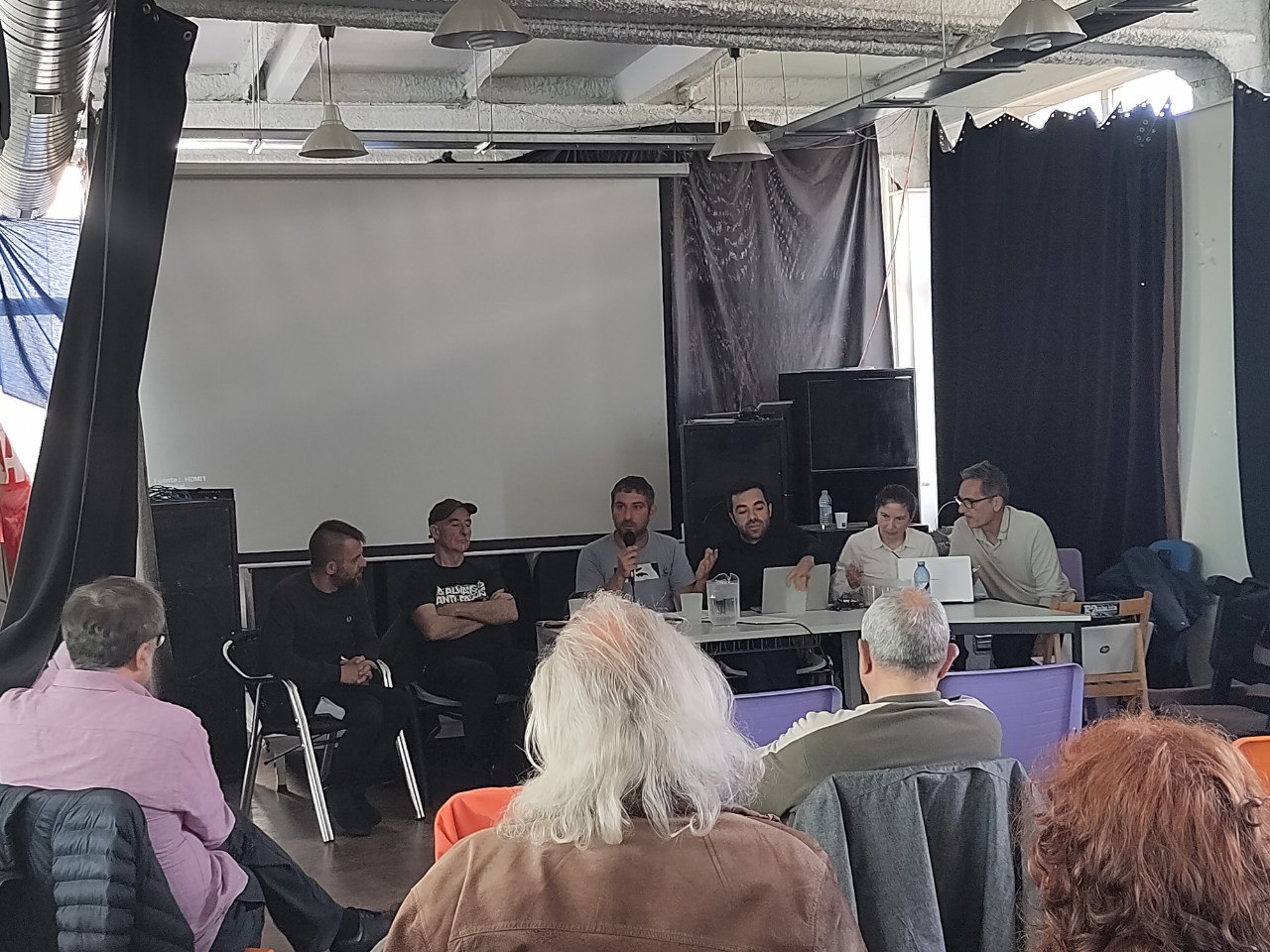
The panel at the afternoon session: from left to right: speakers from Catalonia and Ireland, Basque chairperson, Turkish speakers and translator.

Prisoners on hunger-strike

The chairperson of the panel thanked the speakers and drew together elements from each of their presentations.

He went on to announce the declared intention of a small group of Basque political prisoners to embark on a hunger strike and to outline solidarity events being organised. The prisoners concerned are in the non-compliance minority of Basque political prisoners with a regime that forbids them referring to themselves as political prisoners.

The prison authorities intended to make the prisoners share a cell with other political prisoners who are however in compliance, intending to undermine the resistance of the small group and also posing the danger of conflicts within the cell. (A few days later news came that the hunger-striking prisoners had won their demands).

Amnistia organisation solidarity poster announcing forthcoming hunger-strike of political prisoners, now over because they won their demand.

Summary

The conference in its organisation and content of contributions drew anti-fascism together with imperialism and internationalist solidarity, all from an anti-capitalist perspective. It also drew connections between solidarity with political prisoners and resistance to repression.

All of the Basque organisations represented are in opposition to the trajectory of the leadership of what had been the Basque Left Patriotic movement, now represented by the EH Bildu party led by Otegi (with daily newspaper GARA, its trade union organisation LAB) and many of the older people were ex-supporters of that leadership.

That included some prominent ones such as Inaki Gil de San Vincente and the speakers and organisers of the conference and of the homage to the memory of Kontxi “Rita” Arana. The younger participants might have included ex-members or had come into political consciousness in opposition to that leadership.

Taken together, they are what many call ‘dissidents’ though some reject that term, saying that they are in fact sticking to the original line of independence and socialism and that it is the official leadership and their followers who have deviated. Their numbers are comparatively small at the moment but they are growing.

end.

USEFUL LINKS

Speaking at the Conference:

Boltxe: https://www.boltxe.eus/

Inaki Gil de San Vincente:

Socialist Movement (Socialist Councils) of the Basque Country: LANGILE KAZETA (gedar.eus)

Antifascist Left: Ezkerraldea Antifaxistasta
https://www.facebook.com/profile.php?id=100069359823294

???

Anti-Imperialist Front (Turkey): https://anti-imperialistfront.org/

Dublin Republicans Against Fascism: https://www.facebook.com/profile.php?id=100067893558778

Anti-Repression Platform of Barcelona: https://twitter.com/antirepreBCN
Plataforma Antirepressiva de Barcelona | Barcelona | Facebook

More to come later

Others in Ireland:

Dublin Basque Solidarity Committee: https://www.facebook.com/dublinbasque

Anti-Fascist Action: https://www.facebook.com/afaireland/

Republicans Against Fascism: https://www.facebook.com/profile.php?id=100090617432158

There are also other local antifascist groups and organisations that include antifascist activity in their programs

RESUMEN DE LAS ACTIVIDADES POLÍTICAS RECIENTES EN IRLANDA

Diarmuid Breatnach

(Tiempo de lectura del texto principal: 10 minutos)

Un resumen seleccionado de eventos políticos y sindicales en Irlanda en los últimos meses (edición final 17 de agosto de 2022).

EN LOS 26 CONDADOS

La Coalición Gubernante de partidos neoliberales Fianna Fáil y Fianna Gael, con orígenes en bandos opuestosde la Guerra Civil Irlandesa (1922-1924), y el Partido Verde sobrevivió a moción de falta de confianza a principios de julio en el gobierno con una cómoda mayoría de 26 votos.

La moción fue propuesta por el partido Sinn Féin con motivo de la pérdida de la mayoría absoluta de la Coalición (de 85 a 84) cuando uno de los miembros de la Coalición renunció a su partido.

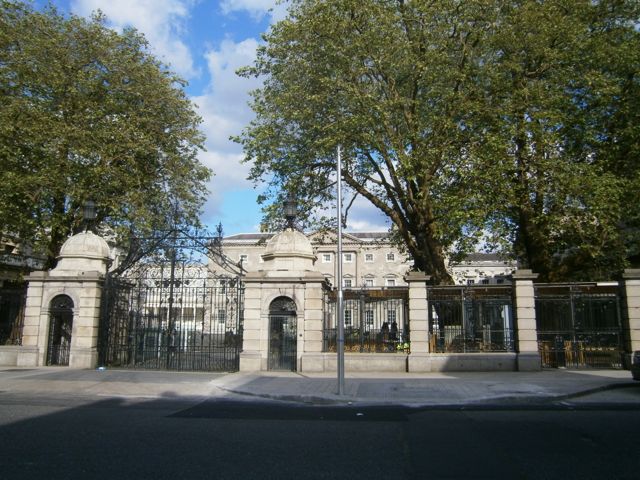
Leinster House, Dublín, ubicación del Dáil, parlamento del estado de Irlanda (imagen descargado del internet)

El Estado recibió más refugiados de guerra de Ucrania de los que pudo manejar cómodamente, con arreglos para su alojamiento que incluyeron campamentos del Ejército, discusiones sobre islas, y retrasos en la investigación de antecedentes de personas que ofrecen alojamiento a cambio de pagos del gobierno.

El Gobierno se mantiene en línea con la tendencia dominante entre los estados de la UE y de los EE.UU./OTAN. Todos los partidos de la Oposición y la mayoría de los diputados Independientes también siguen esa línea, con una pequeña colección en la Izquierda condenando simultáneamente la guerra de la OTAN.

El movimiento republicano (“disidentes”) contiene una variedad de opiniones sobre ese tema incluso dentro de las organizaciones, por lo que ningún partido se siente capaz de expresar una posición concreta sobre la cuestión.

En todo el estado, la influencia de los medios de comunicación se puede ver mucho en el apoyo público al régimen ucraniano y la oposición a Rusia, pero también mucho de eso se debe al odio tradicional a la invasión, junto con la falta general de acceso a fuentes alternativas.

Cualquiera que se aparte de la línea aprobada, por ejemplo, dos eurodiputados irlandeses (Clare Daly y Mick Wallace), es probable que sea atacado ferozmente por los medios de comunicación (y lo que aquí pasa por “la izquierda”), incluso la esposa del presidente, Sabina, que simplemente dijo en público que la lucha debe terminar en negociaciones.

El peligro de que el Estado se una a la OTAN se ha visto muy disminuido por la oposición pública y también se ha desvanecido de unirse a cualquier alianza militar de la UE. Sin embargo, el debate público en torno a él arrojó algunas señales peligrosas de interés por parte de al menos una sección de la élite gobernante.

Además, el Taoiseach (equivalente a Primer Ministro) declaró en el Dáil que el Gobierno podría tomar tal decisión sin la necesidad de un debate y votación sobre la cuestión en el Dáil.

Siguiendo con el Gobierno, recientemente decidió un plan para reducir las emisiones de CO2 en un 25%, muy por debajo de lo que se ha declarado públicamente como necesario para evitar un desastre ambiental.

La decisión fue atacada desde la izquierda y por el partido Demócratas Progresistas pero el Sinn Féin intentó evitar comprometerse ya que quiere el apoyo de los grandes ganaderos y de la industria cárnica.

El intento del fascista Irish Freedom Party de realizar una manifestación en Limerick en marzo fue interrumpido por un gran grupo de antifascistas, ahogando los discursos en gritos y abucheos, muchos ondeando banderas del arcoíris y cantando “¡Escoria fascista fuera de nuestras calles!”

Sección de la oposición a una decena de fascistas del Irish Freedom Party realizando un mitin en la ciudad Limerick en marzo. (Imagen descargado del Irish Socialist Party).

En el servicio de salud (una mezcla de provisión pública y privada), con fondos y personal insuficientes, ya tambaleándose por las tensiones de lidiar con Covid, se citó a un abogado que representa al personal, el efecto de que muchos miembros del personal médico agredidos y amenazados demandarán al Gobierno.

Esto se llevará a cabo bajo las disposiciones de la legislación de Salud y Seguridad en el Trabajo que obliga a los empleadores a tomar medidas para eliminar o, cuando no sea del todo posible, reducir los riesgos para sus empleados. Estos últimos ya no están dispuestos a aceptar los malos tratos como parte ineludible del trabajo.

El sindicato IMPACT, que representa a muchos trabajadores de Dunne’s Stores, ha reclamado un aumento salarial del 7,7 %, días de vacaciones adicionales, mejores descuentos y más contratos a tiempo completo. El costo de vida actual ha aumentado a un promedio del 9%, pero la dirección sindical dice que los beneficios para sus miembros se nivelan por encima de esa cifra.

La última vez que IMPACT se enfrentó a la dirección del supermercado, el sindicato fue derrotado y se quejó de que no recibía suficiente apoyo de sus miembros.

Veinte años de “participación social” de las direcciones sindicales desde la década de 1980 con representantes del gobierno y de los empleadores han dejado a los sindicatos débiles y bajos en afiliación (del 60% al 27%); muchos trabajadores jóvenes nunca han estado en un sindicato ni los consideran útiles.

Las huelgas actuales de trenes en Gran Bretaña por parte del sindicato Ferroviario, Marítimo y de Transporte han despertado cierto interés en Irlanda, ya que el secretario general del sindicato, Mick Lynch, es de ascendencia irlandesa y ha declarado que su héroe es James Connolly, el socialista revolucionario irlandés-escocés ejecutado por Gran Bretaña en 1916.

Este año, siendo el centenario del inicio de la Guerra Civil Irlandesa (1922-1924), muchas conmemoraciones y charlas históricas están siendo organizadas por grupos que no representan al Estado. Este último, después de todo, es descendiente directo de los vencedores de esa Guerra Civil.

Pancarta de la campana para rescatar al mercado callejero y campo de batalla de 1916, participando en el desfile en Junio 2022 de conmemorar el comienzo de la Guerra Civil de Irlanda en 1921. El parque al otro lado de la pared a la izquierda es la ubicacíon de fosa común de insurgentes del 1798; en el fondo lejano se ve parte de los antiguos cuarteles británicos, más tarde rebautizados como Collins Barracks pero ahora un Museo Nacional. (imagen: D.Breatnach)

El movimiento nacionalista-republicano se dividió en 1921 sobre si aceptar el Tratado anglo-irlandés. A pesar de las instrucciones, los delegados a las conversaciones en Londres, bajo la dirección de Michael Collins, ya habían firmado el contenido. Una pequeña mayoría votó a favor en el Dáil.

Sin embargo, una gran mayoría del ala militar que había luchado en la Guerra de la Independencia (1919-1921) (el IRA, Cumann na mBan, Fianna Éireann y el Ejército de Ciudadanos Irlandeses) se oponía a la aceptación de algo que no fuera una República Irlandesa. Algunos de ellos ocuparon los Four Courts en 1922.

Bajo la presión de los británicos, en particular de Churchill y, sin duda, internamente también, el nuevo gobierno irlandés de Michael Collins, con artillería suministrada por los británicos, abrió fuego contra Four Courts (la segunda vez desde el levantamiento de 1916), mató a dos miembros del IRA e hirió a y arrestó a otros.

Ejército del Estado nuevo con artillería prestado por los británicos, bombardeando fuerzas republicanas (IRA) en Los Cuatro Juzgados, iniciando la Guerra Civil en Junio 1921 (imagen descargado del internet)

Cathal Brugha, un héroe de 1916 y uno de los que habían tratado de conciliar entre ambos lados, tomó medidas con otros para tratar de desviar algunas de las fuerzas atacantes de los Cuatro Patios. Ocuparon edificios en la calle O’Connell en el centro de la ciudad, donde Brugha resultó herida de muerte.

La Guerra Civil se extendió al país, durante la cual otro destacado republicano irlandés, Harry Boland, antiguo amigo cercano de Michael Collins, fue asesinado a tiros por soldados enviados por Collins para arrestarlo; aunque se afirmó que había sido un accidente, se necesitaron diez horas para llevarlo al hospital.

El 26 de junio, la Asociación de Tumbas Nacionales organizó una marcha desde el exterior del Museo de Historia Nacional de Collins Barracks hasta los Four Courts para conmemorar el ataque por el “Estado Libre”. Allí se pronunciaron discursos militantes con llamamientos al establecimiento de la República por la que se había luchado.

El punto de partida fue simbólico, ya que el antiguo cuartel del ejército británico lleva el nombre del hombre que ordenó el ataque a los Four Courts y también está justo al lado de Croppies’ Acre, un parque de ocio en el sitio de una fosa común de los insurgentes de los irlandeses unidos en 1798 y sospechados seguidores.

Harry Boland fue conmemorado en una discusión histórica, eventos deportivos y ceremonias junto a la tumba durante los tres días del fin de semana pasado, que incluyó el centenario de su muerte.

Boland había sido director del IRB en Irlanda hasta 1921 (que dejó a Collins para acompañar a De Valera en una gira de recaudación de fondos por los EE. UU.), un hábil organizador, miembro de la Liga Gaelica, un prometedor jugador (en “hurling”) y administrador de su club en la Asociación Gaélica de Atletismo.

Parte de la asistencia en el cementerio de Glasnevin a la conmemoración de Harry Boland, matado por el Estado Irlandés en la Guerra Civíl (imagen: D.Breatnach)

El 7 de julio, Cathal Brugha fue conmemorado con un discurso y una canción en el lugar donde le dispararon, organizado por Republicanos Independientes de Dublín, que también han erigido paneles en varios lugares para recordar a luchadores del IRA asesinados allí por las fuerzas del “Estado Libre” durante la Guerra Civil.

También hay planes para conmemorar el 81 (u 83, los números están en disputa) ejecutados formalmente por el nuevo Estado durante la Guerra Civil, más de lo que los británicos habían ejecutado entre 1916 y 1921.

La calle Moore de Dublín lleva uno de los paneles que conmemoran a un voluntario del IRA asesinado por las fuerzas del Estado irlandés el 9 de junio de 1922, pero el sitio también fue un campo de batalla en 1916. La guarnición del cuartel general del Alzamiento evacuó el GPO en llamas y tuneló por los 16 edificios de la terraza central.

Tanto insurgentes como civiles murieron en las calles aledañas. 300 hombres y mujeres tomaron posiciones allí, incluidos cinco de los Siete Signatarios de la Proclamación de 1916, y fue allí donde se tomó la decisión de rendirse a las fuerzas británicas que los rodeaban.

La calle es también un mercado callejero centenario de alimentos frescos y otros artículos. Sin embargo, los especuladores inmobiliarios lo están desmantelando deliberadamente, y planean un hotel y una zona comercial de cadenas de tiendas, con el apoyo de algunos altos funcionarios municipales de Dublín y ministros del gobierno.

La campaña para conservar la memoria histórica y el mercadillo comenzó hace 20 años y en 2016 los edificios fueron ocupados durante seis días y bloqueados durante seis semanas para evitar su demolición.

Un grupo ha mantenido un puesto de campaña en la calle durante dos horas todos los sábados desde septiembre de 2014 y ha recolectado más de 380.000 firmas para peticiones. Sin embargo, los funcionarios de planificación municipal han dado luz verde a los especuladores y ahora están sujetos a Apelaciones de Planificación.

La vivienda sigue en crisis dentro del estado con la peor situación en Dublín: alquileres más alto que nunca, precios de compra elevados al nivel del auge de los 1990s, familias en albergues, gente durmiendo (y muriendo) en las calles y problemas estructurales con las viviendas construidas de forma privada durante el boom inmobiliario.

Ante la falta de iniciativa de vivienda pública y la dependencia total del gobierno en el sector privado, un pequeño grupo llamado Revolutionary Housing League ha estado ocupando propiedades vacías y llamando a otros a hacer lo mismo, lo cual ha hecho llamar la atención del público (y de la policía y los tribunales).

El Comité Anti internamiento de Irlanda, de diez años de antigüedad, se relanzó a finales de julio como la Campaña Anti internamiento de Irlanda con una constitución actualizada. El grupo sigue siendo independiente de cualquier partido político y realiza piquetes de sensibilización pública con regularidad en Dublín.

EN LOS 6 CONDADOS

El unionismo, esa estructura política antidemocrática y antiirlandesa de apoyo colonialista británico, continúa quejándose de los efectos del Brexit que apoyaron y en protesta, flexionando la amenaza lealista y negándose a formar el gobierno que gestiona la colonia para Gran Bretaña.

La ideología reaccionaria, racista y homofóbica del Lealismo, sembrada por el colonialismo británico con efectos asesinos, enciende cada mes de julio enormes hogueras para celebrar su ideología atrasada, en las que queman banderas irlandesas y palestinas y retratos de algunos políticos.

También continúan despotricando y delirando sobre las “leyes extranjeras” (!) bajo el Brexit (es decir, la salida del Reino Unido de la UE, por la que votaron una mayoría de unionistas), según las cuales se impondrán controles aduaneros a las importaciones de Gran Bretaña a la colonia que aún pueden recibir importaciones del Estado irlandés (que permanece en la UE).

Este año, el lealismo celebró como héroe al miembro de la UDA, John Steele, que murió al cayer de la construcción de una monstruosa hoguera. Dos de la gendarmería colonial, el PSNI, fueron fotografiados saludando su féretro. Otro asesino leal murió al caer en los escalones de su hogar en su exilio en Escocia.

La Ley de Operaciones en el Extranjero (personal de servicio y veteranos) aumentará la impunidad del Estado británico, que evitará el enjuiciamiento de miembros de las fuerzas armadas del Reino Unido acusados de delitos, incluida la tortura, cometidos en el extranjero hace más de cinco años.

El gobierno del Reino Unido también tiene la intención de evitar que se inicien casos penales con respecto al conflicto de 30 años en su colonia y está considerando lo mismo con respecto a los casos civiles, pero todas las partes de la colonia británica se oponen a las propuestas.

El 16 de julio se llevaron a cabo protestas públicas por toda Irlanda por el encarcelamiento continuo de los incriminados Craigavon Two, John Paul Wooton y Brendan McConville, con panfletos y pancartas en el puente Ha’penny de Dublín y muchos otros en las cuatro provincias.

Protesta en solidaridad con los Craigavon Two el 16 de Junio en Dublín (imagen: D.Breatnach)

El internamiento sin juicio continúa en Irlanda por otros medios. El caso más reciente es el del ex preso político republicano irlandés Jason Ceulmans, liberado bajo licencia pero luego revocado por el Secretario de Estado y ahora de regreso en la cárcel sin cargos ni juicio.

Los republicanos y socialistas irlandeses (de varios grupos y activistas independientes) impidieron al fascista Irish Freedom Party llevar a cabo su propaganda racista y homofóbica en Belfast en julio de 2020. Tres republicanos de diferentes grupos fueron acusados por la policía en 2021.

El caso contra los tres fue desestimado en julio de 2022 luego de que la policía no presentara pruebas en su contra. En el Estado irlandés, varios republicanos todavía enfrentan cargos por la prevención masiva en 2016 del intento del grupo fascista islamófobo Pegida de lanzarse en Dublín).

Los activistas buscan la publicación de información policial y una investigación adecuada sobre el niño mestizo de 14 años Noah Donohoe de un área nacionalista, encontrado desnudo y muerto en un desagüe pluvial en distrito leal de Belfast en Junio 2020 con la sospecha generalizada de un encubrimiento policial.

Noah Donohoe, muerto de manera misteriosa (imagen descargado del internet)

Varios miles protestaron en Belfast el 13 de agosto contra la policía colonial pidiendo que emitiera un certificado de “inmunidad de interés público” que permitiera retener algunas pruebas en la investigación sobre la muerte de Noah, que el forense puede conceder o rechazar.

Fin.

Protesta en Belfast 13 agosto en solidaridad con la madre de Noah Donohoe y contra ocultación de información por la policía colonial británica el PSNI. (imagen descargado del internet)


ENLACES ÚTILES y más información (todo en inglés):

Objetivos de emisiones de CO2 bajos: https://www.thejournal.ie/emissions-targets-problematic-5828736-Jul2022/

Sindicato MANDATE: https://mandate.ie/

Agresiones a trabajadores de la salud: https://www.irishexaminer.com/news/arid-40853276.html
https://www.independent.ie/opinion/comment/when-nurses-are-being-threatened-and-punched-its-time-for-tougher-laws-to-protect-them-from-aggressors-41676939.html

Conmemoraciones Históricas:
National Graves Association: nga.ie and https://www.facebook.com/NationalGravesAssociation/
Independent Republicans Dublin: (no link as yet)

Campaña de Moore Street: https://www.facebook.com/save.moore.st.from.demolition
and smsfd.ie

Lucha por la vivienda:
Revolutionary Housing League: https://www.facebook.com/JamesConnollyHouse/
https://catuireland.org/about/

Anti-Internamiento: https://www.facebook.com/people/Ireland-Anti-Internment-Campaign/

Lealismo británico: https://www.irishnews.com/news/northernirelandnews/2022/07/14/news/hundreds_of_mourners_attend_funeral_for_bonfire_fall_victim-2772661/
https://www.ft.com/content/effe6649-f3d9-44bc-8577-f5a89653133f

Impunidad británica:
https://www.hrw.org/news/2020/03/20/uk-bill-license-military-crimes
https://theconversation.com/troubles-amnesty-uk-government-plan-would-subvert-peace-and-reconciliation-in-northern-ireland-164658
https://www.euronews.com/2021/07/14/northern-ireland-uk-plans-to-end-prosecutions-for-historical-troubles-crimes

Craigavon Two: https://www.facebook.com/mrsmcconville
https://www.thecanary.co/uk/analysis/2019/03/09/despite-unreliable-evidence-the-craigavon-two-have-spent-the-last-10-years-in-prison/

Anti-Fascismo: https://www.facebook.com/people/Dublin-Republicans-Against-Fascism/
https://www.facebook.com/limerickagainstfascism/
https://saoradh.irish/saoradh-nuacht/f/crown-force-case-against-anti-fascist-saoradh-member-thrown-out

Noah Donohoe: https://www.vice.com/en/article/v7dkgy/he-was-seen-cycling-naked-through-a-housing-estate-and-then-he-vanished
https://www.bbc.com/news/uk-northern-ireland-62533892

“Nosotros luchamos contra la opresión nacional y social de los estados español y francés, el capital”

Entrevista de Andoni Baserrigorri a Jardun

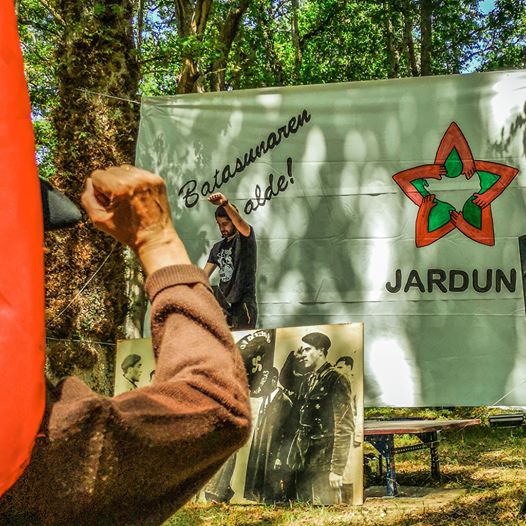
Sorprendió a mediados de agosto de este año tan atípico, la presentación en el Albertia que organiza Eusko Ekintza, este año también Jarki, de la iniciativa Jardun.

El conjunto en Albertia el ano pasado (Photo: D.Breatnach)

Ha pasado dos meses y he tenido una conversación de un representante de Jardun para que nos explique en qué consiste esta iniciativa, cuales son sus objetivos y si ha logrado avanzar en este mes escaso

Bueno… la verdad que fue sorprendente, la noticia de la aparición de este iniciativa… la primera pregunta es obvia… ¿Qué es Jardun?

Jardun es un proyecto político nuevo que surge en forma de coordinadora para llenar un vacío que existe en la izquierda independentista revolucionaria de Euskal Herria. Pretende agrupar a todos los militantes y organizaciones nacionales y locales que luchan por una Euskal Herria independiente, socialista, euskaldun y reunificada. Entendiendo que la independencia pasa por la conformación de un estado socialista vasco. Entendemos que para la consecución de dichos objetivos es necesario que cada organización que conforma Jardun, dentro de su espacio de actuación pero respetando su autonomía, funcionen enmarcadas dentro de una estrategia común que sea la plasmación de un proyecto político que responda a las necesidades de la clase trabajadora de Euskal Herria. Tenemos como principios el internacionalismo, la defensa del medio ambiente, la amnistía y la consecución de una sociedad sin clases y sin opresión de género que van todas de la mano, pues, el no luchar contra todas las opresiones puede perpetuar alguna de ellas y eso para nosotros no es una opción.

Se trata de una iniciativa que han lanzado Eusko Ekintza y Jarki… Un poco, ¿Qué tipo reflexiones habéis hecho común para llegar a estar conclusiones que comentas?

Lo que nos ha llevado a configurar la coordinadora Jardun es que las dos organizaciones que lo hemos conformado advertíamos que había una carencia en cuanto a una alternativa revolucionaria en Euskal Herria. Llevamos algo más de un año reuniéndonos y reflexionando conjuntamente ante el estado de colapso en que se encontraba el movimiento revolucionario vasco. Esto unido a la situación de desmovilización y alienación generalizada en la que se encuentra sumido Euskal Herria y al cierre del ciclo político anterior hace necesario poner en marcha un proyecto político independentista con perspectiva de clase y coherente. Pero más allá de la reflexión de por qué han ocurrido las cosas que han ocurrido durante décadas y han desembocado en la actual situación, lo que nos ha impulsado a dar este paso es la necesidad de ofrecer al Pueblo Trabajador Vasco una alternativa política integral, con vocación para avanzar de una manera real hacia los objetivos mencionados anteriormente. Para ello, necesitamos dotarnos de los instrumentos políticos y organizativos necesarios. Y es por eso que debemos tener la verdadera determinación y el convencimiento de que los objetivos son posibles si conseguimos activar a los sectores más concienciados del Pueblo Trabajador Vasco.

¿Hasta ahora que respuesta ha tenido vuestra iniciativa por los diferentes colectivos de Euskal Herria y que no están de acuerdo con las posiciones de la Izquierda Abertzale, llamémosla “oficial”

En estos momentos Jardun se compone de Eusko Ekintza y la organización revolucionaria Jarki a nivel nacional y de las iniciativas populares Bultza Herri Ekimena en la zona de Bilbo y Askatasun Haizea Herri Ekimena en Busturialdea. Seguimos buscando burkides para este proyecto y estamos encontrando gran receptividad por parte de diferentes grupos con los que estamos abriendo conversaciones y eso es ilusionante y muestra del la linea seguir. Sin duda en los próximos meses y años más grupos se sumarán a Jardun ampliando la base de este nuevo proyecto por la independencia y el socialismo dentro de una izquierda independentista renovada.

En el caso de Eusko Ekintza, ha tenido recientemente una experiencia unitaria, que por decirlo de una manera suave habrá salido trasquilada, me refiero a su experiencia dentro de Herritar Batasuna, en el caso de Jarki, es un colectivo nuevo de reciente aparición. ¿Han tenido muchas dificultades para llegar a acuerdos? ¿Han puesto encima de la mesa que tipo de comportamientos no van a aceptar para que esto vaya a buen puerto?

Las dos organizaciones tenemos recorridos diferentes, cada uno desde su propia realidad, pero nos une la voluntad de articular una alternativa lo suficientemente amplia y plural, dentro de las líneas rojas que nos marcamos, para que el movimiento revolucionario de este país pueda ir creciendo hasta convertirse en una fuerza política determinante de cara a conseguir la independencia y el socialismo. Para ello sobran los dirigentismos, los sectarismos, el buscar enemigos entre los burkides más cercanos a tu proyecto o el intentar construir una alternativa política a la reacción o a la contra de lo que hacen el resto de fuerzas políticas existentes en Euskal Herria. Nosotros luchamos contra la opresión nacional y social de los estados español y francés, el capital y sus gestores socio-políticos.

¿A que perfil militante va dirigida esta iniciativa?

A individuos y organizaciones nacionales, sectoriales o locales que compartan, las bases ideológicas y organizativas recogidas en el documento “Txinparta” (que es el documento base de trabajo para las organizaciones que conformamos Jardun), y que quieran sumarse, de una manera estratégica, para construir un verdadero movimiento capaz de avanzar de una manera real desde la sinceridad, la lealtad y el trabajo conjunto.

De los agentes vascos que se mueven en las coordenadas revolucionarias y abertzales que citáis… ¿Pensáis que se sumara alguno más, aparte de los que ya han dicho públicamente, en redes que aplauden la iniciativa? ¿Os vais a dirigir a ellos?

Además de los grupos que ya te hemos citado, continuamos y continuaremos reuniéndonos con toda nuestra determinación con diferentes grupos y colectivos para que Jardun siga creciendo en los próximos meses y años.

Supongo que con la Izquierda Abertzale “oficial” no tenéis ningún contacto y que no estará interesada en esta iniciativa

Evidentemente si nosotros estamos construyendo esta iniciativa es porque constatamos que el espacio socio-político del socialismo independentista revolucionario no está ni estructurado ni representado hoy en día. La militancia de Sortu ha hecho su propia elección política y nosotros no tenemos nada que decir al respecto puesto que no somos, ni parte, ni disidencia de lo que hoy en día se define como Izquierda Abertzale.

Ya para terminar… Destruir es muy fácil, construir es muy complicado… ¿Pensáis que esta iniciativa abrirá por fin un periodo en el cual haya una herramienta organizativa en nuestro pueblo para lograr sus objetivos históricos de Independencia y Socialismo?

Precisamente para eso constituimos Jardun, pero a la vez somos muy realistas en que construir una alternativa independentista y socialista amplia, eficiente y potente no se consigue de la noche a la mañana. Por eso, es muy importante ir avanzando de una manera firme, con las cosas claras y sin crear falsas imágenes de lo que no se es, pero haciendo llegar a todo el Pueblo Trabajador Vasco lo que sí somos por encima de los cordones sanitarios, bloqueos mediáticos y el boicot que algunos pretenden promover contra esta alternativa ilusionante.

Bueno… pues nada más. Estaremos atentos y atentas a los siguiente pasos que se vayan dando y que ojala conduzcan a ese objetivo…que nuestro pueblo entre vosotros y muchos más se organice y logre sus objetivos históricos

Sí, los objetivos históricos de nuestro pueblo y de nuestra clase.

DELIVEROO RIDERS ARE EMPLOYEES DESPITE EMPLOYER CLAIM

JUDGEMENT OF SPANISH SUPERIOR COURT IN FAVOUR OF THE WORKERS

Report in Publico.es by Pilar Araque Conde.Translation from Castillian by D.Breatnach.

https://www.publico.es/sociedad/deliveroo-tsjm-falla-deliveroo-reconoce-532-riders-trabajadores.html

Deliveroo riders, treated as self-employed workers responsible for their own insurance, without sickness or holiday pay — but in reality employees.
(Photo source: Internet)

Yet another repeat: the nth judicial victory of the riders against Deliveroo. On this occasion, the Superior Court of Justice of Madrid (TSJM) ratified the ruling in favor of 532 deliverers of the digital platform by recognizing them as employees and not as freelancers, as the Labor Inspection of the capital had ruled.

The TSJM dismissed the appeal filed by Roodfoods Spain S.L.U., the holding company of Deliveroo, against the ruling pronounced on July 22nd last year by Madrid’s Social Court No.19. Back then, the court had concluded that the distributors were workers of the company.

“In the provision of services by the deliverers affected by the process, during the period to which the liquidation act refers, labor conditions prevailed, which leads to the judgement of the demand”, states the text accessed by this media. (Trans: ??)

FIRST GREAT COLLECTIVE VICTORY OF THE RIDERS AGAINST DELIVEROO

          Therefore, the TSJM insists on the relationship between the home delivery company and the riders: “The details or characteristics of an employment relationship concur when assessing the existence of habituality, periodic retribution, dependency and subject to orders and business instructions, alienation of benefits and risks and very personal nature of the provision of service”.

A Labor Inspection report estimated that the deliverers were false self-employed and that Deliveroo “covered up” an ordinary labor relationship with them. The General Treasury of Social Security took up the challenge and filed a lawsuit, which was decided by the judge. The oral hearing, held on May 2019, had the testimony of more than 500 riders.

Deliveroo Riders received judgement in their favour in Valencia, Spanish State, last year, displaying placards saying “WE WON” in Catalan on Deliveroo-type background.
(Photo source: Publico.es)

The workers’ lawyer, Esther Comas, highlights the “importance” of the sentence. Not only because it affects 532 workers, “but because it makes a very exhaustive examination of the conditions of employees who, in turn, can be extrapolated to other colleagues in the same company and even from other platforms [Glovo and Uber Eats]”, the member of the Madrid Ronda Collective pointed out to Publico.

Also, the UGT union welcomed the decision of this court: “We consider this judgement very important since it summarises everything that we have been fighting for and which coincides, in its conclusions, with another ruling by the Madrid TSJ on Glovo’s working model,” UGT explained in a press release.

The collective fight of the riders adds another victory. In June 2019, Social Court No.5 of Valencia also ruled in favor of the delivery riders. Delivery riders in cities like Barcelona or Zaragoza await an oral hearing for the law to recognize them as employees, based on the judgements pronounced against Deliveroo and Glovo.

A rider for Just Eat, on similar arrangements to Deliveroo riders, treated as self-employed workers responsible for their own insurance, without sickness or holiday pay — but in reality employees.
(Photo source: Internet)

And, despite the infinity of reports prepared by the Labor Inspectorate in different provinces, digital distribution platforms continue to operate without a regulation that guarantees the rights of their workers. Also, taking into account that the number of employees in the sector is around 14,337 people, UGT estimates that Social Security lose up to 76 million euros, according to the report on digital distribution platforms by Work, presented last September 6th.

end

FURTHER READING:

https://www.independent.ie/life/dublin-deliveroo-worker-i-fell-off-my-bike-when-i-rang-the-call-centre-the-first-thing-they-asked-was-if-the-food-was-okay-35090382.html

https://www.irishtimes.com/news/ireland/irish-news/deliveroo-riders-say-they-are-deliberately-targeted-for-violent-attacks-1.3802955


MIGRANTS IN IRISH HISTORY

(Traducción al castellano de bajo del inglés)

(Reading time: 5 minutes)

Diarmuid Breatnach

Racists and Fascists, posing as Irish “patriots”, malign migrants to Ireland and target them in racist propaganda. This is a fundamentally unpatriotic activity, flying against not only our own huge history of migration to other lands but also against the great history of migrants’ contribution to the struggle for Irish independence and socialism.

          Of the Seven Signatories of the 1916 Proclamation of Independence, two were migrants and two more were sons of migrants.

Of the sixteen of the Rising executed by the English, two were migrants (Connolly and Clarke), another three were sons of migrants (Pearse brothers, Mac Donagh) and at least six bore family names of foreign ancestry (Casement, Ceannt, Clarke, Colbert, Kent, Plunkett).

Numerous migrants took part in the 1916 Rising, mostly from England and Scotland but also some from the USA, one from Argentina, another from Finland and yet another from Sweden).

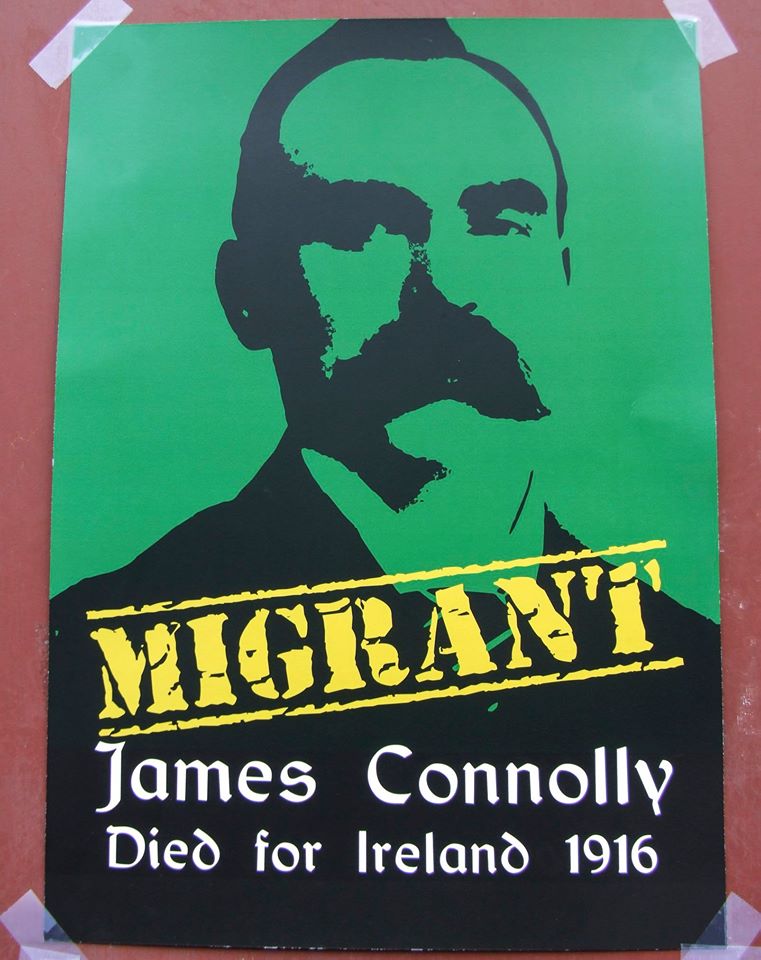
James Connolly, revolutionary socialist and anti-imperialist, author, songwriter, journalist and trade union organiser was a migrant who did not see Ireland until he was a young man.
(Design: Maria Castella; photo: B.Hoppenbrouwers)

Constance Markievicz (nee Gore-Booth), feminist, Irish Republican, Socialist, officer in the Irish Citizen Army, first woman elected to the British Parliament, first female Minister of the Dáil and first Labour Minister in the world, was born in England; she was sentenced to death in 1916 by the English but had her sentence commuted. Volunteer Eamon De Valera, a 1916 Rising garrison Commander, was born in the USA to an Irish mother and a Cuban father. The captain of the Asgard yacht that delivered the Mauser rifles for the 1916 Rising was an Englishman, Erskine Childers and among the crew were his wife Molly from the USA and Mary Spring Rice (born London). Childers fought in the War of Independence and the Civil War and was executed by the Irish Free State in 1922.

Jim Larkin, trade union organiser and Lockout resistance leader, who was in the USA during the Rising, was co-founder of the Irish Transport & General Workers’ Union and of the Irish Citizen Army, also of the Irish Labour Party. Larkin was born and raised in Liverpool and did not see Ireland until sent to Belfast by his England-based trade union.

Constance Markievicz, Irish Republican, revolutionary socialist, officer in the Irish Citizen Army, sentenced to death in 1916 but commuted. She was a migrant, born in England.
(Image source: Internet)

A LONG HISTORY OF MIGRANT CONTRIBUTION TO IRISH STRUGGLES

          The aforesaid should not surprise us as migrants have often participated in struggles for freedom and social progress in their adopted countries and they and their descendants have a long history of taking up those struggles in Ireland – often sacrificing their liberty and even their lives in doing so.

Patrick Sarsfield, a hero of the resistance to William of Orange in the army of James II was of Anglo-Norman descent (he was a prominent member of the Wild Geese and was killed in military service abroad in 1683).

Nearly all the leaders of the Society of United Irishmen, the first Republican revolutionary organisation of Ireland, were Protestants of various sects and descendants of migrants. Henry and Mary Joy McCracken were active in saving Irish traditional melodies; their ancestors were Huguenots (French Protestant refugees).

Henry Joy was executed publicly in Belfast by the English in 1798, his sister walking hand-in-hand with him to the gallows. General Henry Munro, another Antrim Unitedmen leader, also executed in 1798, was of Scottish descent.

Theobald Wolfe Tone, Anglican co-founder of the Unitedmen and often described as the “father of Irish Republicanism”, was also of Huguenot ancestry; he died in jail in Dublin, while his brother Matthew was hanged. Edward Fitzgerald, another leader of the Unitedmen who died of his injuries in a Dublin jail, was a Protestant and descendant of Norman invaders.

Robert Emmet, another famous United Irishman but martyred in 1803, bore a surname of English origin as did one of his prominent comrades, Thomas Russell (“The Man from God Knows Where”), also executed by the English that year.

The Young Irelanders were the next Irish Republican organisation in history, their leaders a mixture of Protestant and Catholic background. One of the most famous was Thomas Davis, the son of a Welshman in the British Army and an Irish woman descended from Irish chieftain Ó Súilleabháin Béara.

Davis founded The Nation newspaper and composed a number of poems and songs, some of the latter being still sung today (e.g A Nation Once Again and The West’s Awake).

James Stephens and a handful of others founded the Irish Republican Brotherhood on 17th March 1858 in Dublin, the third Irish Republican organisation in Irish history and the life of which extended into the 1920s. Stephens is a family name of Anglo-Norman origin.

John Devoy of the Irish Republican Brotherhood in the USA, who was very active in supporting the 1916 Rising and the War of Independence, carried a family name of Welsh origin. Wales was also the likely origin of Michael Davitt’s family name, he who was chief organiser of the Land League’s base membership.

Volunteers Terence McSwiney and Kevin Barry, who both died in the same week in 1920, the first on hunger strike and the second hanged by the English, had family names of foreign origin.

WHO IS NOT A DESCENDANT OF MIGRANTS?

          Of course, we are ALL descendants of migrants. The earliest date for human occupation of parts of Ireland has been calculated as being 7,000 BCE.

Since the earliest date given for the existence of homo sapiens is 300,000 years ago in the Horn of Africa (although throwing spears in Germany have been assessed as being between 380,000 and 400,000 years old), it follows that human settlement in Ireland was comparatively late and that all Irish are descended from migrants.

Stone age people arrived first, then the metal workers of bronze, followed by people of Celtic culture working iron.

Subsequently Ireland saw influxes of other groups, from Norse and Danes when they began to settle in parts of Ireland, followed by their cousins based in Normandy (and mercenaries they brought with them), then English and so on.

Religious groups seeking security such as Jews or fleeing persecution, for example the Huguenots, also entered at various times. Just a study of family names common in the Ireland of today reveals some of those ancestries.

The Norse, Danes, Normans and early English came as invaders, some more came subsequently as planters and many others came just to make a living in Ireland, like most migrants of today.

But descendants of all those groups, including of invaders and planters, contributed to and even led the struggle for Irish independence and social progress. Not only that but a significant number of those who arrived as migrants themselves took a stand for Irish independence, some of them paying the ultimate price.

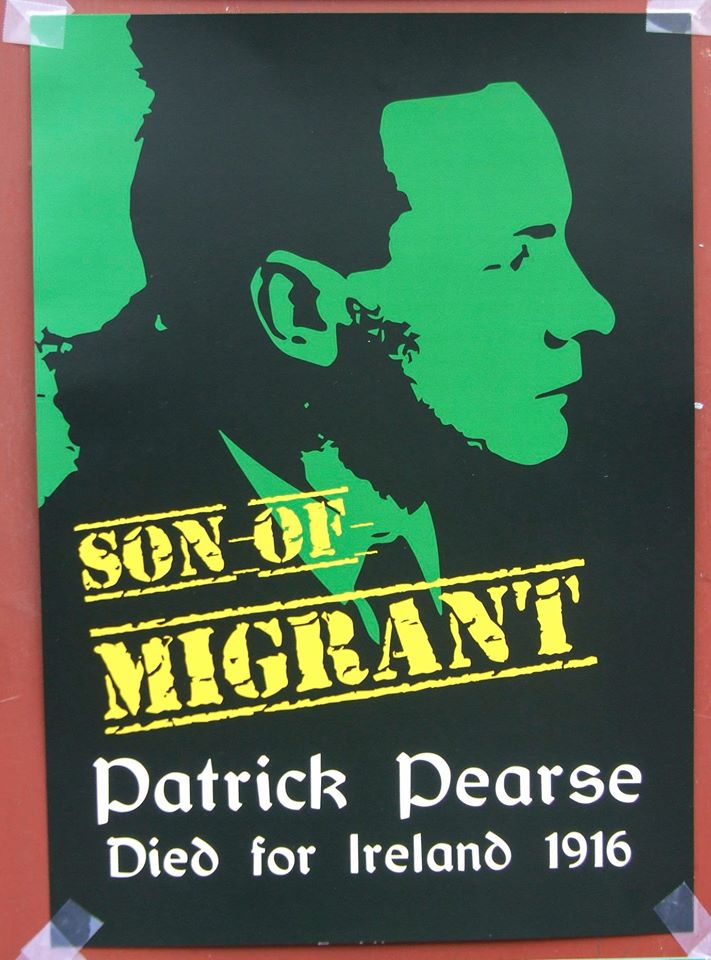
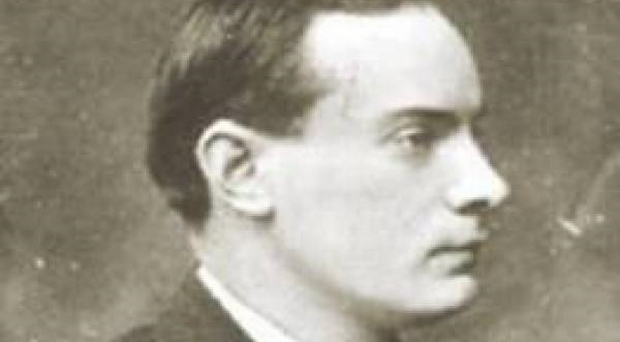
Patrick Pearse, author in Irish and English, poet, journalist, Irish Republican and in overall command of the insurrectionary forces in 1916, was the son of an Englishman, as was his brother William. Both were executed after the surrender.
(Design: Maria Castella; photo: B.Hoppenbrouwers)

CONCLUSION

          Far from being “patriotic”, maligning migrants simply for being migrants is counter to the history of the general struggle for Irish independence and of Irish Republicanism in particular. It actually undermines the unfinished struggle for Irish independence and unification as well, of course, as the struggle of the working people for socialism.

End.

TRADUCCIÓN AL CASTELLANO:

LOS INMIGRANTES EN LA HISTORIA IRLANDESA

          Los racistas y fascistas, haciéndose pasar por “patriotas” irlandeses, atacan a los inmigrantes en Irlanda en su propaganda racista. Esta actividad es fundamentalmente antipatriótica, que vuela no solo contra nuestra enorme historia de migración a otras tierras sino también contra la gran historia de la contribución de los inmigrantes a la lucha por la independencia y el socialismo irlandés.

          De los Siete Signatarios de la Proclamación de Independencia de 1916, dos eran inmigrantes y un tercero era hijo de un inmigrante. De los dieciséis del Azamiento ejecutados por los ingleses, dos eran inmigrantes (Connolly y Clarke), otros dos eran hijos de inmigrantes (hermanos Pearse) y al menos seis tenían apellidos de ascendencia extranjera (Casement, Ceannt, Clarke, Colbert, Kent, Plunkett). Numerosos inmigrantes participaron en el Alzantamiento de 1916, principalmente de Inglaterra y Escocia, pero también algunos de los EEUU, uno de Argentina, otro de Finlandia y otro de Suecia).

Constance Markievicz (soltera Gore-Booth), feminista, republicana irlandesa, socialista, oficial del ejército ciudadano irlandés y primera mujer elegida para el Parlamento británico, la primera mujer ministra del Parlamento irlandés y primera ministra femenina de trabajo del mundo, nació en Inglaterra; fue condenada a muerte en 1916 por los ingleses, pero la conmutaron la pena. El voluntario Eamon De Valera, un comandante de la guarnición del Azamiento de 1916, nació en los Estados Unidos de una madre irlandesa y un padre cubano. El capitán del yate Asgard que entregó los fusiles Mauser para el Alzamiento de 1916 era un inglés, Erskine Childers y entre la tripulación estaban su esposa Molly (de los Estados Unidos) y Mary Spring Rice (nacida en Londres). Childers luchó en la Guerra de la Independencia y la Guerra Civil y fue ejecutado por el Estado Libre de Irlanda en 1922.

Jim Larkin, organizador sindical y líder de la resistencia al Cierre Patronal, que estuvo en los EEUU durante el Alzamiento, fue cofundador del Sindicato de Trabajadores Generales y de Transporte de Irlanda y del Ejército de Ciudadanos de Irlanda, también del Partido Laborista. Larkin nació y creció en Liverpool y no vio Irlanda hasta estar enviado a Belfast por su sindicato con sede en Inglaterra.

UNA LARGA HISTORIA DE CONTRIBUCIÓN MIGRANTE A LAS LUCHA IRLANDESA

          Lo anterior no debería sorprendernos, ya que los migrantes a menudo han participado en luchas por la libertad y el progreso social en sus países adoptados y ellos y sus descendientes tienen una larga historia de asumir esas luchas en Irlanda, a menudo sacrificando su libertad e incluso sus vidas al hacerlo. .

Patrick Sarsfield, un héroe de la resistencia a Guillermo Naranja en el ejército de Jaime II de Gran Bretaña, era de ascendencia anglo-normanda (era un miembro destacado de los “Gansos Silvestes” y fue asesinado en el servicio militar en el extranjero en 1683).

Casi todos los líderes de la Sociedad de Irlandeses Unidos, la primera organización revolucionaria republicana de Irlanda, eran protestantes de varias sectas y descendientes de inmigrantes. Henry y Mary Joy McCracken fueron activos en salvar las melodías tradicionales irlandesas; sus antepasados ​​eran hugonotes (refugiados protestantes franceses). Henry Joy fue ejecutado públicamente en Belfast por los ingleses en 1798, su hermana caminó de la mano con él hacia la horca. El general Henry Munro, otro líder de Los Irelandeses Unidos de Antrim, también ejecutado en 1798, era de ascendencia escocesa. Theobald Wolfe Tone, cofundador anglicano de los Irelandeses Unidos y a menudo descrito como el “padre del republicanismo irlandés”, también era de ascendencia hugonote; murió en la cárcel de Dublín, mientras que su hermano Matthew fue ahorcado. Edward Fitzgerald, otro líder de los Irelandeses Unidos que murió por sus heridas en una cárcel de Dublín, era protestante y descendiente de invasores normandos.

Robert Emmet, otro famoso de los Irelandeses Unidos pero martirizado en 1803, tenía un apellido de origen inglés, al igual que uno de sus camaradas prominentes, Thomas Russell (“The Man from God Knows Where”), también ejecutado por los ingleses ese año.

Los Jóvenes Irlandeses fueron la próxima organización republicana irlandesa, sus líderes una mezcla de antecedentes protestantes y católicos. Uno de los más famosos fue Thomas Davis, hijo de un galés en el ejército británico y una mujer irlandesa descendiente del jefe irlandés Ó Súilleabháin Béara. Davis fundó el periódico The Nation y compuso una serie de poemas y canciones, algunas de las cuales todavía se cantan hoy (por ejemplo, A Nation Once Again y The West’s Awake).

James Stephens y un puñado de otros fundaron la Hermandad Republicana Irlandesa el 17 de marzo de 1858 en Dublín, la tercera organización republicana irlandesa en la historia de Irlanda y cuya vida se extendió hasta la década de 1920. Stephens es un apellido de origen anglo-normando.

John Devoy, de la Hermandad Republicana Irlandesa en los EEUU, que fue muy activo en el apoyo al Alzamiento de 1916 y la Guerra de la Independencia, llevaba un apellido de origen galés, lo qual también fue el origen probable del apellido de Michael Davitt, el principal organizador de la membresía base de la Liga de la Tierra.

Los Voluntarios del IRA Terence McSwiney y Kevin Barry, quienes murieron en la misma semana en 1920, el primero en huelga de hambre y el segundo ahorcado por los ingleses, tenían apellidos de origen invasor.

¿QUIÉN NO ES UN DESCENDENTE DE MIGRANTES?

          Por supuesto, TODOS somos descendientes de migrantes. La fecha más temprana para la ocupación humana de partes de Irlanda se calculó ser en 7,000 aC. Dado que la fecha más temprana dada para la existencia del homo sapiens es hace 300,000 años en lo que hoy es Marruecos, se deduce que el asentamiento humano en Irlanda fue relativamente tarde y que todos los irlandeses son descendientes de migrantes.

Primero llegaron personas de la edad de piedra, luego los trabajadores metalúrgicos de bronce, seguidos por gente de la cultura celta que trabajaban el hierro. Posteriormente, Irlanda vio la afluencia de otros grupos, de nórdicos y daneses cuando comenzaron a establecerse en partes de Irlanda, seguidos por sus primos con sede en Normandía (y mercenarios que trajeron con ellos), luego ingleses, etc. Los grupos religiosos que buscaban seguridad como los judíos o huían de la persecución, por ejemplo los hugonotes, también ingresaron en varios momentos. Un estudio de apellidos comunes en la Irlanda de hoy basta para revelar algunos de esos antepasados.

Los nórdicos, daneses, normandos y los primeros ingleses llegaron como invasores, algunos más llegaron posteriormente como plantadores y muchos otros vinieron para ganarse la vida en Irlanda, como la mayoría de los inmigrantes de hoy. Pero los descendientes de todos esos grupos, incluidos los invasores y plantadores, contribuyeron e incluso lideraron la lucha por la independencia de Irlanda y el progreso social. No solo eso, sino que un número significativo de los que llegaron como migrantes tomaron posición por la independencia de Irlanda, algunos de ellos pagando el precio final.

CONCLUSIÓN

          Lejos de ser “patriótico”, difamar a los migrantes simplemente por ser migrantes es contrario a la historia de la lucha general por la independencia de Irlanda y del republicanismo irlandés en particular. De hecho, mina la lucha todavía inconclusa por la independencia y la unificación irlandesa, así como, por supuesto, la lucha de los trabajadores por el socialismo.

Fin.

WE REPENT EVERYTHING!

WE REPENT EVERYTHING!

(Reading time text: 3 minutes)

Diarmuid Breatnach

Versiones en castellano y en catalan de bajo

Introduction: The Spanish State requires the Basque resistance to repent.  The State refused Basque independence and suppressed the movement for self-determination and the language, arrested and tortured its activists. In response ETA (Basque Homeland and Freedom) was created and for nearly a decade carried out no armed action until finally it killed an armed policeman when stopped at a checkpoint (the activist was also killed in the incident) and later also the police chief in charge of tortures. Years of struggle and repression added hundreds of Basque prisoners to Spanish (and French) jails, dispersed all over the state.

          The Spanish State in more recent years insisted at first that in order for the repression to end, that ETA would have to end its armed activity. ETA did so in 2010 but successively the State insisted on decommissioning of arms, then disbandment of the organisation (which ETA did in 2017 and 2018 respectively), then that its prisoners and Basque leaders apologise for their armed actions. Most of the prisoners still refuse to do that and serve out their sentences or die in jail – but some of the leadership outside have done so, including taking part in commemorations of some of the agents of the Spanish State killed by ETA. Meanwhile, the Spanish State considers it a terrorist-law crime to commemorate the fallen fighters of ETA who died in prison or were gunned down by the forces of the State.

So …. this is on behalf of those who have apologised and those who are planning to.

WE REPENT EVERYTHING, SPANISH STATE!

We repent everything … everything! We beg your forgiveness for all that we have done – we have been like bad children in the face of your goodness. Even worse – much worse!

It’s difficult to know where to start ….

Firstly, we repent having come to this land before you, with our own language that was not even Indo-European. What arrogance! What an insult to your rightful sovereignty! Not even the Moors of Al Andalus, with their lofty science and their pretentious toleration of all religions, had the arrogance to arrive before you. We beg your forgiveness.

We are sorry also for having fought for the independence and rights of the Kingdom of Navarra and for even having supplied some of your early royal families. Again, what arrogance! We beg your forgiveness once more.

We regret not having participated wholeheartedly in your rightful, restrained and proportionate Inquisition. We heartily repent leaving so many witches unburned. Please, please forgive us for that, though in truth it was unpardonable.

And throughout, still speaking that language, probably the oldest in Europe! What shameful arrogance. What lack of gratitude for the Indo-European language you offered us!

We regret – oh, how we regret! — having stood against that wonderful, righteous and Christian leader, Generalisimo Franco. We find it hard to believe now that we had the arrogance to stand with a government elected by the people against the rightful military intervention of the Four Generals and especially his exalted self, General Franco. What could we have been thinking of? How right he was to have his German allies – may they be blessed! — bomb Gernika (sorry, Guernica)!

We apologise for those priests, monks and nuns who did not embrace the Christian Crusade of the Caudillo and the Spanish hierarchy, who persisted in defending the indefensible ideas of nationhood, of giving aid to prisoners and in teaching our accursed language. Of course it was right to shoot some of them – they should all have been shot!

We feel ashamed and deeply repent that even after Franco and his troops showed us the correct way — having had to shoot thousands to do it – that we continued to speak that unChristian language and to teach it in secret in houses, even when you had lawfully forbidden it.

We humbly apologise for the industrial strikes we have carried out in protest against your wise guidance and are very sorry that we forced you to shoot or imprison us.

We can hardly continue, we are so choked with grief and yet must do so; we beg your indulgence, for in some ways, our worst is to come.

On bended knee — no, prostrate on the ground – we beg your forgiveness for having formed the organisation “Land and Freedom”. To have banded together to spread ideas of independence and socialism – independence from you! Atheistic socialism! Your police were quite right to hound us, arrest, torture us and even shoot us. But did we learn? No – instead we took up arms! Against the Power in the land!

For our newspapers that you rightly banned, for our radio stations you rightly shut down; for our activists you rightly forced to confess and jailed, for our other activists who had the temerity to flee so that you had to send assassination squads after them into another state’s administration; for the disgraceful conduct of relatives of people imprisoned who traveled hundreds of kilometres to visit them and had the temerity to campaign for an end to their dispersal; for the prisoners who continued to resist and those who had the arrogance to shame you by ending their own lives; for the refugees whom you had to pursue to Latin America, to Canada and to states of Europe; for continuing to speak that accursed language, for singing it and for even developing an art form of impromptu dialogues in it …..

For all of that, we repent, we apologise, we humbly beg your forgiveness, even though we know we are not worthy of it.

If you allow us, in your benevolence and forbearance, undeserving as we are, although we know we can never achieve it properly and will be but pale imitations, we will try – really, really try – to become like you.

End.

EH Bildu (Abertzale Left party) Mayor of Errentería, Julen Mendoza (nearest to viewer) in commemoration ceremony for four Guardia Civil killed by ETA in the area in 1982 (Source photo: Internet)

CASTELLANO

NOS ARREPENTIMOS DE TODO, ESTADO ESPANOL! 

Lo arrepentimos de todo … pero de todo! Pedimos vuestro perdón por todo lo que hemos hecho, hemos sido como niños malos ante su bondad. Aún peor, mucho peor!

Es difícil saber por dónde empezar …

En primer lugar, lamentamos haber llegado a esta tierra antes que ustedes, con nuestro propio lenguaje que ni siquiera era indoeuropeo. Qué arrogancia! Qué insulto a vuestra soberanía legítima! Ni siquiera los moros de Al-Andalus, con su gran ciencia y su pretendida tolerancia a todas las religiones, tuvieron la arrogancia de llegar antes que ustedes. Pedimos perdón.

Arrepentimos también haber luchado por la independencia y los derechos del Reino de Navarra e incluso por haber proporcionado algunas de sus familias reales. Otra vez, qué arrogancia! Pedimos vuestro perdón una vez más.

Lamentamos no haber participado de manera sincera en vuestra Inquisición legítima, moderada y proporcionada. Lamentamos profundamente dejar muchas brujas y herejes sin quemar. Por favor, perdónenos por ello, aunque, en en realidad, es imperdonable.

Y encima, hablando este idioma vasco, probablemente el más antiguo de Europa! Qué vergonzosa arrogancia. Qué falta de gratitud por la lengua indoeuropea que nos ofrecisteis!

Lamentamos – oh, como lo lamentamos! – habernos mantenido en contra de ese maravilloso, justo y cristiano líder, el Generalísimo Franco. Nos resulta difícil creer ahora que teníamos la arrogancia de apoyar a un gobierno elegido por la gente contra la legítima intervención militar de los Cuatro Generales y sobre todo su exaltado persona, el general Franco. En que podíamos haber estado pensando? ¿Que acertado estuvisteis con sus aliados alemanes – ! benditos sean! – en bombardear a Gernika (perdoname, Guernica)!

Nos disculpamos por nuestros sacerdotes, monjes y religiosas que no aceptaron la cruzada cristiana del Caudillo y la jerarquía Española, que persistieron en la defensa de las ideas indefendibles de la nacionalidad, de dar ayuda a los prisioneros y de enseñar nuestro idioma torpe. Por supuesto, era correcto disparar a algunos de ellos: todos debían de haber sido fusilados!

Nos sentimos avergonzados y profundamente arrepentidos de que, incluso después que Franco y sus tropas nos mostraran el camino correcto — habiendo tenido que disparar miles para ello — seguimos hablando de esta lengua no cristiana y la enseñamos en secreto en las casas , incluso cuando había estado ya prohibido legalmente.

Humildemente nos disculpamos por las huelgas industriales que hemos llevado a cabo en protesta contra vuestra sabia dirección y lamentamos mucho haberles obligado a dispararnos o encarcelarnos.

Apenas podemos continuar, estamos tan abrumados por el dolor y, sin embargo, debemos hacerlo; rogamos su indulgencia, porque de alguna manera, nuestro peor final ha llegado.

De rodillas – no! postrado en el suelo! – le pedimos perdón por haber formado la organización “Tierra y Libertad”. Reunirse para difundir ideas de independencia, socialismo –¡independencia de ustedes! ¡Socialismo ateo! Su policía tenía toda la razón para perseguirnos, arrestarnos y torturarnos e incluso dispararnos. Pero, ¿aprendimos? No, en cambio tomamos las armas! ¡Contra el poder de la tierra!

Para nuestros periódicos que con tanta razón prohibisteis, para nuestras estaciones de radio cerrados correctamente, para nuestros activistas a los que con razón obligasteis confesar y encarcelar, para nuestros otros activistas que tuvieron la temeridad de huir, por lo que tuvisteis que enviar escuadrones de asesinatos en la tierra de otro estado, por la vergonzosa conducta de familiares de personas encarceladas que viajaron cientos de kilómetros para visitarlos y tuvieron la temeridad de hacer campaña para poner fin a su dispersión, por los prisioneros que continuaron resistiendo y los que tenían la arrogancia para avergonzarles por poniendo fin a sus propias vidas, a los refugiados que tuvisteis que perseguir en América Latina, a Canadá y a los estados de Europa, por continuar hablando ese lenguaje maldito, por cantarlo e incluso por desarrollar una forma de arte de diálogos improvisados en él. …

Por todo eso, nos arrepentimos, nos disculpamos, pedimos humildemente vuestro perdón, aunque sabemos que no somos dignos de ello.

Si nos permiten, en vuestra benevolencia y paciencia, sin merecer lo que somos, aunque sepamos que nunca podremos lograrlo correctamente y seremos solo imitaciones pálidas, intentaremos, realmente, realmente intentaremos llegar a ser como vosotros.

Basque victim of Spanish police tortue, Joxe Arregi Izagirre, who incredibly survived until brought to hospital but died quickly afterwards, February 1981.

CATALAN

ENS PENEDIM DE TOT, ESTAT ESPANYOL!

Ens penedim de tot … pero de tot! Demanem el vostre perdó per tot el que hem fet, hem estat com a nens dolents davant la vostra bondat. Encara pitjor, molt pitjor!

És difícil saber per on començar …

En primer lloc, lamentem haver-nos arribat a aquesta terra abans que tu, amb el nostre propi llenguatge que ni tan sols era indoeuropeu. Quina arrogància! Quin insult a la vostra sobirania legítima! Ni tan sols els moros d’Al-Andalus, amb la seva gran ciència i la seva pretesa tolerància a totes les religions, van tenir l’arrogància d’arribar abans que vosaltres. Demanem perdó.

Sentim també haver lluitat per la independència i els drets del Regne de Navarra i fins i tot per haver subministrat algunes de les seves famílies reals. Una altra vegada, quina arrogància! Demanem el perdó una vegada més.

Lamentem no haver participat de manera sincera en la vostra Inquisició legítima, moderada i proporcionada. Lamentem profundament deixar que moltes bruixes i heretges sense cremar. Si us plau, perdoneu-nos per això, encara que, en veritat, no era vàlid.

I tot, parlant encara aquest idioma basc, probablement el més antic d’Europa! Quina vergonyosa arrogància. Quina falta de gratitud per la llengua indoeuropea que ens vau oferir!

Lamentem – oh, com ho lamentem! – Davant d’aquest meravellós, just i líder cristià, el Generalíssim Franco. Ens resulta difícil creure ara que teníem l’arrogància d’estar amb un govern elegit per la gent contra la legítima intervenció militar dels Quatre Generals i sobretot el seu exaltat general, el general Franco. En què podíem estar pensant? Quin dret era tenir els seus aliats alemanys, que beneïts siguin! – Bombardejar Gernika (ho sento, Guernica)!

Ens disculpem pels nostres sacerdots, monjos i religioses que no van acceptar la creuada cristiana del Caudillo i la jerarquia Espanyola, que va persistir en la defensa de les idees indefensables de la nacionalitat, de donar ajuda als presoners i d’ensenyar el nostre idioma maldestre. Per descomptat, era correcte disparar alguns d’ells: tots haurien estat disparats!

Juan Mañas Morales, Luis Montero García and Luis Manuel Cobo Mier, uninvolved Basques tortured and killed by Guardia Civil in 1981. Their bodies were then placed in a car, shot at and the car set on fire. (Source images: Internet)

Ens sentim avergonyits i profundament penedits que, fins i tot després que Franco i les seves tropes ens mostressin la manera correcta: havent hagut de disparar milers per fer-ho, continuem parlant d’aquesta llengua cristiana i ensenyem-la en secret a les cases, fins i tot quan tenies ho ha prohibit legalment.

REFERENCES

A Councillor of the official Abertzale (Basque pro-Independence) Left attends memorial of victim of ETA and lays flowers at memorial: https://www.efe.com/efe/espana/politica/eh-bildu-asiste-por-primera-vez-en-19-anos-al-homenaje-a-miguel-angel-blanco/10002-2984272

EH Bildu, party of the Abertzale Left, declares it wished to attend commemoration of victim of ETA: https://www.europapress.es/nacional/noticia-eh-bildu-afirma-ausencia-homenaje-blanco-nadie-deberia-ir-sitio-donde-no-bienvenido-20140714112609.html

A Mayor of the Abertzale Left attends commemoration of four Guardia Civil killed by ETA in Errentería (an area somtimes nicknamed “the Basque Belfast”, where resistance was strong and many Basques were killed by police, by state-sponsored murder gangs, including kidnappings and rapes): https://www.eldiario.es/norte/navarra/Ongi-Jose-Miguel-Maria-Dolores_0_814718789.html

ANDALUSIAN CITY COUNCIL TO DIG UP MASS GRAVE OF FRANCO VICTIMS

(Reading time entire text 5-10 minutes)

Report by RAÚL BOCANEGRA in Publico.es (translation and comment by Diarmuid Breatnach).

Mass grave of victims of Francoist repression, Burgos.
(Photo source: Internet)

“The City Council of Seville has guaranteed on its own to provide the necessary funding — 1.2 million euros — to exhume the Pico Reja pit, in which historians believe that there are at least 1,103 bodies of of victims of the repression, led by the General Queipo de Llano, following the military coup of July 18, 1936.

This exhumation will be the largest ever to be undertaken in Spain, following that which that was carried out in Malaga, in the San Rafael Trench, between 2006 and 2009, and may indicate the path to take for the other capitals (of Spanish state regions – Trans).

The Mayor of Seville, Juan Espadas (PSOE), guaranteed that the grave will be exhumed throughout the mandate of the current Council. “It is a truly historic step in Seville and one of national importance, since it is perhaps the biggest mass grave that [at this moment] has a definite project for its exhumation,” the Councilor said at a press conference.

“And, therefore, it is also one of the most important projects in terms of Historical Memory to be undertaken in our land, due to the importance and volume of the Pico Reja mass grave. It was a commitment that this Government (i.e of the Andalusian region) gave during the past mandate to relatives and memorial groups and today it is made a reality with this tender,” added Espadas.

“Next Friday the City Council of Seville, through the Governing Board will approve the specifications and, therefore, the public tender for a technical service for the exhumation and genetic identification of the bodies of the Pico Reja mass grave, in the Cemetery of San Fernando,” reads a statement issued by the City Council. “The ultimate goal [of the exhumation] is to dignify the memory of the people who were thrown there, give them a dignified burial and attend to the requests of their families,” adds the Council (statement – Trans).”

Militia Women of the Anarchist FAI -CNT in Catalonia, early years of the Spanish Anti-Fascist War. Women in areas captured by the Franco forces were exposed to endemic rape and many female prisoners were shot after being raped.
(Photo source: Internet).

BEGINNING AND COMPLETION OF WORK

          “Accordingly, Espadas will not wait for the Council of Andalucía or the Regional Government to sign the agreement, to which they had committed themselves. Confirming now, at the start of the mandate, the works, the Mayor ensures that the exhumation will not be delayed and will be carried out throughout this term. Municipal sources assured Público of their belief that both the Council and the Andalusian Government will collaborate with the exhumation, the Andalusian Council not before September.

Should they contribute money, the amount would be deducted from the 1.2 million that the Council calculates as necessary to carry out the works. Espadas recalled that the signing of an agreement in this regard with the Board and the County Council to finance these works is still outstanding. “And let’s hope that it is signed as soon as possible.”

“This contract guarantees the beginning of the work and its conclusion, without waiting for the remaining public administrations –- provincial, Andalusian and national — to finalise their contributions,” reads the Council’s note.

Espadas and the Delegate for the Department for Equality, Education, Citizen Participation and District Coordination, Adela Castaño, related the details of this contract to relatives of the victims and to the different organisations involved in the area of Historical Memory in Seville. “Do not fear, the exhumation and the identification of bodies will be done,” the Mayor assured them.

THE DETAILS

          The company that gains the contract must include at least one historian, five professionals in Forensic and Physical Anthropology, five in Archeology and 10 auxiliary support workers. “With the maximum guarantees of scientific rigor, a survey will be performed, material collected on the surface, excavations made in the pit, exhumations and recovering of bodies and remains,” says the City Council in the note. “Likewise, it must preserve and safeguard, also with all scientific guarantees, the samples of bone remains and biological samples taken from the family members until delivery to the University of Granada for genetic identification,” the City Council insists.

The project will be be completed in three phases, explained the Council. The first concerns the exhumation itself and the identification of the bodies, along with works including: the archaeological excavation; dealing with the remains found (the excavation and the direct and individualized identification of these bodies will determine whether or not they are relatives); exhumation (identification, recording of traces of violence and individual extraction of each body or remains); forensic anthropology (that is, determining sex, age, pathologies or anomalies); anthropological analysis in a laboratory manner; and conservation and protection to preserve these skeletal remains and DNA analysis.

The second phase will consist of the presentation of a final report as a logical contribution to the history of Franco’s repression. And the last phase will be the final destination of the remains.

The City Council will respect at all times the wishes of relations about the identified remains. The unidentified remains and those which the relatives wish to remain in the same place, “will be buried in an authorised space with appropriate technical indications for future identification”.

After finishing the works, “the area will be restored as an expository and explanatory site of the historical significance of the Pico Reja pit”. The successful bidder must submit a proposal for reconstruction of the current site that includes a columned monument to honor the victims.

Exhumation work on mass grave of Franco’s victims in Burgos.
(Photo source: Unai Aranzadi)

COMMENT:

(Diarmuid Breatnach)

          According to official figures, 120,000 victims have been identified (not exhumed) from 2,591 unmarked graves around the Spanish state. The areas with the largest number of graves are Andalusia in the south and the northern regions of Aragón and Asturias – in Andalusia alone, 55,000.

Map of grave sites of victims of Francoist repression in Andalucia (Photo source: Internet)

A mapping work undertaken by the Council of Andalusia region, which was presented publicly in the regional capital in 2011, illustrates 614 mass graves in 359 Andalusian municipalities. Only around half of the 47,000 bodies that were discovered have been identified due to there being no relatives available for DNA tracing or because calcium oxide (quicklime) had been thrown over the bodies.1

In Malaga province alone there are 76 mass graves in 52 towns, containing the remains of 7,471 people who were killed by General Franco’s forces. The largest of these mass graves was discovered in Malaga city’s San Rafael cemetery. 2,840 bodies were exhumed in early 2010, although more than 4,500 are registered as having been buried there”.2

The usual figure given for the total of non-combat killing by Franco’s forces is 150,000 and which does not include those who died of malnutrition and lack of adequate medical care in prisons and “penal battalions” or through confiscations, or economic and financial sanctions in areas occupied by his forces. Nor does it include the civilian victims of bombing by military-fascist air force, whether of cities or of refugee columns.

Against that, the total figure for non-combat killings by the forces against Franco are estimated at around 50,000. Also, while the latter killings for the most part took place in the early months of the military uprisings, before Republican Government control could be established, most of the non-combat killings by Franco’s forces were carried out after they had beaten the resistance and occupied the area and much of it also after the war was over. Typically too, according to Paul Preston (The Spanish Holocaust (2012), Harper Press), women were routinely raped before they were shot.3

The issue of the executed after a cursory military trial or simply taken out and murdered by Franco’s forces is a live one in the Spanish state today. Before Franco’s death it was not even possible to discuss it publicly and bereaved relatives were not permitted to mourn publicly – to hold a funeral or to have a mass said for their souls according to Catholic custom or even to mark their graves.

The Transition process to convert Franco’s Spain into a “democracy” accorded legal impunity to the perpetrators of even the worst atrocities during the Civil War but unofficially extended beyond, to the years afterwards and even to murders carried out during the “Transición” itself. And why not, when all the upper echelons of police, army, judiciary, civil service, Church, media and business were and are for the most part the same people as before or their sons and daughters? When the Head of State and of the Armed Forces, the King Juan Carlos, was specifically chosen by Franco to be his successor and even after the Dictator’s death glorified him and his political trajectory.

‘LET THE DEAD STAY BURIED’

          The fascists and their descendants want the dead and their stories to stay buried and even when a very senior judge like Baltasar Garsón, who presided over the repression and torture of many Basque and Catalan political detainees (but is incredibly lauded as “a foremost human rights defender” by liberals!) decided to play a power and publicity game and and became a problem by authorising the opening of some mass graves in 2012, he was slapped with legal appeals, charges of wire-tapping and disbarred from office for 11 years.

The other graves they don’t want opened are the mausoleum of Franco himself and of Rivera, founder of the Spanish fascist Falange, who lie in the memorial park built by political prisoner slave labour to honour Dictatorship and Fascism, a shrine for fascists today. The order of the PSOE Government to exhume and transfer them to a family graveyard has been paralysed by the Spanish Supreme Court after protests by Franco’s descendants.

If the Pico Reja exhumation in Seville goes ahead and is properly documented, it will be as the PSOE-controlled Seville City Council says, of huge historical — but also of huge political – importance. Can this happen in the same region where the corrupt PSOE administration has lost power after decades without se

The “Valle de Los Caidos” memorial park, constructed by slave prisoner labour, which contains the mausoleum containing the bodies of Franco and Rivera
(Photo: Paul Hanna, Reuters)

rious challenge and is now ruled by a de facto coalition of all the main parties descended from Franco, the Partido Popular, Ciudadanos and Vox? The Seville City Council says it can and that if necessary they will fund it all themselves. We can hope.

End.

FOOTNOTES:

1See “Mass graves in Andalusia” in References.

2As above.

3See Review of Paul Preston’s book in References.

REFERENCES AND SOURCES:

Main article: https://www.publico.es/politica/memoria-publica-alcalde-sevilla-garantiza-dinero-exhumar-mandato-fosa-pico-reja-hay-1100-represaliados.html

Review Paul Preston’s The Spanish Holocaust: https://elpais.com/elpais/2011/04/04/inenglish/1301894444_850210.html

Mass graves in Andalusia: http://www.surinenglish.com/20110107/news/andalucia/mass-graves-201101071754.html

Map of mass grave sites in Andalusia: https://www.theolivepress.es/spain-news/2011/01/14/terror-map/

UNION SPOKESPERSON ARRESTED FOR INSULTING THE MONARCH

Diarmuid Breatnach

According to his trade union and other sources, Oscar Reina, spokesperson for SAT (Sindicato Andaluz de la Tierra — Andalucian Workers’ Union) was arrested at midday in Granada today while lunching with some of his colleagues, taking a break from preparations for the big demonstration on December 4th, the National Day of Andalucía as well as postering for a festival against repression planned for December 8th in Marinaleda, at which the band Ska-P will launch their most recent CD.

Oscar Reina, spokesperson for SAT, who was arrested today on a charge of “disrespect for the Monarchy” (the union flag seen nearby bears the traditional colours of Andalucia).
(Image sourced: Internet)

Reina has been required to attend court since being ordered to do so to answer charges of sending a “disrespectful to the Monarchy” tweet in 2016. H

According to trade union colleague José Caballero, communicated to the newspaper El Salto, he had not presented himself voluntarily to answer the charges in line with his union’s policy of disobedience for the leadership, adopted unanimously some years ago against the rising repression suffered by SAT, with a million in government fines and demands for imprisonment of more than 300 years with nearly 500 trade unionists charged.

The tweet for which the trade union leader is to be tried: “You must feel little shame Felipe de Borbón; you are a disgrace. Your position which nobody has voted for is inherited from an institution that was maintained as a result of a Francoist and terrorist coup.

I would award you the Prize for Lack of Decency and Hypocrisy, with a trip into exile.”

The SAT (Andalusian Worker’s Union) is a trade union operating within the Andalusian autonomous region within the Spanish state and claims a membership of 20,000. It was founded in 2007 and describes itself as: a trade union of class, alternative, anti-capitalist, assemblyist, of solidarity, internationalist, pluralist, anti-patriarchal, confederal, republican, Andalusian nationalist, of the Left and communist. Its General Secretary is Diego Canamero. The union is known for actions such as occupations of unused land and a 2013 raid on a supermarket to distribute school materials on families in need.

A recent protest of the union has been against the proposed Lands Law which they say will “sink forever the dream of our Andalusian working population for Agrarian Reform. One cannot understand Andalusia with the struggle for the land and that is more recent than might appear ….”

Andalusia has an unemployment rate of 24.4% (2017 official figures), with male unemployment at 21.6% and female unemployment reaching 27.9%. According to SAT’s figures, 50% of the land is in the hands of 2% of the population and that concentration is increasing. That is an average and in some areas the situation is much worse. One worker a day dies on the land, according to the union and 60% of Andalusians earn less than 1,000 euro a month. Around 40% are so poor they cannot afford educational materials.

The union spokesperson denounced the PSOE (which has the majority in the autonomous government) and put forward a six-point program of reforms demanded by the union which they say will address all these issues.

Reina ended the communiqué by calling on the working population of Andalusia to mobilise militantly and to demand “Tierra y Libertad!” (Land and Liberty).

LINKS:

News story: https://www.elsaltodiario.com/injurias-a-la-corona/detienen-granada-oscar-reina-miserable-a-felipe-vi?fbclid=IwAR1J9olUJkF1X9SLVGDBVTO6iTuzyqMlH7M1uh_harxL9zmHb433_DYDKHw#

S.A.T. Site: http://sindicatoandaluz.info/

S.A.T Sevilla (lots of union struggles, marches): https://www.satsevilla.org/

Video discussing unused land occupation in Andalusia and collaboration with the Red de Semillas (Seed Network), promoting older seed types more in keeping with the local environment, not relying on chemicals, etc: http://sindicatoandaluz.info/2016/12/19/somonte-vs-monsanto-semillas-de-dignidad-por-la-soberania-alimentaria/


GUERRA, DIVISIÓN Y PLANIFICAR LA INSURRECCIÓN

Diarmuid Breatnach


El 5 de agosto de 1914, el Consejo Supremo de la IRB1, un mes después de que los británicos declararon la guerra a Alemania, decidió en principio instigar un alzamiento por la independencia de Irlanda.

El 5 de agosto de 1914, un mes después de que los británicos declararon la guerra, el Consejo Supremo de la Hermandad Republicana Irlandesa2 decidió en principio liderar un levantamiento. Ellos imaginaron, como muchos observadores hicieron también, que la Guerra no duraría mucho y armarse y prepararse para una insurrección sería difícil dentro de ese marco de tiempo. La Guerra continuó mucho más allá del período esperado de un año, proporcionó al IRB el espacio para organizar, planificar y preparar, y también con un aliado para armarlos: Alemania.

La división en los Voluntarios Irlandeses causada por el discurso de Redmond3 en Woodenbridge, ofreciendo los Voluntarios al imperialismo británico para la guerra contra el imperialismo alemán y Turquía, dejó a la Hermandad Republicana Irlandesa secreta en una posición para tomar el control del resto, aquellos que declinaron luchar por Gran Bretaña y, en cambio, decidieron luchar por la independencia de Irlanda. Durante varios meses, Patrick Pearse se convirtió en Director de la Organización Militar, Bulmer Hobson Intendente General, Joseph Plunkett se convirtió en Director de Operaciones Militares, Éamonn Ceannt, Director de Comunicaciones, mientras que Thomas MacDonagh se convirtió en Director de Capacitación.

El académico del gaélico Eoin Mac Neill, jefe titular de los voluntarios irlandeses antes y después de la división de 1914. Más tarde sería deshonrado a los ojos de muchos por su cancelación pública del Levantamiento de 1916 que siguió sin él pero muy disminuido en número.
(imagen originada: Internet)

Bulmer Hobson en años posteriores. En 1916 se había separado del IRB que había ayudado a reorganizar e incluso fue puesto bajo detención armada por un período por el IRB. (Imagen originada: Internet)

El jefe titular de los Voluntarios, el erudito del gaélico Eoin Mac Neil, y figuras fundadoras como El O’Rahilly, mientras ocupaban puestos prominentes y se negaban a seguir a Redmond, no incorporaban la misma coherencia y determinación para la insurrección que encarnaba el IRB.

Patrick Pearse
(Imagen originada: Internet)

Esa lista de puestos de oficiales de IRB dentro de los Voluntarios contiene cuatro de los posteriores siete signatarios de la Proclamación de 19164. Que no aparecen los nombres de Seán Mac Diarmada y Thomas Clarke, aunque son figuras centrales en la reorganización del IRB en años anteriores, no es sorprendente: el Fenian mayor, veterano de 15 años en la cárcel británica en condiciones que, se dice, envió un tercio de sus camaradas locos y otro tercio a tumbas tempranas, prefirió trabajar en las sombras. Sin duda había instruido a su estudiante y enérgico organizador, Mac Diarmada, a hacer lo mismo en la medida de lo posible. Sin embargo, ellos también se unieron al ampliado Consejo Militar a fines de 1915.

Thomas Clarke, ex preso Fenian y el verdadero jefe de la IRB en Irlanda. (Imagen originada: Internet)

Seán Mac Diarmada, reclutado al IRB originalmente por Hobson se convirtió en colaborador cercano con Clarke. (Imagen originado: internet)

El quinto de los signatarios de la Proclamación que falta es James Connolly5, quien en agosto de 1914 se estaba recuperando y reconstruyendo el Sindicato de Transporte y Trabajadores Generales de Irlanda, meses después del final de la agotadora lucha de 8 meses contra el patronal de Dublín6. Pero estaba horrorizado por la guerra imperialista y el enfrentamiento de los trabajadores entre sí, dividido por las clases dominantes de sus respectivas ubicaciones, vestidos en uniformes de diferentes colores que ocultaban sus intereses comunes. Connolly quería un levantamiento, no solo por la independencia, sino también contra la próxima carnicería de la guerra. La reorganización del Ejército Ciudadano Irlandés, la milicia de la defensa obrera, comenzó a comprometer las energías de Connolly, pero el solamente tomó el juramento del IRB en enero de 1916, tres meses antes del Alzamiento.

James Connolly, foto tomada en 1900. (Imagen originada: Internet)

Tantos hilos diferentes de la vida irlandesa – cultural, política, de clase y de nación – se habían unido para tejer un tapiz que se leería de diferentes maneras durante décadas pero que aún tendría poderosos imágenes, colores y palabras para mover a mujeres y hombres un siglo después.

Fin.

Notas a pie de página

1Irish Republican Brotherhood, organización revolucionaria republicana secreta. Además de en Irlanda, tenía grande representación in Gran Bretaña y en los EEUU.

2La misma organización y a veces llamada La Hermandad Fenian.

3John Redmond, jefe del Partido Nacionalista de Irlanda, cual poco antes había obligado a los Voluntarios aceptar sus nominados en el Ejecutivo.

4Patrick Pearse, Joseph Plunkett, Thomas Mac Donagh y Éamonn Ceannt.

5Revolucionario comunista y republicano, criado en la diáspora irlandesa en Edimburgo.

6El Cierre Patronal de Dublín del 1913, que también había comenzado en el agosto.